

Dianella is what happens when a plant decides to be easy and interesting at the same time. These clumping Australian natives, known as flax lilies, offer strappy foliage in an unusually wide palette, blue-grey, silver-striped, deep emerald and red-flushed, topped in spring by sprays of small starry blue flowers with yellow anthers, followed by glossy purple-blue berries. Birds work the berries, blue-banded bees work the flowers, and you do very little at all. For flowers with more drama in the same bed, pair them with the plants in our kangaroo paw care guide.
Like lomandra, dianella earns its keep in the tough spots: dry shade under trees, coastal beds, nature strips and the narrow strip beside the driveway. Our Lomandra longifolia care guide covers the closest alternative if you want something coarser. But its extra colour range makes it the better pick when you want the low maintenance layer of the garden to actually contribute to the design rather than just cover ground.
Quick facts
| Botanical name | Dianella caerulea, tasmanica, revoluta and hybrids |
| Type | Evergreen strappy native perennial |
| Height | 0.3 to 1m depending on variety |
| Position | Full sun to part shade |
| Soil | Well drained; adaptable |
| Flowers | Blue, spring, followed by purple berries |
| Climate | All but the coldest Australian climates |
Choosing a dianella

The classics
The Blueberry Lily (Dianella caerulea) is the widespread east coast species and the all-rounder of the group, an adaptable 60cm to 1m clump that handles sun, shade, sand and clay while delivering the full show of blue flowers and berries. Its inland cousin, sold here as Blue Flax Lily (Dianella brevipedunculata), from $23.95, brings blue-toned foliage and the same easy nature.
For foliage colour
Cherry Red Dianella, from $22.95, flushes its leaf bases and new growth with deep cherry tones, strongest in cool weather, and being a tasmanica form it is one of the best dianellas for shade and cold. Silver Streak Dianella carries crisp white-striped variegation that reads almost silver in shade, while Dianella Clarity Blue holds strikingly steel-blue foliage in a tidy upright clump that barely sets seed, keeping plantings clean.
For borders and small spaces
Dianella Baby Breeze and the fine-leafed Petite Marie Flax Lily stay compact at 30cm to 40cm, perfect for edging paths where bigger strappies would flop across the pavers. Dianella Emerald Fountain, from $19.95, sits between the two groups, a graceful arching clump of deep green that is the cheapest way into the modern hybrids.
Design-wise, dianellas do their best work repeated in drifts of five or more rather than dotted about, and a ribbon of a single variety along a fence line or driveway gives a garden instant coherence. They are a natural component of a low-maintenance native garden, and one of the better choices for planting around the base of a tree. The blue and silver forms are particularly good at cooling down hot colour schemes and softening grey concrete and Colorbond.
Planting
Dianellas are flexible on position, taking everything from full sun to the bright shade under open trees; variegated and red-toned forms colour best with at least a few hours of direct sun. They prefer well-drained soil but tolerate short wet periods better than most natives, and established plants handle drought, light frost and coastal wind.
Space compact varieties 30cm to 40cm apart and larger forms 50cm to 60cm apart for a continuous effect within about 18 months. Dig through a little compost in poor soil, plant at the same depth as the pot, water in well and mulch. Water weekly for the first six to eight weeks, after which rainfall does the job in most regions.
Ongoing care
Watering: Almost none once established. A deep monthly soak through a hot dry summer keeps foliage plump, and plants in dry root-filled shade under trees appreciate the occasional extra drink.
Feeding: A light spring application of native slow-release fertiliser encourages fresh growth and better flowering, but mature clumps get by happily on nothing.
Grooming: Comb or cut out dead leaves once a year and trim spent flower stems at the base. Every three or four years, tired clumps can be cut back to about 15cm in late winter, or lifted and divided in autumn, with the divisions replanted or given away as instant goodwill.
Common problems
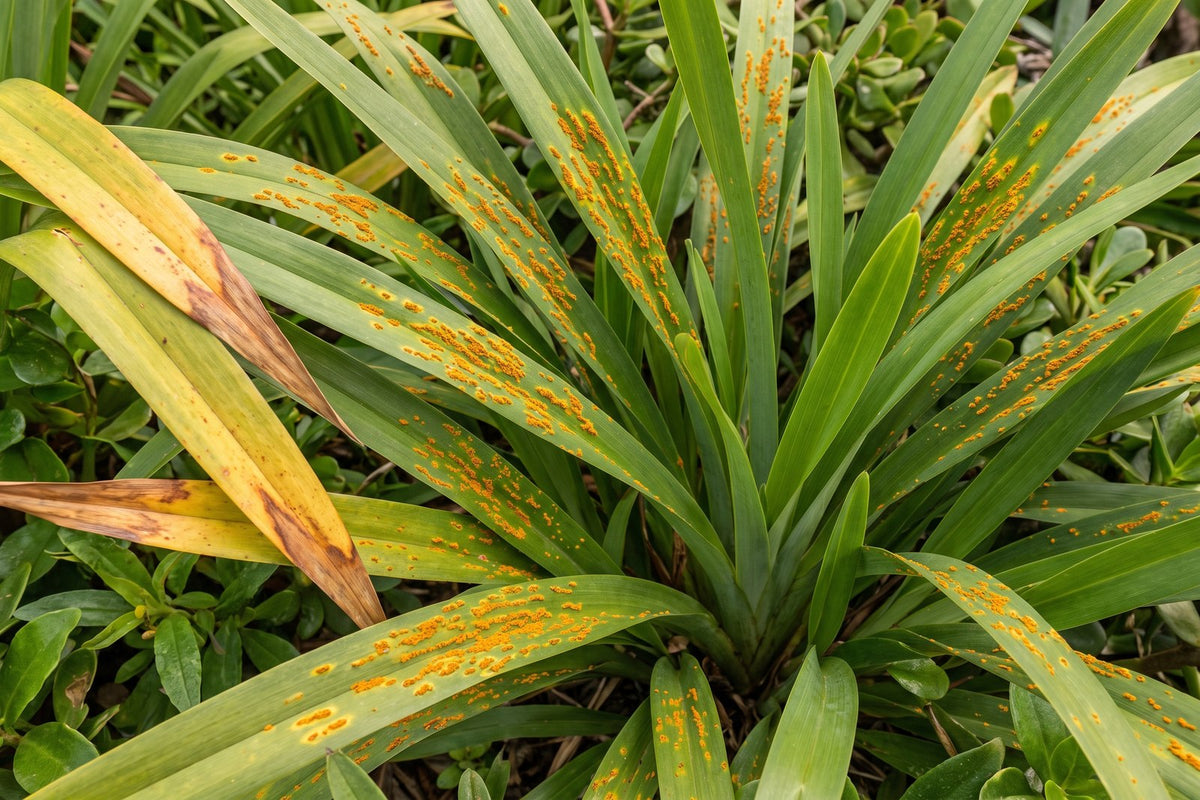
Rust spots: Orange pustules on leaves in humid, crowded plantings. Cut affected foliage out hard, thin surrounding growth for airflow and avoid overhead watering in the evening.
Bleached foliage: Harsh full sun on shade-bred varieties like tasmanica forms can bleach leaves. Match variety to exposure; caerulea types take the hottest spots.
Clumps thinning in deep shade: Dianella tolerates shade but not darkness. If growth turns sparse and stretched, move the plant somewhere with bright light or morning sun.
Snails on new growth: An occasional nuisance on soft spring shoots; bait or hand collect after rain.
Where dianella grows in Australia

Dianella, the native flax lily, occurs naturally right across Australia - coastal heath, dry forest, rainforest margins and alpine areas all have their own species. That breadth is why it performs in every capital city and why it turns up in almost every commercial landscape planting in the country.
| Location | How it performs |
|---|---|
| Brisbane and southeast Queensland | Excellent in sun or shade; watch drainage in wet summers |
| Sydney and coastal NSW | Outstanding, including exposed coastal sites |
| Melbourne, Canberra, Tasmania | Very good. D. tasmanica is native to the cooler south |
| Adelaide and Perth | Excellent once established - genuinely drought tolerant |
| Dry inland | One of the more reliable strappy plants for hard conditions |
| Tropical north | Grows well with good drainage through the wet season |
Sun or shade, which is unusual
Very few plants genuinely perform in both full Australian sun and dry shade, and dianella is one. In an open bed it stays tight and upright; under an established tree it grows a little looser and greener but keeps going where lawn and most groundcovers fail. That makes it one of the most useful plants available for the awkward transitions in a garden - the strip that is sunny at one end and shaded at the other.
Cutting back
Like lomandra, dianella accumulates dead leaf in the centre of the clump over time and starts to look tired. Cut the whole clump back to about 15cm every three or four years in late winter, and it returns fresh and dense within weeks. That is essentially the entire maintenance requirement.
Berries and birds
The small blue-purple berries that follow the flowers are a genuine feature and are eaten by birds. They were also used as a food and a source of dye by Aboriginal peoples across Australia, and the strong leaves were used for weaving in much the same way as lomandra. In a suburban garden the berries are one of the simpler ways to bring small birds in.
Feeding
Use a low-phosphorus native fertiliser in spring if you want to push growth on a young mass planting. Established clumps generally need nothing at all, and overfeeding produces soft floppy growth that loses the neat upright form.
Frequently asked questions
Are dianella berries edible?
Treat them as ornamental. While some species were traditionally eaten in small amounts, identification between species is tricky and some cause stomach upset, so enjoy them as bird food and garden colour.
Does dianella grow in shade?
Yes, it is one of the best strappy natives for dry shade under trees, and it appears in our shortlist of the best ground cover plants for shade. Tasmanica varieties like Cherry Red handle the deepest shade of the group.
How far apart should I plant dianella?
30 to 40cm for compact forms, 50 to 60cm for larger varieties. Closer spacing fills faster but is rarely worth the extra plants.
Is dianella frost tolerant?
Most garden varieties handle light to moderate frost, and tasmanica forms cope with hard frost. In the coldest inland districts, plant in autumn so roots establish before summer rather than before winter.
Ready to plant?
Layer dianella with the rest of our native plants, edge with something from climbers and groundcovers, or fill big areas cheaply from tubestock. See delivery for dispatch times to your postcode.
Flax lilies are a mass planting workhorse, and mass planting is the second most common reason Victorians buy plants. The state by state breakdown is in What Australia Planted in 2025-26.
If the property runs on a septic system, the septic drain field planting guide sets out what may go over the trenches and what must stay well away.


