


Creeping boobialla (Myoporum parvifolium) is the groundcover landscapers specify when bare soil has to disappear quickly and stay covered with almost no care. It sits 10 to 20 cm high, runs to about 2 m across from a single plant, roots down as it spreads, and shrugs off frost, drought, salt wind and poor soil. The catch is a short list: it wants full sun and sharp drainage, and in a humid, wet summer it can thin out in patches. Get those two things right and it is close to the toughest carpet plant in the country.
Quick facts
| Detail | Creeping boobialla |
|---|---|
| Botanical name | Myoporum parvifolium, an Australian native from the southern mainland |
| Size | 10 to 20 cm high, 1.5 to 2.5 m across depending on the form |
| Growth rate | Fast: a metre grid closes over in one to two warm seasons |
| Position | Full sun; thin and leggy in shade |
| Soil | Any soil that drains, including sand, gravel and poor clay on a slope |
| Tolerates | Frost, drought, heat, salt spray, coastal wind, poor soil |
| Flowers | Small white or pink stars, late spring through summer, worked by bees and butterflies |
| Climates | Cool temperate to subtropical and arid; in the humid tropics give it full sun and the driest bed you have |
| Best planting window | Spring and autumn; any month in frost-free districts |
Choosing the right boobialla
Every form we sell is the same species and behaves the same way. The differences are leaf width, leaf colour and flower colour, and they matter more than they sound because a bank of one form reads as a single sheet of texture.
| Form | Height x spread | Leaf and flower | Choose it for |
|---|---|---|---|
| Creeping boobialla (the species) | 15 cm x 2 m | Mid green, white stars | The all-rounder for banks, verges and big beds |
| Fine Leaf | 15 cm x 2.5 m | Narrow bright green leaves, white stars | The widest spread per plant, so the cheapest way to cover a large area |
| Broad Leaf | 15 cm x 2 m | Wider, fleshier leaves, white stars | A denser mat that reads as a solid green surface from a distance |
| Purpurea | 15 cm x 2 m | Green with a purple flush in the cooler months, white stars | Winter colour in cold districts, where the purple is strongest |
| Yareena | 20 cm x 2 m | Purple-tinted green, white stars | A selected form with the purple tint held through more of the year |
| Fine Leaf Pink | 15 cm x 2 m | Fine green leaves, pink and white stars | Flower colour over a fine textured mat |
| Coarse Leaf Pink | 15 cm x 2 m | Broader leaves, pink and white stars | Flower colour with the coarser, denser texture |
Mixing forms on one bank looks patchy once the plants knit together, because each form holds a slightly different green. Pick one and buy enough of it. The Myoporum collection has every form in tubes, 100 mm and 140 mm packs for mass planting, and 200 mm pots where you want faster cover from fewer plants.
Do not confuse the creeping species with the New Zealand boobialla, Myoporum laetum, a shrub that has escaped along parts of the southern coast. The creeping plant stays flat, sets little viable seed in gardens and is the one councils plant on their own verges.
Where it works, and where it does not
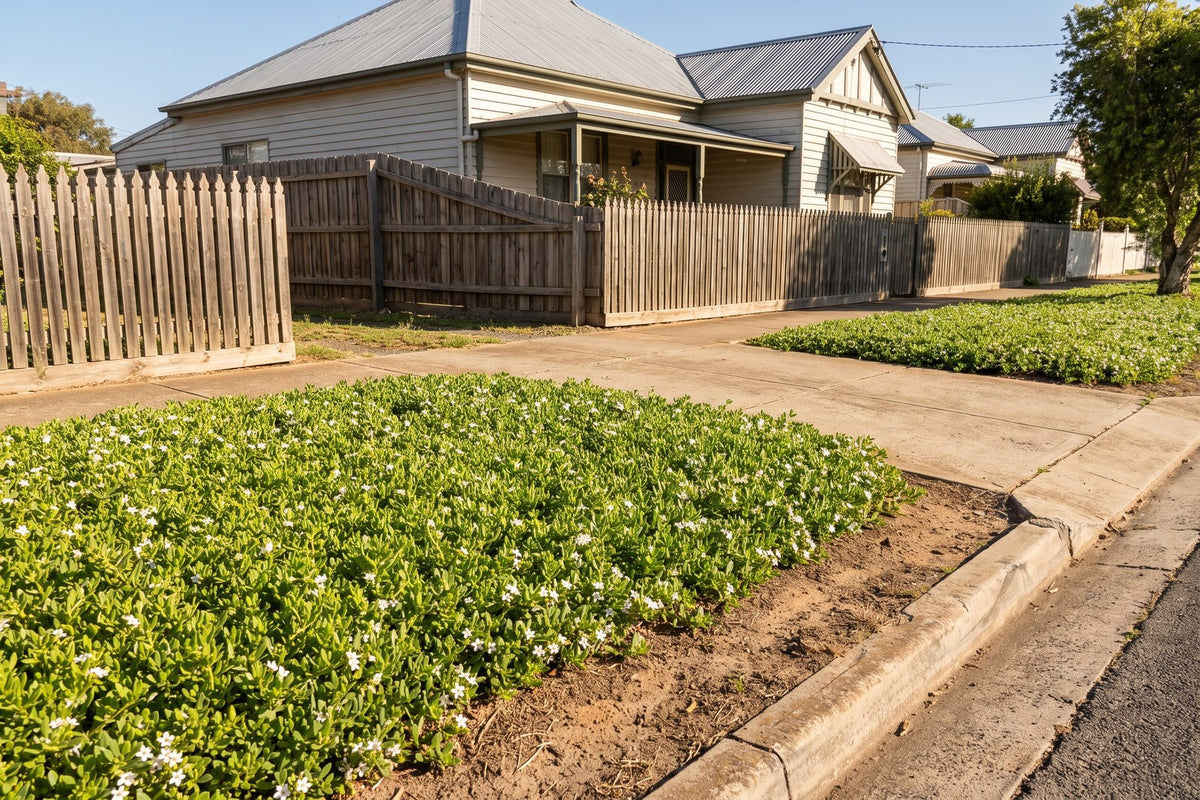
Banks and batters. This is the plant's best job. The stems root wherever they touch soil, so a slope that sheds mulch every storm is knitted together within a year. It also hides the ugly top edge of a retaining wall by spilling over it; our guide to trailing plants for retaining walls puts it beside the other spillers.
Verges and nature strips. It takes the reflected heat off a road, needs no mowing and stays low enough for sight lines at a driveway. Keep it 30 cm back from the kerb so it does not creep onto the bitumen.
Big low-maintenance beds. Planted under widely spaced shrubs it does the work of mulch and keeps doing it. It is one of the plants that makes the low-maintenance native garden work.
Between steppers, with care. It copes with an occasional footfall but not a daily path. For a walked route use the plants in our guide to groundcovers between pavers instead.
Where it struggles. Shade: under a dense tree canopy it grows thin and open and the weeds come back through. Wet feet: a bed that stays sodden after rain, or a humid subtropical summer with overhead sprinklers running every night, invites root rot and the mat dies out in patches. On the coast north of Brisbane it still works, but only in full sun on a raised or sloping bed that drains in minutes, with the irrigation turned off once it is established.
How to plant
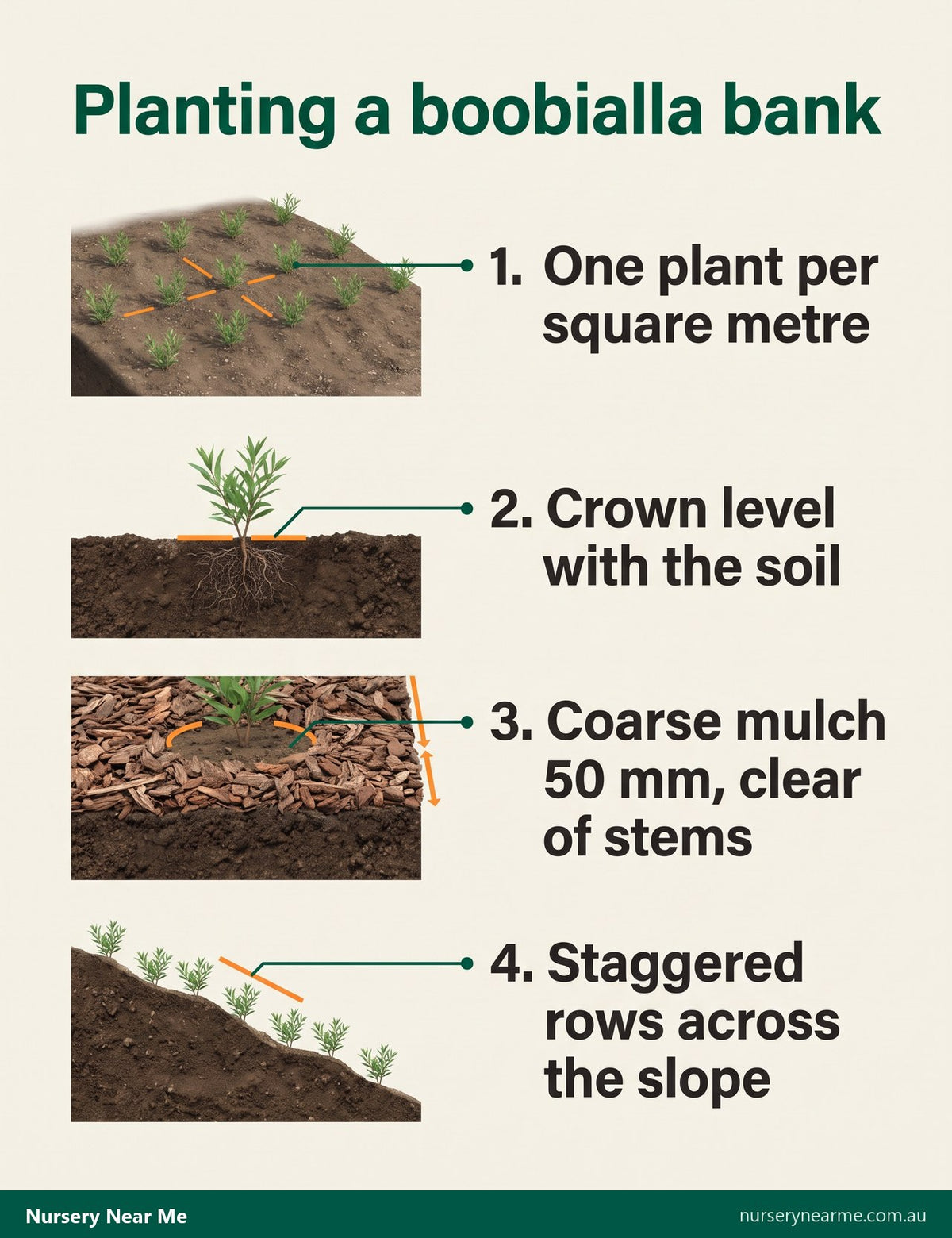
Spacing. One plant per square metre is the standard: a grid at 1 m closes over in one to two warm seasons. At 80 cm the cover is a season quicker and the bed looks finished sooner, which is worth it on a front verge. Wider than 1.2 m and you will be weeding the gaps for two years. Count the area, not the plants: a 20 square metre bank is 20 plants at the standard grid, or two packs of 10.
Soil. No improvement is needed in sand, gravel or a sloping clay bed. On flat heavy clay, mound each planting position 100 mm above the surrounding level so the crown never sits in water. Skip compost and manure; this plant grows faster and tighter on lean soil than on rich soil.
Planting. Water the pots an hour before. Dig each hole just wider and no deeper than the root ball, set the crown level with the soil, firm it in and water. Mulch between plants with a coarse 50 mm layer, keeping it clear of the stems, so the soil stays cool and weeds stay down while the mat closes. The basics for any new planting are in our step-by-step planting guide.
Timing. Spring planting gives the fastest first season. Autumn planting in frost-prone districts still works, because the roots keep moving through winter and the plant is ready to run as soon as the soil warms. In the subtropics plant in autumn or early spring, not in the middle of the wet season.
Ongoing care
Watering
Water deeply twice a week for the first six weeks, then once a week through the first summer. After that, rain is enough in most of the country. An established bank will come through a dry summer looking tired and recover with the first autumn rain. If you have drip irrigation, run it rarely and deeply; if you have sprinklers, wean the bed off them, because leaf wetness every night is what starts the rot.
Feeding
None is needed on most soils. If growth stalls on pure sand, a light dressing of a low-phosphorus native fertiliser in spring is plenty. Standard complete fertilisers and lawn food drifting into the bed do more harm than good, for the reason set out in our grevillea feeding guide: Australian natives are built for low phosphorus.
Pruning
The only regular job is an edge trim where the mat reaches a path, a kerb or a neighbour's bed, two or three times a year with shears or a line trimmer. Every three or four years, in early spring, you can cut the whole bed back by half to thicken it. It reshoots from the rooted stems, so a hard cut is safe as long as you leave green growth behind. A bed that has gone woody and bare in the middle after eight to ten years is at the end of its useful life: replant rather than nurse it.
Common problems and fixes
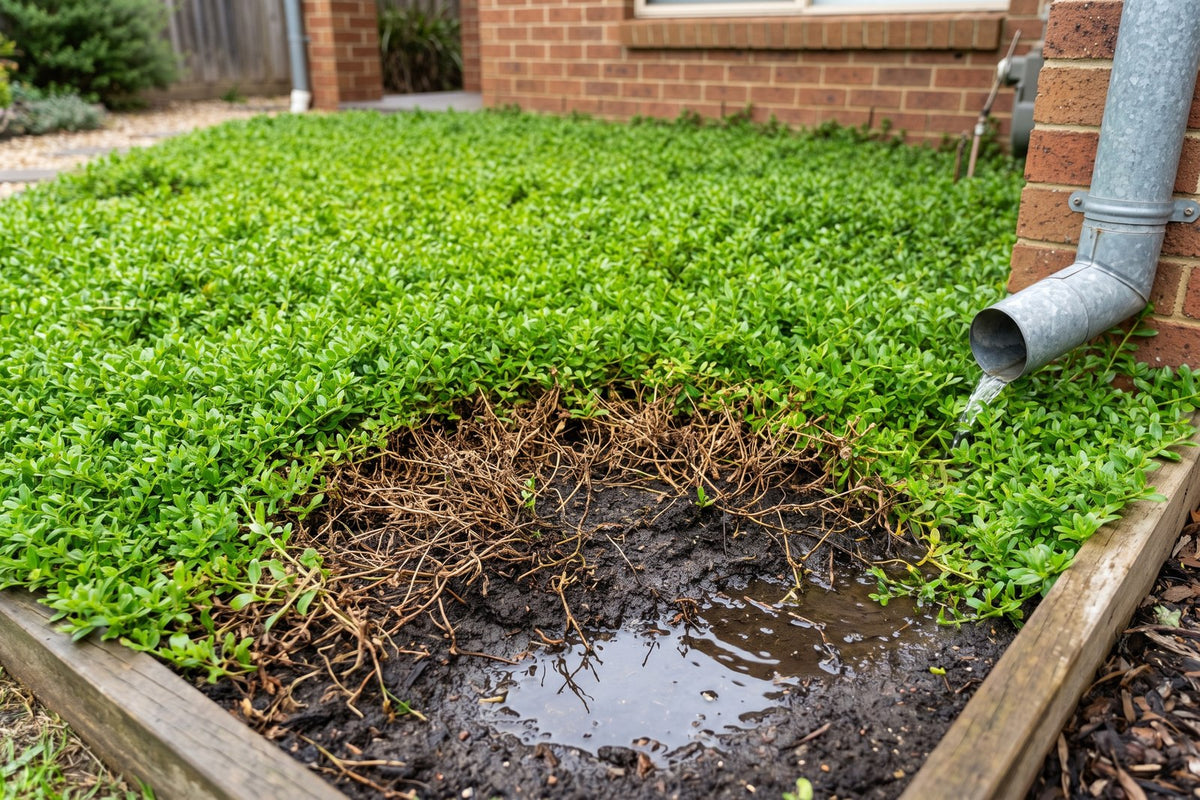
Dead patches after a wet summer. Root and stem rot in ground that stayed wet. Pull the dead material out, improve the drainage with a mound or a slope, stop overhead watering, and let the surrounding plants run back into the gap. In a bed that floods every summer, choose a different plant.
Thin, open growth with weeds coming through. Not enough sun, or too much shade from a tree that has grown since the bed was planted. Lift the canopy or move the boobialla to the sunny edge and use a shade groundcover under the tree; our guide to groundcovers for shade covers the options.
Purple or bronze leaves in winter. Normal cold colouring, strongest on the purple forms and after frost. It greens up in spring without any help.
Bare woody centre with growth only at the edges. Age. Cut back hard in early spring to force new shoots from the rooted stems, or replant if the bed is past eight years old.
Scale or sooty mould on the stems. Uncommon, and usually in a sheltered, over-watered spot. Improve the airflow and water, and treat with a horticultural oil on a cool morning if the scale persists.
Frequently asked questions
How fast does creeping boobialla spread?
Quickly. A 140 mm pot planted in spring reaches about a metre across by the end of its first summer and 2 m or more by the end of its second. A bed planted at one per square metre is usually closed over within 12 to 18 months, faster in warm districts with good spring rain.
Can I walk on it?
Occasionally, yes. The stems take a footfall now and then without harm, but a daily route across the bed will wear a track through it. Put steppers along any regular path and let the boobialla run around them.
Does it grow in Brisbane and the subtropics?
Yes, with conditions. It needs full sun and a bed that drains in minutes, and it must not be sprinkler-watered every night through summer. On a sloping or raised bed with the irrigation turned off once it is established it does well. In a flat, heavy, wet bed it will die out in patches after the first wet summer.
Is it frost hardy?
Yes. It handles the frosts of inland New South Wales, Victoria, the ACT and the Adelaide Hills, colouring purple in the cold and greening up again in spring. Only very severe frost on a young, unestablished plant does lasting damage.
How many plants do I need for a slope?
Measure the area in square metres and plant that many at a 1 m grid, or multiply by 1.5 for an 80 cm grid that closes a season sooner. A 4 m by 5 m bank is 20 plants at the standard grid. On a steep batter, plant in staggered rows across the slope so each plant catches water running down from the one above.
Ready to plant?
Choose one form and buy enough of it for the whole area: the Myoporum collection has every form in packs for mass planting. If you are covering a bank, the plants for retaining walls and slopes collection holds the spillers and binders that work beside it, and the groundcover collection is the place to compare it with lomandra, dichondra and the other carpet plants. For the wider picture, read our guide to groundcover plants before you decide.


