

Grevilleas are the great multitaskers of the Australian garden. The genus runs from sprawling groundcovers to the mighty silky oak, and nearly all of them share two traits gardeners love: extravagant nectar rich flowers held over a very long season, and a fan club of honeyeaters, wattlebirds and lorikeets that treat a flowering grevillea as a full time restaurant. If a busy garden is the goal, they sit near the top of our list of bird-attracting native plants for Australian gardens.
They are also easy, provided you respect one rule that trips up more gardeners than any pest ever has: phosphorus. Grevilleas belong to the Proteaceae family, whose roots are so efficient at mining phosphorus from poor soils that a standard garden fertiliser can poison them. Feed them a native specific blend, give them sun and drainage, and they are among the most rewarding plants you can own, which is why they form the backbone of the low-maintenance native garden.
Quick facts
| Botanical name | Grevillea species and hybrids |
| Type | Evergreen native shrubs and trees |
| Height | 1m groundcovers to 25m trees |
| Position | Full sun for best flowering |
| Soil | Free draining, slightly acidic; avoid heavy wet clay |
| Flowers | Spider or toothbrush blooms, many varieties year round |
| Climate | Most of Australia; species vary in frost tolerance |
Choosing the right grevillea
For groundcover and low screens
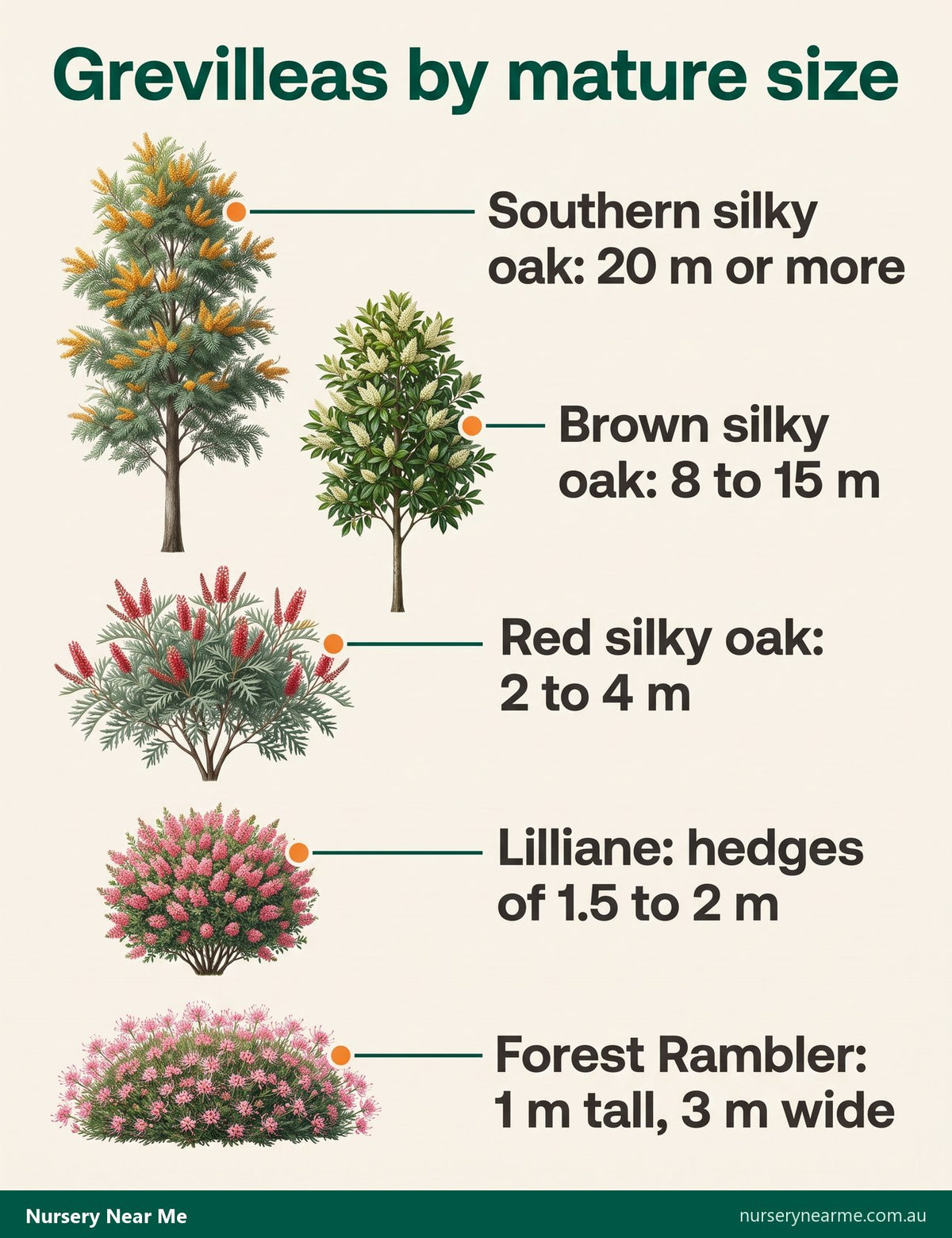
Forest Rambler Grevillea, from $28.95, is a tough spreading shrub around 1m tall and up to 3m wide, smothered in pink spider flowers and dense enough to suppress weeds across a bank or verge. Lilliane Grevillea, from $36.95, is a reliable mid sized shrub whose pink blooms keep the honeyeaters coming for most of the year, well suited to informal hedges of 1.5m to 2m.
For feature shrubs
Kimberley Gold Grevillea brings golden flowers on an arching shrub that reads as tropical without any of the water bill, and it pairs well with the other native plants with yellow flowers we recommend, an excellent specimen beside a pool or entry. Red Silky Oak (Grevillea banksii) sits between shrub and small tree at 2m to 4m, with deeply divided leaves and bold red toothbrush flowers.
For trees and large blocks
Brown Silky Oak (Grevillea baileyana) is a handsome rainforest species with bronze backed leaves and creamy white flower heads, reaching 8m to 15m in gardens. The biggest of all is Southern Silky Oak Tree (Grevillea robusta), a fast growing shade tree to 20m or more that lights up gold in late spring; give it room, it did not get the memo about small blocks. Both silky oaks also cut beautifully for the vase, and the common name is earned: the sawn timber of Grevillea robusta shimmers like silk.
Planting
Full sun and free drainage are the two essentials. On clay soils, plant into a mound 30cm high or a raised bed rather than a dug hole that will collect water. Do not add manure or mushroom compost to the planting hole; a handful of native slow release fertiliser is all they want. Space shrub grevilleas at roughly two thirds of their mature width for a continuous screen, so Lilliane at about 1.2m apart. Plant silky oaks at least 6m from structures, drains and pools. Soak the root ball in a bucket of diluted seaweed solution while you dig, tease out any circling roots, water in well and mulch with coarse bark or gravel. Winter is the traditional planting season in frost free areas, giving roots a head start before summer, while spring suits colder districts.
Ongoing care
Watering: Weekly deep watering for the first summer, then only through long dry spells. Established grevilleas are outstandingly drought hardy and resent soggy roots, putting them in the same easy company as our other drought-tolerant plants for a Brisbane garden. Water at the roots rather than over the foliage, which helps keep fungal leaf spots away in humid weather.
Feeding: Once a year in spring with a low phosphorus native fertiliser (look for P below 2 percent). Never use general purpose or lawn fertilisers near them.
Pruning: Tip prune after each flowering flush to keep shrubs dense and multiply next season's flowering wood. Like the shrubs in our westringia care guide, they dislike hard cuts into old bare wood, so little and often wins. Spent flowers can be left on bird favourites like Forest Rambler, since honeyeaters keep working them long after the main show fades.
Common problems
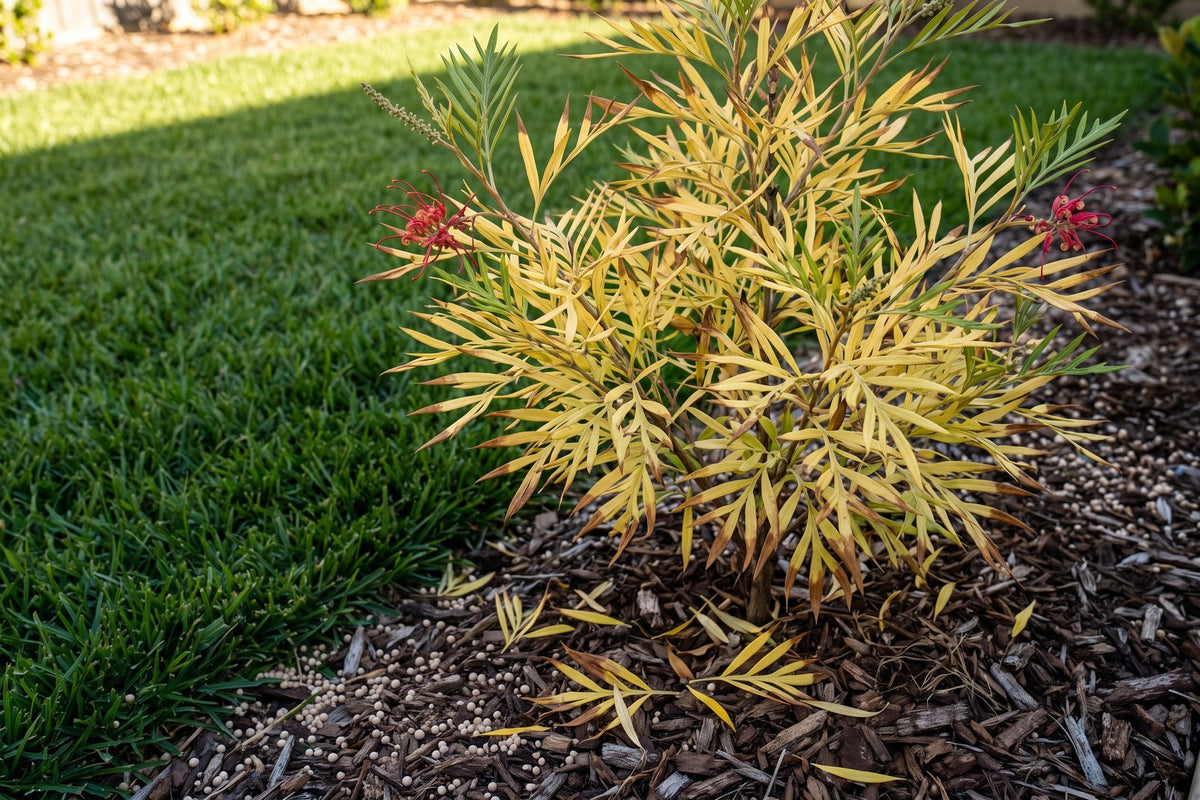
Yellowing leaves after feeding: Classic phosphorus toxicity. Stop the offending fertiliser, water deeply to help leach it, and expect recovery over a season if caught early.
Yellow new growth with green veins: Iron chlorosis, usually in alkaline or limey soil or beside new concrete and render. Grevilleas want slightly acidic to neutral soil, about pH 5.5 to 6.5, and most tolerate up to about 7. Water in iron chelate for a quick green up and a little sulphur to lower the pH for a lasting one. If the whole plant yellows in wet weather, suspect the roots, not the soil chemistry.
Sudden collapse in wet weather: Root rot in poorly drained soil. Improve drainage or replant on mounds; a collapsed grevillea rarely comes back.
Scale and sooty mould: Black coated leaves point to scale insects. Spray with horticultural oil in the cool of the evening.
Leaf spots in humid summers: Mostly cosmetic. Improve airflow by thinning congested growth and avoid overhead watering.
Where grevilleas grow in Australia
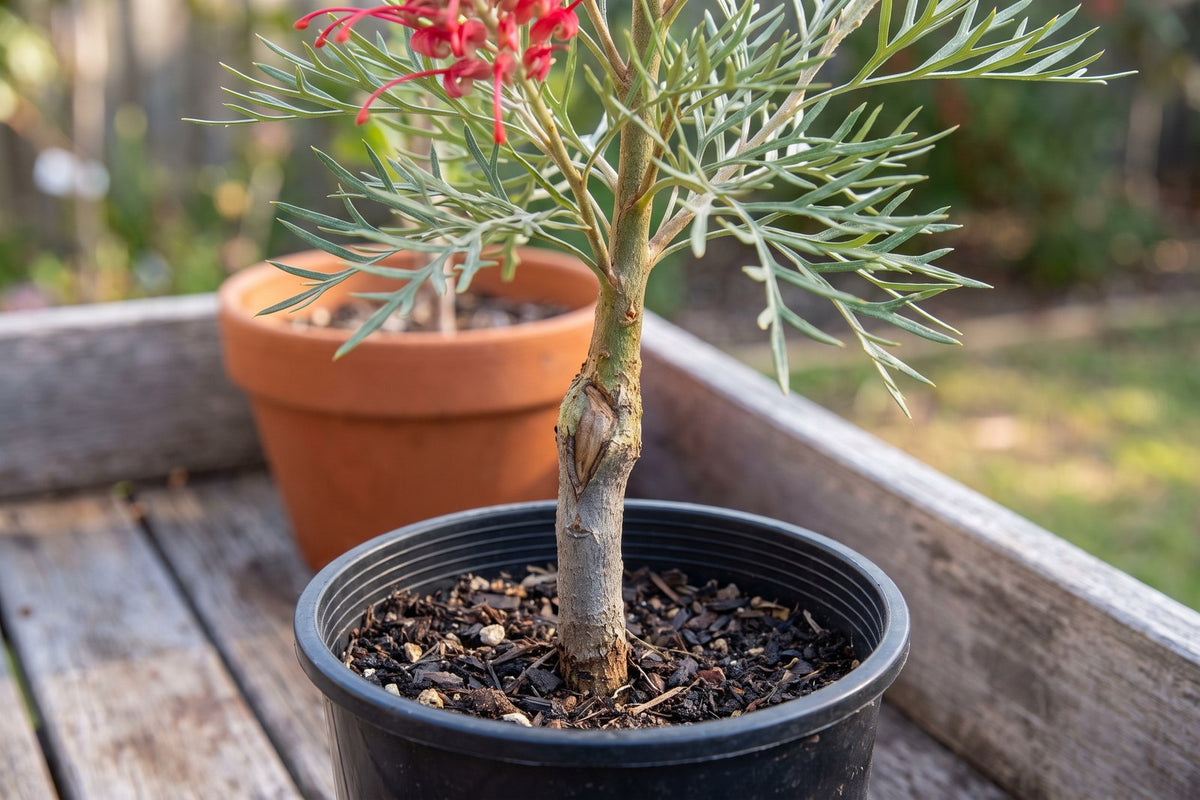
Grevillea is one of the largest Australian plant genera, with around 360 species spread from the Western Australian sandplains to the Queensland rainforest edge. That range is the reason two gardeners can have completely different experiences with plants sold under the same common name.
| Location | What to plant |
|---|---|
| Perth and southwest WA | The Western Australian species, in their native conditions |
| Adelaide and dry inland | WA and arid-zone species do well with sharp drainage |
| Melbourne and Canberra | Eastern and alpine species such as G. lanigera and G. rosmarinifolia |
| Sydney and coastal NSW | Eastern species and grafted plants |
| Brisbane and southeast Queensland | Grafted plants and humidity-tolerant eastern species only |
| Tropical north | Limited - most grevilleas resent constant humidity |
The grafted plant question
This matters more than anything else on the east coast. Many of the most spectacular grevilleas come from Western Australia, where summers are dry, and they die of root rot within a season or two in Brisbane or Sydney humidity when grown on their own roots.
Grafting onto a hardy rootstock, usually Grevillea robusta, solves the problem completely and lets eastern gardeners grow Western Australian species successfully. If you are east of the Great Dividing Range and have killed a grevillea before, buying a grafted plant is very likely the fix.
Phosphorus will kill them
Grevilleas belong to the Proteaceae, the family adapted to the ancient phosphorus-depleted soils that cover most of Australia. They produce specialised cluster roots to extract phosphorus that is barely present, and they cannot switch that mechanism off when it suddenly is.
Ordinary garden fertiliser, lawn fertiliser drifting into a native bed, or fresh manure will damage or kill a healthy grevillea. Use only a low-phosphorus native blend, and keep lawn feeding away from native planting. This kills more grevilleas in Australian gardens than every pest and disease combined.
Frequently asked questions
Why is my grevillea not flowering?
Almost always shade or phosphorus rich fertiliser. Grevilleas need six hours of sun to flower well, and lawn food drifting into the bed grows leaves instead of blooms.
Are grevilleas frost tolerant?
Many popular hybrids handle light frosts to about -2C, and some cope with more. Tropical species like Grevillea baileyana are best in frost free gardens.
Can grevilleas cause skin irritation?
Some people react to the foliage and flowers of certain species, so wear gloves and long sleeves when pruning. It is a sensitivity, not a toxicity, and birds and bees are unaffected.
How close to the house can I plant a silky oak?
Keep Grevillea robusta at least 6m from foundations, pipes and pools. It is a fast, large tree with roots and leaf drop to match, best admired from a slight distance.
Ready to plant?
Explore the rest of our native plants, browse flowering trees for larger statement species, or start small with tubestock. Delivery details for your area are on our delivery page.
If native bees are part of the plan, our native bee plants collection holds 295 plants with a documented native bee record, rather than a general bee friendly tag.


