

Australia has well over 1,700 species of native bee, and almost none of them live in a hive. Most are solitary insects that nest in a burrow in bare soil or a hollow in old timber, and they feed on whatever is flowering within a few hundred metres of that nest. The one idea that matters most for a garden is therefore continuity: a native bee garden is not a bed of pretty flowers, it is a sequence of flowers that never runs out, from the first wattle of late winter to the last tea tree of autumn, with somewhere safe to nest in between.
This guide gathers the planting advice of the Australian Native Bee Research Centre (Aussie Bee), the Wheen Bee Foundation and ACT for Bees, and adds the practical detail a home gardener needs: which plants native bees visit, how to arrange them so something is always in flower, what the bees need beyond nectar, and what to keep away. It summarises those sources and is not a substitute for the regional planting lists they publish.
Quick facts
| Question | Answer |
|---|---|
| How many native bees are there? | At least 1,700 named species according to Aussie Bee; the Wheen Bee Foundation puts the total above 2,000. The honey bee is an introduced species, brought from Europe in the 1820s. |
| Do they sting? | The eleven social stingless species (Tetragonula and Austroplebeia) cannot sting. The solitary species can, but they are not defensive and stings are rare. |
| What do they eat? | Nectar and pollen only. A plant with showy but nectarless flowers, or one that flowers for a fortnight and stops, feeds nobody for long. |
| Which flowers suit them? | Short-tongued bees want shallow flowers (daisies, tea tree, eucalypt and melaleuca blossom); long-tongued bees want tubes (coastal rosemary, lavender, salvia). Plant both shapes. |
| When do they fly? | Most solitary bees fly only in the warm months. Stingless bees, reed bees and carpenter bees fly on warm days all year, so winter flowers matter too. |
| What else do they need? | Nesting sites: bare, undisturbed soil, old timber, hollow stems and, for leafcutter and resin bees, soft leaves and tree resin. No insecticide. |
Why a garden can beat the bush
Aussie Bee makes a point that surprises most gardeners: a well-planned garden can be a better food source for native bees than natural bushland. In the bush, the trees and shrubs of one community tend to flower together and then stop, and for months there may be little on offer. A garden can be planted so that something is in flower in every month, with a far greater variety of flower shapes and colours in a small space. Even a small garden counts, because the bees forage across yours and your neighbours' together.
The flip side is that a garden planted for a single spectacular season is of little use. Think of the year in four parts and give each one at least two reliable flowering plants. In most of Australia the hungry gap is late autumn and winter, when the solitary bees are dormant but the stingless bees, reed bees and carpenter bees still forage on warm days.
Matching flowers to bees

Native bees differ in tongue length, body size and preference, so the Aussie Bee advice is to plant a variety of shapes and colours rather than a single favourite.
- Shallow, open flowers suit the short-tongued majority: daisies, tea tree, eucalypt and melaleuca blossom, wattle and the flat heads of yellow buttons. These are the workhorses of a bee garden.
- Tubular flowers suit the long-tongued bees, including blue banded bees: coastal rosemary, lavender, salvia and hardenbergia.
- Colour: some species prefer blue or purple, but mauve, pink, yellow and white flowers are all well used. A mix beats a theme.
- Natives and exotics both count. Aussie Bee is clear that native bees happily forage on exotic flowers such as lavender and salvia, and even on dandelions. A native garden is the stronger choice for habitat, but a lavender hedge is not wasted on them.
- Plant in groups. A row or drift of one species is found and worked far more readily than single plants scattered through a bed.
Flowers are only half of it
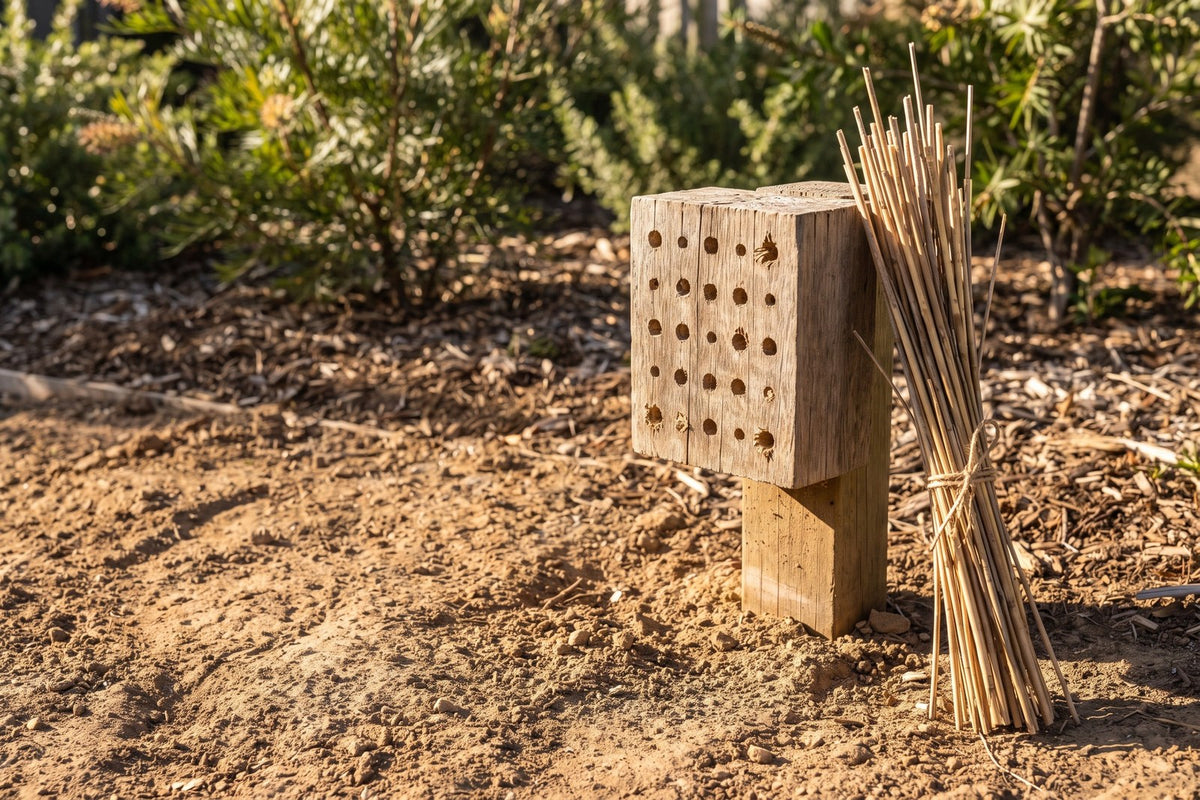
A bee that cannot nest within flying range of your flowers will not stay. Aussie Bee lists the nesting materials the different groups need, and most of them are things tidy gardens remove.
- Bare, undisturbed soil for the ground-nesting majority, including blue banded bees. A patch of unmulched earth in a sunny spot, left alone, is habitat. Thick mulch everywhere is not.
- Old timber and hollow stems for the species that nest in holes: a dead branch, a block of untreated hardwood with drilled holes, or last year's cut grass canes left standing.
- Soft leaves for leafcutter bees, which cut neat circles from roses, buddleja, bauhinia and wisteria to line their nests. The damage is cosmetic and the bees are worth it.
- Resin for resin bees, which gather it from trees to build their cells. Native trees and shrubs that weep a little resin are part of the picture.
Plants native bees visit, by role
The plants below are well documented bee forage in Australian gardens and cover the year between them. Where climate changes the answer it is noted; the Wheen Bee Foundation's regional planting guides and the ACT for Bees Canberra list are the place to check local species for your district.
Trees and tall shrubs: the big nectar flows
- Coast banksia (Banksia integrifolia) flowers from late summer into winter when little else does, and tolerates salt wind and poor sand. Too large for a small suburban yard.
- Ivory curl tree (Buckinghamia celsissima) carries long cream flower spikes in summer that hum with bees; a rainforest tree for Queensland and coastal New South Wales gardens.
- Lemon scented myrtle (Backhousia citriodora) gives masses of small cream flowers in summer, works as a screen, and the leaves are a kitchen herb. Frost tender when young.
- Brisbane golden wattle (Acacia fimbriata) is the late winter pollen source that opens the year in the subtropics; wattles offer pollen rather than nectar, so pair them with a nectar plant.
Shrubs: the backbone of the sequence
- Tea tree 'Ballerina' (Leptospermum) and lemon scented tea tree (Leptospermum petersonii) give the shallow spring and summer flowers short-tongued bees prefer; the first is a compact shrub, the second a small tree for a hedge or windbreak.
- Thyme leafed melaleuca (Melaleuca thymifolia) is a metre-high shrub with mauve brushes through spring and summer, happy in the damp or clay soils that defeat other natives.
- Bottlebrush 'Little John' (Callistemon) and white bottlebrush (Callistemon salignus) flower in spring with repeat flushes; bottlebrushes are among the most reliable nectar plants for native and honey bees across the mainland.
- Coastal rosemary 'Zena' (Westringia fruticosa) is the tubular flower Aussie Bee names for long-tongued bees, and it flowers in most months in a mild climate; it also takes salt, wind and drought.
- Grevillea 'Forest Rambler' is a low, spreading grevillea with pink spider flowers most of the year, the same role Aussie Bee gives Grevillea 'Poorinda Royal Mantle'. Choose small-flowered grevilleas for bees; the large hybrid flowers are built for birds.
- Banksia 'Cherry Candles' (Banksia spinulosa) is a compact hairpin banksia that flowers in autumn and winter, the hungry gap for the year-round foragers.
Ground covers and climbers: flowers at bee height
- Hardenbergia 'Sea of Purple' (Hardenbergia violacea) flowers purple in late winter and early spring, the colour and the season bees need most; it climbs a fence or sprawls as a cover.
- Native violet (Viola hederacea) flowers for most of the year in damp shade where little else will, and small bees work it.
- Creeping boobialla (Myoporum parvifolium) is a flat, tough cover with small white flowers through spring and summer, useful on dry banks and as a lawn substitute.
- Yellow buttons (Chrysocephalum apiculatum) gives the flat yellow daisy heads that short-tongued bees land on, and keeps flowering in heat and drought.
- Cut leaf daisy 'White Bliss' (Brachyscome) is a native daisy for pots and edges, flowering through the warm months.
- French lavender (Lavandula dentata) is the tubular, purple, long-flowering exotic that Aussie Bee names as a native bee favourite, and it flowers in winter in warm climates. Rosemary, thyme and salvia do the same job.
For a garden that also feeds birds and butterflies, the guide to designing a native garden for wildlife covers layout and shelter, and the bird attracting natives guide covers the larger-flowered grevilleas and banksias that honeyeaters want. The native bee plants collection and the wider bee and butterfly plants collection group the plants above by use.
What to keep away
- Insecticides of every kind. Aussie Bee's fifth rule is simply to avoid them: systemic insecticides move into nectar and pollen, and contact sprays kill on the day. If a pest must be treated, spot treat at dusk when bees are not flying, and never spray open flowers.
- Doubled and sterile flowers. Many bedding plants and florist roses have been bred for extra petals at the cost of nectar and pollen. They look like food and are not.
- Wall-to-wall mulch and paving. Ground-nesting bees need bare earth. Leave some.
- A single-season planting. A garden of spring natives alone starves the year-round foragers from May to August. Add the winter flowerers: coast banksia, hairpin banksia, hardenbergia, wattle and lavender.
- Treated timber for bee hotels. Use untreated hardwood, and replace drilled blocks every couple of years so parasites do not build up.
Getting it right
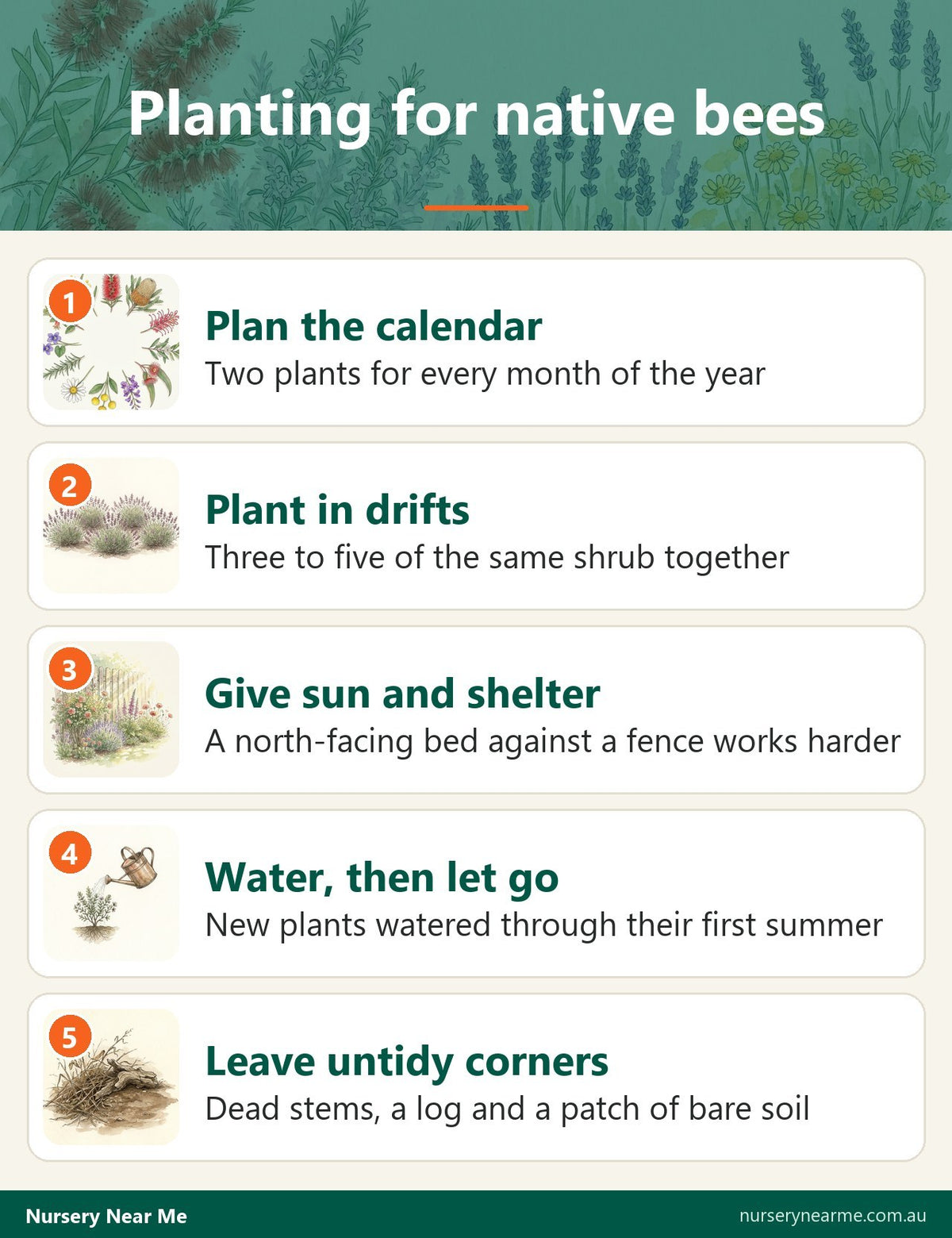
- Plan the calendar first. Write the months down the page and put at least two plants against each; fill the gaps before buying anything else. In the cool south the gap is winter; in the tropical north it is often the end of the dry season.
- Plant in drifts of three to five of the same shrub or ground cover rather than one of everything.
- Full sun and shelter. Bees forage where it is warm and still; a north-facing bed against a fence works harder than an exposed one.
- Water new plants through their first summer, then let the natives harden off. Most of the plants above need no fertiliser once established, and phosphorus-rich fertiliser harms banksias and grevilleas.
- Leave the untidy corners. Standing dead stems, a log, a bare patch of soil and a few weeds in flower are habitat, not neglect.
- Check your region. The Wheen Bee Foundation publishes 37 regional Powerful Pollinators planting guides for specific districts, and ACT for Bees publishes a Canberra list; use them to add the local species a national guide cannot.
A word of caution
This guide is about garden plants and general habitat, not about keeping stingless bee hives, which is a separate craft with its own rules on climate and hive care. Flowering times vary by district and season, so treat the months above as a starting point and watch what actually flowers in your garden. Native solitary bees can sting when handled, so anyone with a known allergy should enjoy them from a step back. For the species list that suits your exact district, the regional planting guides named in the sources are the authority.
Sources
- Aussie Bee, How to plant a bee-friendly garden: the five planting tips this guide follows.
- Aussie Bee, What are native bees?: species numbers, sizes and nesting habits.
- Wheen Bee Foundation, Australian native bees: species count and pollination value.
- Wheen Bee Foundation, Powerful Pollinators planting guides: 37 regional plant lists.
- ACT for Bees, Grow a pollinator-friendly garden: the Canberra planting list and calendar.


