

Clematis has a reputation as a plant for English gardens, and that reputation hides how many kinds grow well here. There are vigorous spring climbers that smother a shed in pink or white, large-flowered hybrids with blooms the size of a saucer, a winter-flowering evergreen from the Mediterranean, and Australia's own native clematis, which drape the bush in cream stars every spring. They share a few habits: they climb by wrapping their leaf stalks around anything thin, they like cool roots and sunny tops, and they must be pruned at the right time for their group. Get those three things right and clematis is not difficult. This guide explains how.
Quick facts
| Feature | Detail |
|---|---|
| Botanical name | Clematis species and hybrids |
| Type | Twining climbers, deciduous or evergreen depending on the kind |
| Size | 2 to 3 m for large-flowered hybrids; 5 to 8 m or more for montana and native kinds |
| Position | Top growth in sun or part shade, roots shaded and cool |
| Climate | Exotic kinds are best in cool and temperate districts; native kinds suit a wider range |
| Soil | Deep, moist and well drained, with plenty of compost |
| Flowers | Winter, spring or summer depending on the kind |
| Support | Wire, mesh or lattice no thicker than a pencil |
| Safety | All parts are irritant and toxic to dogs, cats and horses if eaten |
The kinds of clematis and where each grows

There are four groups worth knowing, and they behave differently enough that it pays to choose the group before the colour. All are in the clematis collection.
Montana clematis
Clematis montana, from the Himalayas, is the easiest exotic clematis and the most vigorous. It is deciduous, grows 6 to 8 m, and in mid spring it disappears under hundreds of four-petalled flowers about 5 cm across with a light vanilla scent. Rubens has rosy pink flowers and bronze-tinted new leaves, and Snowflake is pure white. Montana wants a cold winter and is at its best in Victoria, Tasmania, the ACT, the Adelaide Hills and the tablelands and highlands of New South Wales. It grows in Sydney's cooler suburbs and the Blue Mountains and is not suited to the humid subtropics.
Large-flowered hybrids
These are the clematis of picture books, with flowers 10 to 15 cm across in purple, blue, pink, red and white from late spring through summer. Our large-flowered clematis belong to the summer-flowering Jackmanii type, which blooms on the current season's growth and reaches 2 to 3 m. They are deciduous and suit the same cool and temperate districts as montana. They are more compact, so they are the ones to grow on an obelisk, through a climbing rose or in a large pot.
Winter clematis
Freckles is a form of Clematis cirrhosa, an evergreen from the Mediterranean. It carries nodding, bell-shaped cream flowers heavily speckled with maroon inside from late autumn through winter, followed by silky seed heads. Because it comes from a land of mild, wet winters and hot, dry summers, it suits southern Australia very well, including Adelaide, Perth and Melbourne, and it grows in Sydney. It often rests and drops some leaves in the heat of summer, which is normal.
Native clematis
Two Australian species are widely grown. Old man's beard, Clematis aristata, grows in forests from Queensland to Tasmania. It is an evergreen climber of 5 m or more with masses of cream, starry, lightly scented flowers in spring, followed on female plants by the fluffy, silvery seed heads that give it its name. It likes a cool root run and part shade and grows well up the east coast, including the ranges of south-east Queensland. The small-leaved clematis, Clematis microphylla, comes from drier country across southern Australia. It has fine, divided leaves and cream flowers from late winter into spring, and it tolerates sandy soil, coastal exposure and dry summers better than any other clematis. Both are excellent for wildlife gardens, and our guide to designing a native garden has more ideas.
Planting clematis
Head in the sun, feet in the shade. The old rule is sound. Clematis flower best with their top growth in sun, or in morning sun and afternoon shade in hot districts, and they grow best with their roots cool and evenly moist. Plant on the shaded side of the support and let the stems grow around into the light, or shade the root zone with a low shrub, a ground cover or a deep mulch. A hot west-facing wall with bare soil at its base is the worst place for one.
Soil. Dig a generous hole, 40 cm wide and deep, and mix compost through the soil you take out. Clematis are hungry, deep-rooted plants and repay the effort. The soil must drain: they like moisture and hate being waterlogged. Our guide on preparing soil for planting covers the method.
How deep. Plant montana, winter and native clematis with the top of the root ball level with the soil surface, like any other plant. Large-flowered hybrids are the exception: set them 5 to 8 cm deeper than they sat in the pot, so the base of the stems is buried. If the top growth is ever damaged or collapses with wilt, the plant can reshoot from buds below the ground.
Against a wall or fence. Plant 30 to 45 cm out from the base, where the soil is not sheltered from rain by the eaves, and lean the stems back to the support on a cane.
When. Autumn and early spring are the best times. Water in well, mulch 5 to 7 cm deep and keep the mulch a few centimetres back from the stems.
Giving clematis something to climb
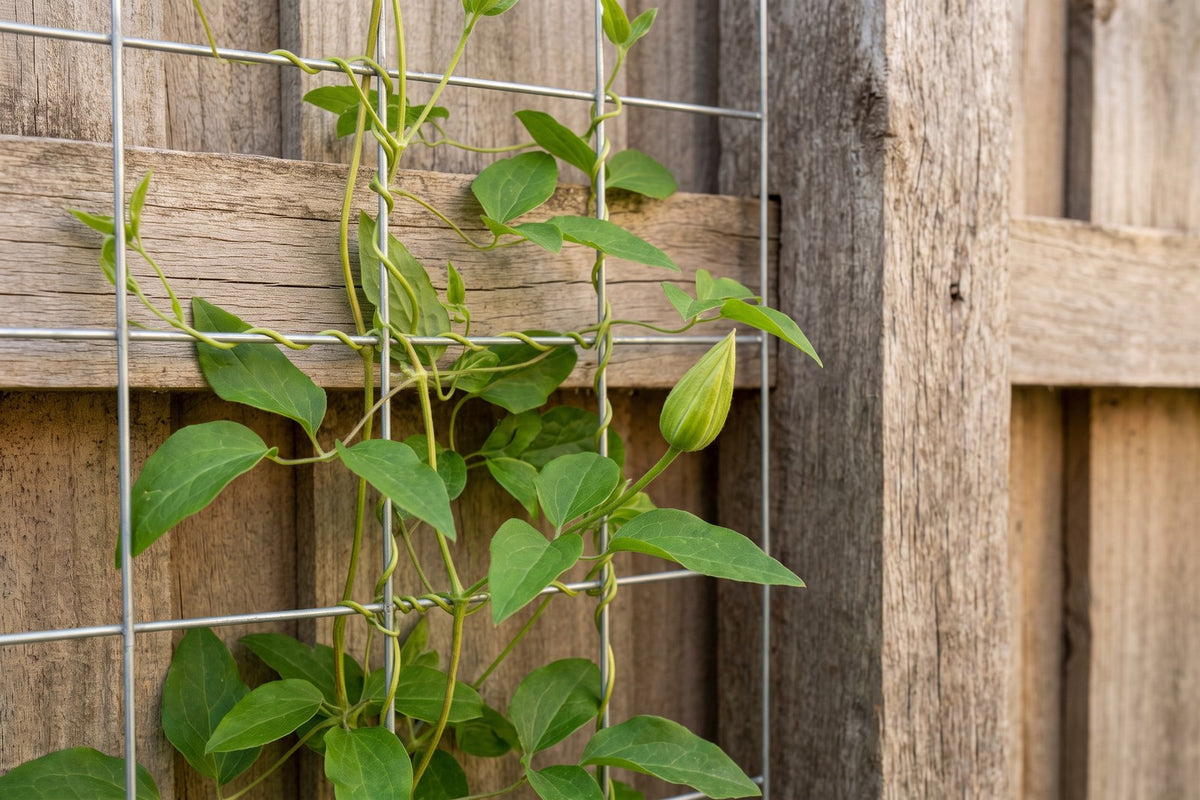
Clematis do not twine their stems like a jasmine, and they do not cling like a climbing fig. They climb by wrapping their leaf stalks around a support, and a leaf stalk can only get around something thin. A timber post, a paling or a thick lattice bar is too fat to grip. Give them wire, steel mesh, netting or thin cane, nothing thicker than a pencil.
On a fence, fix horizontal wires 30 cm apart, or attach a panel of galvanised mesh, held a few centimetres off the surface so the leaf stalks can pass behind. On a pergola post, wrap the post in mesh or run two or three vertical wires. Tie the young stems in loosely until they take hold, and spread them out sideways as they grow so the plant covers its support from the base instead of rushing to the top. Our guides to the best climbers for a fence and the best plants to soften fences and retaining walls compare clematis with other options.
Pruning by group
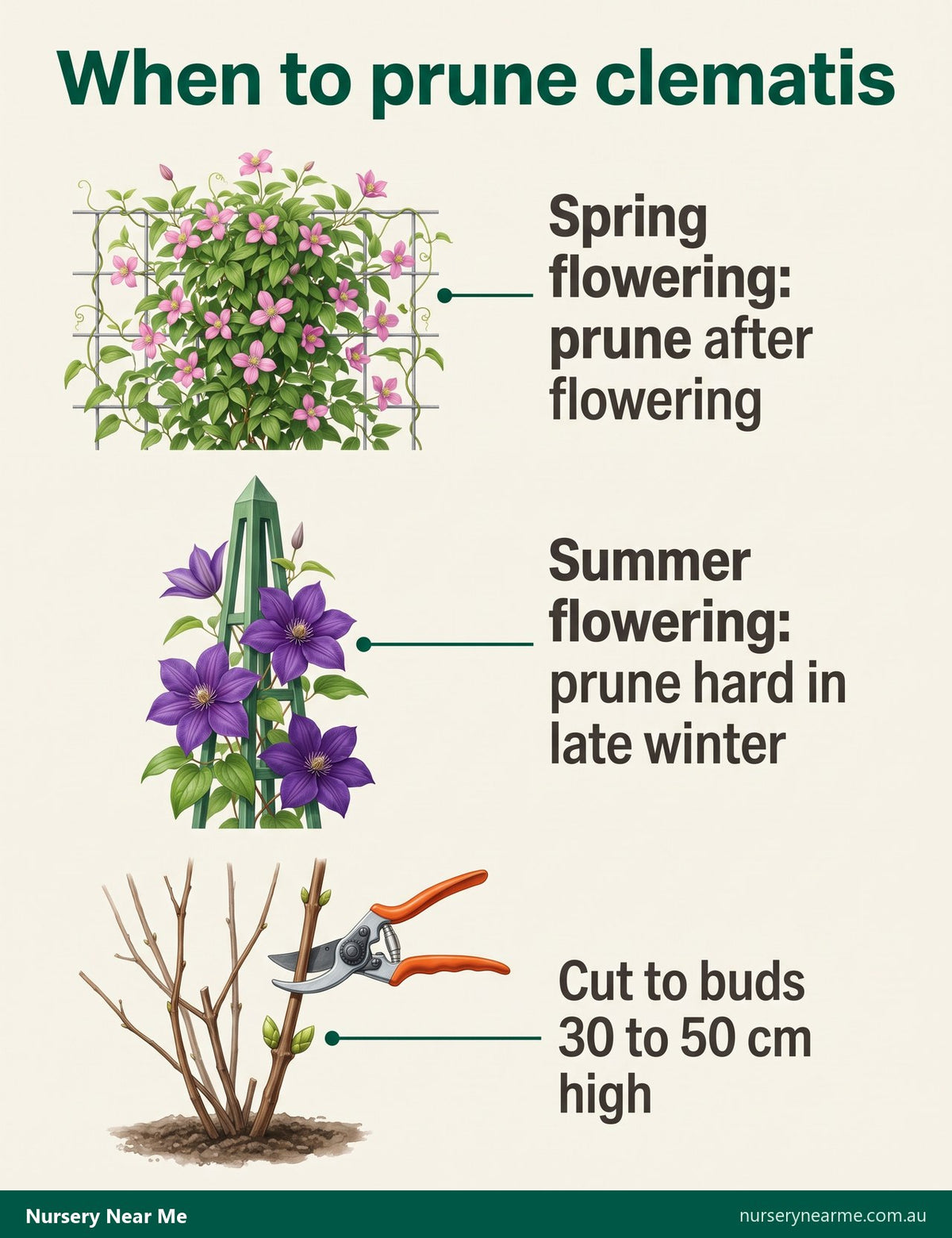
The rule is simple once you know when your clematis flowers. If it flowers before the end of spring, it flowers on stems grown last year, so prune it only after flowering. If it flowers in summer, it flowers on new growth, so prune it hard in late winter.
Montana, winter and native clematis. These need no regular pruning. If one has outgrown its space or become a tangle, cut it back straight after flowering finishes, removing as much as you need to, and it will regrow and set next year's flower buds over summer. If you prune one of these in winter you cut off the coming season's flowers.
Summer-flowering large-flowered hybrids. In late winter, as the buds begin to swell, cut every stem down to a pair of strong, healthy buds 30 to 50 cm above the ground. It looks severe. The plant responds with vigorous new stems that flower from top to bottom in summer. Left unpruned, it becomes a bare-legged tangle with a few flowers out of sight at the top.
In the first spring after planting, cut any clematis back to about 30 cm, whatever its group. You lose a few flowers and gain a plant with several stems from the base instead of one. The basic technique is in our pruning guide for beginners.
Watering and feeding
Water deeply twice a week through the first summer, and weekly in dry weather after that. Clematis are not drought-tolerant plants, with the partial exception of the small-leaved native and the winter clematis once they are established. A plant that dries out in spring drops its buds.
Feed exotic clematis in early spring with a slow-release fertiliser made for roses or flowering plants, and give the large-flowered hybrids a second feed in early summer. Feed native clematis lightly with a native plant fertiliser in spring. Renew the mulch every spring to keep the roots cool.
Common problems and fixes
A whole stem suddenly wilts and turns black. Clematis wilt is a fungal disease that mainly affects large-flowered hybrids, often just as the buds are about to open. Cut the affected stems off at ground level or below and bin them. A deeply planted clematis usually reshoots from below the soil. Montana, winter and native clematis are rarely affected.
No flowers. Pruning at the wrong time is the usual cause, followed by too much shade and too much nitrogen. A young plant may also take two years to settle before it flowers well.
Brown, crisp leaf edges. Hot roots and dry soil. Mulch, shade the base and water more deeply.
Chewed shoots in spring. Snails and slugs graze the new shoots at ground level, and earwigs chew the flowers. Check at night and protect young plants. Aphids on the shoot tips can be hosed off. See our guide to common plant pests and diseases.
Frequently asked questions
Does clematis grow well in Australia?
Yes, when the kind is matched to the climate. Montana and large-flowered clematis suit cool and temperate districts, winter clematis suits the dry-summer south, and the native species grow across much of eastern and southern Australia.
Can clematis grow in Queensland?
The exotic kinds struggle in humid heat but grow on the Granite Belt and the cooler ranges. The native old man's beard, Clematis aristata, is the best choice and grows naturally in the forests of south-east Queensland.
When should I prune clematis?
Prune spring, winter and native clematis straight after they finish flowering, and only if needed. Prune summer-flowering large-flowered hybrids hard in late winter, to strong buds 30 to 50 cm above the ground.
Is clematis poisonous to dogs and cats?
Yes. All parts contain an irritant compound and can cause drooling, vomiting and diarrhoea if chewed or eaten, and the sap can irritate skin. Plant it where pets and horses will not graze it and wear gloves to prune.
Can I grow clematis in a pot?
Yes. A large-flowered hybrid suits a pot at least 45 cm wide and deep with an obelisk to climb. Keep the pot shaded, the mix evenly moist, and feed regularly.
Ready to plant?
Choose yours from the clematis collection, and compare them with the other climbers and the jasmines for a fence, arch or pergola. Every plant is sourced from partner nurseries around Australia and delivered Australia wide.
Sources
Clematis pruning groups and clematis wilt: Royal Horticultural Society. Native clematis: Australian National Botanic Gardens. Plants and pets: ASPCA toxic and non-toxic plant list.


