
New South Wales
Live plants delivered Australia wide. 30 day healthy plant guarantee.

This is our New South Wales collection: over 2,100 plants matched to the state's remarkable spread of conditions. It runs from screening lilly pillies and murraya hedging to jacarandas, magnolias, maples and coastal natives. One state holds subtropical coast, frosty tablelands and hot western plains, so use each plant's climate notes and the sidebar filters to match your patch before you shortlist.
Which size? How many?
Size ladder: what each pot looks like on arrivalHedge calculator: plants per metre, pricedHeights on arrival sit under every size on the product page. Freight is quoted with multiple freight companies and passed on at cost.

Lilly Pilly Resilience Syzygium australe 'Resilience'
10 sizes, Tube to 350L
42% offFrom $17.95$30.95Unit price /Unavailable-
Little Gem Magnolia Magnolia grandiflora 'Little Gem'
14 sizes, Tube to 2000L
44% offFrom $247.95$443.95Unit price /Unavailable 
Straight and Narrow™ Lilly Pilly Syzygium australe 'SAN01' PBR Intended
7 sizes, Tube to 100L
28% offFrom $22.95$31.95Unit price /Unavailable-
French Lavender Lavandula dentata
3 sizes, Tube to 300mm
45% offFrom $16.69$30.19per plant, packs of 10Unit price /Unavailable -
Star Jasmine Trachelospermum jasminoides
8 sizes, Tube to 110L
15% offFrom $10.95$12.95Unit price /Unavailable -
3 sizes, Tube to 200mm
50% offFrom $15.95$31.95Unit price /Unavailable -
Xanadu Philodendron Philodendron xanadu
3 sizes, 140mm to 300mm
49% offFrom $130.95$258.95Unit price /Unavailable -
Mock Orange Murraya paniculata
10 sizes, Tube to 200L
32% offFrom $12.95$18.95Unit price /Unavailable -
Elephants Ear Plant Alocasia brisbanensis
4 sizes, 140mm to 400mm
55% offFrom $115.95$255.95Unit price /Unavailable -
Miami Crepe Myrtle Lagerstroemia 'Miami'
6 sizes, Tube to 100L
18% offFrom $13.95$16.95Unit price /Unavailable -
Foxtail Palm Wodyetia Bifurcata
10 sizes, 140mm to 600L
28% offFrom $165.95$230.95Unit price /Unavailable -
Evergreen Frangipani Plumeria pudica
6 sizes, 140mm to 100L
31% offFrom $148.95$215.95Unit price /Unavailable -
Eureka Lemon Tree Citrus limon 'Eureka'
6 sizes, 200mm to 150L
29% offFrom $261.95$368.95Unit price /Unavailable -
Giant White Bird of Paradise Strelitzia Nicolai
7 sizes, 140mm to 200L
44% offFrom $148.95$266.95Unit price /Unavailable -
White Crepe Myrtle Lagerstroemia 'Natchez'
15 sizes, Tube to 1500L
38% offFrom $188.95$306.95Unit price /Unavailable -
No Mow Grass Zoysia tenuifolia
6 sizes, Tube to 330mm Tile
38% offFrom $14.95$23.95Unit price /Unavailable -
Silver Falls Dichondra Dichondra argentea
4 sizes, Tube to 200mm
15% offFrom $16.95$19.95Unit price /Unavailable -
Acoma Crepe Myrtle Lagerstroemia 'Acoma'
8 sizes, Tube to 150L
12% offFrom $132.95$150.95Unit price /Unavailable -
Helena Olive Tree Olea europaea 'Helena'
5 sizes, Tube to 100L
28% offFrom $22.95$31.95Unit price /Unavailable -
Weeping Lilly Pilly Tree Waterhousea floribunda
15 sizes, 140mm to 2000L
43% offFrom $185.95$326.95Unit price /Unavailable -
Pink Crepe Myrtle Lagerstroemia 'Zuni'
9 sizes, 200mm to 400L
41% offFrom $195.95$332.95Unit price /Unavailable -
Native Gardenia Randia fitzalanii
9 sizes, Tube to 400L
38% offFrom $158.95$256.95Unit price /Unavailable -
Giant Taro Alocasia macrorrhizos
5 sizes, 140mm to 110L
41% offFrom $173.95$294.95Unit price /Unavailable -
Desert Star Carissa macrocarpa
4 sizes, Tube to 300mm
29% offFrom $14.95$20.95Unit price /Unavailable -
Lemonicious Lemon Tree Citrus limon 'Lemonicious'
3 sizes, 140mm to 250mm
49% offFrom $54.49$107.65per plant, packs of 6Unit price /Unavailable -
Kalamata Olive Tree Olea europaea 'Kalamata'
8 sizes, Tube to 200L
28% offFrom $22.95$31.95Unit price /Unavailable -
Pencil Pine Cupressus sempervirens 'Nitschke's Needles'
5 sizes, 140mm to 100L
42% offFrom $132.95$229.95Unit price /Unavailable -
Teddy Bear Magnolia Magnolia grandiflora 'Teddy Bear'
12 sizes, 300mm to 1000L
32% offFrom $478.95$704.95Unit price /Unavailable -
Lemon Scented Myrtle Backhousia citriodora
12 sizes, Tube to 2000L
41% offFrom $45.95$77.95Unit price /Unavailable -
Fountain Grass Pennisetum alopecuroides
3 sizes, Tube to 200mm
35% offFrom $14.89$22.89per plant, packs of 10Unit price /Unavailable -
Alstonville Tibouchina Tibouchina lepidota 'Alstonville'
7 sizes, Tube to 100L
35% offFrom $14.95$22.95Unit price /Unavailable -
12 sizes, Tube to 2000L
21% offFrom $231.95$293.95Unit price /Unavailable


More information
Matching plants to your part of New South Wales
No Australian state covers more growing conditions, and a hundred kilometres can separate a jacaranda flowering freely from one burnt back by frost. Place yourself first, then shortlist.
- Sydney, Central Coast and Illawarra. Warm temperate and forgiving. Lilly Pilly 'Resilience' reaches 5m untrimmed, holds happily at 2m to 3m and goes in at 1m spacing for a screen; mock orange, magnolias and sweet viburnum are equally at home. Sandstone soils drain fast but hold few nutrients, so feed in spring; western Sydney clay appreciates gypsum and slightly raised planting.
- North Coast. Subtropical warmth and summer rain drive fast screening growth and suit palms, tuckeroo and lemon scented myrtle. Humidity brings psyllid pressure, so choose a resistant lilly pilly selection like 'Resilience'.
- Tablelands, Southern Highlands and the ACT fringe. Real frost, sometimes hard. Japanese maples make about 5m here and colour superbly, alongside crepe myrtles, Japanese box, Spartan juniper and American sweetgum. Leave palms and other soft tropicals to the coast.
- Western slopes and plains. Heat, drying wind and variable rain. The White Crepe Myrtle 'Natchez' is a proven performer at 6m, frost hardy, drought tolerant and untroubled by poor soil. Water deeply rather than often, and mulch heavily.
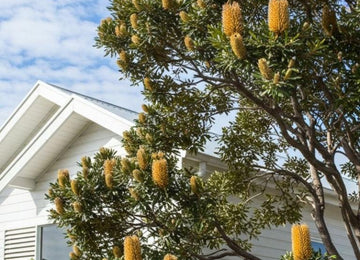
On the coastline itself, Coast Banksia (Banksia integrifolia) takes direct salt wind and makes a windbreak planted 3m apart, usually settling at 8m to 10m in gardens and lower on exposed sites.
Using the filters to shortlist
The sidebar filters do the heavy lifting on a page this broad. Filter by climate to remove anything wrong for your district, then by mature height, sun and use, whether that is screening, a shade tree or groundcover. Every product page carries the same spec data, so what you read matches what you can filter on.
Planting and establishment
Dig each hole twice as wide as the pot and no deeper, so the plant sits at its original soil level. Water in well, mulch 75mm deep with mulch kept off the trunk, and water deeply twice a week through the first summer rather than lightly every day. In frost districts, plant in spring once the worst has passed; on the coast, autumn planting gives roots a full mild season head start.
Common questions
Do you deliver across regional NSW?
Yes. We deliver Australia wide, with delivery from $29.95 and no minimum order. Advanced and large stock is freighted at cost on specialist transport, which can take a few extra days to arrange.
Which plants here handle tablelands frost?
Japanese maple, American sweetgum, crepe myrtles, Japanese box, Spartan juniper and Little Gem magnolia all cope with cold winters. Use the climate filter to shortlist, and keep frost tender growers such as palms for coastal or sheltered sites.
What grows well near the beach?
Coast banksia, tuckeroo and Thomas's pohutukawa handle front line salt wind. One street back, most of the hedging and screening range performs without complaint.
Can I browse natives only?
A large share of this page is locally grown Australian species. Browse the full Australian native plant collection, or compare the Queensland collection if you garden near the border.
