

Few perennials make a statement like a red hot poker. From a clump of grassy leaves it throws up stiff, leafless stems, each topped with a torch of tubular flowers in red, orange, yellow, lime or cream, and often two of those colours at once. Honeyeaters and wattlebirds find the flowers within hours of them opening. Red hot pokers come from South Africa, they are tough in sun, wind, heat and frost, and with a little planning different kinds will carry flowers in every season, including the middle of winter. This guide covers where they grow, how to choose between the dwarf, mid-sized and giant kinds, and the care that keeps them flowering.
Quick facts
| Feature | Detail |
|---|---|
| Botanical name | Kniphofia species and hybrids; also called torch lily |
| Type | Clump-forming perennial, mostly evergreen |
| Size | Dwarf kinds 30 to 50 cm; mid-sized 60 cm to 1 m; tall kinds 1.2 to 1.5 m in flower |
| Position | Full sun |
| Climate | Cool, temperate, Mediterranean and subtropical districts; not for the wet tropics |
| Frost | Hardy to moderate and heavy frost once established |
| Soil | Free draining; tolerates sand, coastal soil and clay that does not stay wet in winter |
| Flowers | Summer and autumn for most hybrids; winter for the winter pokers |
| Wildlife | Rich in nectar for honeyeaters, wattlebirds and bees |
Where red hot pokers grow
Red hot pokers grow in most of Australia outside the wet tropics. They are at their best in the southern states, from the coast to the tablelands, where winters are cool and summers are dry: Victoria, Tasmania, South Australia, the ACT, most of New South Wales and the south-west of Western Australia. Old clumps on farms and in country gardens survive for decades with no care at all.
They also grow well around Sydney and in south-east Queensland, provided the drainage is sharp. In humid districts the summer-flowering hybrids can rot at the crown in a wet summer, so plant on a slope or a raised bed, in the open where the air moves. The winter-flowering pokers, which grow through the cool months, are often the most reliable kind in the subtropics.
They take coastal wind and salt, they stand up to heat reflected from paving and walls, and established clumps come through drought. That toughness makes them a natural choice for a waterwise garden, alongside the plants in our waterwise garden guide.
A weed warning. The old species Kniphofia uvaria has escaped from gardens and is regarded as an environmental weed in parts of Victoria, Tasmania, South Australia and Western Australia, where it spreads along roadsides, creek lines and into damp bushland. If your garden adjoins bushland or a waterway, choose one of the named compact hybrids, cut the flower stems off before they set seed, and never dump unwanted clumps over the fence. Dispose of them in the green waste bin.
Choosing a red hot poker
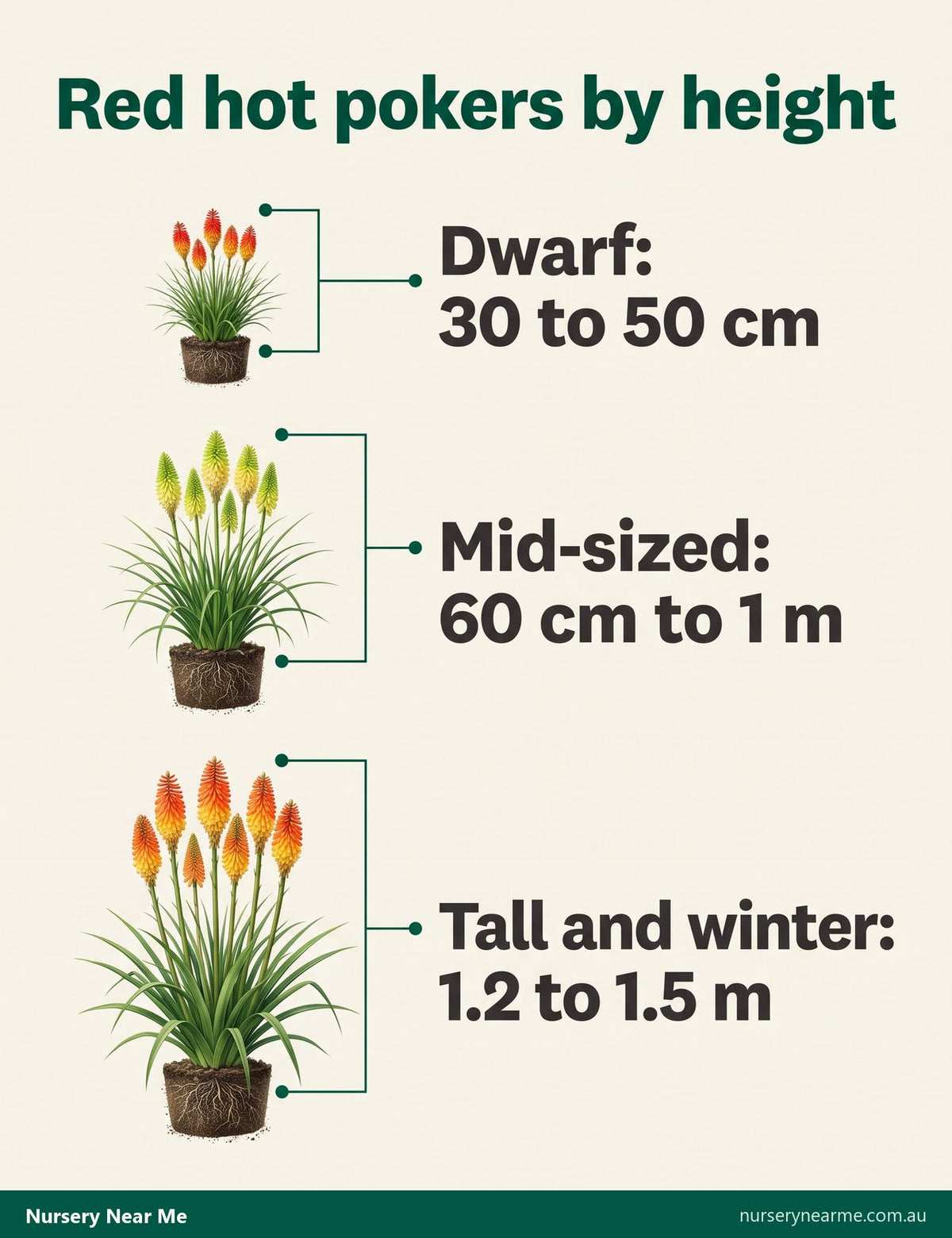
The whole range is in the red hot poker collection. Choose by height first and flowering season second.
Dwarf pokers for pots, edges and small gardens. The Poco series was bred to be compact and to flower repeatedly from late spring to autumn. Poco Red reaches about 45 cm, with red buds over orange flowers, and Poco Citron is the same size in clear lemon yellow. Rocket Jr is smaller again at 30 to 40 cm, with slender two-toned orange-red and yellow spikes through summer and autumn. Little Maid is a refined older variety about 60 cm tall, with narrow leaves and slim spikes that open pale yellow and fade to ivory.
Mid-sized pokers for mixed borders. Limelight has no red in it at all: lime-green buds open greenish yellow on spikes 80 cm to 1 m tall in summer, which sits easily beside blue and purple flowers. The lemon red hot poker is a species with soft lemon-yellow flowers.
Tall pokers for the back of a bed. John Benary is an old cultivar valued for holding a strong, even scarlet on spikes 1.2 to 1.5 m tall through summer.
Winter pokers. These flower when nectar is scarce and the garden is bare. Winter Cheer makes a robust clump about a metre wide, with orange-red and orange-yellow spikes 1.2 to 1.5 m tall from winter into early spring. The winter red hot poker has distinctive rounded, egg-shaped flower heads in orange and yellow from autumn into winter.
Plant a dwarf summer kind, a mid-sized summer kind and a winter poker, and you will have torches in flower for most of the year.
Planting

Position. Full sun, at least six hours a day. In shade the leaves grow long and floppy and the plant flowers poorly or not at all.
Soil. The crown must not sit wet in winter. Sandy and loamy soils suit pokers without any preparation. On clay, dig in compost and coarse sand or fine gravel and raise the bed 15 to 20 cm. Our guide to plants for clay soil explains how to work with heavy ground.
Planting. Plant in spring or autumn. Set the crown, the point where the leaves meet the roots, level with the soil surface and no deeper, because a buried crown rots. Water in well. Mulch around the plant but keep the mulch pulled back a hand's width from the crown. Gravel makes a good mulch for pokers.
Spacing. Space dwarf kinds 30 to 40 cm apart, mid-sized kinds 60 cm, and the tall and winter kinds 80 cm to 1 m. Plant in groups of three or five for a drift of colour. Good partners include salvias, ornamental grasses, agapanthus and kangaroo paws, which like the same conditions, and our guide to perennials for a cottage garden has more combinations.
In pots. The dwarf pokers grow well in pots 30 cm wide or larger filled with a free-draining potting mix. Water when the top of the mix is dry and feed in spring and again in midsummer.
Care through the year
Watering. Water weekly through the first summer. Established clumps survive on rainfall in most temperate districts, but they flower far better with water at the right time: a deep soak every week or two from when the flower stems first appear until flowering finishes. Keep the soil on the dry side in winter for summer-flowering kinds.
Feeding. Feed in early spring with a slow-release fertiliser or a layer of compost around, not over, the crown. Avoid high-nitrogen lawn fertilisers, which give masses of leaf and few flowers.
Deadheading. As each spike finishes, cut the stem off as low as you can reach. This keeps the clump tidy, prevents self-seeding, and on repeat-flowering kinds such as the Poco series it brings on the next flush.
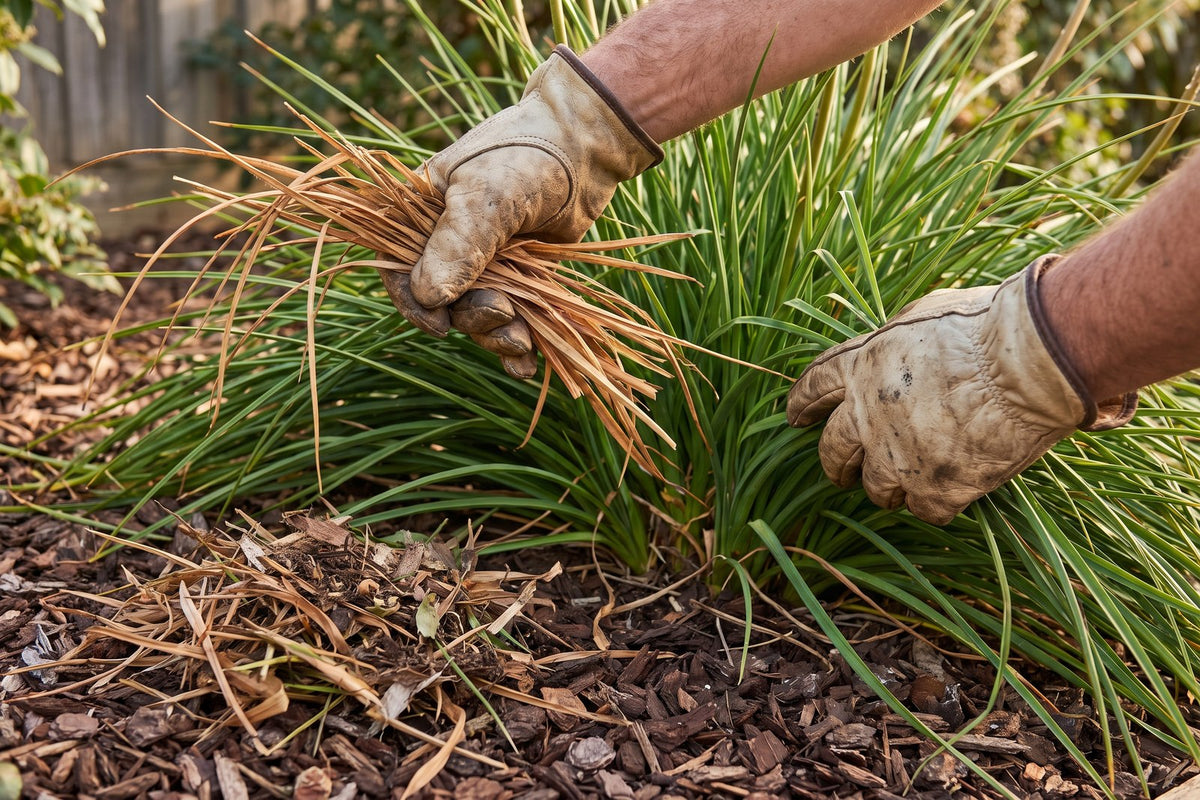
The annual tidy. Evergreen pokers gather a skirt of dead, brown leaves. In late winter or early spring, comb or pull the dead leaves out by hand, wearing gloves, as the leaf edges are finely toothed. If a clump is very untidy, cut all the foliage back to 15 to 20 cm with shears. Do this just as new growth begins, not in autumn: in cold districts the old leaves protect the crown from frost through winter. Tidy the winter-flowering kinds after they finish flowering in spring.
Dividing. Pokers resent disturbance and flower best in established clumps, so divide only when a clump has become congested and is flowering less, usually after five years or more. Lift it in spring, split it with a spade into sections with several growing points each, trim the leaves by half and replant at once. Divisions often skip a season of flowering while they settle.
Common problems and fixes
No flowers. The usual causes are too much shade, a clump planted too deep, too much nitrogen, or a young or recently divided plant that needs another season. A badly congested old clump also stops flowering and should be divided.
The centre of the clump rotting. Crown rot from wet soil, the most common cause of losses, especially in humid summers and wet winters. Lift healthy outer sections and replant them in a raised, better-drained spot.
Silvery streaks and distorted flower spikes. Thrips feed inside the buds in hot, dry weather. Cut off and bin affected spikes and water the plant well, since thrips are worst on stressed plants.
Chewed leaves and flower buds. Snails shelter in the base of the clump. Clear out dead leaves and hand-pick at night. See our guide to common plant pests and diseases for more.
Floppy leaves. Shade, rich soil or too much water. Pokers are sturdiest when grown lean and in full sun.
Frequently asked questions
When do red hot pokers flower in Australia?
It depends on the kind. Most hybrids flower from late spring through summer and into autumn, and winter pokers such as Winter Cheer flower from winter into early spring.
Should I cut back red hot pokers?
Cut off each flower stem at the base when it finishes. Tidy the leaves in late winter or early spring by pulling out dead foliage, or cut the clump back to 15 to 20 cm if it is very untidy.
Do red hot pokers attract birds?
Yes. The tubular flowers are full of nectar and are visited constantly by honeyeaters, wattlebirds and other nectar-feeding birds, as well as bees.
Are red hot pokers a weed in Australia?
The species Kniphofia uvaria is an environmental weed in parts of southern Australia. Near bushland or waterways, grow compact named hybrids, remove spent flower stems and never dump garden waste.
Can red hot pokers grow in pots?
The dwarf kinds, such as the Poco series and Rocket Jr, grow and flower well in pots 30 cm wide or larger in full sun.
Ready to plant?
Choose yours from the red hot poker collection. For more plants that bring birds into the garden, see the bird attracting plants and our guide to bird attracting native plants, and for sun-loving companions browse the plants for full sun. Every plant is sourced from partner nurseries around Australia and delivered Australia wide.
Sources
Weed status of Kniphofia uvaria: Weeds Australia. Kniphofia cultivation: Royal Horticultural Society.


