

Dry shade under established trees is the hardest spot in most gardens, and the renga renga lily is one of the few plants that makes it look easy. It forms a lush, evergreen clump of broad, soft green leaves that arch like a small flax, and in late spring it sends up airy sprays of white starry flowers that light up the shade for weeks. It comes from the coastal cliffs of New Zealand, where it grows in rock crevices under pohutukawa trees, so it is used to root competition, salt wind and long dry spells. This guide covers where it grows in Australia, the forms we sell, its two Australian native relatives, and the one pest that really matters.
Quick facts
| Feature | Detail |
|---|---|
| Botanical name | Arthropodium cirratum; also called New Zealand rock lily and renga lily |
| Type | Evergreen clumping perennial |
| Size | 60 to 90 cm tall and wide; compact forms 40 to 50 cm |
| Position | Shade, part shade or morning sun; full sun only near the coast or in cool districts |
| Climate | Temperate and subtropical districts, coast and inland; not for the tropics or hard-frost areas |
| Frost | Light frost only; leaves burn below about minus 2 degrees |
| Soil | Any free-draining soil, including sand and thin soil over roots |
| Flowers | White, starry, in branching sprays from late spring to early summer |
| Main pest | Snails and slugs |
Why gardeners plant it
A renga renga lily solves several problems at once. It grows under trees, where the soil is dry and full of roots. It keeps its leaves all year, so the ground stays covered in winter. Its foliage is broad and soft, which is a welcome change among the narrow, grassy leaves of most strappy plants. And it flowers properly in shade, with hundreds of small white stars, each with a purple and yellow centre, held on wiry stems above the leaves in November and December.
Landscapers use it in the same way as clivia or liriope: massed under trees, along the shaded side of a house, lining a path, or filling the narrow, awkward bed between a fence and a driveway. It is also a good plant for coastal gardens. In its home it grows within reach of salt spray, so it shrugs off sea wind that scorches most soft-leaved plants. Our guide to planning a coastal garden has more on planting near the sea.
Where renga renga lilies grow in Australia
Temperate coast and ranges. Sydney, Melbourne, Adelaide, Perth and the coast between them are ideal. The plant handles the dry summers of the south and the wetter summers of the east equally well, provided the soil drains.
The subtropics. In Brisbane and along the coast of northern New South Wales and south-east Queensland it grows well in shade with good drainage and air movement. Keep it out of the hot afternoon sun, and do not crowd the clumps, because warm, wet weather encourages leaf spotting.
Cold districts. Frost is the limit. A light frost marks the leaf tips and the plant recovers in spring. Repeated hard frosts, as in Canberra, the tablelands and inland Victoria, burn the foliage badly. In those districts plant it under the canopy of evergreen trees or beneath eaves, where the frost does not settle, or grow it in a pot that can be moved under cover.
The tropics. Constant heat and humidity do not suit it.
Sun or shade. The leaves are at their best, wide and deep green, in full shade to part shade. In hot inland sun they bleach yellow and scorch at the edges. Near the coast and in cool-summer districts the plant takes full sun and flowers more heavily for it. If you are choosing plants for a shaded garden, our guides to shade gardening and ground covers for shade list good companions.
Renga renga lilies and their relatives
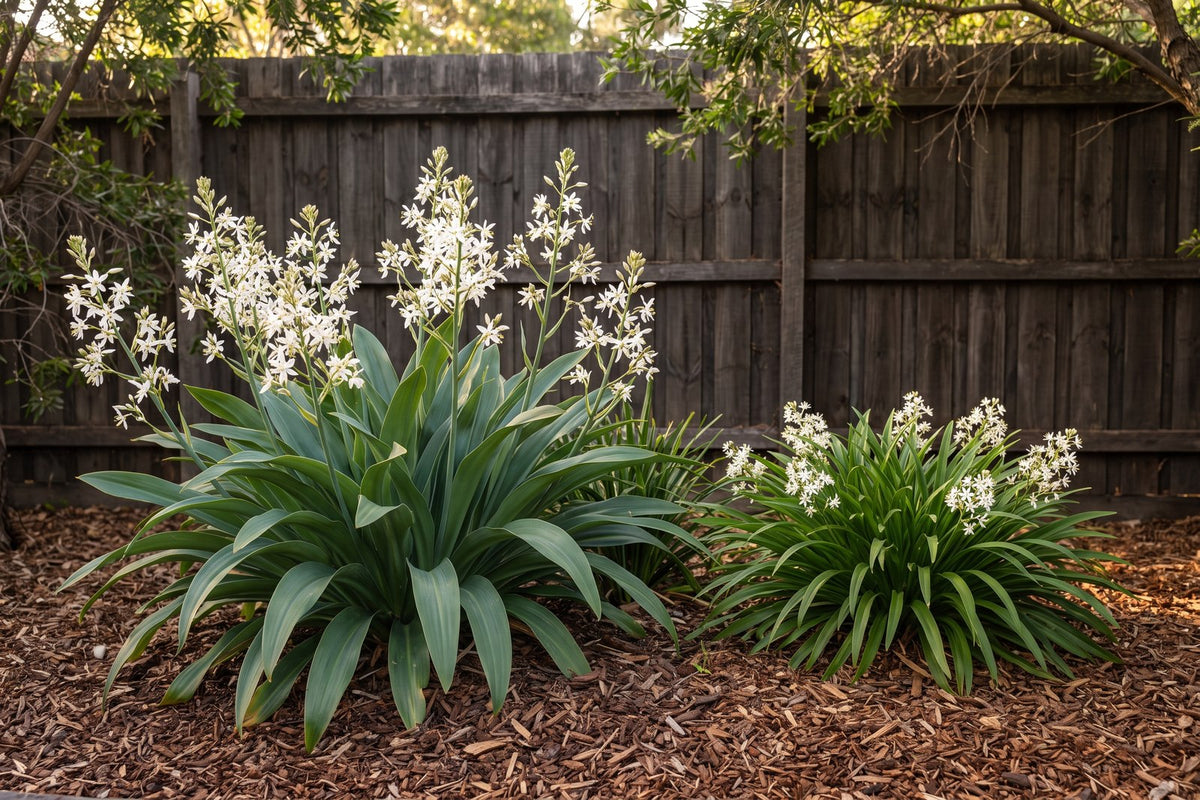
All of them are in the renga renga and arthropodium lily collection.
New Zealand rock lily. The species, sold as the New Zealand rock lily, is the standard choice for mass planting: 60 to 80 cm tall, with mid-green leaves and tall, open flower sprays.
Matapouri Bay. Matapouri Bay is the selection most landscapers ask for. Its leaves are broader and slightly blue-green, the clump is fuller, and the flower sprays are larger and more densely packed. It is the pick for a bold, lush look.
Te Puna. Te Puna is the compact form, 40 to 50 cm high and wide, with narrower leaves and shorter flower sprays that sit just above the foliage. Use it for edging, small courtyards and pots.
Chocolate lily. Australia has its own arthropodiums, and they are very different plants. The chocolate lily is a native of grasslands and open woodland in south-eastern Australia. It has fine, grassy leaves and slender stems of mauve flowers in spring that smell distinctly of chocolate on a warm day. It grows from small tubers and dies back to them over summer, returning with the autumn rain. Plant it in sun or light shade among native grasses, and do not water it while it is dormant.
Pale vanilla lily. The pale vanilla lily is a taller native relative, with blue-green leaves and sprays of pale lilac to white flowers in late spring and summer that carry a light vanilla scent. It also grows from tubers and rests after flowering. Both natives suit a meadow-style planting, and our guide to designing a native garden shows how to combine them with other local plants.
Planting and spacing
Soil. Drainage is the only real requirement. Renga renga lilies grow in sand, loam and the thin, dry soil over tree roots. In heavy clay that stays wet in winter the fleshy roots rot, so raise the bed or choose another plant. Our guide to preparing soil for planting explains how to check drainage.
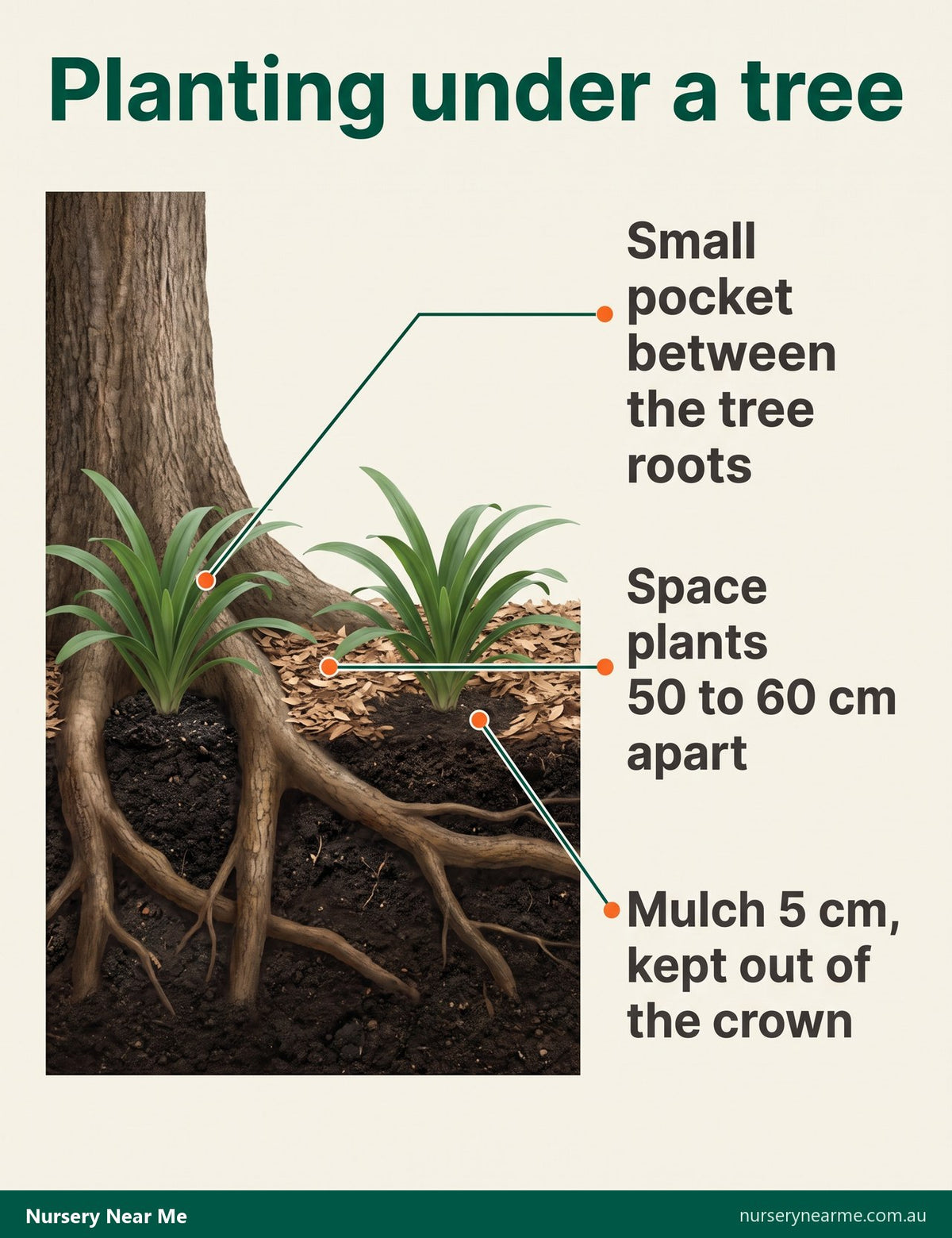
Planting under trees. Do not dig a large hole among tree roots. Use small plants, open a pocket just big enough for each root ball with a trowel, tuck the plant in between the roots and backfill with the same soil mixed with a little compost. Small plants establish faster than large ones under trees because they need less water while their roots find their way.
Spacing. For a continuous cover, space plants 50 to 60 cm apart, or 40 cm for Te Puna. The clumps meet in about two years. Plant in staggered rows, not a single line, for a natural drift.
Timing. Autumn is best, because the plant makes roots through the cool months and meets its first summer established. Spring is the next choice. Water in well and mulch 5 cm deep with leaf litter or fine bark, keeping the mulch out of the crown.
In pots. A renga renga lily is a handsome pot plant for a shaded veranda or entry. Use a pot at least 30 cm wide with a quality potting mix, water when the top few centimetres are dry, and feed in spring.
Care through the year
Watering. Water twice a week for the first two months, then weekly through the first summer. An established clump stores water in its thick roots and gets by on rainfall in most temperate districts, though a deep soak every fortnight in a dry summer keeps the leaves lush. Under large trees, which take most of the rain, water a little more often.
Feeding. Scatter a slow-release fertiliser around the clumps in early spring. Under trees, a yearly layer of compost or leaf mulch is usually enough.
Tidying. Once the flowers finish in summer, cut the spent stems off at the base, unless you want seedlings, which appear readily around the parent. Pull away yellow and tattered outer leaves at any time. If a clump has been shredded by snails or burnt by frost, cut the whole plant back to about 10 cm in early spring. It regrows fresh within a few weeks.
Dividing. Every four or five years, or whenever you want more plants, lift a clump in autumn, pull or cut it into sections each with roots and a fan of leaves, trim the leaves by half and replant at once. Water the divisions well until they are growing again.
Common problems and fixes

Holes and shredded leaves. Snails and slugs love this plant, and the dense, shady clumps give them a place to hide by day. This is the main problem and it is worst in spring and after rain. Go out with a torch on a damp night and pick them off, clear away the dead leaves at the base where they shelter, and use an iron-based snail bait, which is the safer kind around pets and wildlife, scattered thinly as the label directs.
Yellow, bleached leaves. Too much sun, usually hot afternoon sun inland. Move the plant in autumn or give it shade.
Brown, burnt leaf tips in winter. Frost. Leave the damaged leaves on as protection until the frosts are over, then trim.
Brown spots on the leaves. Fungal leaf spot, in humid weather or where clumps are crowded and watered overhead. Remove the worst leaves, thin the clumps and water at the base in the morning.
The crown turning soft and collapsing. Root rot from wet soil. Improve the drainage or replant on higher ground. More help is in our guide to common plant pests and diseases.
Frequently asked questions
Do renga renga lilies grow in full shade?
Yes. They are among the best flowering plants for full shade and dry shade under trees. They flower a little more in part shade or morning sun.
When do renga renga lilies flower in Australia?
From late spring into early summer, usually November and December, with white starry flowers in branching sprays above the leaves.
Are renga renga lilies frost hardy?
Only to light frost. The leaves burn below about minus 2 degrees, so in cold districts plant them under evergreen trees or eaves.
How far apart should I plant renga renga lilies?
Space them 50 to 60 cm apart for a continuous ground cover, or about 40 cm apart for the compact form Te Puna.
Are renga renga lilies native to Australia?
No. The renga renga lily is native to New Zealand. Its relatives the chocolate lily and the pale vanilla lily are Australian natives.
Ready to plant?
Choose your plants from the renga renga and arthropodium lily collection. For companions, see the plants for full shade and the wider grasses and strappy leaf plants. Every plant is sourced from partner nurseries around Australia and delivered Australia wide.
Sources
Arthropodium cirratum in the wild and in cultivation: New Zealand Plant Conservation Network. Australian arthropodiums: Australian National Botanic Gardens.


