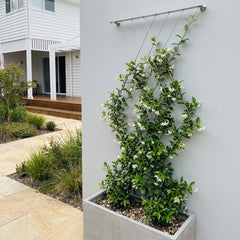
Native Clematis (Clematis microphylla) is a vigorous, twining Australian climber that reaches about 5m tall and 2m wide. In winter and spring it covers itself in small cream-yellow stars with very slender petals, and in autumn the flowers give way to whiskery, fluffy seedheads. It is semi-deciduous, with small neat leaves that turn purple in the cold.
Why you'll love it
-
Fast cover. A vigorous grower that will clothe an arbour, pergola or fence quickly once it has something to climb.
-
Winter and spring flowers. Cream-yellow, four-petalled stars appear when little else is in bloom.
-
Fluffy autumn seedheads. The flowers turn to whiskery seedheads, which earn it the old name of old man's beard.
-
Purple winter leaves. The small leaves take on a purple hue in cold weather, so the vine keeps interest in winter.
-
Tough and widespread. It grows wild in every state and territory except the Northern Territory. It is frost tolerant and drought tolerant once established, and it will grow in rocky ground.
Where it works best
Arbours and pergolas. Plant one at each post and let the vine twine up. Annual pruning stops it overloading a light structure.
Fence lines. Plant 2m apart along a fence with wires or trellis to hold the stems. It makes a quick, informal screen.
Up large trees. A mature tree can carry it, and the cream flowers then show in the canopy. In a mixed flower bed, plant it with caution, because it is vigorous.
Growing Native Clematis in Australia
Position and climate. Plant in a sunny, open position with plenty of space to climb. It grows wild across the south and suits warm temperate, cool temperate, Mediterranean and arid gardens, and it also grows in subtropical regions. It is frost tolerant.
Soil. Almost any soil will do, and in the wild it often grows in rocky conditions. Clematis perform better with cool roots, so plant groundcovers or lay mulch and stones at the base.
Water and feed. Mulch and water regularly for about 12 weeks until the plant is established. After that it copes with dry spells. A handful of slow release native fertiliser in spring helps on poor ground.
Pruning. Prune after flowering to keep the vine in check and to encourage flowering shoots lower down. Do not wait until it has overwhelmed its support.
What to expect when it arrives
We sell Native Clematis as tube stock, a young plant in an 80mm deep tube that establishes quickly, and in 140mm pots in packs of 10. Tubes are the economical choice for long fences, while the potted packs give a stronger plant to start with. Expect a small, slender plant on arrival that takes off as soon as it has something to climb.
Plants are delivered Australia wide, with delivery from $29.95. Every plant is covered by our 30 day healthy plant guarantee.
Plant care guides and related reading
Common questions
Does it need support?
Yes. It climbs by twining its leaf stalks around thin supports, so give it wire, mesh, trellis or a tree to scramble through.
Do all plants have the fluffy seedheads?
Only female plants carry the whiskery seedheads. A young plant shows its sex only when it flowers, so you cannot choose in advance.
Is it safe for pets?
No. Like other clematis it is irritating and toxic if chewed, so it is not a pet friendly plant. Keep dogs and cats from chewing the stems.