

Agaves are the punctuation marks of garden design. One well placed rosette brings more structure than a bed full of shrubs, holding its sculptural form in searing heat, drought and coastal wind without complaint. As water bills climb and summers lengthen, these Mexican natives have moved from collector oddity to mainstream Australian landscaping, and for good reason: no other plant group delivers this much presence for this little care.
Care is almost embarrassingly simple. Agaves want sun, sharp drainage and to be left alone. The whole craft lies in choosing the right variety for the space, because they range from 30cm pot jewels to two metre monsters, and a mislocated Agave americana is not a plant you casually relocate later.
Quick facts
| Botanical name | Agave species and hybrids |
| Type | Evergreen succulent rosette |
| Height | 30cm collectors to 2m landscape giants |
| Position | Full sun to light shade |
| Soil | Sandy or gravelly, sharply drained; pots need cactus mix |
| Growth rate | Slow to moderate |
| Climate | Arid to coastal; most tolerate light frost when dry |
Choosing the right agave
For pots and small spaces
Blue Glow Agave is the designer favourite: a compact 45cm to 60cm rosette of blue green leaves edged in glowing red that looks lit from within when the sun is behind it, from $71.95. Twin flowered Agave (Agave geminiflora), from $22.95, forms a soft looking sphere of hundreds of fine, flexible leaves, ideal where you want the agave look without serious armament. The collector's prize is Queen Victoria Agave, a slow, perfect dome of white pinstriped leaves. All three stay in scale with a courtyard for a decade or more, which is not something you can say of many statement plants.
For landscape statements
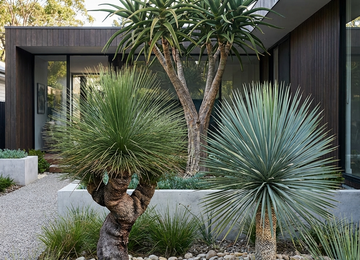
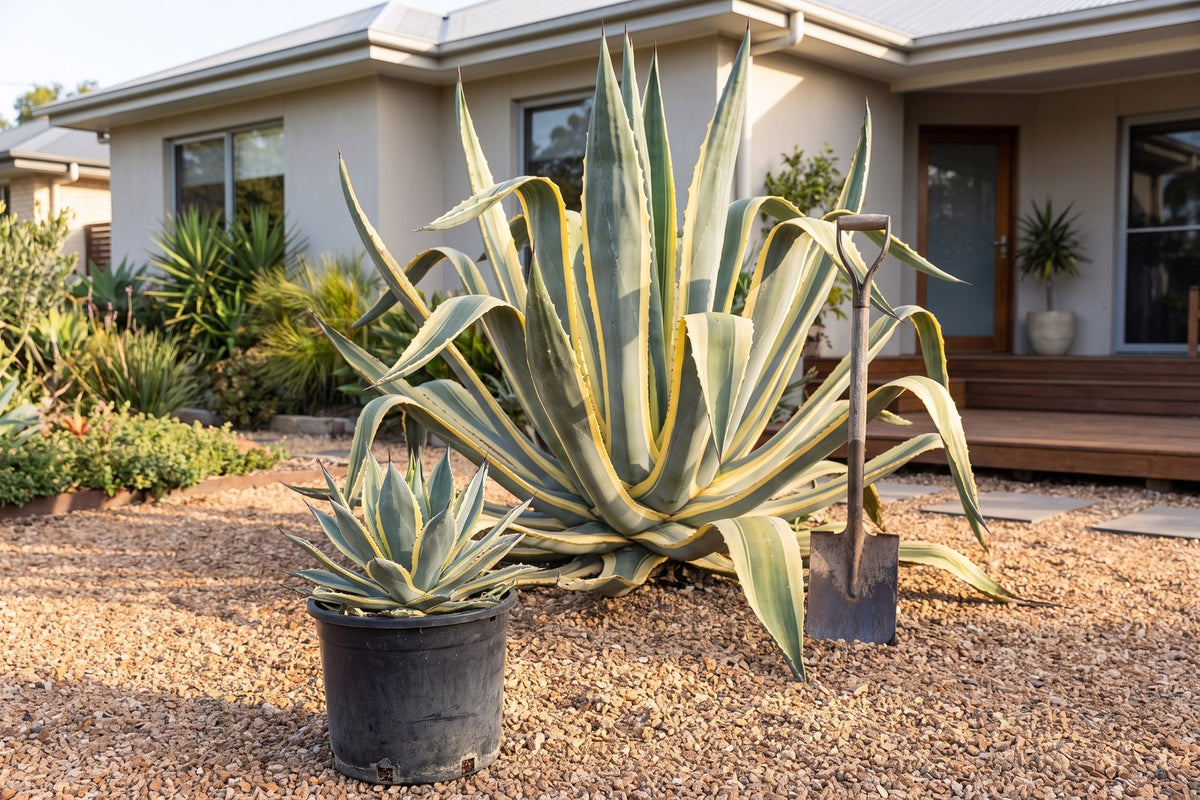
Variegated Agave (Agave americana Variegata) is the big one, a 1.5m to 2m rosette of cream banded blue leaves that anchors a gravel garden or driveway entrance. Lions Tail Agave, from $39.95, brings soft, spineless, pale green rosettes about a metre across, the large agave that is safe beside a path or a pool. For something stranger, Dragon Toes Agave offers chunky variegated leaves on a mid sized frame that works in large pots or the ground. Their bold silhouettes pair naturally with fine textured grasses and gravel mulches, which show the form off best.
Planting
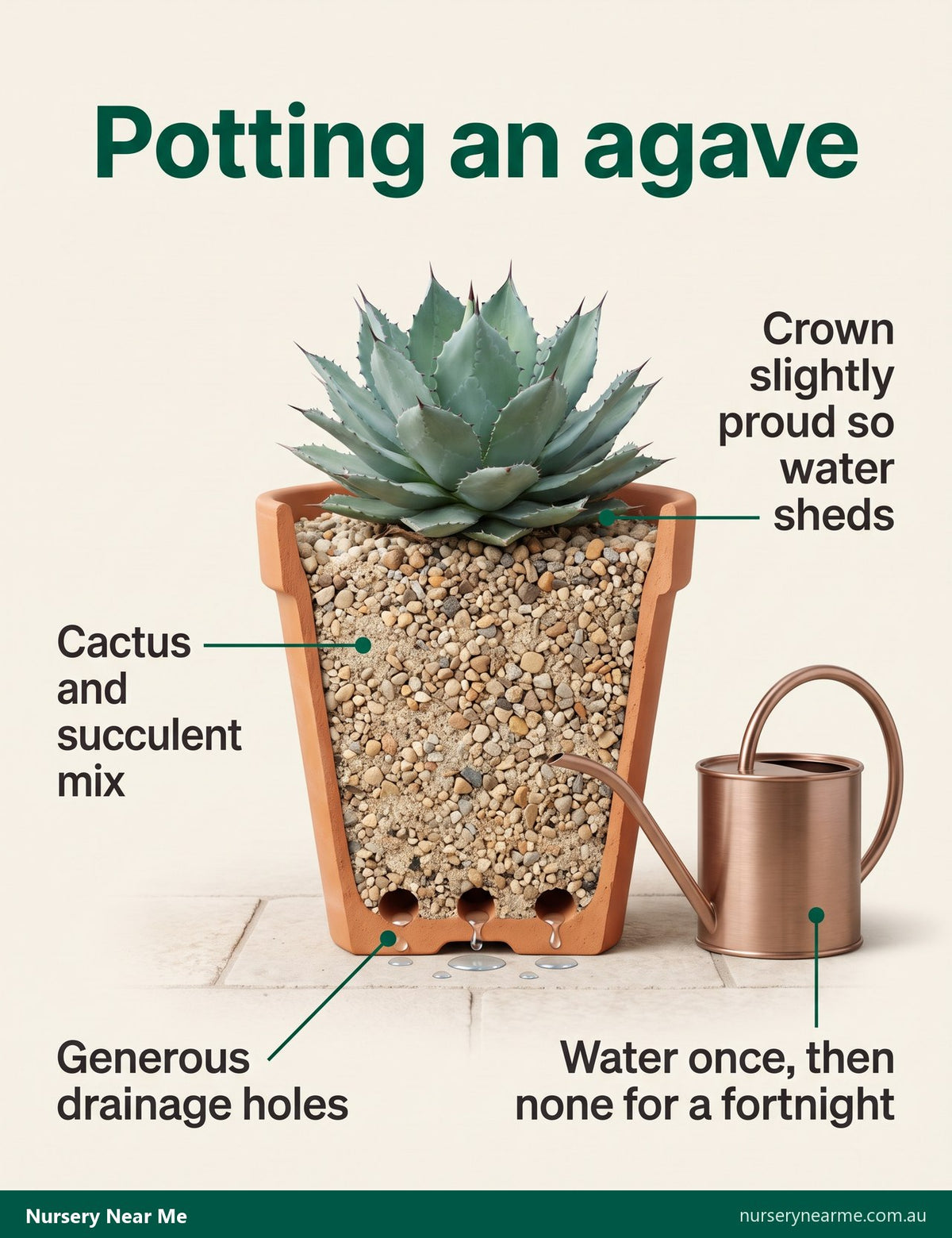
Full sun and drainage, in that order. In the ground, plant into a raised mound of soil blended half and half with coarse sand or fine gravel; on heavy clay this is not optional. Sit the rosette slightly proud of the soil so water sheds away from the crown. Give large agaves like americana at least 2m clearance from paths, and set toothed varieties well back from walkways, letting the plant's spines argue with the postie is a landscaping decision you only make once. In pots, use a cactus and succulent mix in a container with generous drainage holes. Water once to settle, then withhold water for a fortnight. Autumn and spring are the ideal planting seasons; summer plantings establish fine but need light shading in their first weeks.
Ongoing care
Watering: In most of Australia, rainfall is enough for in ground agaves after their first summer. Pots want a deep drink when the mix is fully dry, roughly fortnightly in summer and barely monthly in winter. If in doubt, hold off; a thirsty agave recovers in a day, an overwatered one often not at all.
Feeding: Optional. A half strength succulent fertiliser once in spring nudges growth along; more than that produces soft, floppy leaves.
Grooming: Remove spent lower leaves at the base with a knife, and remove pups (offsets) with a spade if you want a single clean rosette. Pups pot up easily and make free plants for the rest of the garden. Wear thick gloves for any of this work; even the soft leafed varieties have fibrous edges.
Common problems
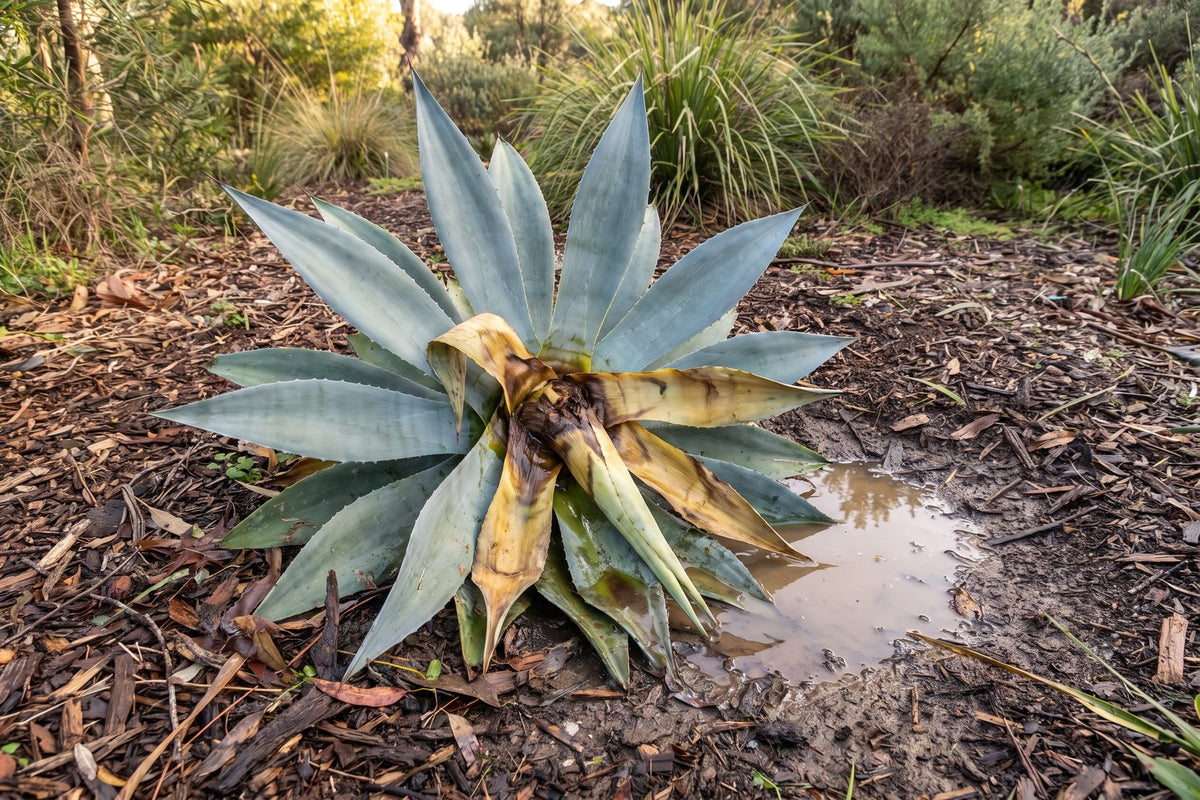
Crown or root rot: The only common killer. A collapsing, foul smelling centre means water has been sitting in the crown or roots, usually in winter. Prevention is the cure: mounded planting, gritty soil and dry feet in the cold months.
Frost scarring: Cold nights below about -3C leave bleached patches on many varieties, especially when the plant is wet. Damage is permanent on that leaf but the plant grows through it.
Mealybug in leaf bases: White cottony clusters deep in the rosette. Flush out with a jet of water and treat with horticultural oil.
Sunburn after moving: A pot agave shifted from shade to full summer sun can scorch. Transition over two or three weeks.
Frequently asked questions
Do agaves die after flowering?
Yes, most agaves are monocarpic: after ten to twenty five years the rosette sends up a spectacular flower spike, sets seed and dies. By then it has usually produced pups that carry on in its place.
How fast do agaves grow?
Slow to moderate. Compact types like Blue Glow take four to six years to reach full size, while Agave americana can hit 1.5m in five to seven years in the ground.
Are agaves frost tolerant?
Most popular varieties handle light frosts to around -3C if their soil is dry. Lion's tail (attenuata) is the exception and needs a frost free spot. Cold plus wet is the dangerous combination, so winter drainage matters more than the thermometer.
Are agave spines dangerous?
The terminal spines on species like americana are genuinely sharp and the sap can irritate skin. Plant them back from paths, wear gloves and eye protection when trimming, or choose soft leafed types like lion's tail (attenuata) or geminiflora near walkways.
Ready to plant?
Build out the look with more waterwise structure from our shrubs and feature trees, and find the right container in pots and planters. See our delivery page for how spiky cargo travels safely.


