

Lomandra longifolia is the most planted native in Australian landscaping, and it earned the position honestly. It survives drought, frost, coastal salt, heavy clay, deep shade and full sun, needs cutting back roughly once every two or three years, and looks the same in July as it does in January. If you have a difficult strip of ground and no appetite for maintaining it, this is usually the answer.
Quick facts
| Detail | What to expect in Australia |
|---|---|
| Botanical name | Lomandra longifolia, the spiny-headed mat rush |
| Origin | Native to eastern and southern Australia |
| Mature size | 300 mm to 1.2 m depending on cultivar |
| Position | Full sun to deep shade - genuinely both |
| Soil | Almost anything, including clay and sand |
| Water | Regular for the first season, then rainfall |
| Frost | Hardy well below zero |
| Maintenance | Cut back every 2-3 years. Otherwise nothing |
| Best climates | Every Australian capital, coastal and inland |
Why it is planted everywhere
Walk through any new estate, shopping centre carpark or council streetscape in Australia and you will find lomandra. Landscape architects specify it because it does something very few plants manage: it looks deliberate and tidy without anyone tending it. It also holds soil on batters and swale edges, tolerates the runoff and reflected heat of a carpark, and does not need replacing every few years.
For home gardens the same qualities apply. It is the plant for the strip beside the driveway, the slope nobody wants to mow, the shaded bed under a gum where nothing else survives, and the dry front garden that has to look presentable with no irrigation.
Choosing the right cultivar
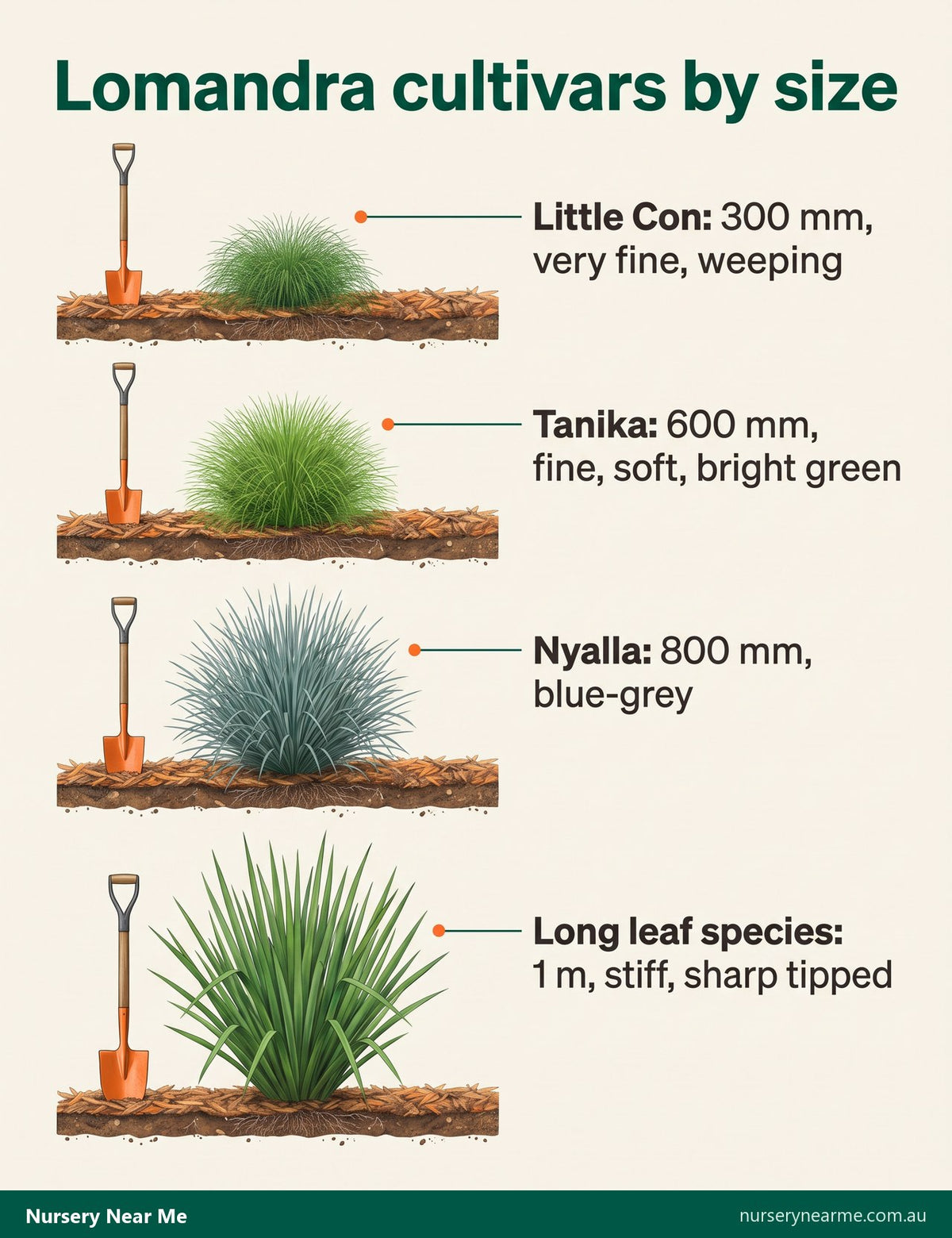
This is where most people get it wrong. The straight species reaches over a metre with coarse, sharply pointed leaves, while the modern cultivars range from 300 mm cushions to fine weeping clumps. They are not interchangeable.
| Cultivar | Size | Foliage | Best for |
|---|---|---|---|
| Tanika | 600 x 600 mm | Fine, soft, bright green | Mass planting, the default landscape choice |
| Long leaf (species) | 1 m x 1 m | Broad, stiff, sharp tipped | Erosion control, revegetation, large areas |
| Nyalla | 800 x 800 mm | Blue-grey | Colour contrast against green planting |
| Verday | 700 x 700 mm | Deep green, robust | Tough exposed sites |
| Lime Tuff | 500 x 500 mm | Fine, lime green | Brightening shaded beds |
| Little Con | 300 x 400 mm | Very fine, weeping | Borders, edging, small gardens |
| Little Pal | 350 x 400 mm | Fine, compact | Front-of-bed groundcover |
| Crackerjack | 600 x 800 mm | Fine, arching | Softening walls and rock edges |
| Shara | 500 x 500 mm | Very fine, weeping | Dry sites, low borders |
| Tropic Cascade | 600 x 900 mm | Fine, strongly weeping | Retaining walls and raised beds |
| Little Cricket | 400 x 500 mm | Fine, upright | Damp and shaded positions |
If you want one recommendation
Tanika is the most planted lomandra in Australia for good reason - fine soft foliage, a neat 600 mm dome, no sharp tips, and it holds shape for years. For mass planting it is very hard to beat.
For spilling over a wall
Tropic Cascade and Crackerjack both arch outward rather than standing upright, which softens the hard edge of a retaining wall or raised planter far better than a domed cultivar.
For small gardens and edging
Little Con and Little Pal stay around 300 to 350 mm, which suits a courtyard border or the front row of a bed where a full-size lomandra would swamp everything.
For damp ground
Lomandra hystrix and Little Cricket come from creek banks and handle wetter soil than L. longifolia, making them the better choice for a swale, a drainage line or a shaded damp corner.
Where it grows in Australia
Practically everywhere, which is unusual enough to be worth stating plainly. Lomandra longifolia occurs naturally from Queensland through New South Wales and Victoria to Tasmania and South Australia, and cultivars perform in Brisbane humidity, Melbourne frost, Adelaide and Perth dry heat and coastal salt wind alike. In the tropics it grows well but appreciates a little shade through the worst of the wet season.
It is also commonly included in low-flammability planting lists used in bushfire-prone areas, though local council or fire service guidance should always take precedence over any general planting advice.
How to plant
- Plant in autumn or spring so roots establish before extreme heat or cold.
- Sun or shade both work. Plants in deep shade grow slightly looser and greener; those in full sun stay tighter.
- Space by mature width. Tanika at 600 mm centres gives a continuous mass in about two years; the small cultivars go at 400 mm.
- Improve drainage on heavy clay by planting slightly proud of the surrounding soil. Lomandra tolerates clay but not standing water.
- Mulch to 50 mm, kept off the crown.
- Water weekly through the first summer, then let it fend for itself.
Ongoing care
Cutting back
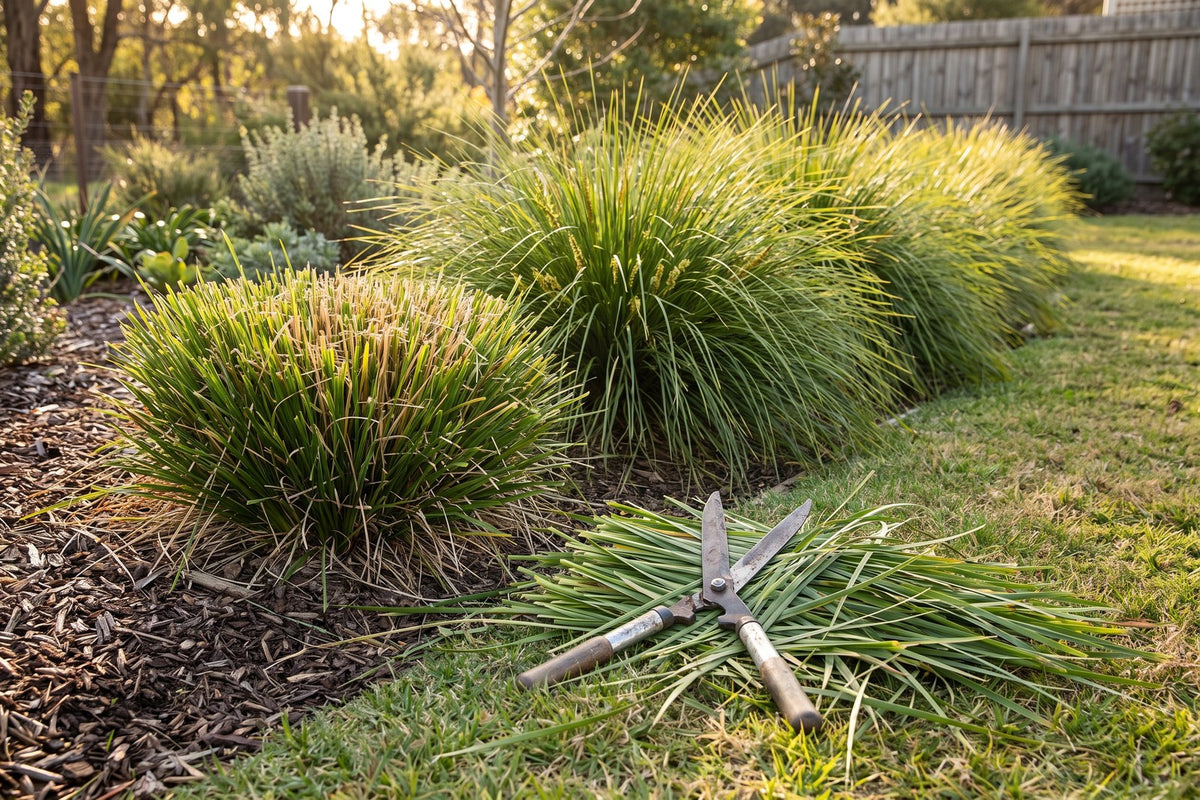
This is the only real job. Every two or three years, cut the whole clump back to roughly a third of its height in late winter or early spring. It looks brutal and the plant returns fresh and dense within weeks. Skipping it lets dead leaf build up in the centre, which is what makes older plantings look tired and straggly.
Hedge shears work for a few plants; a brushcutter or hedge trimmer is the sensible tool for a mass planting.
Watering and feeding
Established plants need neither in most Australian gardens. A light application of native-safe slow-release fertiliser in spring will speed up a young mass planting, but mature clumps are perfectly happy without. Avoid high-phosphorus fertilisers, which many Australian natives resent.
Common problems and fixes
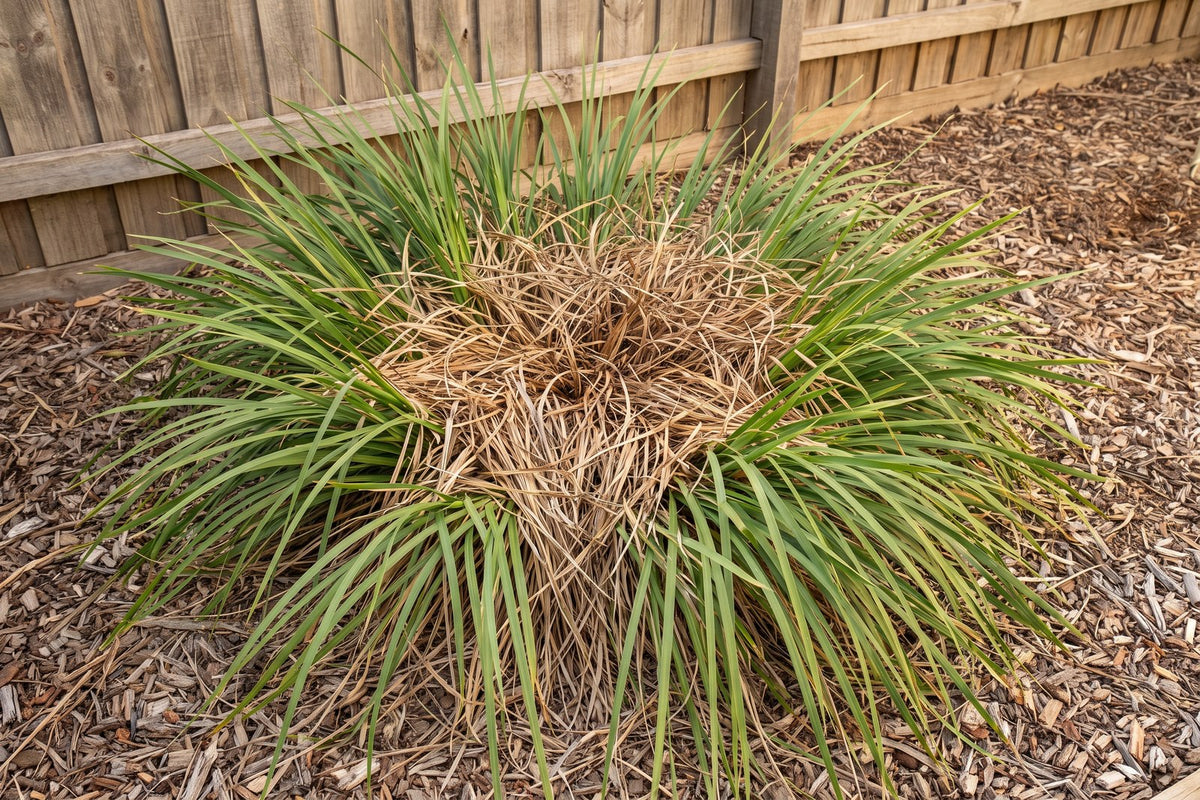
- Brown centre with green outer leaves means accumulated dead thatch. Cut the clump hard back in late winter and it recovers completely.
- Whole clumps yellowing and collapsing is almost always root rot from waterlogged soil. Improve drainage, or switch to L. hystrix which tolerates wet feet.
- Sparse, floppy growth usually means very deep shade plus rich soil. It is cosmetic rather than harmful.
- Sharp leaf tips causing complaints means the wrong cultivar. The straight species has genuinely spiny tips; Tanika, Little Con and Shara do not.
- Seedlings appearing nearby is normal for the species. Cutting back before seed sets prevents it.
- Plants outgrowing the space is a selection problem, not a care problem. Lomandra does not respond well to being permanently kept smaller than its natural size.
A plant with a long history here
Long before it became a landscape staple, lomandra was used by Aboriginal peoples across eastern Australia. The strong flexible leaves were woven into baskets, mats and eel traps, and the soft white leaf bases were eaten. The flower spikes carry a distinct honey scent in spring that gives away the plant's older common name, mat rush.
Frequently asked questions
Is lomandra an Australian native?
Yes. Lomandra longifolia occurs naturally from Queensland through New South Wales and Victoria to Tasmania and South Australia. The named cultivars sold in nurseries are selections of Australian species rather than introduced plants.
How often should lomandra be cut back?
Every two to three years, to about a third of its height, in late winter or early spring. That is genuinely the whole maintenance schedule. Regrowth is fast and the plant looks better for it.
Does lomandra grow in full shade?
Yes, which is unusual for a plant that also thrives in full sun. Shaded plants grow a little looser and greener. It is one of the few reliable options for dry shade under established trees.
Which lomandra has soft leaves?
Tanika, Little Con, Little Pal, Shara and Lime Tuff all have fine soft foliage. The straight species and some older forms have stiff sharply pointed tips, which is why it is called the spiny-headed mat rush - worth avoiding beside paths and play areas.
Why is my lomandra dying in the middle?
Almost always dead leaf accumulating in the crown rather than disease. Cut the clump back hard in late winter and it fills in again. If entire plants are collapsing and the soil stays wet, that is root rot and a drainage problem.
How far apart should I plant lomandra?
Around 600 mm apart for Tanika and similar mid-size cultivars, which closes to a continuous mass in roughly two years. Small cultivars such as Little Con go at 400 mm, and the full-size species needs a metre.
Ready to plant?
We grow the full lomandra range, from compact Little Con through to the straight species for revegetation and erosion control. Browse our landscaping grasses collection, or the wider Australian natives range.
Planning a low-maintenance garden? See drought tolerant plants and the low-maintenance native garden.
One more thing before the courier turns up: our guide to what to do when your plants arrive covers the first 48 hours, from unboxing to the first watering, so nothing is lost in the handover.
Planting where young children play? Our guide to safe plants for childcare centres and school gardens lists what the poisons centres and Kidsafe say to remove, and the tough, soft and edible plants that fit a play space.
On a septic block the planting rules change: our guide to what to plant over a septic drain field gathers the state guidelines on cover plants, tree distances and the signs of a failing trench.


