

Wisteria in full flower is one of the great sights in an Australian garden - long lilac or white racemes hanging in curtains from a pergola, before the leaves appear. It is also frequently misdescribed as an Australian native, which it is not. Wisteria comes from China and Japan. Australia does have a native climber that produces a similar cascade of purple flowers, and for many gardens it is the better choice.
Quick facts
| Detail | What to expect in Australia |
|---|---|
| Botanical name | Wisteria sinensis (Chinese), W. floribunda (Japanese) |
| Origin | China and Japan - not native to Australia |
| Size | 10 m or more, very heavy at maturity |
| Position | Full sun for flowering |
| Flowering | Spring, before or with the new leaves |
| Chill requirement | Needs cold winters to flower well |
| Time to flower | 2-3 years grafted, up to 20 from seed |
| Best climates | Melbourne, Adelaide, Canberra, Tasmania, cool tablelands |
Buy a grafted plant, not a seedling
This is the most important single point. Wisteria grown from seed can take ten to twenty years to flower, and some never do. Grafted plants, propagated from a proven flowering parent, bloom within two or three years.
Nearly every "my wisteria has never flowered" story traces back to a seedling. Buy a named grafted variety such as Wisteria sinensis 'Alba' and you skip the problem entirely.
Where wisteria performs in Australia
- Melbourne, Adelaide, Canberra, Tasmania, the tablelands - ideal. Cold winters produce the heaviest flowering.
- Sydney and the Blue Mountains - very good, particularly in cooler suburbs.
- Perth - grows well, though flowering is lighter than in colder districts.
- Brisbane and subtropical Queensland - it grows vigorously but flowers poorly, because it does not get the winter chill it needs. The vine takes over and gives little in return.
If you are in a subtropical climate and want that cascading purple effect, plant hardenbergia instead. It is genuinely better suited, and it is native.
The Australian native alternative

Hardenbergia violacea, the native purple coral pea, produces masses of purple pea flowers in late winter and early spring - a useful time of year when little else is out. It is a fraction of the size and weight of wisteria, it is not invasive, and it grows across most of Australia.
| Wisteria | Hardenbergia | |
|---|---|---|
| Origin | China and Japan | Australian native |
| Size | 10 m+, very heavy | 2-4 m, light |
| Structure needed | Substantial steel or hardwood | Ordinary trellis or wires |
| Flowering | Spring, needs winter chill | Late winter, no chill needed |
| Warm climates | Poor flowering | Flowers reliably |
| Weed risk | Naturalised in parts of Australia | None |
Sea of Purple is the strong-flowering climbing form, Lilac Lace is a softer lilac, White Out flowers white, and Meema is the spreading groundcover form.
Two things wisteria will do if you let it
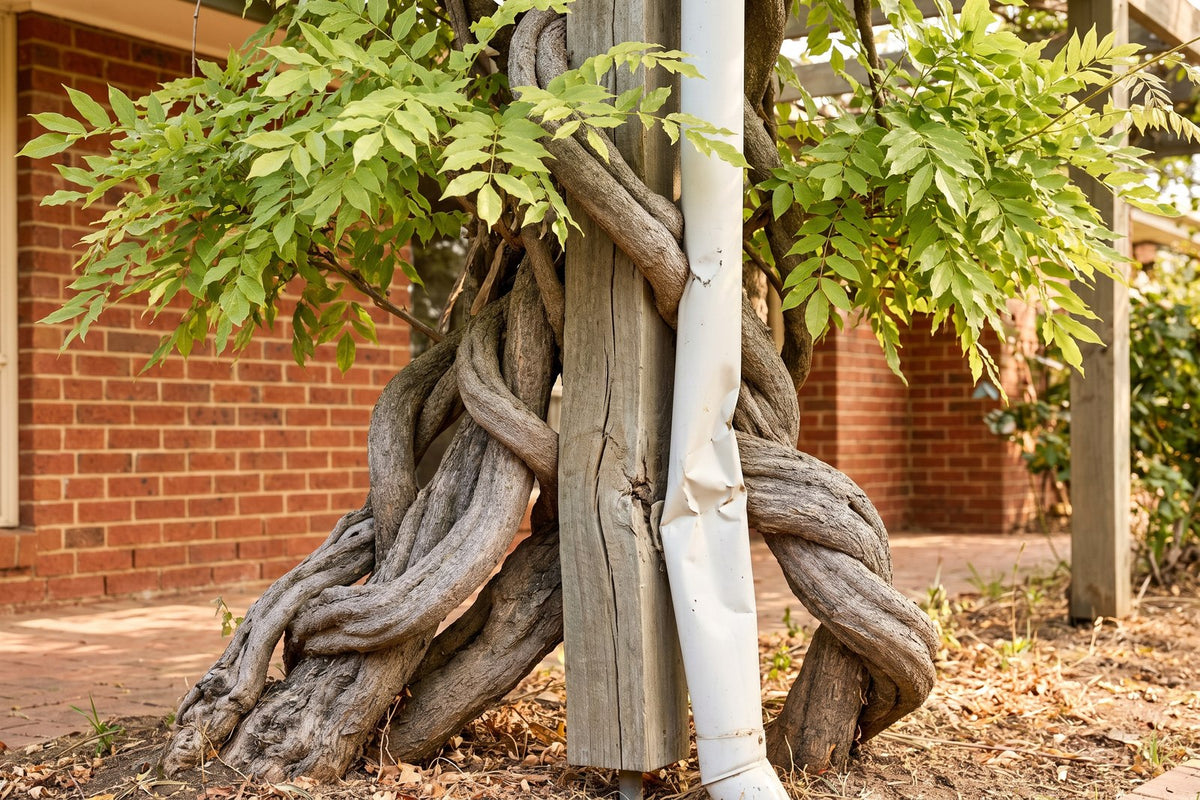
It is genuinely heavy
A mature wisteria weighs hundreds of kilograms and the stems thicken into woody trunks that can crush a timber pergola or bend steel. It also strangles anything it twines around, including downpipes, gutters and small trees. Build the structure for the mature plant, not the one in the pot.
It escapes
Wisteria sinensis has naturalised in parts of southeastern Australia, spreading by suckers and by stems layering where they touch the ground. In a maintained garden this is controllable, but it is a real consideration near bushland, creek lines or a neglected boundary. Remove suckers as they appear.
How to grow wisteria well
- Plant in winter while dormant, in full sun.
- Build the structure first. Galvanised steel, substantial hardwood or a masonry-supported frame - not a light timber lattice.
- Keep it well away from the house, gutters, downpipes and roof.
- Do not over-enrich the soil. Rich soil and high-nitrogen fertiliser give rampant growth and few flowers.
- Water through the first two summers, then it is fairly self-sufficient.
- Train the framework early - establish the permanent arms in the first two or three years, then prune to them.
Pruning: twice a year, and it matters

Wisteria flowers on short spurs, and pruning is what creates them.
- Summer, about two months after flowering: cut back the long whippy new growth to about five or six leaves.
- Winter, while dormant: cut those same shoots back further, to two or three buds. This is where the flower spurs form.
Skip this and you get a very large leafy vine with a scattering of flowers. It is the single biggest difference between a spectacular wisteria and a disappointing one.
Common problems and fixes
- No flowers on a healthy plant is usually a seedling rather than a grafted plant, insufficient pruning, too much nitrogen, or not enough winter chill.
- Rampant growth, few blooms means the soil is too rich or it is not being pruned twice a year.
- Suckers appearing metres away is normal. Remove them promptly.
- Damage to structures comes from underestimating the mature weight. Rebuild rather than hope.
- Yellow leaves generally means poor drainage or an iron shortage in alkaline soil.
- Poor flowering in Brisbane is a climate mismatch, not a care fault. Plant hardenbergia instead.
Frequently asked questions
Is wisteria an Australian native?
No. Wisteria comes from China and Japan. The Australian native climber with a similar cascade of purple flowers is Hardenbergia violacea, the purple coral pea, sometimes informally called native wisteria.
Why won't my wisteria flower?
Most often because it is a seedling rather than a grafted plant - seedlings can take up to twenty years. The other causes are not pruning twice a year, too much nitrogen fertiliser, too little sun, or insufficient winter chill in a warm climate.
Will wisteria grow in Brisbane?
It grows very vigorously but flowers poorly, because subtropical winters do not give it the chill it needs. You get an enormous leafy vine and few blooms. Hardenbergia gives the purple cascade reliably in warm climates.
Is wisteria invasive in Australia?
Wisteria sinensis has naturalised in parts of southeastern Australia, spreading by suckers and by layering. In a maintained garden it is manageable, but remove suckers promptly and think carefully before planting near bushland or a creek.
How strong does a wisteria pergola need to be?
Very. A mature plant weighs hundreds of kilograms and thickens into woody trunks that can crush timber and distort steel. Build in galvanised steel or heavy hardwood, sized for the mature vine rather than the young one.
When should I prune wisteria?
Twice a year. In summer, about two months after flowering, cut new growth back to five or six leaves. In winter, cut those shoots back to two or three buds. That second cut is what forms the flowering spurs.
Ready to plant?
We grow grafted wisteria and the full hardenbergia range for gardens where a native climber suits better. Browse our climbers and groundcovers collection, or Australian natives.
Related reading: star jasmine as an ornamental vine and native vs exotic plants.
For a garden that has to sit in a bushfire zone, the bushfire-wise planting guide explains the design rules the fire agencies publish and which plants appear on their lists.


