

Star jasmine is the most useful climber sold in Australia, and the reason is that it is not really one plant but three. Left to climb it covers a fence or pergola in two seasons. Left flat it makes a dense evergreen groundcover that suppresses weeds. Clipped, it forms a green wall panel as crisp as a hedge. Add heavily scented white flowers through spring and it is easy to see why landscapers specify it constantly.
Quick facts
| Detail | What to expect in Australia |
|---|---|
| Botanical name | Trachelospermum jasminoides |
| Family | Apocynaceae - related to frangipani, not true jasmine |
| As a climber | 4-6 m with support |
| As a groundcover | 300-450 mm high, spreading 1-2 m |
| Position | Full sun to part shade |
| Flowering | Spring into early summer, intensely fragrant |
| Frost | Hardy once established |
| Best climates | Every Australian capital |
It is not a true jasmine, and that matters
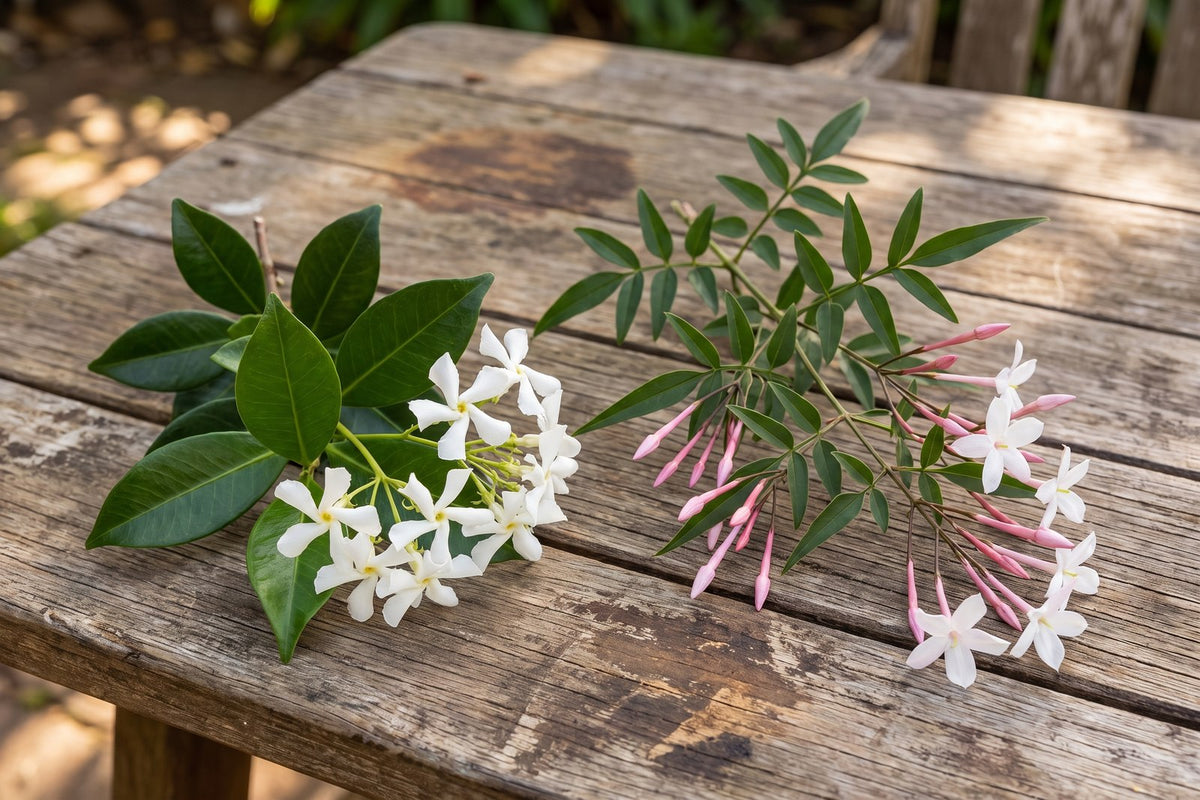
Despite the name, Trachelospermum jasminoides belongs to the same family as frangipani and oleander. Practically, that means two things: the stems exude a milky sap that irritates skin, so wear gloves when pruning, and it is unrelated to the jasmines that have become weeds in Australia.
That last point is worth being clear about. Jasminum polyanthum, the pink-budded jasmine that scents Australian gardens in early spring, has naturalised in parts of southeastern Australia and is treated as an environmental weed in some regions. Star jasmine does not behave that way - it spreads slowly by layering rather than by seed or runners, and it is not on weed lists. If you have been avoiding jasmine for that reason, star jasmine is the one to plant.
Three ways to use it
As a climber
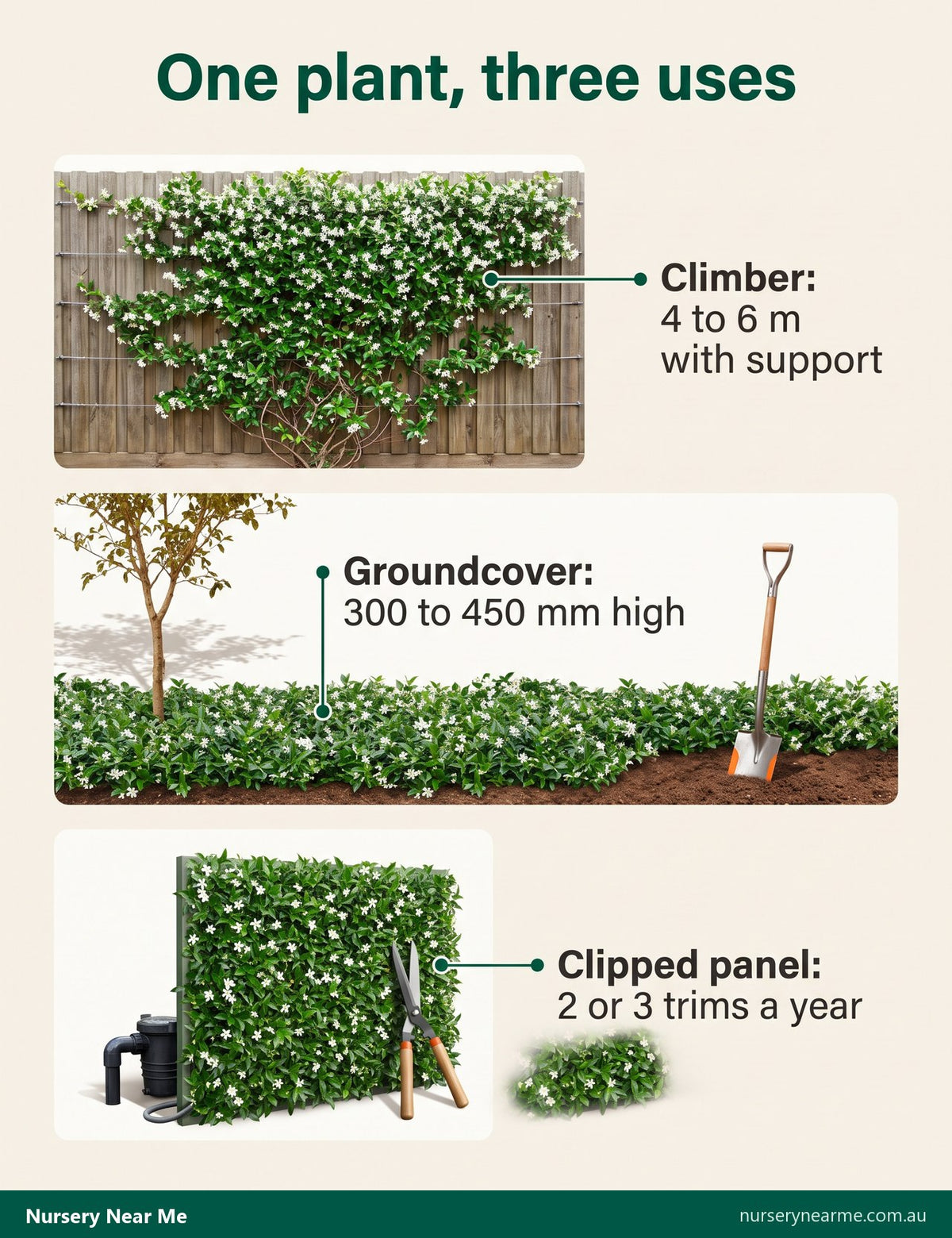
Twining stems need something to wrap around - wire, mesh, lattice or a rail. Unlike climbing fig it will not attach itself to a bare wall, which is an advantage: it can be removed later without damaging render or paint. Install the wires first, tie in the leading stems, and it does the rest.
As a groundcover
Planted without support it stays around 300 to 450 mm high and spreads outward into a dense evergreen mat. This is one of the best weed-suppressing groundcovers available in Australia - it handles sun or shade, tolerates dry spells once established, and needs only an annual trim.
As a clipped panel
Grown on a frame and trimmed two or three times a year, star jasmine makes a flat green wall as neat as a clipped hedge. It is the standard solution for screening a fence, a pool pump, a bin store or a blank rendered wall.
Which variety to plant
| Variety | Foliage | Best for |
|---|---|---|
| T. jasminoides | Glossy dark green | All three uses. The default choice |
| Tricolor | Green, cream and pink variegation | Feature panels, brightening shade |
| T. asiaticum | Smaller, denser, bronze new growth | Tighter groundcover, finer texture |
| Flat Mat | Low, spreading | Groundcover only - does not climb well |
For most jobs the standard species is right. Flat Mat is bred for groundcover use and stays lower and denser. Tricolor lifts a dark corner, and Asiatic star jasmine gives a finer, tighter mat with attractive bronze new growth.
Where it grows in Australia
Almost everywhere, which is unusual for a plant this ornamental. Star jasmine grows and flowers reliably in Brisbane, Sydney, Melbourne, Adelaide, Perth, Canberra and Hobart. It handles frost once established, tolerates coastal conditions, and copes with both humid subtropical summers and dry Mediterranean ones.
The only qualification is that flowering is heaviest in full sun. In deep shade it grows perfectly well as foliage but blooms sparsely.
How to plant
- Plant in autumn or spring, avoiding extreme heat and cold.
- Install supports first if it is climbing. Retrofitting wires around an established plant is unpleasant work.
- Space at 1 m for a climbing screen, or 600-800 mm for groundcover.
- Improve the soil with compost and ensure reasonable drainage.
- Mulch to 50 mm, kept off the stems.
- Water regularly through the first summer, then reduce - it becomes quite drought tolerant.
Ongoing care
Pruning
Prune straight after flowering finishes in late spring or early summer. Flower buds form on growth made during the previous season, so pruning in autumn or winter removes next spring's display - the most common reason a healthy star jasmine does not flower.
For a clipped panel, trim two or three times through the growing season and accept fewer flowers. For maximum perfume, prune once after flowering and let it grow.
Watering and feeding
Water regularly through the first two summers, then only in prolonged dry spells. Feed in early spring with a controlled-release fertiliser. It is not a demanding plant and overfeeding produces rank growth with fewer flowers.
Common problems and fixes
- No flowers is usually pruning at the wrong time or too much shade. Prune only after flowering, and give it sun if you want perfume.
- Yellowing leaves generally means poor drainage or, in alkaline soils, iron deficiency. Check drainage first.
- Bare woody base on a climber is normal with age. Cut back hard in late spring and it reshoots from old wood.
- Sparse thin growth in shade is a light problem rather than a health one.
- Scale and sooty mould occur in still shaded positions. Treat with horticultural oil.
- Skin irritation after pruning is the milky sap. Wear gloves and long sleeves.
Star jasmine or climbing fig?
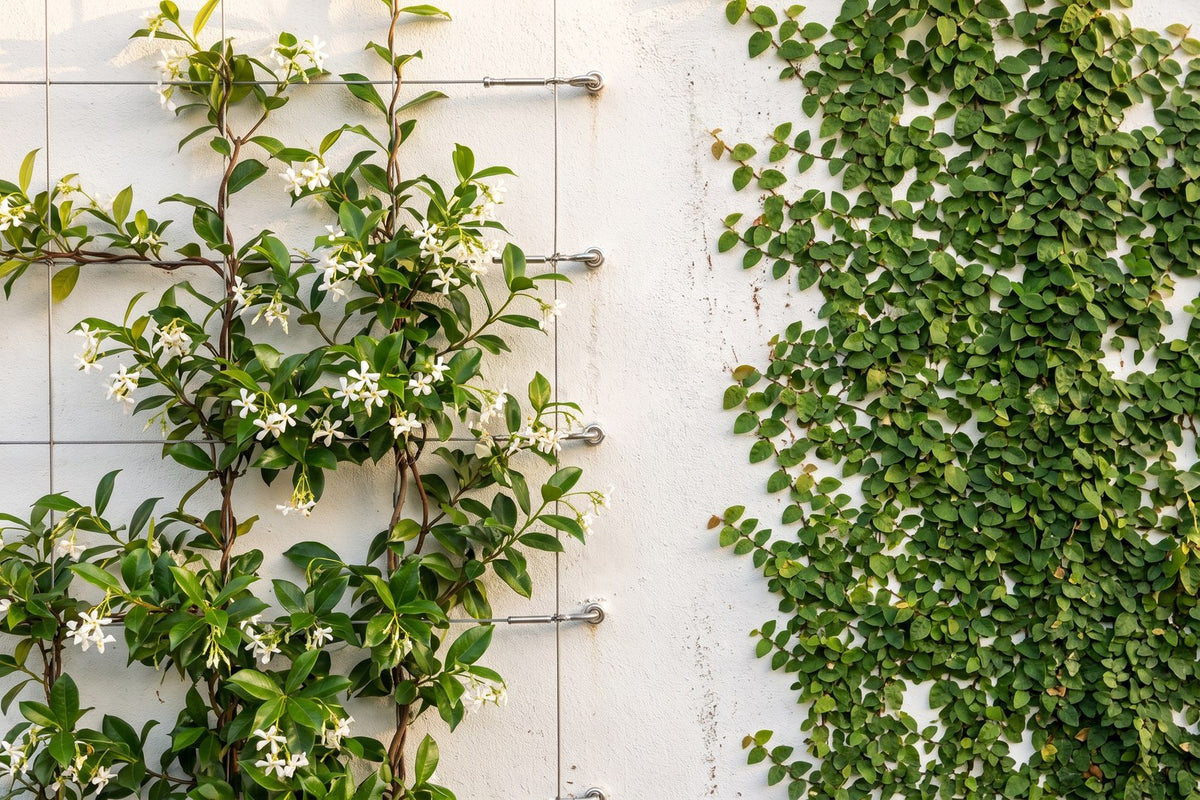
| Star jasmine | Climbing fig | |
|---|---|---|
| Attaches to | Wires and frames only | Directly to masonry |
| Wall damage | None - removable | Takes render and paint on removal |
| Flowers | Yes, strongly scented | Insignificant |
| Trimming | 1-3 times a year | 2-3 times a year, permanently |
| Coverage speed | 2-3 years | 2 years |
If the wall is rendered, painted, or one you may want to restore, star jasmine on wires is the safer choice by a wide margin.
Frequently asked questions
Is star jasmine invasive in Australia?
No. Trachelospermum jasminoides spreads slowly by layering where stems touch soil, and it is not listed as an environmental weed. The jasmine that has naturalised in parts of southeastern Australia is Jasminum polyanthum, a different plant entirely.
Why is my star jasmine not flowering?
Usually pruning at the wrong time. Buds form on the previous season's growth, so autumn or winter pruning removes them. Prune only after flowering finishes. Deep shade also reduces flowering considerably.
Does star jasmine damage walls?
No. It twines around wires and frames rather than attaching itself to masonry, so it can be removed without damaging render or paint. That is its main advantage over climbing fig.
Can star jasmine be used as a groundcover?
Yes, and it is one of the best available. Without support it stays 300 to 450 millimetres high and forms a dense evergreen mat that suppresses weeds. Flat Mat is bred specifically for this use.
How fast does star jasmine grow?
It covers a typical fence or pergola in two to three years once established. Growth is slow in the first year while roots develop, then accelerates noticeably.
Is star jasmine toxic?
The milky sap irritates skin and eyes and should not be ingested, in common with other plants in the frangipani family. Wear gloves when pruning and wash afterwards.
Ready to plant?
We grow all four forms of star jasmine, from climbing stock to groundcover selections. Browse our climbers and groundcovers collection.
Comparing options? See climbing fig care and the best groundcovers for shade.
If you garden in a bushfire prone area, our guide to bushfire-wise garden plants gathers what the CFA, CSIRO and the native plant societies say about placement, plant traits and the species on their published lists.
If the property runs on a septic system, the septic drain field planting guide sets out what may go over the trenches and what must stay well away.


