

Most people picture conifers as a northern hemisphere thing - spruce, fir, snow. Australia has its own, and some of them are extraordinary: the bunya pine that drops five-kilogram cones, the hoop pines that make up the dark spires of subtropical rainforest, and the Wollemi pine, found alive in 1994 after being known only from fossils. Alongside those, the imported cypresses and junipers do the everyday work of formal screening and structure in Australian gardens.
What makes a conifer
Conifers are cone-bearing plants that reproduce without flowers, and most carry needle or scale-like foliage. They are ancient - conifers dominated the world's forests long before flowering plants appeared - and they hold their form through the year, which is exactly what makes them useful in garden design.
Australia's native conifers
| Species | Mature size | Where it grows |
|---|---|---|
| Bunya pine (Araucaria bidwillii) | 30-45 m | Southeast Queensland |
| Hoop pine (Araucaria cunninghamii) | 30-50 m | Queensland, northern NSW |
| Queensland kauri (Agathis robusta) | 30-45 m | Coastal Queensland |
| Norfolk Island pine (Araucaria heterophylla) | 30-50 m | Norfolk Island, planted along the coast |
| Brown pine (Podocarpus elatus) | 10-20 m | Queensland and NSW rainforest |
| Black cypress pine (Callitris endlicheri) | 8-15 m | Dry inland eastern Australia |
Bunya pine
Araucaria bidwillii is one of the great Australian trees, with a distinctive domed silhouette visible from kilometres away. Its cones weigh up to ten kilograms and the seeds inside were a major food source for Aboriginal peoples of southeast Queensland, who gathered for large ceremonial events when the trees fruited. It is a magnificent tree for a rural block or park - and genuinely unsafe to plant where people park or sit, because of those falling cones.
Hoop pine
Araucaria cunninghamii makes the tall dark columns you see rising above the rainforest canopy in southeast Queensland. Narrow and upright, it is a striking specimen tree where there is height to spare, and it was historically a major Australian timber species.
Queensland kauri
Agathis robusta has broad flat leaves rather than needles, which surprises people, and a magnificent straight trunk. A superb large specimen tree for warm climates.
Brown pine
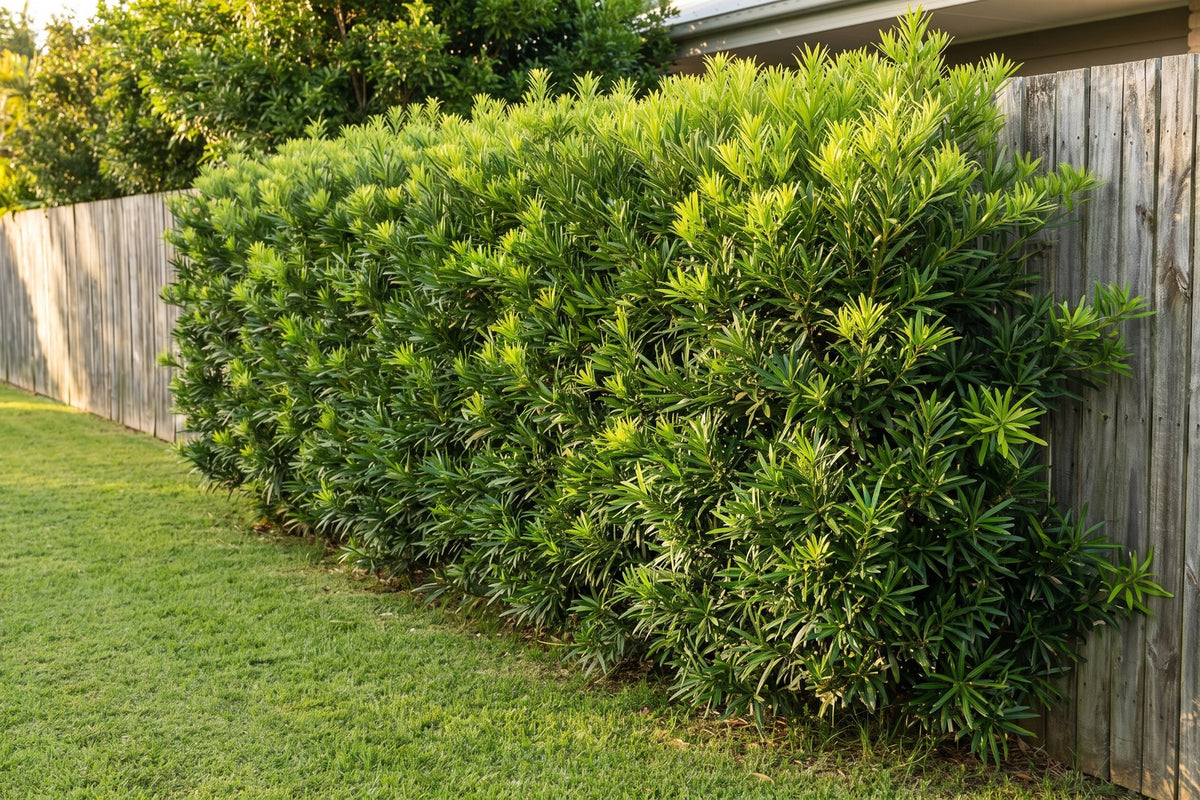
Podocarpus elatus is the most garden-friendly native conifer. It reaches ten to twenty metres rather than forty, tolerates clipping, handles coastal conditions, and produces edible blue-black fruit known as the Illawarra plum. It works as a large hedge, a screen or a specimen.
Cypress pine
Callitris endlicheri comes from dry inland eastern Australia and is genuinely drought hardy, with aromatic timber naturally resistant to termites. A good choice for hot dry gardens where imported conifers struggle.
Conifers for everyday garden use
The native species are mostly forest trees. For hedges, screens and formal structure, the imported conifers do the work.
For vertical accents
Italian cypress and pencil pine give the narrow Mediterranean exclamation mark - eight metres tall and barely a metre wide. Swane's Gold is the golden form, and Skyrocket juniper gives a similar shape in blue-grey.
For formal hedging
Emerald Green arborvitae makes a dense narrow hedge that needs little clipping, and Spartan juniper holds a tight column. Golden biota stays compact and rounded for low structure.
For groundcover and banks
Glauca juniper and Blue Forest spread horizontally into blue-grey mats, useful on slopes and over retaining walls where they suppress weeds and need almost nothing.
For wet ground
Swamp cypress is one of very few conifers that thrives in waterlogged soil, and unusually it is deciduous, turning rust-orange before dropping its foliage.
Where conifers grow in Australia
- Melbourne, Adelaide, Canberra, Tasmania - the cool-climate conifers are at their best here. Cypresses, junipers and thuja all perform well.
- Sydney and coastal NSW - good, though humidity increases disease pressure on cypresses.
- Brisbane and subtropical Queensland - native conifers thrive. Imported cypresses are more prone to canker in the humidity.
- Perth and dry inland - Mediterranean cypresses and junipers suit the dry heat very well.
- Tropical north - stick with the native species; most northern hemisphere conifers struggle.
Cypress canker: know about this one
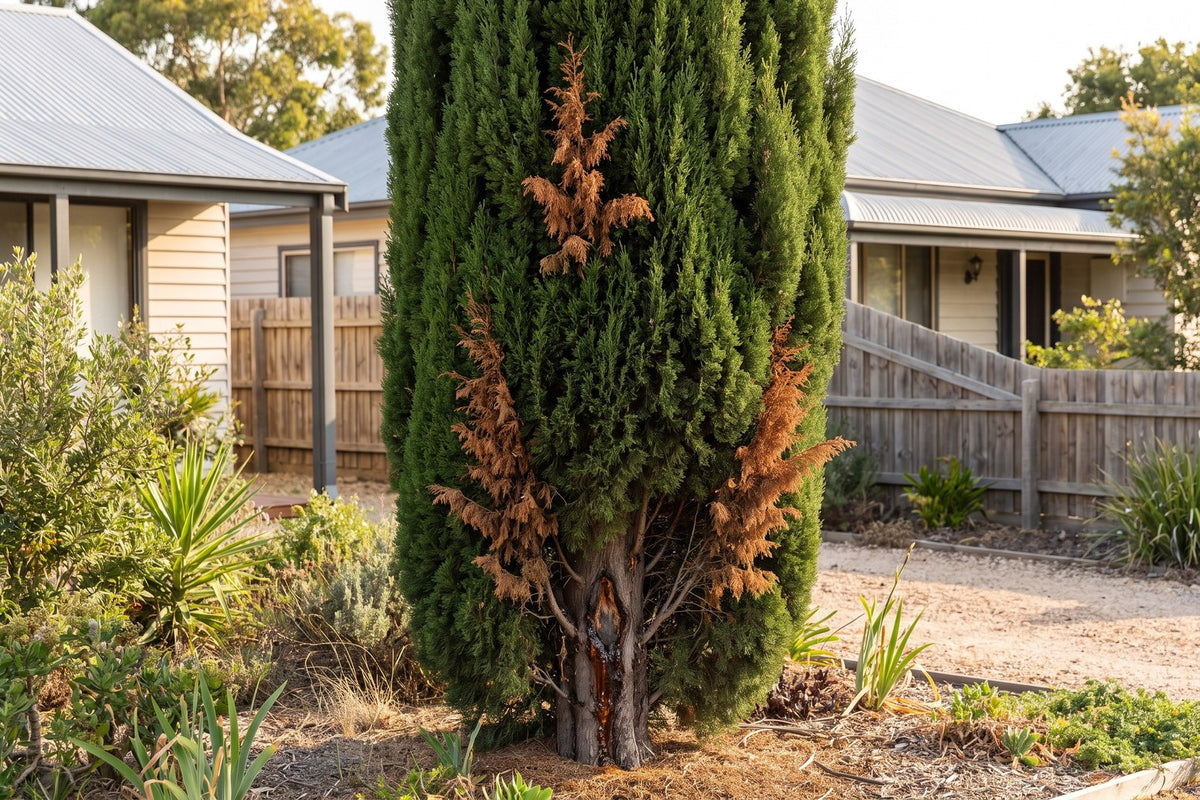
Cypress canker is a fungal disease that affects Cupressus and related conifers in Australia, and it is the main reason a healthy-looking Italian cypress suddenly develops dead brown branches. It shows as sunken lesions on stems with resin bleeding, and individual branches dying while the rest of the tree looks fine.
There is no reliable cure. Prune out affected branches well below the damage and disinfect tools between cuts. Avoid overhead watering and crowded planting, since humidity and poor airflow make it worse. In humid subtropical climates, consider junipers, thuja or native conifers rather than Cupressus.
Planting and care
- Plant in autumn or spring across most of Australia.
- Full sun for almost all of them. Conifers thin out and go sparse in shade.
- Drainage matters more than fertility. Most conifers rot in wet soil - swamp cypress is the exception.
- Water deeply through the first two summers, then most become quite drought tolerant.
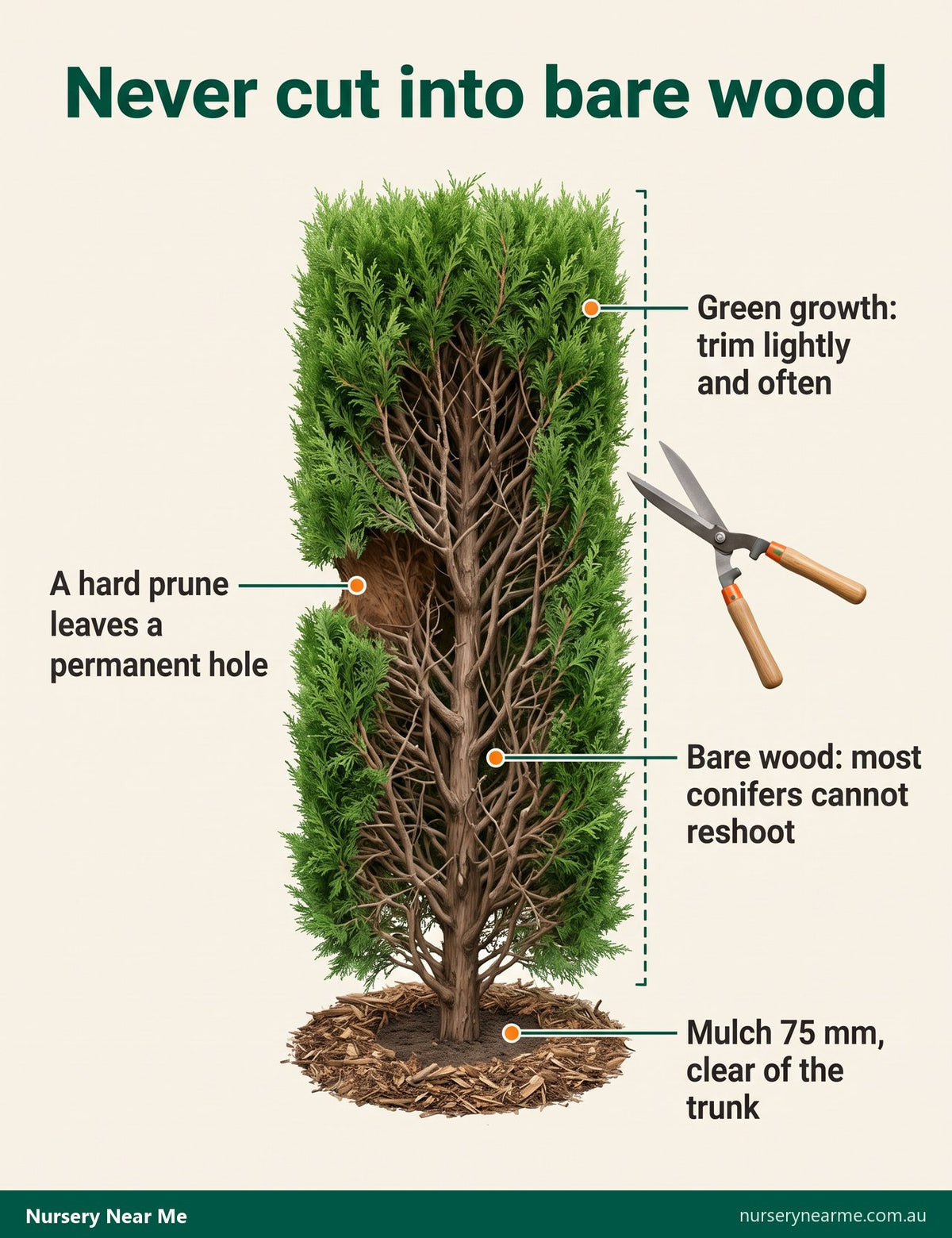
- Mulch to 75 mm, kept clear of the trunk.
- Never cut back into bare wood. Most conifers cannot reshoot from old wood, so a hard prune leaves a permanent hole. Trim lightly and often instead.
Frequently asked questions
Are there Australian native conifers?
Yes, and some are remarkable. The bunya pine, hoop pine, Queensland kauri, brown pine and cypress pines are all native, along with the Wollemi pine, found alive in 1994 after being known only from fossils.
Can conifers be cut back hard?
Generally no. Most conifers will not reshoot from bare old wood, so cutting back beyond the green growth leaves a permanent gap. Trim lightly and regularly rather than letting a hedge get away and then cutting it hard.
What is killing my Italian cypress?
Most likely cypress canker, a fungal disease that causes individual branches to brown and die while the rest looks healthy. Look for sunken lesions and resin bleeding on the stems. Prune out affected wood well below the damage; there is no reliable cure.
Which conifer makes the best hedge in Australia?
Emerald Green arborvitae for a dense narrow formal hedge, or Spartan juniper for a tight column. In humid subtropical climates these are safer choices than Cupressus, which is more susceptible to canker.
Do conifers have invasive roots?
Most are relatively well behaved compared with figs or willows, but the large native species are forest trees reaching thirty metres or more and need corresponding room. Allow three to four metres from paving and services for garden conifers.
Is it safe to plant a bunya pine near the house?
No. Bunya cones weigh up to ten kilograms and fall from great height. It is a magnificent tree for a rural block or large open space, but it should never be planted where people park, sit or walk regularly.
Ready to plant?
We grow both the native conifers and the full range of cypresses, junipers and arborvitae. Browse our trees collection, or hedging and screening for formal options.
Related reading: pencil pine care and the best trees for lining driveways.
The same thinking applies out the front. See front yard planting for kerb appeal for the combinations that photograph well and survive neglect.
If there is a sewer or stormwater line anywhere near the planting spot, our planting near pipes guide gathers the water utilities' distances and their lists of trees to avoid.
If you garden in a bushfire prone area, our guide to bushfire-wise garden plants gathers what the CFA, CSIRO and the native plant societies say about placement, plant traits and the species on their published lists.


