

Xanadu is the plant that quietly fills half the shaded garden beds in Brisbane, Sydney and Perth. It makes a tidy waist-high mound of deeply lobed glossy leaves, it stays put instead of climbing, it copes with shade that kills most things, and once established it needs almost nothing. If you have a strip beside the house that gets two hours of morning sun and nothing else, this is very likely the answer.
Quick facts
| Detail | What to expect in Australia |
|---|---|
| Botanical name | Thaumatophyllum xanadu, still widely sold as Philodendron xanadu |
| Mature size | 1 m tall, 1.5 m wide |
| Position | Part shade to full shade. Morning sun is ideal |
| Soil | Free draining, enriched with compost |
| Water | Regular in summer, less in winter |
| Frost | Tender. Damaged below about 2°C |
| Habit | Clumping - it does not climb |
| Toxicity | Sap irritates. Keep away from pets and small children |
| Best climates | Brisbane, coastal NSW, Sydney, Darwin, coastal Perth |
Why it is used so heavily in Australian landscaping
Xanadu solves a specific and very common problem: a shaded bed that needs to look full and green without ongoing work. Unlike most tropical foliage plants it holds a compact self-contained shape, so a row of them reads as deliberate planting rather than a jungle. It does not send out runners, it does not climb a wall, and it does not need staking or training.
It also handles the awkward conditions of suburban side gardens and courtyards - reflected heat from a wall, deep shade for part of the day, and root competition from nearby trees. Commercial landscapers plant it by the hundred for exactly these reasons, and the same logic applies at home.
Xanadu is not a climbing philodendron
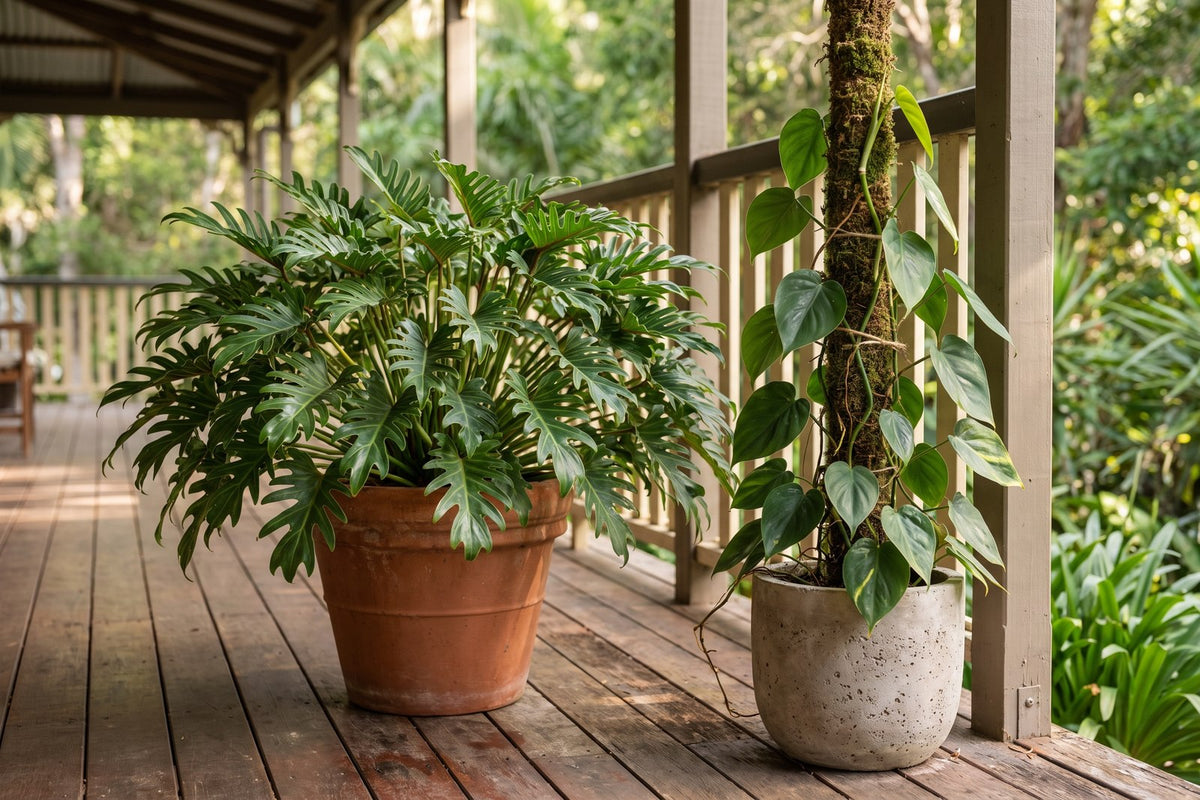
This confuses a lot of people. Most philodendrons sold as indoor plants climb, sending aerial roots up a moss pole or a tree. Xanadu belongs to a different group that was reclassified into the genus Thaumatophyllum in 2018, and it forms a self-supporting clump instead.
Practically, that means a xanadu will never take over a fence or a wall, and it will never need a pole. It grows outward slowly into a broad mound and stops at roughly a metre high and a metre and a half wide.
Where it grows in Australia
- Brisbane, the Gold and Sunshine Coasts, northern NSW - ideal. Grows year-round with no protection.
- Sydney - excellent in a sheltered position, one of the most planted shade fillers in the city.
- Darwin and tropical Queensland - thrives, and grows noticeably faster.
- Coastal Perth - very good with regular summer water, since sandy soil dries quickly.
- Melbourne, Adelaide, Canberra - frost is the limit. Grow in a pot that can shelter over winter, or plant under dense eaves.
Frost is the only real constraint. A light frost marks the foliage; a hard one can kill the plant to the ground. In warm districts it is close to indestructible.
Xanadu or Xanadu Gold?
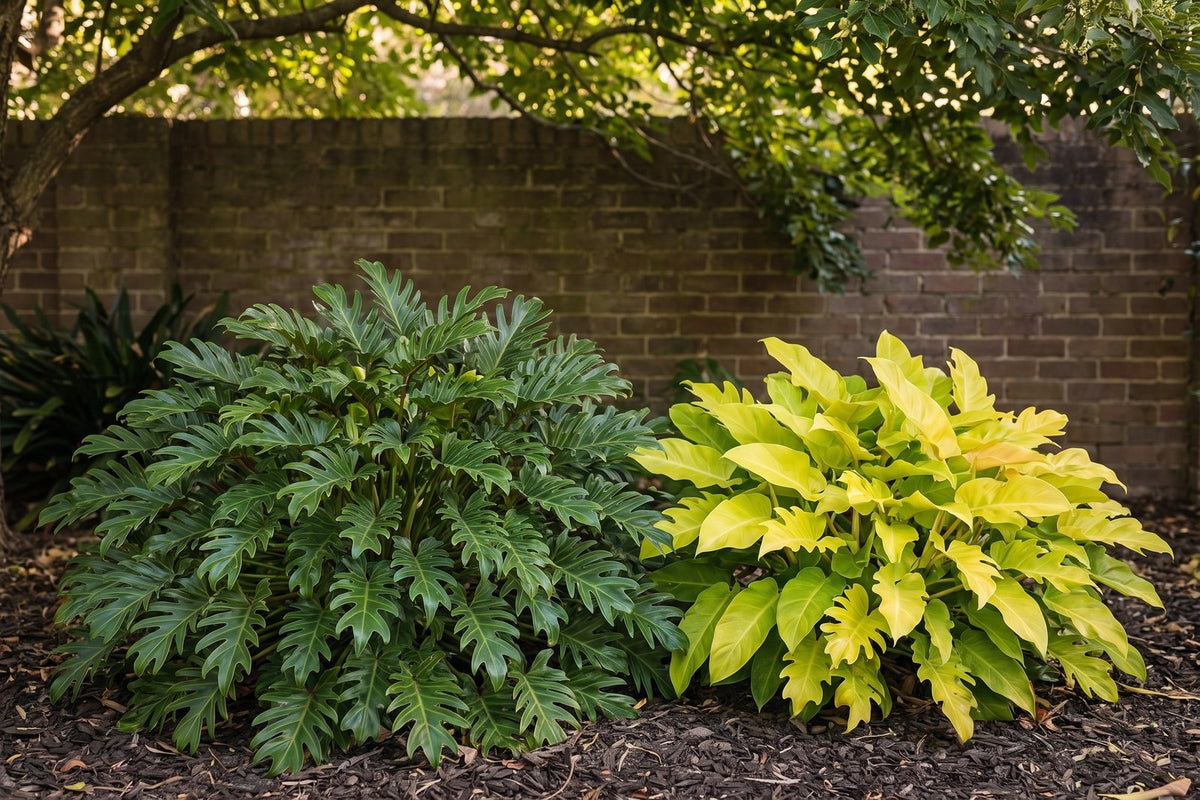
| Xanadu | Xanadu Gold | |
|---|---|---|
| Foliage | Deep glossy green | Chartreuse to golden |
| Best position | Part to full shade | Bright shade or filtered light |
| Sun tolerance | Morning sun only | Burns more readily than the green form |
| Use | Mass planting, structure, shaded beds | Lifting dark corners, contrast planting |
The standard green xanadu is the workhorse for mass planting. Xanadu Gold is genuinely useful for brightening a dark corner, but its paler foliage scorches in direct sun far more easily, so keep it in bright shade rather than an open position.
How to plant
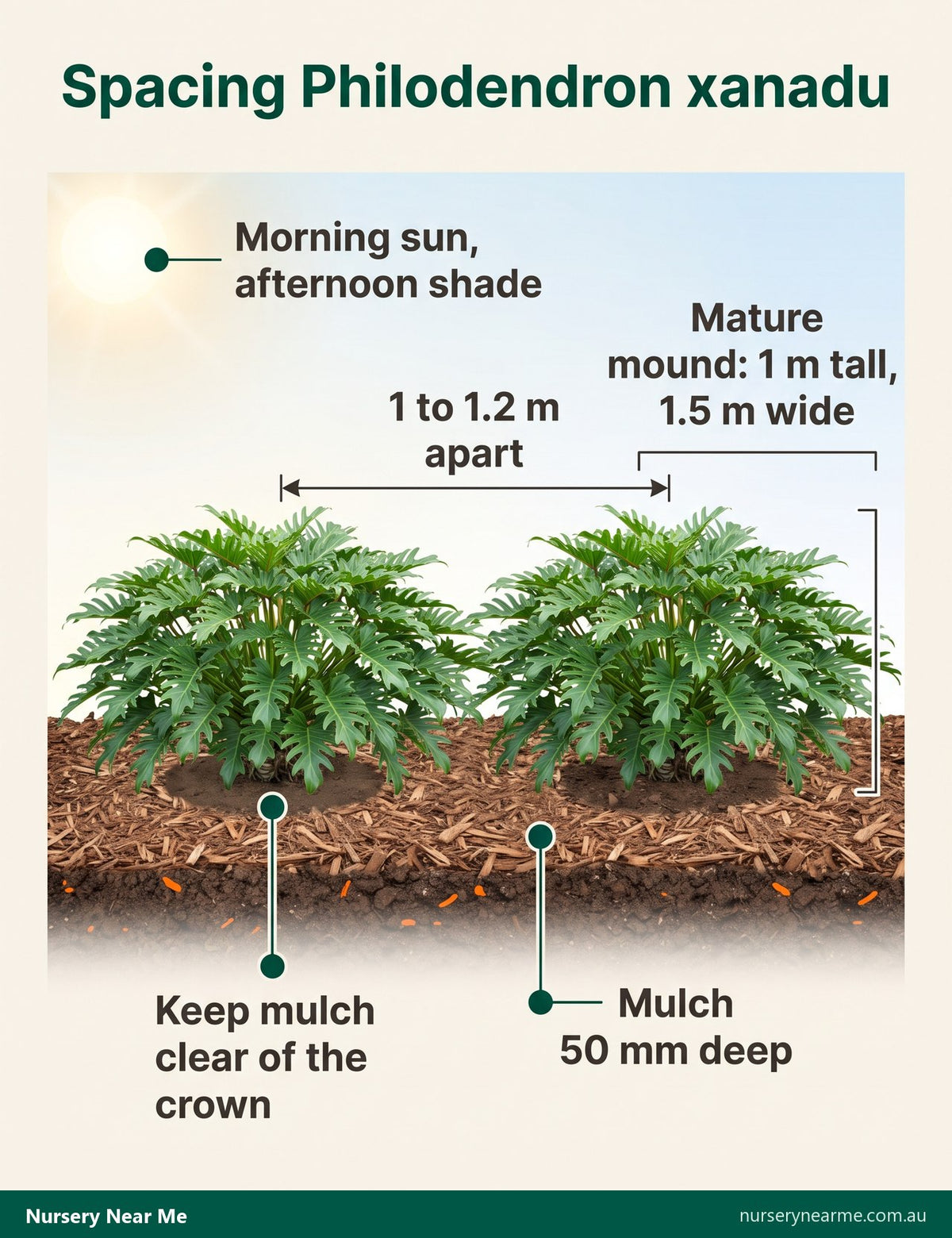
- Plant in spring or early summer so it establishes in warm soil.
- Choose part shade. Morning sun with afternoon shade gives the best colour and density. Full afternoon sun bleaches and burns the leaves.
- Enrich the soil with compost and make sure drainage is good. It likes moisture but not waterlogging.
- Space at 1 to 1.2 m for a continuous mass planting, allowing for the 1.5 m mature width.
- Mulch to 50 mm, kept clear of the crown.
- Water regularly through the first summer while roots establish.
Growing it in a pot
Xanadu does very well in containers and is the standard way to grow it in Melbourne or Adelaide. Use a wide pot at least 400 mm across with quality potting mix, keep it in bright shade, and move it under cover before winter. Potted plants stay a little smaller than those in the ground.
Ongoing care
Watering
Water regularly through spring and summer, letting the top few centimetres dry between waterings. Reduce noticeably in winter, when the plant is barely growing and wet cold soil causes root rot. In a Brisbane summer, natural rainfall often covers it entirely.
Feeding
A controlled-release fertiliser in early spring and again in midsummer is plenty. Xanadu is not a heavy feeder, and overfeeding produces soft floppy growth that loses the compact shape.
Tidying
No real pruning is needed. Cut old yellowing leaves off at the base to keep the clump looking clean, and remove any frost-marked foliage in spring. Wear gloves - the sap irritates skin.
Common problems and fixes
- Yellowing leaves most often means overwatering or poor drainage, particularly in winter. Check the soil before watering again.
- Bleached or brown patches is sunburn from too much direct sun. Move it, or accept that damaged leaves will not recover and new growth will be fine once shaded.
- Leggy, sparse growth means very deep shade. A little more light restores the dense mound.
- Blackened foliage after winter is frost damage. Leave it until spring, then cut back to healthy growth.
- Plant outgrowing its space is a spacing problem. Xanadu does not respond well to being cut back hard to keep it small - divide the clump instead, or move it.
- Mealybug in sheltered positions shows as white cottony patches at the leaf bases. Treat with horticultural oil.
What to plant with it
Xanadu's strong rounded form works best against contrasting shapes. It sits well beneath palms and tree ferns, alongside strappy plants such as lomandra and dianella, and in front of taller tropical foliage like strelitzia or heliconia. In a courtyard, a row of xanadu along a shaded wall with a single feature plant behind gives structure without looking busy.
Frequently asked questions
Does Philodendron xanadu climb?
No. Unlike most philodendrons it forms a self-supporting clump and never needs a pole or support. It was reclassified into the genus Thaumatophyllum in 2018 for this reason, though it is still sold under the old name almost everywhere.
How big does xanadu get?
About a metre tall and a metre and a half wide at maturity, growing slowly outward. Plants in tropical Queensland reach full size faster than those in Sydney or Perth. It stays somewhat smaller in a pot.
Can xanadu grow in full sun?
Not in Australian conditions. Morning sun is fine, but afternoon sun bleaches and burns the leaves, and the golden form scorches more readily still. Part to full shade gives the best foliage.
Is xanadu toxic to pets?
Yes. Like other aroids it contains calcium oxalate crystals, and the sap irritates skin, mouth and eyes. It is worth avoiding in gardens where dogs chew plants or small children play, and gloves are sensible when tidying it.
Will xanadu survive frost?
Not well. Light frost marks the foliage and heavy frost can kill it back entirely. In Melbourne, Adelaide and Canberra, grow it in a pot that shelters over winter rather than planting it in an open garden bed.
How far apart should I plant xanadu?
One to 1.2 metres apart for a continuous mass planting, given the 1.5 metre mature width. Closer spacing crowds the plants and spoils the individual rounded form that makes them look good.
Ready to plant?
We grow both the green and gold forms in a range of sizes for shaded beds and courtyards. Browse our plants for partial shade, or the wider tropical garden plants collection.
Planting a shaded area? See our shade gardening guide and designing a tropical garden.
If a flowering plant for a bright windowsill is what you are after, our guide to growing African violets and gesneriads indoors covers the light, watering and potting that keep them in bloom in Australian homes.


