


Few trees announce the end of an Australian winter as loudly as a flowering cherry or plum. From late July through September the bare branches load up with pink or white blossom, hold it for two or three weeks, then leaf out into a quiet shade tree. Getting one to perform reliably comes down to two things: matching the species to your winter chill, and giving it drainage it can live with.
Quick facts
| Feature | Detail |
|---|---|
| Mature size | 2.5-3 m (weeping forms) to 5-6 m tall; spreading types reach 6-8 m wide |
| Position | Full sun, at least six hours; shelter from strong wind to make blossom last |
| Soil | Free-draining loam, pH 6.0-7.0; will not tolerate waterlogging |
| Water | Moderate; deep watering through the first two summers, then seasonal |
| Climate zones | Best in temperate and cool districts - Melbourne, Adelaide Hills, Canberra, Tasmania, Southern Highlands, Perth Hills and the Granite Belt |
| Blossom period | Plums late July to August; cherries late August to September |
| Typical lifespan | 25-40 years in garden conditions |
Choosing the right flowering cherry or plum
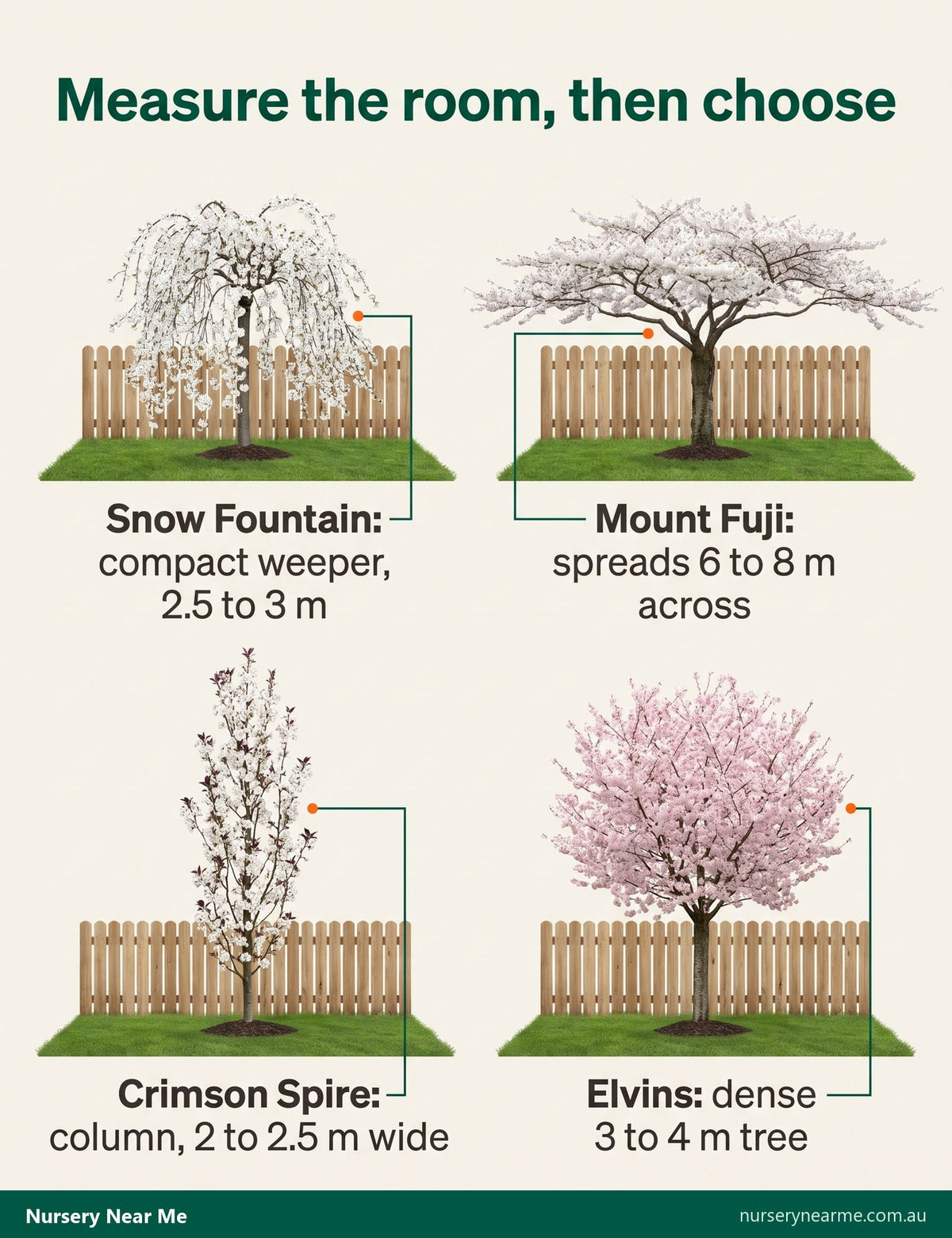
The single biggest predictor of success is winter chill. Ornamental cherries derived from Prunus serrulata and Prunus subhirtella want roughly 400-800 hours below 7 degrees to open a full crop of buds. Flowering plums in the Prunus cerasifera group usually flower well on 300-400 hours, which makes them the more dependable choice on the warm coastal plain around Brisbane and Sydney. Shape matters just as much, so measure the horizontal room you have before choosing.
- Cheal's Double Pink Weeping Cherry reaches around 3-4 m tall and just as wide, with a domed weeping habit and heavy double pink blossom.
- Mount Fuji (Prunus x Shirotae) is wider than it is tall - roughly 4-5 m high and 6-8 m across - with layered branches and semi-double white flowers.
- Snow Fountain is the compact weeper at about 2.5-3 m, small enough for a courtyard or a large pot.
- Purple Leaf Plum (Prunus x blireana) flowers double pink on bare wood at 4-5 m, then holds bronze-purple foliage all summer.
- Oakville Crimson Spire suits tight spots: a narrow column of about 5-6 m by 2-2.5 m for a driveway edge or side boundary.
- Prunus 'Elvins' is the most forgiving of warm winters, making a dense 3-4 m tree smothered in pink.
All of these drop their leaves, which is the point in a cold climate - winter sun reaches the house and summer shade returns when you need it. If you are weighing that against a screen that holds foliage all year, our comparison of evergreen and deciduous trees works through the trade-off.
How to plant
Autumn and late winter both work; in most districts the window from May to early September gives roots time to move before the first hot spell. Our guide to the best time to plant a tree covers how soil temperature shifts that window between states.
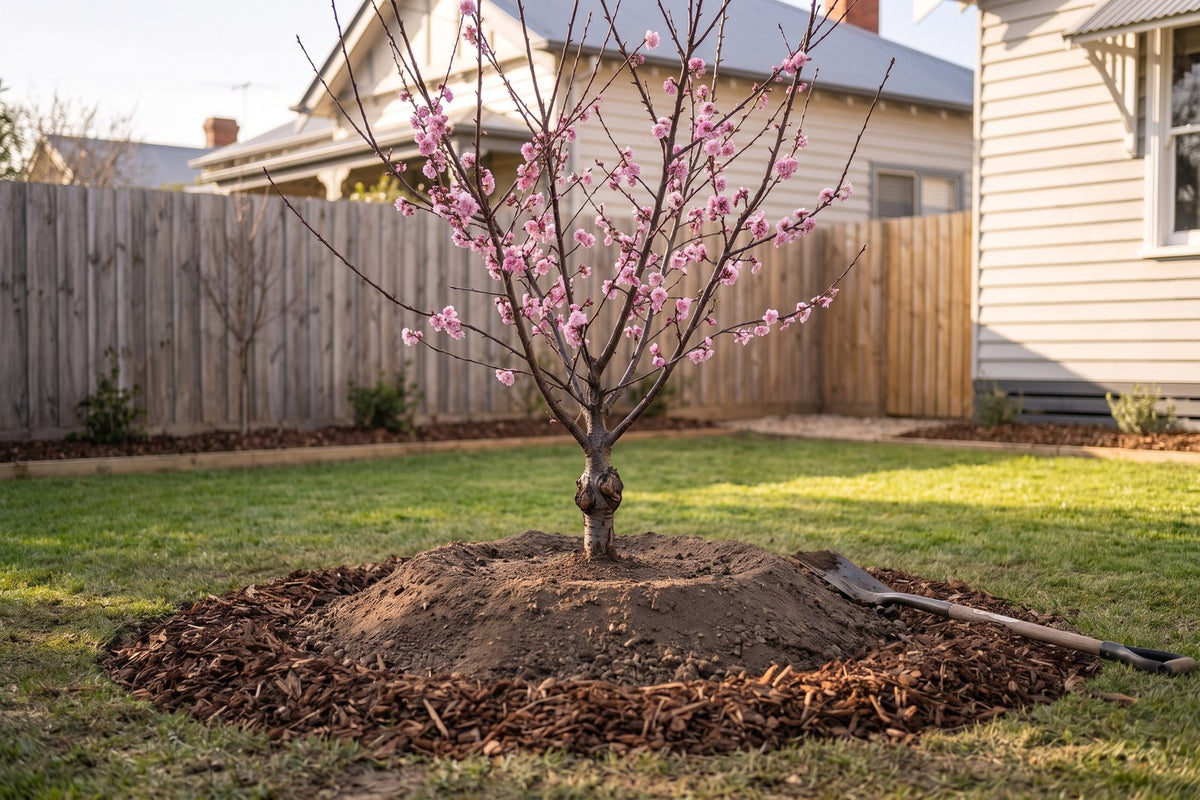
Dig a hole twice the width of the root ball but no deeper. Prunus roots sit shallow, and a tree planted low in heavy ground is the most common cause of early failure. Sit the root ball level with or slightly above the surrounding soil, keep the graft union clear, backfill with the soil you removed rather than a rich imported mix, water in heavily, then mulch to about 75 mm with coarse bark, pulled back 100 mm from the trunk.
On clay, plant on a raised mound 200-300 mm above grade rather than digging a sump. Waterlogging kills more ornamental Prunus in Australia than cold ever does. Stake only if the site is exposed, and remove the stakes after twelve months.
Ongoing care
Watering
Through the first summer, give a young tree 10-20 litres twice a week rather than a light daily sprinkle. The aim is to wet the full depth of the root ball, then let the surface dry. In the second summer, drop back to once a week in hot weather. Established trees only need help in extended dry spells, though they will drop leaves early and flower poorly the next spring if they run dry through January.
Feeding
Apply a complete slow-release fertiliser once flowering has finished in early spring, spreading it across the root zone out to the drip line rather than against the trunk. In warm districts a second light application in early autumn helps build reserves. Avoid high-nitrogen lawn fertiliser near the root zone: it produces soft leafy growth and reduces flowering the following season.
Pruning
Ornamental Prunus need very little pruning, and timing matters more than technique. Prune in late summer or early autumn during a settled run of dry days, never in wet winter weather, because open wounds in cold damp conditions are how silver leaf and bacterial canker get in. Remove dead, crossing or rubbing branches, plus any suckers rising from below the graft. Weeping cultivars need the ends lifted clear of the ground and the interior thinned every few years.
Common problems and fixes
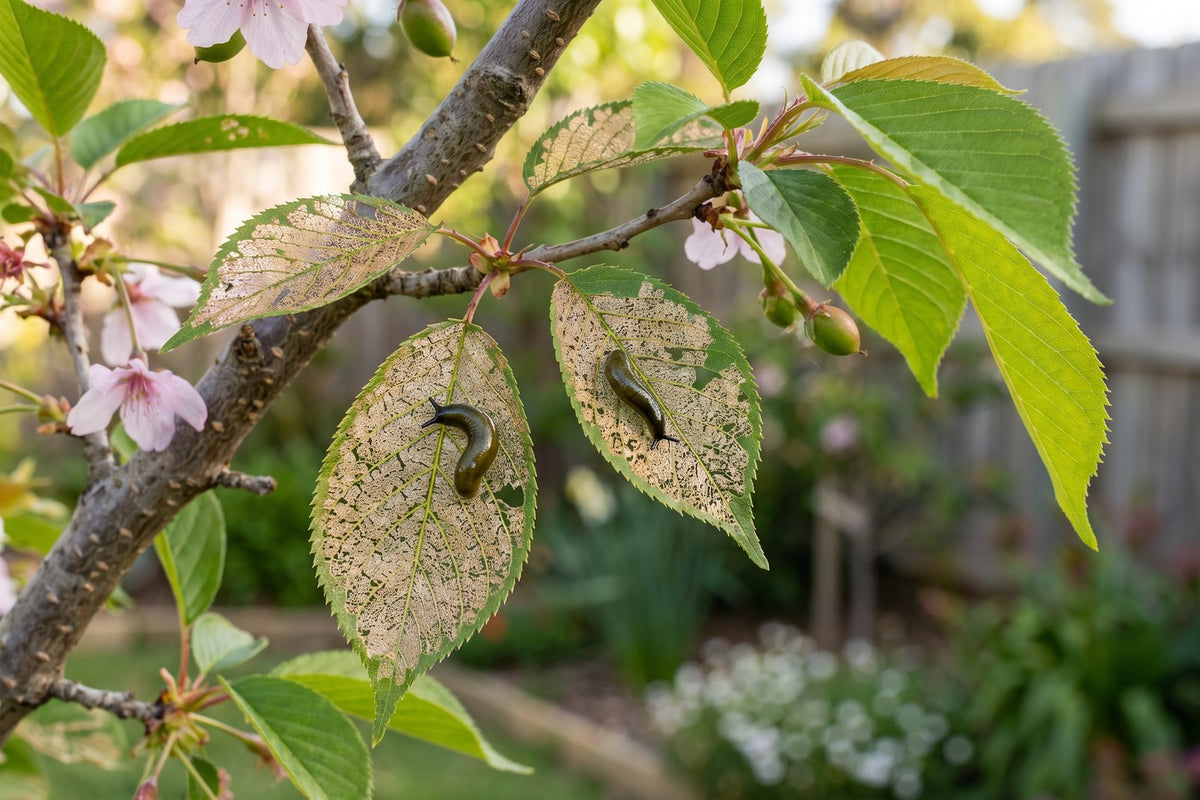
- Pear and cherry slug. The dark larvae of the sawfly Caliroa cerasi skeletonise leaves from late spring, leaving a lacework of veins. A firm hose blast knocks them off and a light dusting of wood ash or agricultural lime dries them out.
- Aphids. Clusters on soft new shoots curl the tips and bring sooty mould. Hose them off and hold back on nitrogen, which usually triggered the flush.
- Brown rot. In a wet spring, Monilinia browns the blossom and leaves shrivelled flowers hanging on the twig. Remove affected wood and improve air movement through the canopy.
- Bacterial canker. Amber gum oozing from a limb, often with dieback above it, points to Pseudomonas syringae. Cut back to clean wood in dry summer weather and sterilise tools between cuts.
- No flowers. Almost always insufficient chill, too much nitrogen, or a young tree still building its frame.
- Sudden summer collapse. Check drainage first. Roots sitting in wet clay through a warm spell fail quickly, and borers then move into the stressed trunk.
Frequently asked questions
Can I grow a flowering cherry in Brisbane?
Coastal Brisbane rarely accumulates the 400 or more chill hours a true flowering cherry needs, so blossom tends to be thin and patchy. Gardeners on the Granite Belt, around Toowoomba and in the higher parts of the Scenic Rim do much better. On the coastal plain a flowering plum such as Prunus 'Elvins' or a purple-leaf cherry plum is the far more reliable substitute.
When do flowering cherries and plums bloom in Australia?
Flowering plums open first, usually from late July into August, often on completely bare wood. Cherries follow from late August into September, with cool districts such as Canberra and Tasmania running a week or two later than Melbourne. Each display lasts roughly two to three weeks, shorter if hot wind or heavy rain arrives mid-bloom.
Do these trees produce fruit?
Ornamental cherries set little or no fruit, and what forms is small, hard and of interest only to birds. Flowering plums in the Prunus cerasifera group can set small round plums about 25 mm across in a good year. They are edible but sharp, and over a paved courtyard the drop is worth planning around.
How far from the house should I plant one?
Allow half the mature canopy width plus a metre. For a 6 m wide spreading cherry that means around 4 m from a wall; for a narrow upright plum, about 2 m is enough. Prunus roots are shallow and fibrous rather than aggressive, so they rarely trouble pipes or footings, but a canopy over a roof means gutters full of leaves each autumn.
Can flowering cherries handle frost?
Yes, and they need it. Mature wood is unbothered by frosts well below zero, which is why these trees perform best in the districts covered in our guide to frost tolerant plants in Australia. The only real risk is a late frost on open blossom, which browns the petals for that season without harming the tree.
Ready to plant?
A flowering cherry or plum earns its space twice over: three weeks of blossom in late winter, then clean summer shade and, on the purple-leaf forms, a full season of coloured foliage. Browse the deciduous trees and flowering trees ranges to compare mature sizes. If your winters are too mild for Prunus, an ornamental pear delivers similar blossom on far lower chill.


