

Almost every Australian house has one: the strip down the side, somewhere between 900 mm and 1.5 m wide, walled by render on one side and a steel fence on the other. It is the hardest growing position on the block - dry under the eaves, dark most of the day, airless, and criss-crossed by service trenches. Planted correctly it becomes a green corridor. Planted wrongly it becomes a graveyard of leggy shrubs.
Quick facts
| Condition | What it means for plants |
|---|---|
| Width | Typically 0.9-1.5 m; keep 700-900 mm clear for walking and bin access |
| Light | Two to four hours at best; a south-facing passage may get none in winter |
| Rain shadow | The first 600 mm out from the wall stays dry even after heavy rain |
| Airflow | Poor, which encourages scale, sooty mould and fungal leaf spot |
| Heat | West-facing passages bounce reflected heat off pale walls in summer |
| Root space | Often sits over sewer, stormwater and gas lines; check before digging |
| Best plant shape | Columnar screening under 1.2 m wide, climbers on the fence, low ground layer |
Choosing the right plants for a narrow passage
Work in three layers, and pick each one for width before you pick it for looks.
Columnar screening plants. These give height without eating the walkway. Straight and Narrow Lilly Pilly holds a genuinely upright shape at roughly 4-5 m tall by about 1 m wide and takes full sun through to part shade, which suits the sunnier half of most passages. Callistemon SLIM reaches about 3 m by 1.3 m and flowers in a spot that rarely offers much colour. In cooler districts, Sky Pencil Japanese Holly is the neatest option at 2-3 m tall and only 600-800 mm across, and it copes with genuine shade.
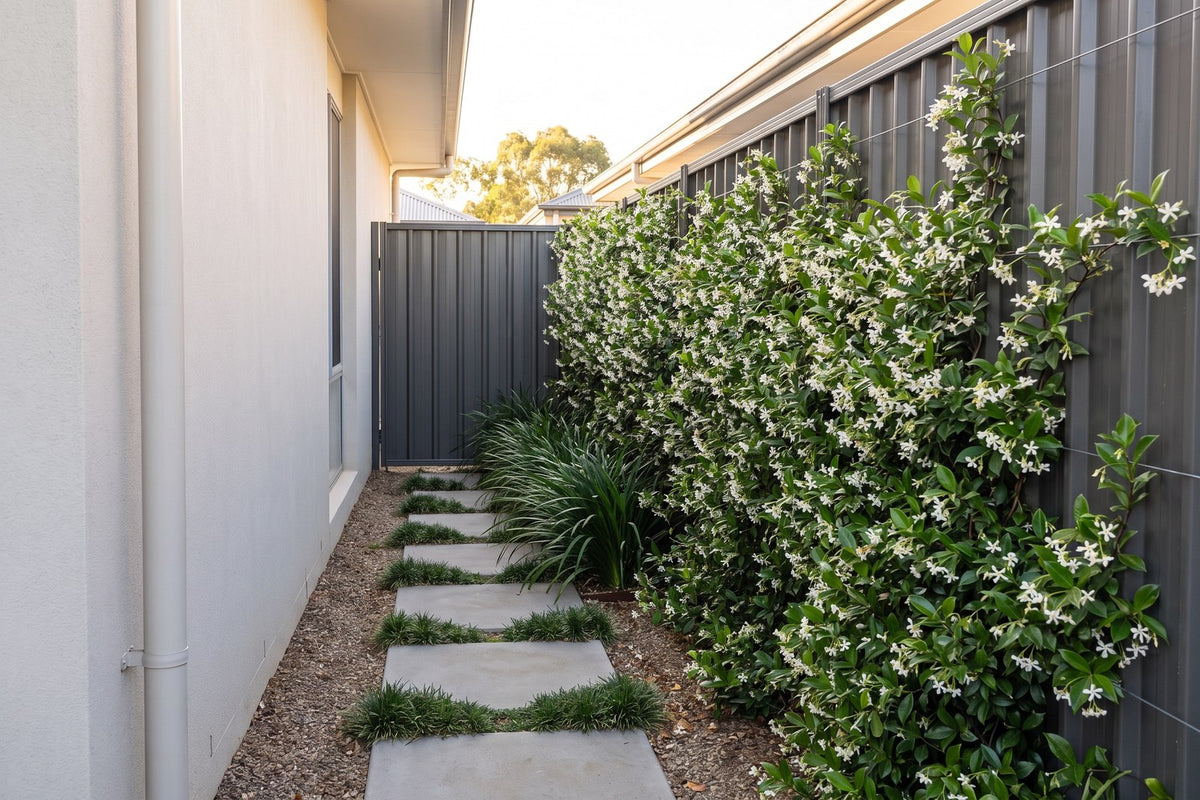
Climbers on the fence. A climber occupies almost no floor space, which is why it is often the best answer in a passage under a metre wide. Star jasmine twines onto wires or mesh, tolerates part shade and is easy to keep flat with two trims a year. Climbing fig gives the flattest, most architectural green wall, but it clings with adhesive rootlets that will lift render and paint, so use it only on masonry you are happy to commit, never on a neighbour's fence without their agreement, and expect to trim it hard twice a year.
The ground layer. Bare soil in a side passage compacts and then sheds water. Native violet forms a 50-100 mm mat in damp shade and takes occasional foot traffic. Dwarf mondo grass is the tidiest choice between pavers at about 100 mm, and it will grow in shade deep enough to kill turf. For structure at knee height, Evergreen Giant Liriope reaches 600-700 mm and is useful for hiding downpipes and meter boxes. Our guide to ground cover plants for shade covers more options for the darkest end.
How to plant
Before anything goes in the ground, find your services. Sewer inspection openings, stormwater lines and gas meters commonly run down the side of an Australian house, and many titles carry an easement along that boundary. Nothing woody should go directly over a sewer line.
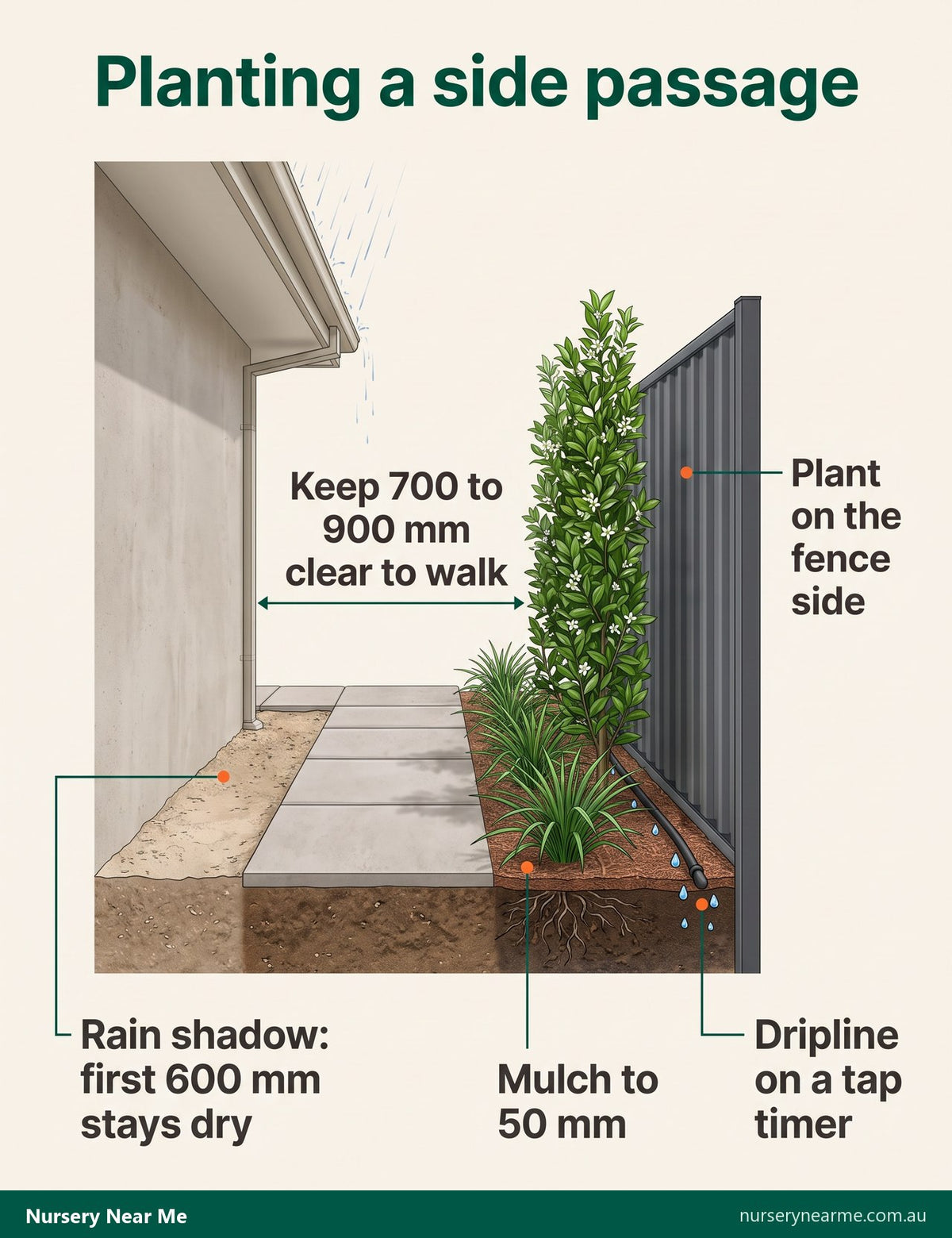
Plant against the fence side rather than the house side. That keeps the wall, weep holes and gutters accessible, and moves the root zone out of the driest part of the rain shadow. Side passages are usually builder's fill compacted by years of foot traffic, so dig over the full strip to a spade's depth and work through compost and coarse gravel if drainage is poor.
Set plants at their nursery depth, water in, and mulch to 50 mm with a fine bark that will not wash onto the path. Then install irrigation. A single dripline on a tap timer is close to essential here, because that first 600 mm out from the wall gets almost no rainfall however wet the season. If the passage stays soggy instead, our notes on waterlogged gardens cover the drainage fixes worth doing first.
Ongoing care
Watering
Assume the passage is drier than the rest of the garden, even in a wet summer. Run drippers for a long, infrequent cycle rather than a daily splash: roughly 20 minutes twice a week in summer and once a fortnight in winter suits most established plantings. Pots dry out faster again in the reflected heat off a west-facing wall and may need daily attention in January and February.
Feeding
Use a controlled-release fertiliser in early spring and again in early autumn. Shade-grown foliage plants need less than you think, and overfeeding in a low-light position produces soft, stretched growth that flops across the path. A liquid seaweed drench every six weeks does more for root health in compacted fill than extra nitrogen will.
Pruning
Trim columnar screening plants twice a year, in early spring and again in late summer, and always cut to keep the plant narrower than the walkway. Climbers need the same rhythm, with a hard cut back to the wire in late winter. Thinning the interior of each plant matters more here than anywhere else in the garden: air movement is the single best defence against the fungal problems that still, shaded corridors invite.
Common problems and fixes
- Leggy, one-sided growth. Plants lean toward the open end of the passage. Choose genuinely shade-tolerant species rather than sun lovers, and rotate any potted plants a quarter turn each month.
- Scale and sooty mould. Still air and low light favour scale insects, and the black sooty mould that follows is the giveaway. Treat with horticultural oil in spring and autumn, and thin the canopy to move air.
- Dry soil after rain. Classic rain shadow. Extend the dripline, top up mulch, and pull the planting line 300-400 mm further from the wall.
- Damage to render or paint. Caused by self-clinging climbers or by shrubs pressed against the wall. Keep a 300 mm air gap between foliage and the building.
- Blocked access. If the bins no longer fit, the plants are too wide. Replace spreading shrubs with columnar forms or move the screening onto the fence as a climber.
Which side of the house is it?
This determines everything, and in the southern hemisphere the answer is the reverse of what northern hemisphere gardening books say.
| Aspect | Conditions in Australia | What to plant |
|---|---|---|
| South-facing | Shaded almost all day, cool, often damp | Ferns, clivia, xanadu, native violet, mondo |
| East-facing | Morning sun, afternoon shade - the gentlest | Almost anything shade-tolerant, gardenia, camellia |
| West-facing | Shaded until midday then brutal afternoon sun | Only tough plants - lomandra, dianella, agave |
| North-facing | Sunniest, often hot and dry against the wall | Sun-hardy natives, succulents, olives in pots |
A west-facing side passage is the trap. It reads as a shaded corridor for most of the day, so people plant ferns and shade lovers, and then the afternoon sun arrives and burns them. Watch the space through a full day before choosing anything.
The rain shadow
Most Australian side passages get little or no rainfall. Eaves overhang them, fences block driving rain, and the strip against the wall can stay dry through a wet week. Plants there depend entirely on you, and this is the most common reason a side passage planting fails despite everything else being right.
Check the soil by hand after rain rather than assuming, mulch heavily, and run a simple drip line if the passage is long.
Builder's rubble
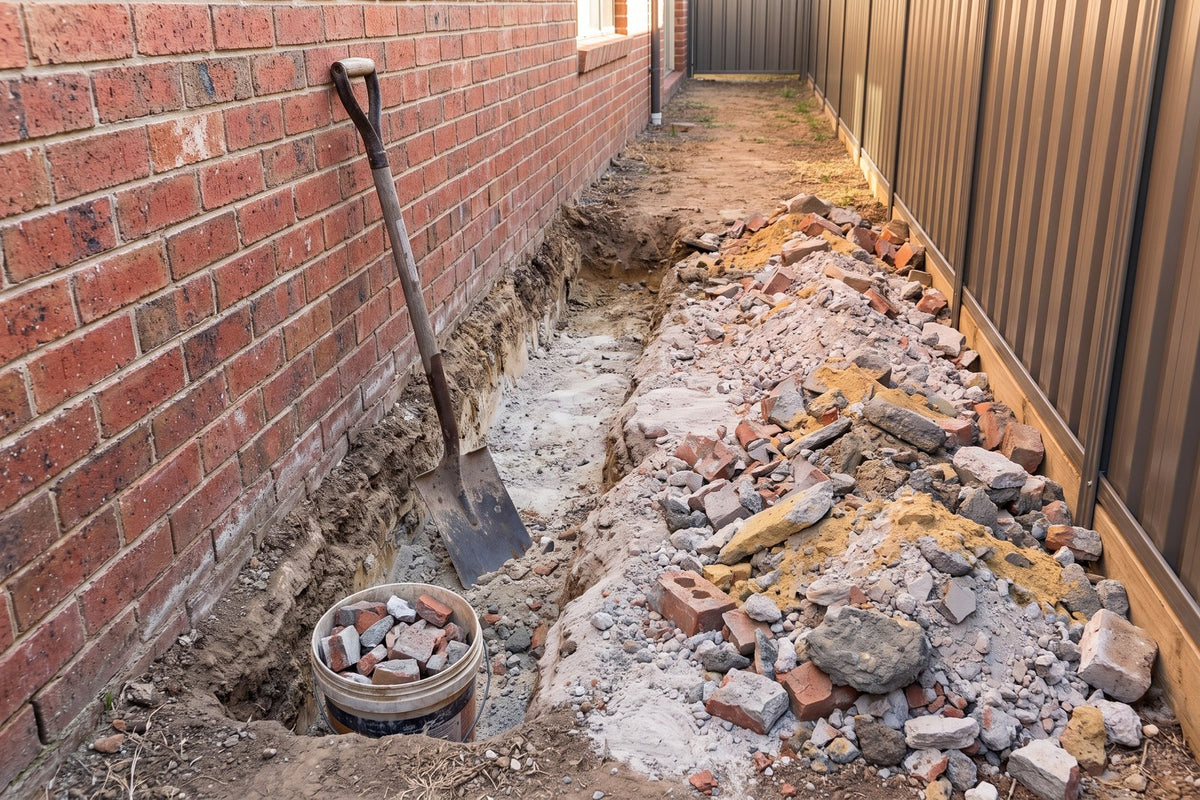
Side passages are where construction waste ends up. Sand, mortar, brick fragments and compacted fill are common in the first 300 mm, and lime leaching from mortar and concrete raises the soil pH sharply - which is why gardenias, camellias and azaleas often yellow badly there.
Dig out and replace the soil rather than planting into it, and test the pH before choosing acid-loving plants for a spot against a brick wall or slab.
Access and services
Australian side passages usually carry the meter box, taps, air-conditioning units, downpipes and sometimes the sewer inspection point, and they are often the only route to the backyard. Keep a clear walking width, avoid planting over service access, and choose plants that will not need constant cutting back to keep the path usable.
Narrow columnar plants earn their place here - Straight and Narrow lilly pilly holds about a metre wide, and a wire-trained star jasmine on the fence takes up almost no ground at all.
By city
- Brisbane and southeast Queensland - humidity plus poor airflow makes fungal problems common in a closed passage. Space plants and avoid overhead watering.
- Sydney and coastal NSW - a shaded south side passage here is ideal fern and clivia country.
- Melbourne and Canberra - a south-facing passage stays cold and damp through winter; choose frost-hardy plants and watch for rot.
- Perth and Adelaide - the rain shadow problem is at its worst in dry summers. Irrigation is effectively compulsory.
- Darwin and tropical Queensland - drainage matters most, since a narrow passage collects wet-season runoff.
Frequently asked questions
What is the narrowest screening plant that still reaches 3 m?
Straight and Narrow Lilly Pilly is the standout, holding roughly a metre of width at 4-5 m tall without constant clipping. Sky Pencil Japanese Holly is narrower again at 600-800 mm but tops out around 3 m and prefers cooler districts. Both need a trim twice a year to stay tight, and both do better with a dripline than with hand watering.
Can I plant a hedge in a passage that is only 900 mm wide?
A conventional hedge, no. At that width almost any shrub will block the path within two seasons. Use a climber trained flat on the fence instead, backed by a low ground layer. That gives you green on both vertical planes and keeps the full 900 mm clear for walking, bins and trades access.
Will anything grow in a passage that gets no direct sun at all?
Yes, though the list is short. Dwarf mondo grass, native violet and liriope all cope with bright shade and no direct sun. A bird's nest fern in a pot is another reliable option in a fully shaded, sheltered corridor. What will not work is anything sold for full sun, including most natives, lavender and rosemary.
Do I need permission for a climber on the boundary fence?
A shared fence is jointly owned in every Australian state, so a self-clinging climber such as climbing fig on a neighbour's side is a conversation worth having first. Twining climbers grown on your own wire frame, set 50 mm off the fence, avoid the issue entirely and make later fence maintenance easier.
Ready to plant?
A side passage is rarely a design feature, but it is the view from a bedroom or bathroom window for most of the year, and it takes little to turn it green. Start with the screening plants for privacy range for the vertical layer, then fill the floor from the plants for full shade collection. If the passage opens onto a courtyard, our guides to softening fences and retaining walls and fast growing screening trees carry the planting through.


