

A waterlogged garden kills plants by drowning the roots: the soil fills with water, the air is pushed out, and roots rot. In Australia the cause is usually the structure of the soil and not the amount of rain, and it differs by region, so the first job is to find out what is going on. This guide covers the signs, how to test the drainage, the fixes that work, and the plants that grow where the ground stays wet.
Signs of a waterlogged garden

- Water still pooling a day after rain.
- Leaves that yellow and wilt although the soil is wet.
- A sour, stagnant smell when you dig, and grey or blue tinged soil.
- Moss and algae on the surface, and patches of lawn that thin and die.
- Plants that rock in the ground because the roots have rotted. Our guide to root rot covers what to do for an affected plant.
Why Australian gardens waterlog
| Region | Usual cause |
|---|---|
| Brisbane and south east Queensland | Heavy clay and intense summer downpours |
| Western Sydney | Clay formed from shale, which seals when wet |
| Melbourne and Adelaide | Clay subsoil and long winter rain |
| New estates anywhere | Compacted fill and buried builder's rubble |
| Perth | Less common; water sitting above a hard layer in the sand |
| Tropical north | Wet season volume that overwhelms any drainage |
New housing estates deserve a special mention. Construction traffic compacts the subsoil, the topsoil is often stripped and replaced with poor fill, and rubble, sand and mortar end up buried in the yard. The result is a shallow layer of soil over a compacted pan that water cannot get through. A planting hole dug into that pan is a bathtub: water collects in the improved soil and has nowhere to go. This is why so many new gardens lose plants in their first wet season.
Diagnose before you dig
- Dig a test hole 30 cm deep and fill it with water. If it has not drained within four to six hours, there is a real drainage problem.
- Check for a hard layer. Push a crowbar or steel rod down and feel for a sudden stop.
- Test the clay. Drop a dry crumb into a glass of clean water. If the water turns cloudy as the crumb breaks down, gypsum will help. If it stays clear, gypsum will do nothing.
- Watch where the water runs in heavy rain. Do not guess.
What works

- Raised beds and mounds. The most effective fix, and far cheaper than underground drains. Raising the root zone 20 to 30 cm solves most garden waterlogging.
- Breaking the compacted layer where you can, with a crowbar, a fork or deep ripping, before adding anything.
- Gypsum on the right clay only, at the rate on the bag, watered in.
- Organic matter. Compost improves soil structure over time and is the long term answer. Our guide on how to prepare the soil for planting covers the method.
- Redirecting the source. A downpipe emptying into a garden bed causes more waterlogging than rain does. Connect it to the stormwater.
- A slotted drain or a swale where the volume warrants it. Check where the water will go: sending it onto a neighbour's land is not allowed and causes disputes.
What does not work
- A little sand in clay. Without a very large volume, sand makes clay set harder.
- A deeper hole filled with good soil. It becomes a sump.
- Gypsum on clay that does not respond to it. Test first.
- Gravel in the bottom of the hole. Water sits above it in the finer soil.
Short term help after heavy rain
- Keep off wet soil. Walking on it compacts it further.
- Open a shallow channel to let surface water away from the base of plants.
- Hold off watering and feeding until the soil has drained and the plants are growing again.
- Pull mulch back from stems for a few days so the surface can dry.
- Lift pots onto feet so the drainage holes are clear.
Plant for the conditions

Where the ground stays wet, working with it is cheaper and more reliable than fighting it. These tolerate soil that is saturated from time to time, and several grow in exactly those conditions in the wild:
- Melaleucas and callistemons for trees and screens.
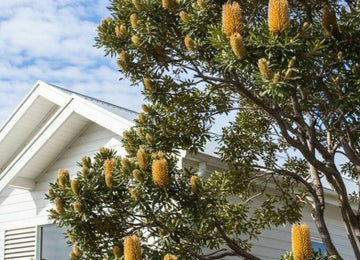
- Swamp banksia, a shrub to 2.5 metres with large leaves and green to gold flowers.
- Lomandra hystrix and Carex appressa for massed strappy planting, with rushes (Juncus) in the wettest spots.
- Louisiana iris for flowers at the edge of a soak.
A rain garden or a planted swale in the wet spot turns the problem into a feature and slows stormwater before it reaches the drain, which a number of councils now encourage. For other positions, browse the full plant range by soil and water needs.
Common questions
How do I know if my garden has poor drainage?
Fill a hole 30 cm deep with water. If it is still there after four to six hours, the drainage is poor.
Will gypsum fix a waterlogged garden?
Only on clay that disperses in water. Test a crumb in a glass first.
What is the cheapest fix for waterlogged soil?
Raise the planting on mounds or beds 20 to 30 cm high, and send downpipes to the stormwater.
What can I plant in a boggy spot?
Melaleuca, callistemon, swamp banksia, Lomandra hystrix, Carex appressa and rushes.


