

Almost nobody searches for how to grow a Calathea. They search for why the edges have gone brown and crisp, or why the leaves have rolled into tight tubes overnight. Both are the same plant telling you the same thing in two different ways, and both are fixable once you understand what a rainforest understorey plant is actually asking for.
This guide works through the two failure modes first, then the routine that prevents them, in the context of an Australian home with reverse-cycle heating in winter and hard tap water in most capitals.
Quick facts
| Mature size | Position | Soil | Water | Climate zones |
|---|---|---|---|---|
| 40-70 cm tall x 40-60 cm wide | Bright indirect light, never direct sun | Free-draining indoor mix with coir and perlite | Rainwater or filtered water, evenly moist | Indoors nationally; outdoors only in sheltered subtropical shade |
Choosing the right Calathea
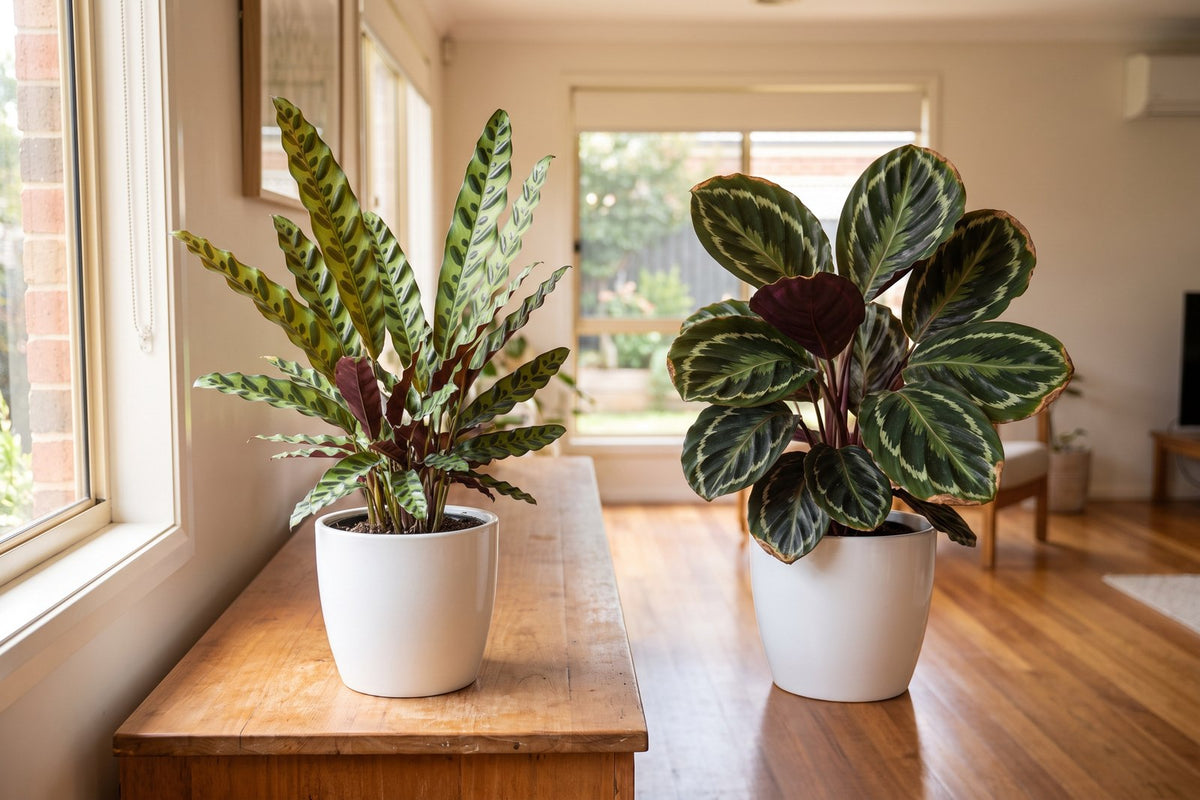
Calatheas, many of which are now correctly classified as Goeppertia, come from the shaded floor of South American rainforests. Everything about their care follows from that: dappled light, warm air, high humidity and soft rainwater filtered through a canopy. They are not difficult plants, but they are specific ones, and some are considerably more forgiving than others.
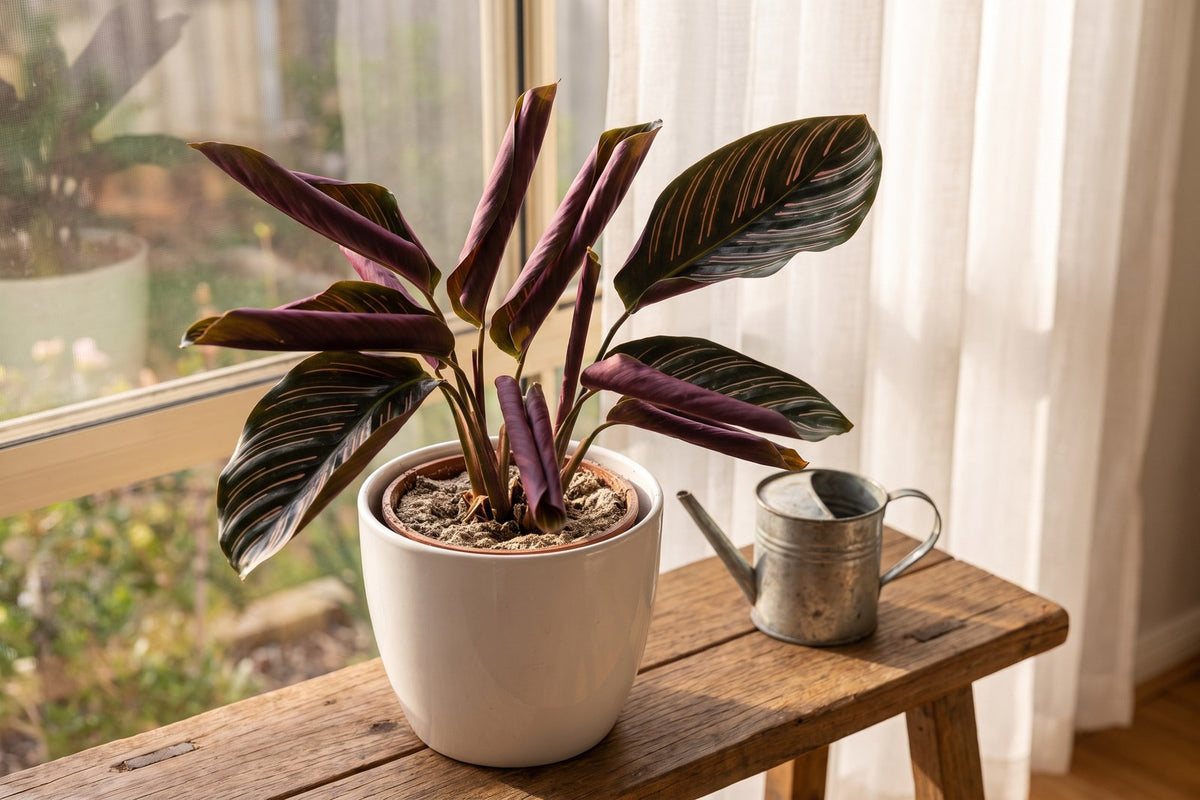
If this is your first, start with the tougher members of the group. Rattlesnake Plant, with its wavy banded leaves, and the Zebra Plant tolerate lower humidity than most. Peacock Plant Calathea roseopicta and the Medallion are the showiest, with deep purple undersides and pale feathered centres, but they are quickest to show brown edges in dry air. The Pin Stripe sits in between and is the classic bathroom plant for good reason.
Match the plant to the room rather than the other way around. A bathroom or kitchen with a window is the easiest place in an Australian house to keep a Calathea happy. A living room with ducted heating running all winter is the hardest, and misting alone will not fix it.
How to plant
Pot into a free-draining indoor mix rather than a heavy general one. Premium indoor mix with about a third added coir and perlite gives Calatheas what they want: consistent moisture without waterlogging. Choose a pot only 20 to 40 mm wider than the current one, with drainage holes, and use an outer cachepot rather than a saucer that leaves the base sitting in water.
Repot in spring every one to two years, or when roots appear at the drainage holes. Calatheas dislike being disturbed, so avoid teasing the root ball hard; slide it into the new pot, backfill around the sides and water in. Our guide to repotting without setting a plant back covers the technique in more detail.
Set the plant somewhere with bright but filtered light. An east-facing window with a sheer curtain is close to ideal. A metre back from a south-facing window works. Direct sun through glass, even for an hour, will bleach the pattern out of the leaves permanently.
Ongoing care
Watering
This is where the brown edges come from. Calatheas are sensitive to the fluoride, chlorine and dissolved salts in tap water, and Adelaide, Perth and much of Melbourne's supply is hard enough to show it. Use rainwater, filtered water or tap water left to stand overnight in an open container, and flush the pot thoroughly every few months so accumulated salts wash out through the drainage holes.
Keep the mix evenly moist but never soggy. Water when the top 20 to 30 mm has just dried, which usually means weekly in summer and every ten to fourteen days in winter. Water thoroughly until it runs from the base, then tip out whatever collects. Underwatering causes the tight curling that is the other classic Calathea complaint; the leaves roll to reduce their surface area and will unfurl within a day or two once the plant is properly watered.
Feeding
Feed lightly. A balanced liquid indoor fertiliser at half the recommended strength, every four to six weeks from September to March, is plenty. Stop entirely over winter. Overfeeding is a common cause of brown leaf tips, since the excess salts sit in the mix and burn the finest roots. If you have been feeding at full strength, flush the pot and start again at half.
Pruning
Remove damaged leaves at the base of the stem, unless the leaf is otherwise healthy, in which case trim the crisp margin away following the natural leaf shape. Take off yellowed lower leaves as they age, which is normal. Wipe the foliage with a damp cloth every few weeks to keep the pattern clear and discourage spider mite.
Common problems and fixes
Brown, crispy edges. The usual cause is dry air, with hard tap water and fertiliser salts close behind. Move the plant to a humid room, group it with others, stand it on a pebble tray, and switch to rainwater. Aim for humidity above 50 per cent; a small hygrometer takes the guesswork out.
Leaves curling inwards. Almost always thirst, occasionally cold. Water thoroughly and check again the next morning. If the mix was already wet, the problem is the opposite: roots damaged by waterlogging cannot take up water, and the plant behaves as if it is dry.
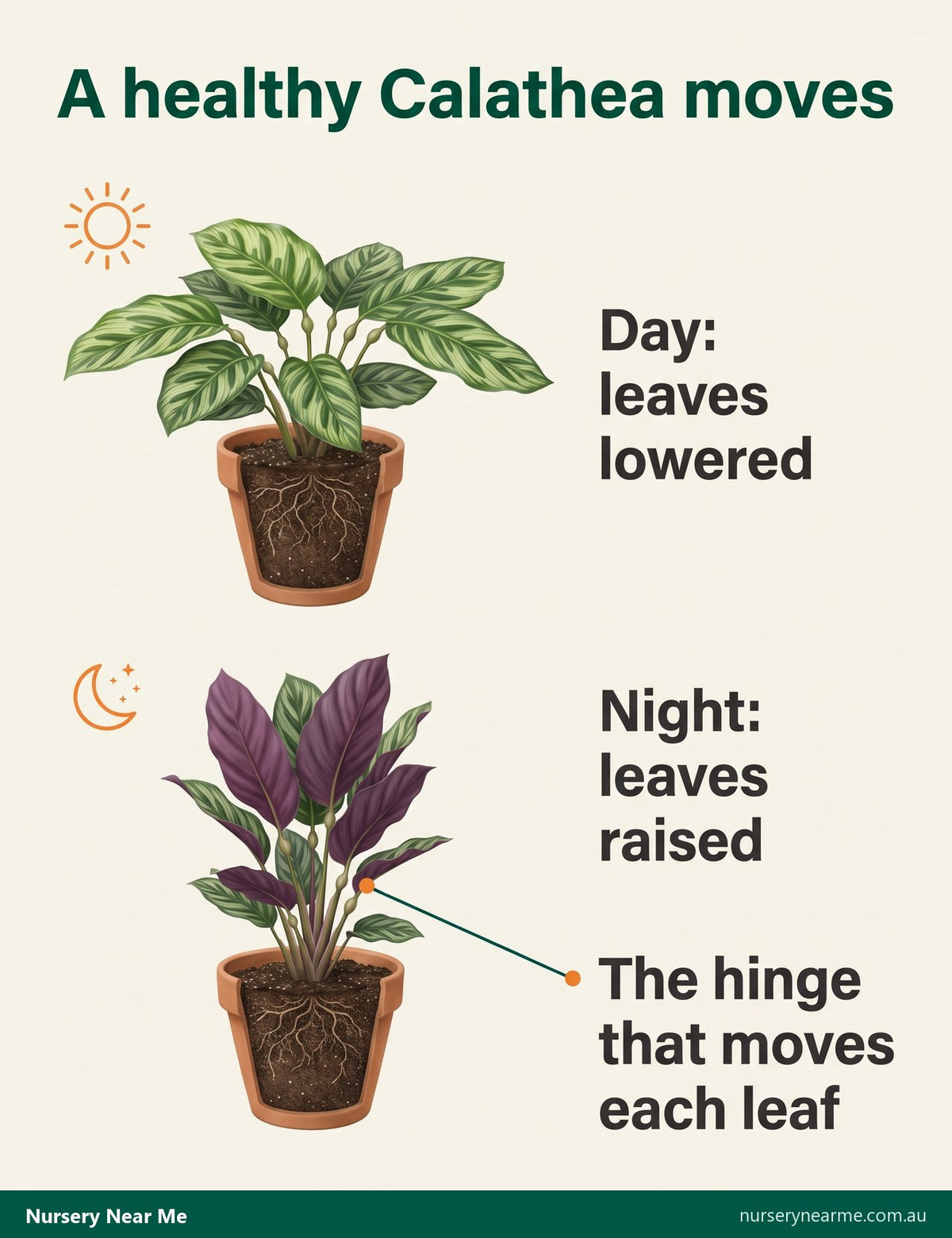
Leaves that stop moving. Calatheas raise their leaves at night and lower them by day, driven by a hinge at the base of each leaf stalk. A plant that stops doing this is stressed, usually by cold. They sulk below 15 degrees and suffer real damage below 10, so keep them away from windows on a Melbourne or Canberra winter night.
Fine webbing and stippled leaves. Spider mite, which thrives in exactly the dry heated air that also causes brown edges. Rinse both leaf surfaces in the shower, raise humidity and treat with horticultural oil. Our guide to diagnosing leaf burn helps separate pest damage from environmental scorch.
Frequently asked questions
Why does my Calathea get brown edges even though I water it?
Because the problem is the air and the water quality rather than the amount. Dry indoor air pulls moisture from the leaf margins faster than the plant can replace it, and the fluoride, chlorine and salts in hard tap water accumulate at the leaf edges where transpiration is highest. Switch to rainwater, raise humidity above 50 per cent, and flush the pot every couple of months.
Should I mist my Calathea?
Misting raises humidity for a matter of minutes, so on its own it achieves very little and can encourage fungal spotting on the leaves overnight. A pebble tray, a group of plants together, a humid room such as a bathroom, or a small humidifier all work far better. If you do mist, do it in the morning so the foliage dries before evening.
Can I grow a Calathea outdoors in Australia?
Only in a warm, frost-free, deeply shaded and sheltered position in subtropical areas such as Brisbane or northern New South Wales, and even then they need protection from wind and afternoon sun. Everywhere else they are indoor plants. Calathea lutea, the Cigar Plant, is the exception and grows into a large clumping garden plant in tropical and subtropical gardens.
Why are the new leaves smaller than the old ones?
Usually not enough light, or a plant that has exhausted the nutrients in its mix. Move it closer to a window without putting it in direct sun, begin a half-strength liquid feed through the warm months, and repot in spring if it has been in the same mix for more than two years.
Are Calatheas safe around pets?
Yes. Calathea and the related Maranta are among the few genuinely popular houseplants that are non-toxic to cats and dogs, which is why they turn up so often on pet-safe plant lists alongside the parlour palm and the peperomias. Chewed leaves will still upset a small animal's stomach, but the plant itself contains no toxic compounds.
Ready to plant?
A Calathea that gets soft water, humid air and bright shade is a spectacular plant and a genuinely easy one. Browse the full house and indoor plants range to find the pattern you like, or start with the forgiving Pin Stripe Calathea if you are working with an ordinary living room rather than a bathroom. For the wider indoor routine, our guides to keeping indoor plants alive and indoor plant basics for beginners cover the habits that keep everything on the shelf healthy.


