

Many gardeners grapple with the challenge of choosing suitable grasses to flourish around tree bases. It is a delicate balance: the tree wants the water and nutrients, the grass wants the light, and the space between them is one of the hardest positions in any garden to plant well.
Selecting the right grasses for planting near trees ensures harmony, fosters healthy growth and lifts the overall landscape. This guide covers the factors that decide success, the varieties that cope with shade and drought, how to establish them and how to keep them looking good once they are in.
Factors to consider when choosing grasses
When seeking the best grasses for planting near trees, several crucial factors come into play, and a well-informed approach is what separates a lush tree base from a patch of bare, compacted dirt.
Light conditions around the tree will influence grass survival and growth more than any other single variable. Soil composition plays a pivotal role, determining how well a grass adapts. Climate factors, including temperature and rainfall, must be accounted for. The potential competition between grass and tree roots for water and nutrients has a direct impact on growth, and it is usually the tree that wins. Finally, considering maintenance requirements is essential to ensure the chosen grass stays healthy without constant intervention.
A thoughtful selection based on these factors will foster a thriving, attractive result. If the position is deeply shaded, it may be worth considering non-grass alternatives too, and our guide to the best ground cover plants for shade covers the options that succeed where turf simply will not.
Soil composition and preparation
Understanding the soil where trees and grasses coexist is paramount. The right soil composition allows both to thrive, encouraging robust growth and good health for each.
Soil testing is the first essential step. Tests reveal nutrient levels, pH and structure, and with that knowledge you can make informed decisions about amendments rather than guessing.
After testing, amending the soil with organic matter enhances aeration and drainage, fostering an environment where both tree and grass roots prosper. Incorporating compost, aged manure and organic mulch works well, promoting vigorous growth across the whole planting. Work carefully around surface roots, since severing them to improve the soil defeats the purpose entirely.
Shade-tolerant grass varieties
Selecting grasses for planting near trees requires knowledge of shade-tolerant varieties that thrive in partially lit conditions. Among these, certain grasses have consistently demonstrated their resilience.
One prominent type is fine fescue, known for its shade adaptability. Its resilience stems from finely textured blades and steady growth under minimal sunlight. Its ability to maintain a lush green appearance even in dappled shade makes it an excellent choice for tree base planting.
Other options include buffalo and zoysia. Buffalo copes well with partial shade in warmer climates, while zoysia offers versatility and drought resistance. For genuinely dark positions beneath a dense canopy, mondo grass outperforms all of them, and our guide to growing mondo grass explains how to establish it as a no-mow carpet.
Drought-resistant grasses
When choosing grasses for planting near trees, drought resistance is of paramount importance, especially in Australia's often dry climates. The tree takes the majority of available soil moisture, so anything planted beneath it lives on what is left.
Buffalo grass stands out for its exceptional durability, requiring less water than many other types. Its deep root system naturally seeks moisture, making it an ideal choice for drought-prone areas.
Couch is another reliable option, with an impressive ability to withstand prolonged dry periods without losing its appearance, and kikuyu offers real robustness in drought conditions, although it is vigorous enough to become a nuisance in garden beds. By selecting drought-resistant varieties, you get a sustainable, vibrant landscape that endures water scarcity gracefully.
Low maintenance grass types
Selecting low maintenance grasses significantly reduces the time and effort required, allowing you to focus on the rest of the garden. These grass types inherently possess qualities that let them thrive with minimal intervention.
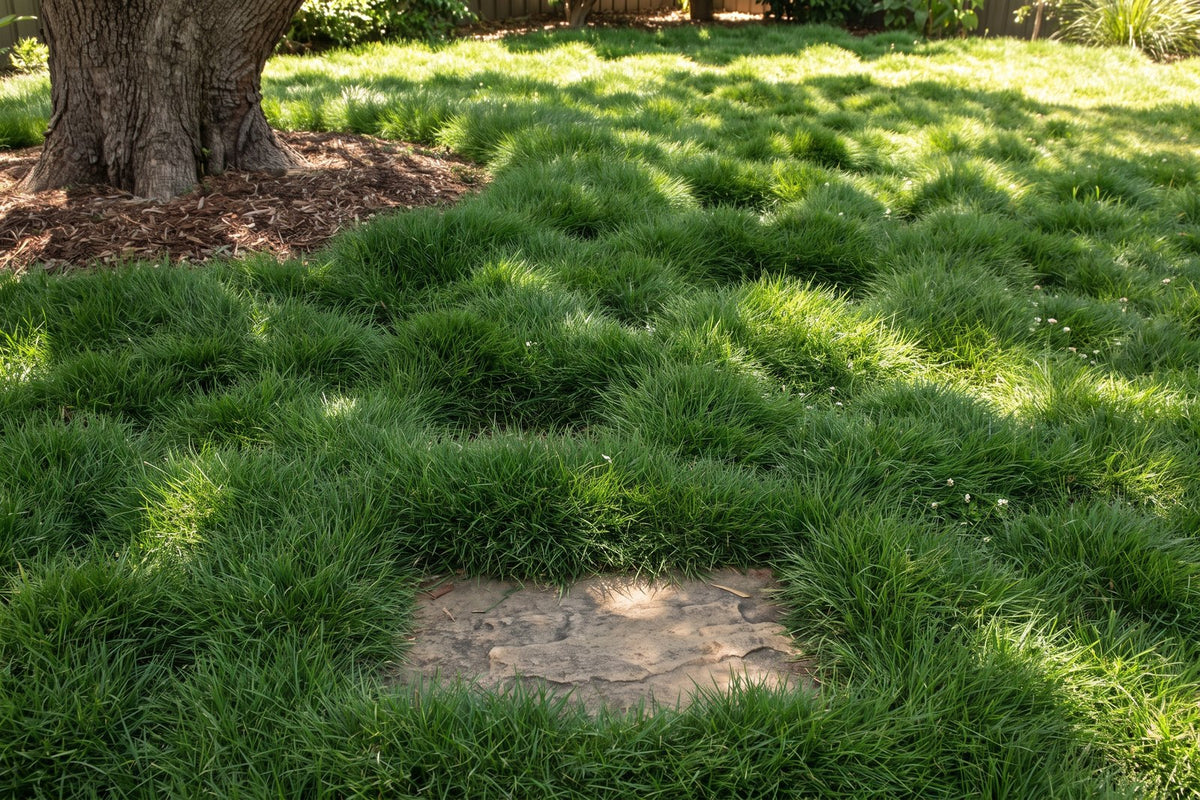
Zoysia tenuifolia, sold as no mow grass, is a prime example, known for its slow growth rate and thick, weed-resistant turf that requires less frequent mowing and feeding. It forms a soft, undulating carpet that looks deliberate rather than neglected, and our full guide to no mow grass as a ground cover covers establishment and spacing in detail.
Another excellent option is blue fescue, particularly the hard and fine-leaved forms, which are remarkably drought tolerant and shade resistant. Their ability to maintain a healthy appearance with minimal upkeep makes them a top contender for tree base planting. These grasses also adapt well to varying conditions, further simplifying maintenance.
Cool-season versus warm-season grasses
Understanding this distinction is crucial. Cool-season and warm-season grasses each have advantages and limitations when it comes to planting near trees.
Cool-season grasses, such as fescues and ryegrasses, thrive in Australia's cooler regions, growing most vigorously through autumn and spring while slowing in summer heat. Warm-season grasses such as buffalo, couch and zoysia excel in hotter, subtropical regions, flourishing through the peak summer months and going semi-dormant in winter.
Matching the grass to your season pattern matters more than matching it to the tree. A cool-season grass in a subtropical garden will struggle in exactly the months you most want it looking good.
The benefits of fescue
Fescue has numerous virtues when considering grasses for planting near trees, and its reputation as a hardy, adaptable species makes it a top contender.
Among its many benefits is drought tolerance, and fescue handles dry spells with impressive resilience. In the often harsh Australian climate, its adaptability to varied conditions stands out as a significant strength.
Its deep root system also helps prevent soil erosion, maintaining soil integrity around tree bases where rain runs off the canopy and concentrates. Fescue requires minimal maintenance, reducing the need for extensive watering and feeding, which not only conserves resources but ensures tree roots are not deprived of nutrients by a hungry lawn. Together, these benefits explain why fescue is among the best choices for planting near trees.
Using ornamental tussocks instead of turf
Where turf will not establish, clumping ornamental grasses often will. Lomandra, dianella and poa all form dense tussocks that tolerate root competition, need no mowing and hold soil on slopes. Planted in drifts rather than as a lawn, they give a softer, more naturalistic look under a canopy and cope with the dry shade that defeats turf entirely.
Lomandra in particular is the workhorse of Australian landscaping for this exact position, and our Lomandra longifolia care guide covers spacing, trimming and the varieties that stay compact. For design ideas using grasses as a deliberate feature rather than a fallback, see our guide to ornamental grasses in garden design.
Growing buffalo grass near trees
Growing buffalo grass near trees is an excellent choice thanks to its robust nature, water efficiency and resilience under partial shade. It thrives even beneath large tree canopies, providing ground cover where many other grass types fail outright.
Buffalo requires minimal maintenance, making it ideal for anyone seeking low-effort landscaping that still delivers a good result. This combination of hardiness and adaptability means consistent performance in challenging conditions. Its deep root system also supports soil stability, helping prevent erosion while contributing to a healthier ecosystem beneath the tree.
How to plant grass seed near trees
Proper preparation ensures success. Begin by clearing the area of debris and large rocks. Loosen the soil with a rake to a fine texture that suits seed germination, working shallowly to avoid damaging tree roots. This preparation helps new seedlings establish roots effectively and produces a much more even coverage.
Choose the right grass variety for the conditions. Cool-season grasses work well in shaded areas, providing year-round coverage in the right climate, and include ryegrass and the fescues.
Consistent watering is critical to seedling success, so keep the soil consistently moist until the new grass is well established. Irrigate evenly, ensuring seeds receive the right amount of moisture without becoming waterlogged. Patience and regular monitoring will be rewarded with a thriving patch of grass that complements the surrounding tree rather than competing with it.
Maintenance tips for grass under trees
Nurturing grass beneath a canopy requires careful attention to watering, mowing and feeding. These essentials maintain the delicate balance between lush grass and overhanging branches.
Regularly monitor moisture levels around the tree's base and pay close attention to signs of dryness, since the canopy sheds a surprising amount of rain away from the trunk. Equally, avoid over-watering, which encourages root rot and fungal disease. Both extremes need managing.
Mow to a height of roughly 7cm to 8cm so the grass is not stressed by excessive trimming; taller leaf means more photosynthesis, which matters enormously in low light. Adjust mowing practices as the seasons change.
A slow-release, balanced fertiliser applied annually significantly boosts grass health under trees. Weed control is another vital aspect, as weeds compete with grass for the limited nutrients and light available and quickly take over thin patches.
Ultimately, success hinges on ongoing, thoughtful maintenance. That diligence yields a landscape that melds with the natural beauty of the trees. For the wider picture of planting in low light, our guide to shade gardening covers everything from soil moisture to plant selection.
Dealing with common grass problems
Dealing with common grass problems requires vigilance and a commitment to ongoing care. Even the best-chosen grasses near trees encounter challenges.
The most prevalent issue is inadequate sunlight, and grass planted near trees must genuinely tolerate shade rather than merely accept it. Soil compaction is another frequent problem, particularly in areas with foot traffic, and compacted soil restricts root growth for both grass and tree.
Pests such as lawn grubs and nematodes attack grass roots, undermining stability and health, and integrated pest management techniques give the most durable result. It is also crucial to differentiate between fungal infection and nutrient deficiency, as they produce similar symptoms and each requires a specific treatment.
A proactive approach with regular monitoring and appropriate intervention ensures resilient grass. With perseverance and knowledge, a thriving green space that complements your trees is entirely achievable.
Grass options at a glance
| Option | Shade tolerance | Water need | Mowing |
|---|---|---|---|
| Buffalo | Good in part shade | Low once established | Monthly in summer |
| Zoysia (no mow) | Moderate | Low | Once or twice a year |
| Fine fescue | Very good | Low to moderate | Occasional |
| Couch | Poor | Low | Frequent |
| Mondo grass | Excellent | Moderate | None |
| Lomandra and dianella | Very good | Low | Trim every few years |
Spacing and establishment
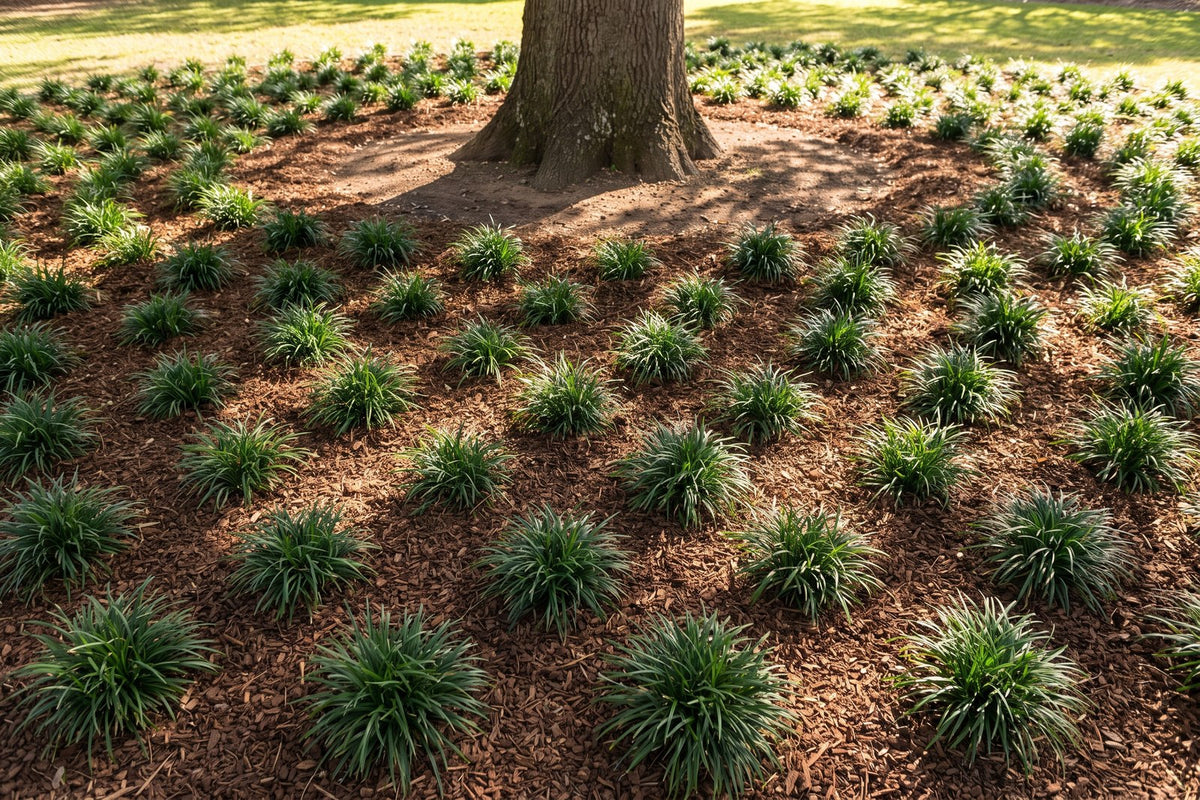
Spacing determines how long you wait for coverage and how much weeding you do in the meantime. As a rough guide, mondo grass planted at 15cm to 20cm centres knits into a solid mat within two growing seasons, while a wider 30cm spacing halves the plant cost but doubles the wait. Clumping grasses such as lomandra are usually planted at 60cm to 80cm centres depending on the variety's mature width, which is worth checking rather than assuming, since compact cultivars and full-size species differ by more than a metre.
Whatever you plant, mulch the gaps. Bare soil between young plants is an invitation to weeds, and weeding by hand around shallow tree roots is slow, unpleasant work. A 5cm layer of fine bark or sugarcane mulch, kept clear of the plant crowns and the tree trunk, suppresses most annual weeds while the planting fills in.
Water new plantings deeply twice a week through the first summer rather than lightly every day. Tree roots will take the majority of shallow moisture, so anything you apply needs to penetrate past that competition to reach the new plants underneath.
Why planting under a tree is hard in Australia
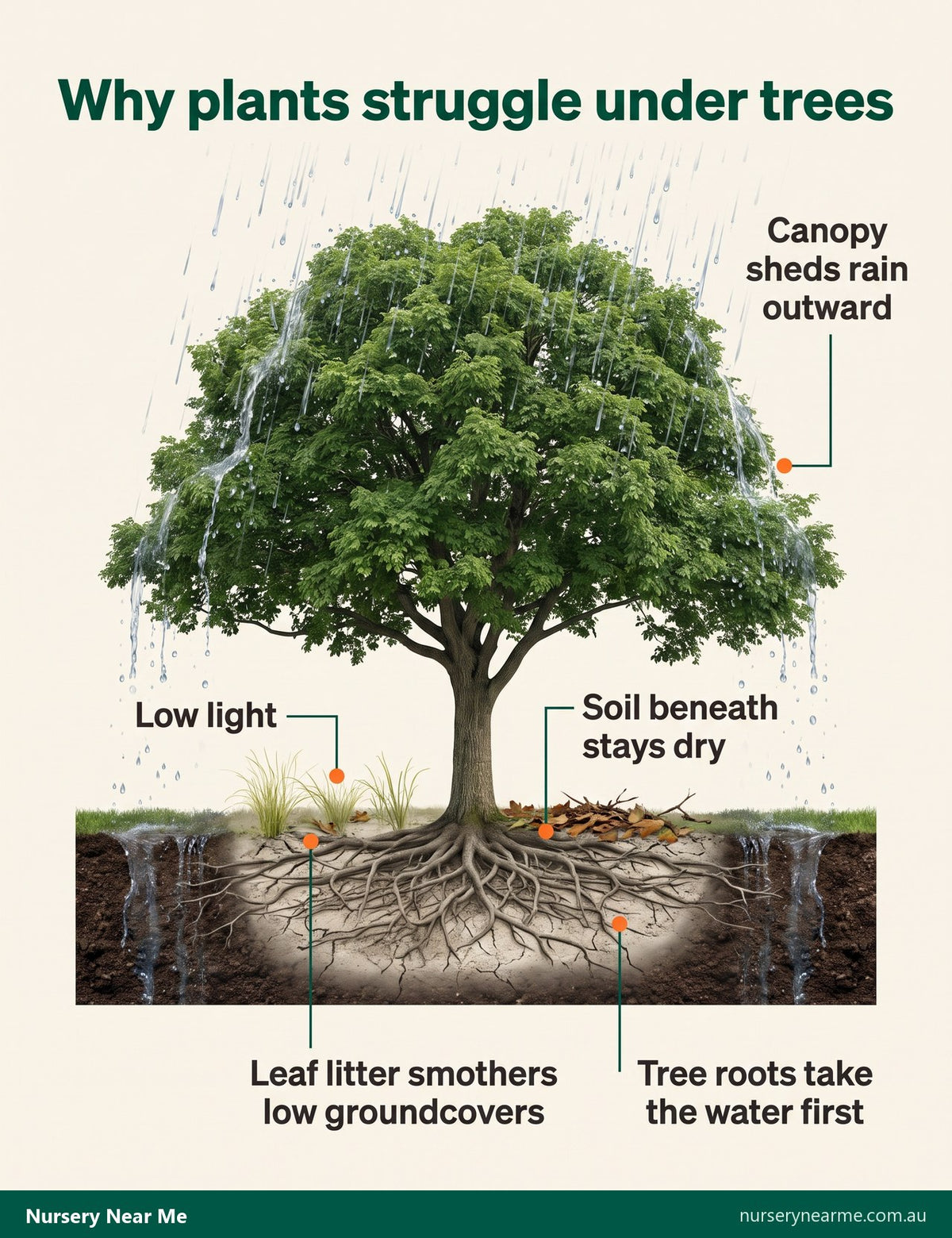
The bare ring of dirt under an established tree is one of the most common problems in Australian gardens, and it is usually misdiagnosed as a light problem when it is really a water problem. A mature tree has an enormous root system and takes moisture from the topsoil before anything else gets it. Add the rain shadow of a dense canopy and the soil under a big tree can stay dry through a wet week.
| Condition | Consequence for planting |
|---|---|
| Root competition | Water and nutrients taken first by the tree |
| Rain shadow | Canopy sheds rain outward; soil beneath stays dry |
| Low light | Rules out most flowering and sun-loving plants |
| Leaf litter | Smothers low groundcovers; suits tougher strappy plants |
| Allelopathy | Some eucalypts release compounds that suppress neighbours |
Grasses and strappy plants that genuinely cope
- Lomandra - the standout. One of very few plants happy in both full sun and dry shade, with fibrous roots that establish among tree roots. Tanika for a fine 600 mm dome, Little Con for a lower border.
- Dianella - the native flax lily tolerates root competition well and gives blue flowers and berries.
- Liriope - excellent in dry shade, with purple flower spikes in late summer. Big Blue and Evergreen Giant are the workhorses.
- Mondo grass - slow but reliable, and the dwarf form gives a crisp low finish.
- Carex appressa - the native tall sedge, good where the ground stays damper.
Non-grass options for the same position
Clivia is worth naming here because it is the best flowering plant for dry shade in Australia, blooming orange in late winter under trees where nothing else will. Asiatic star jasmine forms a dense weed-smothering mat and is genuinely drought tolerant once established. Native violet suits the damper shaded side.
Do not do this to the tree
- Never add a layer of soil over the root zone. Raising the soil level even 100 mm suffocates surface roots and is a common cause of slow decline in mature Australian trees.
- Do not build a raised garden bed against the trunk. Same problem, plus collar rot.
- Do not rotary hoe or dig extensively. Cutting major roots destabilises the tree and opens it to decay.
- Plant small stock and hand dig, working between roots rather than through them.
- Keep mulch 100 mm clear of the trunk, at 50-75 mm depth over the root zone.
Establishing plants under a tree
Plant in autumn across most of Australia so roots develop through the cool months. Water more than seems reasonable for the first year - check by hand rather than assuming rain has reached the soil, because under a dense canopy it often has not. Once established, lomandra, dianella and liriope need very little.
The alternative worth considering
If the position is genuinely hostile - deep shade, dense surface roots, and a eucalypt taking every drop - a mulched circle with no planting at all is a legitimate and good-looking answer. It is better than a ring of struggling plants, and it is far better for the tree.
Frequently asked questions
Why does grass always die under my tree?
Three causes, usually in combination: not enough light, root competition for water, and the dry shadow effect where the canopy sheds rainfall away from the trunk. Improving one alone rarely fixes it. Raising the canopy by removing lower limbs increases light and is often the single most effective change you can make.
Can I add soil over tree roots to level the ground?
Only a very shallow layer. Piling soil over a tree's root zone suffocates the feeder roots that sit in the top 20cm, and mature trees can decline years later as a result. If the surface is uneven, work with it and plant a ground cover that suits the contour rather than burying the roots.
Is it better to mulch instead of planting?
In deep shade beneath a dense evergreen canopy, often yes. A well-maintained mulch bed looks deliberate, conserves moisture for the tree and eliminates the annual failure of struggling turf. You can always add a few clumping grasses through it for interest.
How close to the trunk can I plant?
Keep a clear circle of at least 30cm around the trunk, and further for larger trees. Plants and mulch pressed against bark trap moisture and encourage collar rot, which is one of the few problems capable of killing an otherwise healthy mature tree.
When is the best time to plant beneath a tree?
Autumn is ideal in most of Australia. Soil is still warm enough for roots to move, the heat has passed, and the new planting has the whole cool season to establish before it faces its first summer competing with the tree above. Spring is the second-best option. Avoid planting in midsummer, when the tree is drawing hardest on soil moisture and anything underneath is fighting a losing battle from day one.
Ready to plant?
The right grass under a tree is the one that suits the light you have, not the one that looks best in a catalogue. Start with an honest assessment of the shade, then choose accordingly.
Browse our groundcover range for alternatives to turf, or explore shade-tolerant trees and plants for the rest of the planting beneath your canopy.
If you are ordering these online, read what to do when your plants arrive first. The first two days after delivery matter more than the first two months.
If the property runs on a septic system, the septic drain field planting guide sets out what may go over the trenches and what must stay well away.
For shade that lowers the cooling load, the shade trees guide covers placement in the southern hemisphere and the trees that do the job without damaging the house.


