

Ornamental grasses do the work in Australian gardens that hedging cannot: they give movement, they hold soil on a slope, and once established most of them want no water at all. They are also the plants landscapers mass-plant by the hundred, which means the questions that matter are not decorative ones. How many per square metre? How hard do you cut them back, and when? This guide answers both, alongside a variety table covering the strappy plants and true grasses that perform reliably across Australian conditions.
Quick facts
| Plant | Botanical name | Mature height | Sun tolerance | Frost | Plants per square metre |
|---|---|---|---|---|---|
| Spiny-head mat rush | Lomandra longifolia | 1m | Full sun to part shade | Hardy to about -7C | 3 to 4 |
| Slender mat rush | Lomandra hystrix | 1.2m | Part shade to full sun | Hardy to about -5C | 3 |
| Tanika lomandra | Lomandra longifolia 'Tanika' | 60cm | Full sun to part shade | Hardy to about -7C | 4 to 5 |
| Blue flax lily | Dianella caerulea | 60cm | Full sun to part shade | Hardy to about -5C | 5 to 6 |
| Big blue liriope | Liriope muscari 'Big Blue' | 40cm | Part shade to shade | Hardy to about -8C | 7 to 9 |
| Mondo grass | Ophiopogon japonicus | 25cm | Part shade to shade | Hardy to about -8C | 16 to 25 |
| Tussock grass | Poa labillardieri | 1m | Full sun | Hardy to about -8C | 3 to 4 |
| Fountain grass | Pennisetum alopecuroides | 1m | Full sun | Hardy to about -8C | 3 |
Choosing the right ornamental grass
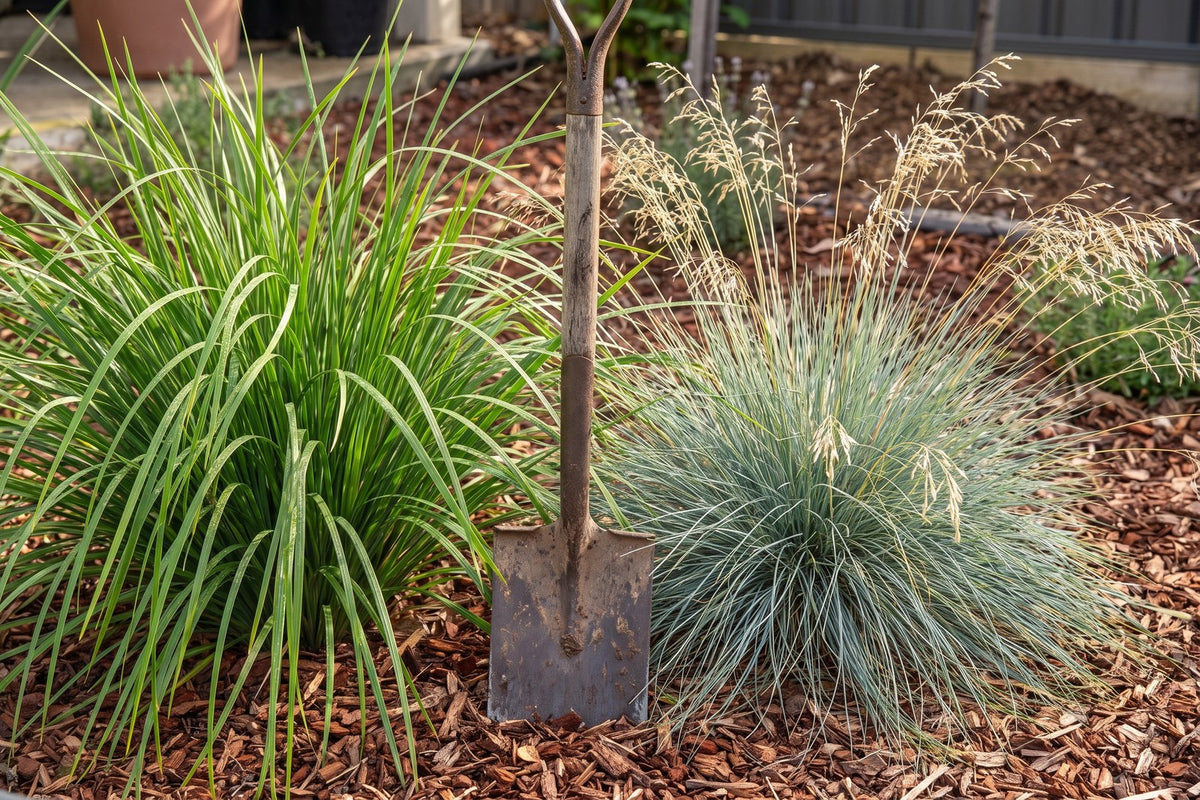
For a hot, exposed bank or a road verge, Lomandra longifolia is the default and deserves to be. It survives drought, tolerates periodic waterlogging, and holds a slope with a dense fibrous root system. Tanika is the finer-leaved cultivar for smaller spaces. Our Lomandra longifolia care guide covers it in full.
For damp ground or a bioswale, Lomandra hystrix handles wet feet far better than most and keeps a softer, more arching form. For shade under trees, Liriope muscari and mondo grass are the two that genuinely perform; see Liriope muscari and know mondo grass. Planting at the base of an established tree is its own problem, and choosing the best grasses for tree base planting covers it.
For movement and seed heads, the true grasses are the ones to use. Poa labillardieri gives a soft blue-grey tussock that catches the wind, and Pennisetum alopecuroides carries bottlebrush flower heads through late summer and autumn. Both are deciduous or semi-deciduous in habit and need an annual cutback, unlike the evergreen strappy plants.
Where you want a mown look without mowing, a running turf grass is a different tool entirely; see no mow grass.
How to plant
Prepare the whole bed rather than digging individual holes, since mass plantings live or die on even soil conditions. Cultivate to a spade's depth, work compost through the top 20 centimetres, and level before setting out.
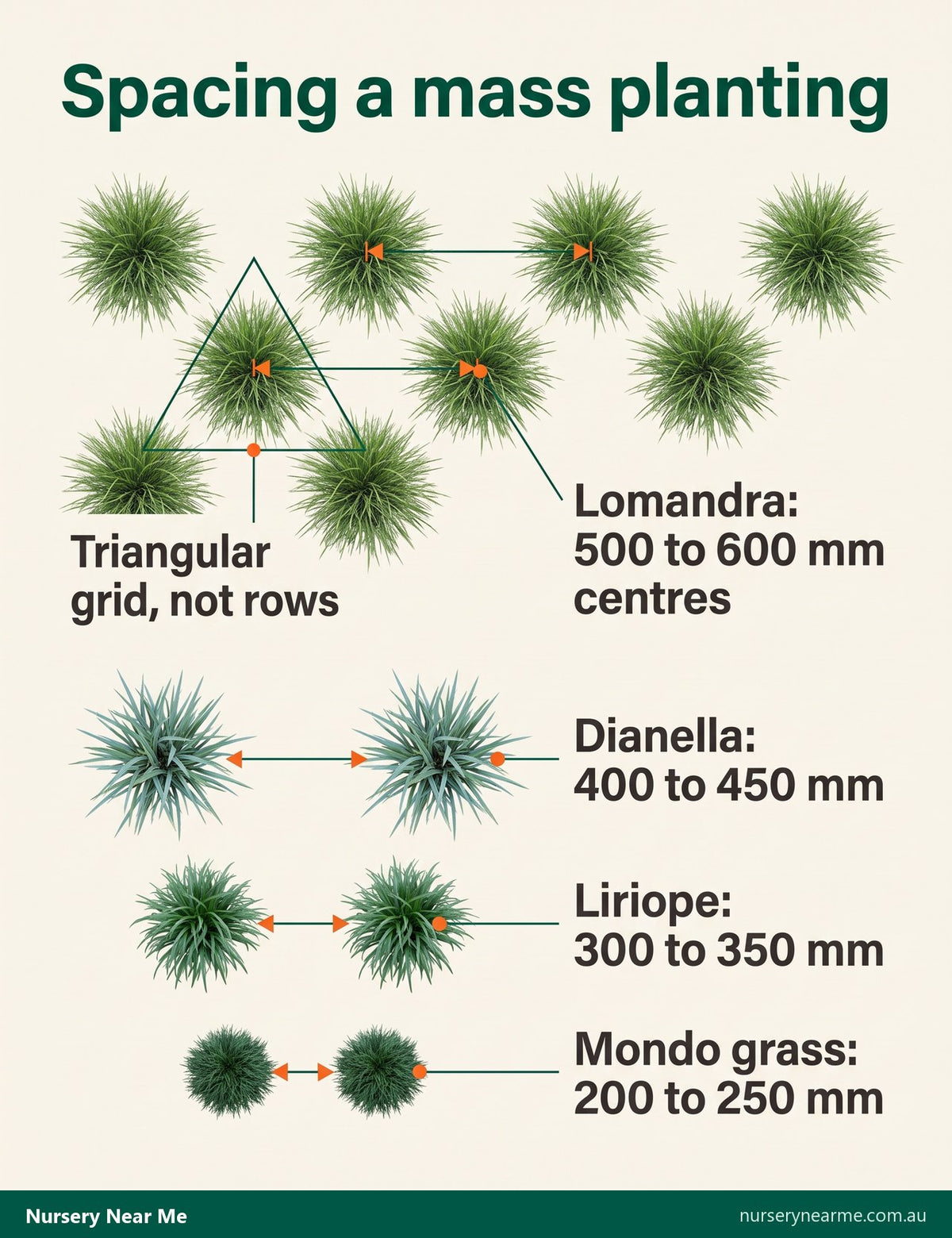
Use the density column in the table above and set plants out on a triangular grid rather than in rows, which closes the gaps faster and looks less mechanical. As a rule of thumb, spacing equals roughly 70 per cent of the mature clump width: lomandra at 500 to 600 millimetre centres, dianella at 400 to 450, liriope at 300 to 350, and mondo grass at 200 to 250 for a solid carpet within two seasons.
Plant with the crown level with the soil surface, never buried, since a buried crown rots in a wet summer. Water in well and mulch to 50 millimetres between plants, keeping mulch out of the crowns.
Ongoing care
Watering
Water twice weekly through the first summer, then weekly through the second, and after that most of these plants need nothing beyond drought relief. Liriope and mondo grass in deep shade are the exceptions and appreciate a soak during extended dry spells.
Feeding
One application of a controlled-release fertiliser in early spring is plenty. Use a native formulation on lomandra and dianella, both to avoid phosphorus problems and because overfeeding makes them floppy and shortens the interval between hard cutbacks.
Pruning
This is the part most guides omit, and it differs by type. Evergreen strappy plants, meaning lomandra, dianella and liriope, are cut back hard only every three to four years, in late winter, to about 15 centimetres above the crown. Doing it annually weakens them. Mondo grass rarely needs cutting at all; run a mower over it on the highest setting every few years if it looks tired.
Deciduous true grasses are the opposite. Poa and Pennisetum should be cut back to 10 to 15 centimetres every year in late winter, before new growth starts, or the old foliage smothers the crown. Remove spent Pennisetum flower heads in autumn if self-seeding is a concern in your district.
Common problems and fixes
Brown, dead centres in an old lomandra or liriope clump mean it is overdue for a hard cutback or for division. Cut it back in late winter, or lift and split the clump into three or four pieces and replant.
Yellowing in liriope and mondo grass usually reflects too much sun rather than a nutrient problem; both scorch in full afternoon sun in warm districts. Floppy, splayed lomandra almost always follows over-fertilising or too much shade. Patchy establishment in a mass planting nearly always traces back to uneven soil preparation, not to the plants. Fungal leaf spot after a wet summer is cosmetic and disappears after the next cutback.
Australia's own ornamental grasses
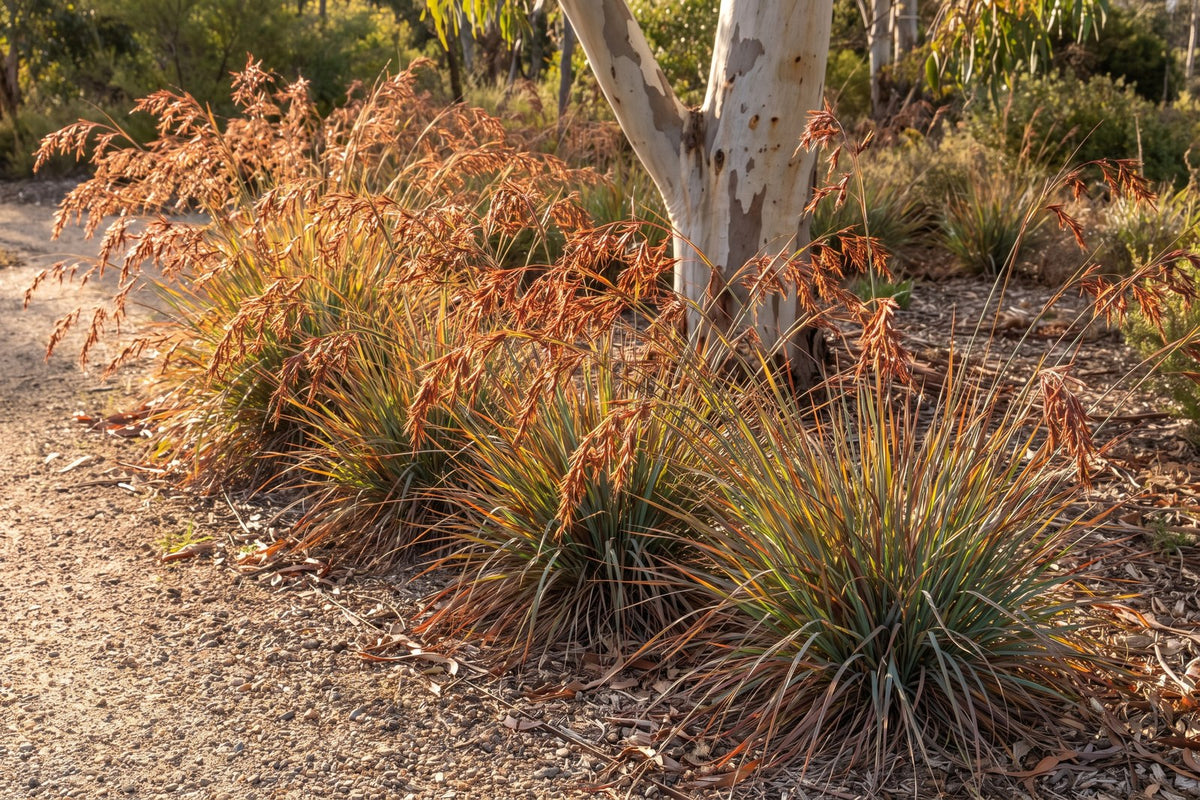
Most of the strappy plants used in Australian landscaping are natives, and several are not grasses at all - lomandra and dianella are both in different families entirely. That is a technicality, but it matters for how they behave: they clump rather than run, and they do not need mowing.
| Plant | Size | Conditions |
|---|---|---|
| Lomandra | 300 mm - 1 m | Sun or shade, wet or dry, every capital |
| Dianella | 400-800 mm | Sun or dry shade; blue flowers and berries |
| Poa labillardierei | 600 mm - 1 m | Cool climates, tussock form |
| Themeda (kangaroo grass) | 500 mm - 1 m | Native grassland species, seasonal colour |
| Ficinia nodosa | 600 mm | Coastal, salt and wet tolerant |
| Carex appressa | 1 m | Wet ground, swales, pond margins |
| Liriope | 300-450 mm | Dry shade, purple flower spikes |
| Mondo grass | 50-300 mm | Shade, between pavers |
Why they dominate Australian landscaping
Because they survive. Lomandra handles full sun and dry shade, drought and periodic waterlogging, frost and coastal salt, and needs cutting back roughly once every two or three years. That combination is why it appears in almost every commercial planting in the country, and the same logic applies at home.
Cutting back is the entire maintenance schedule
Lomandra, dianella and liriope all accumulate dead leaf in the centre of the clump over time and start to look tired. Cut the whole clump back to about 15 centimetres above the crown in late winter or early spring, and it returns fresh and dense within weeks.
Timing matters for liriope - cutting too late removes the developing flower spikes. A brushcutter or hedge trimmer makes short work of a mass planting.
Avoid the imported ones that became weeds
Worth being clear about. Several ornamental grasses sold overseas are serious environmental weeds in Australia. Pampas grass is a declared weed in parts of New South Wales, Victoria and elsewhere, and fountain grass (Pennisetum) has naturalised widely. Both produce enormous quantities of wind-blown seed.
The native alternatives above give the same effect without the risk, handle Australian conditions better, and in the case of dianella and lomandra provide habitat and food for local wildlife.
Using them well
- Mass plant, do not dot. Strappy plants read as design in drifts and as clutter individually.
- Space by mature width - 600 mm for Tanika lomandra, 400 mm for the small cultivars, 500 mm for dianella.
- Contrast with rounded or broad-leaved plants - the strong vertical line needs something to work against.
- Use them for erosion control. Fibrous roots bind soil, which is why lomandra is used on batters and swales in civil works.
- Feed with a low-phosphorus native blend, or not at all. Established clumps generally need nothing.
Frequently asked questions
How many lomandra do I need per square metre?
Three to four plants per square metre for the full-size forms at 500 to 600 millimetre centres, and four to five for compact cultivars such as Tanika. That gives a closed planting within about two growing seasons.
When should I cut back ornamental grasses in Australia?
Late winter, before new growth begins. Cut deciduous grasses such as Poa and Pennisetum back annually to 10 to 15 centimetres. Cut evergreen strappy plants such as lomandra and liriope back only every three to four years.
Which ornamental grasses grow in shade?
Liriope muscari, mondo grass and Lomandra hystrix are the reliable performers in shade. Most true grasses, including Poa and Pennisetum, need full sun and thin out badly without it.
Are ornamental grasses drought tolerant?
Once established, lomandra, dianella and Poa are among the most drought-tolerant plants available for Australian gardens. They still need regular water through the first summer to build the root system that makes that possible.
Do ornamental grasses become weeds?
Some exotic species self-seed readily in certain districts, so check local restrictions before mass-planting Pennisetum in particular. Australian natives such as lomandra and dianella are the safe choice in bushland-adjacent gardens.
Ready to plant?
Work out your area, use the density column, and order in one go. Our grasses for landscaping range covers everything in the table, the lomandra collection lists every cultivar we carry, and structured foliage is the place to look for companion planting.
On a septic block the planting rules change: our guide to what to plant over a septic drain field gathers the state guidelines on cover plants, tree distances and the signs of a failing trench.


