

Pandanus are sold in Australia under a handful of species that differ far more than their shared common names suggest. One reaches eight metres with spines sharp enough to require gloves and long sleeves; another stays at two metres and is completely spineless. Choosing the wrong one for a courtyard or a pool surround is a mistake that gets worse every year, so it is worth knowing exactly what you are buying.
The five varieties compared

| Variety | Height | Spines | Foliage | Best use |
|---|---|---|---|---|
| Coastal screw pine | 4-6 m | Yes, sharp | Green, stiff | Beachfront, native gardens, dune stabilisation |
| Red edge | 5-8 m | Yes, red-edged | Green with red margins | Large feature specimen |
| Baptist's | 2-3 m | None | Soft green | Courtyards, pools, paths |
| Variegated Baptist's | 2-3 m | None | Gold-striped | Brightening shaded courtyards |
| Unicorn | 3-5 m | Yes | Green, distinctive form | Collectors, unusual feature |
Coastal screw pine
Pandanus pedunculatus is the true Australian native, growing wild along beaches from Queensland down the New South Wales coast. It is the one responsible for the iconic silhouette on the Sunshine Coast and Gold Coast headlands.
Its strengths are exactly those of a dune plant: outstanding salt tolerance, happy in pure sand, and stilt roots that anchor it against wind. Reaching four to six metres, it is the right choice for a genuine coastal garden and for anyone wanting the authentic Australian beach look.
The catch: the leaf margins carry sharp spines. Keep it well away from paths, pool edges and anywhere children play.
Red edge pandanus
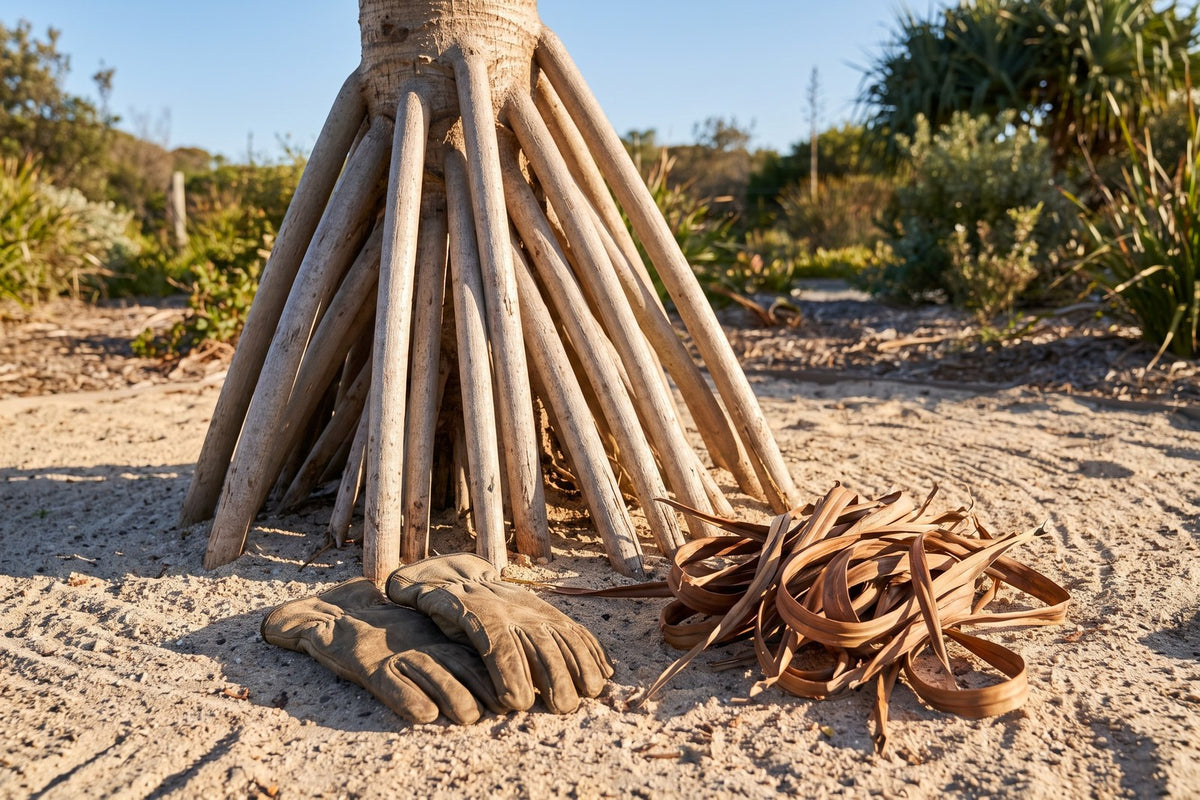
Pandanus utilis 'Red Edge' is the largest of the group at five to eight metres, with striking red margins along the leaves that make it a genuine feature plant. The stilt roots on a mature specimen are dramatic and should be left exposed rather than buried in planting.
It needs real space and a position where it can be seen properly. Also spined, so the same siting caution applies.
Baptist's pandanus
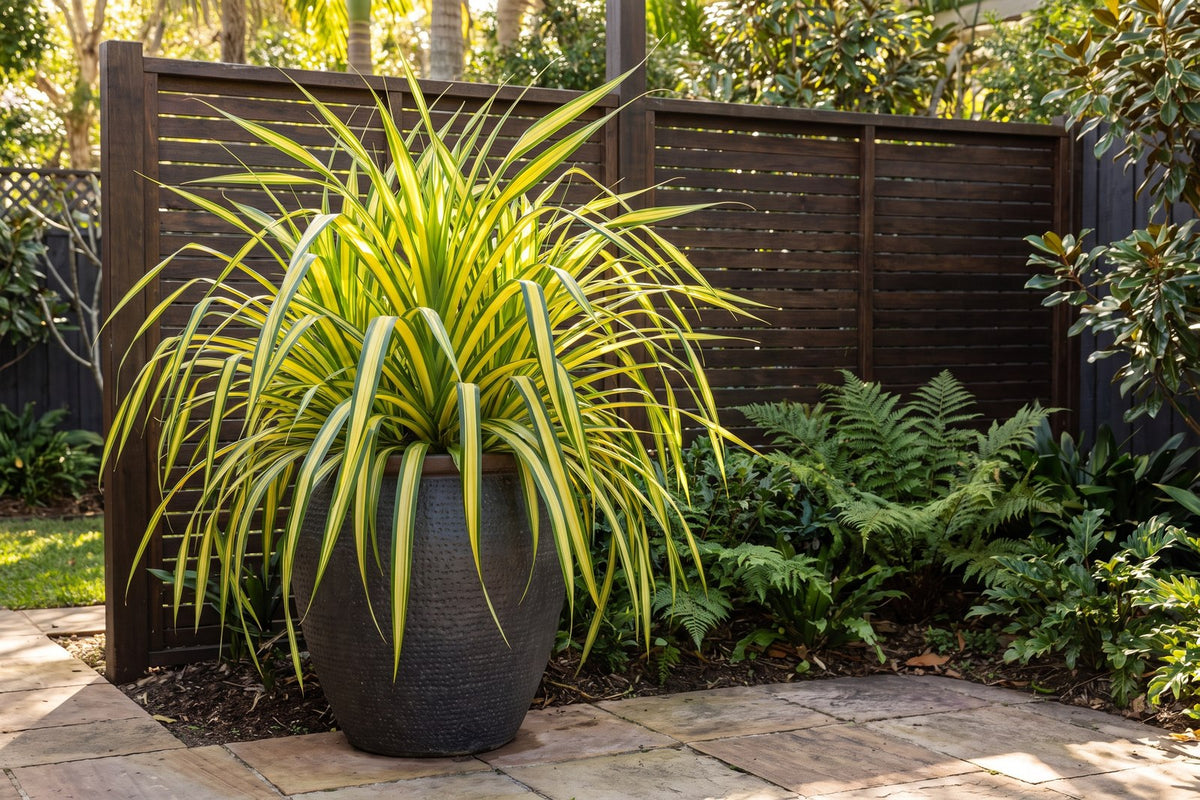
Pandanus baptistii is the one most home gardens should plant. It is completely spineless, stays at a manageable two to three metres, and gives the same architectural spiral of strappy foliage without the hazard.
That makes it the sensible choice for a courtyard, beside a path, around a pool, or anywhere people brush past. It also handles more shade than the coastal species and does well in a large pot.
Variegated Baptist's
The variegated form carries gold striping along the leaves and lifts a dark corner considerably. Same size, same spineless habit, slightly slower growing. Give it bright filtered light rather than deep shade to hold the variegation, and avoid harsh afternoon sun, which scorches the pale tissue.
Unicorn pandanus
Pandanus unicornutus is the unusual one, valued for its distinctive form by people who already have the common species. It sits between the others in size at three to five metres and is spined.
Choosing by situation
- Beachfront or exposed coastal garden - coastal screw pine. Nothing else matches its salt and wind tolerance.
- Courtyard, pool surround or near a path - Baptist's or variegated Baptist's. Spineless is not optional in these positions.
- Large feature in an open garden - red edge, given room for the stilt roots to develop.
- Shaded courtyard needing brightness - variegated Baptist's.
- Pot or balcony - Baptist's, which stays small enough to manage.
- Something unusual - unicorn pandanus.
Where they grow in Australia
- Sunshine Coast, Gold Coast, northern NSW - the natural range for the coastal species. All varieties thrive.
- Brisbane - excellent, including well inland from the coast.
- Tropical Queensland and Darwin - fastest growth and largest specimens.
- Sydney - good in warm sheltered positions, slower than further north.
- Perth - workable in warm coastal gardens with free-draining sand.
- Melbourne, Adelaide, Canberra - too cold. Frost damages the crown. Grow Baptist's in a pot that shelters over winter.
Before you buy: pandanus dieback
Pandanus along the Queensland and northern New South Wales coast have been killed in large numbers by the pandanus planthopper, Jamella australiae, which was carried south on transplanted trees into regions without its natural predators. Councils in affected areas have run biological control programmes using a parasitic wasp, with good results.
For a home gardener the practical advice is straightforward: buy nursery-grown stock rather than moving established trees between regions, check the crown for sticky honeydew and sooty mould before buying, and act early if a crown starts yellowing from the centre outward.
Care, in brief
- Full sun for the coastal and red edge species; Baptist's accepts part shade.
- Sharp drainage. These are sand-country plants and will not tolerate heavy wet soil.
- Allow room for stilt roots to spread outward from the trunk over time.
- Water weekly through the first summer, then very little.
- Feed sparingly - a slow-release fertiliser in spring is plenty.
- Remove dead lower leaves to expose the stilt roots, wearing thick gloves for spined species.
Frequently asked questions
Which pandanus has no spines?
Pandanus baptistii and its variegated form are completely spineless. They stay at two to three metres, which makes them the right choice for courtyards, pool surrounds and anywhere near a path or play area.
Which pandanus is the Australian native?
Pandanus pedunculatus, the coastal screw pine, grows naturally along beaches from Queensland through New South Wales. It has outstanding salt tolerance and is the species behind the classic Australian beachfront silhouette.
How big do pandanus get?
It depends entirely on species - two to three metres for Baptist's, four to six for the coastal screw pine, and five to eight for red edge. All are slow growing at around 200 to 300 millimetres a year.
Which pandanus suits a pot?
Baptist's or the variegated form. Both stay small enough to manage in a large container, are spineless, and tolerate part shade, which suits a courtyard or balcony.
Can pandanus grow away from the coast?
Yes. They are famous as coastal plants because of their salt tolerance, but they grow well in inland Brisbane and other warm districts provided drainage is good and frost is not an issue.
What is killing pandanus on the Queensland coast?
The pandanus planthopper, Jamella australiae, carried south on transplanted trees into areas without its natural predators. Infested crowns yellow from the centre and collapse. Buy nursery-grown plants and inspect the crown before purchase.
Ready to plant?
We grow spined and spineless pandanus in sizes from small plants through to advanced specimens. Browse our palms, ferns and tropical collection.
Related reading: using pandanus as a feature tree and the best plants for coastal gardeners.


