

Nothing says Australian coastline quite like a pandanus. The stilt roots, the spiralling crown of strappy leaves and the tolerance of salt wind straight off the water make it the defining tree of Queensland and northern New South Wales beaches. It also works inland as a sculptural feature in a courtyard or beside a pool, provided you choose the right species and know about the pest that has killed thousands of them along the east coast.
Quick facts
| Detail | What to expect in Australia |
|---|---|
| Botanical name | Pandanus species - also called screw pine |
| Mature size | 3-8 m depending on species |
| Position | Full sun. Tolerates fierce exposure |
| Soil | Free draining. Thrives in pure coastal sand |
| Water | Regular while establishing, then very drought tolerant |
| Salt tolerance | Outstanding - front-line coastal planting |
| Frost | Tender. Not suited to frost-prone districts |
| Growth rate | Slow, around 200-300 mm a year |
| Best climates | Brisbane, Gold and Sunshine Coasts, northern NSW, tropical Queensland, Darwin |
Pandanus dieback: the thing to know first
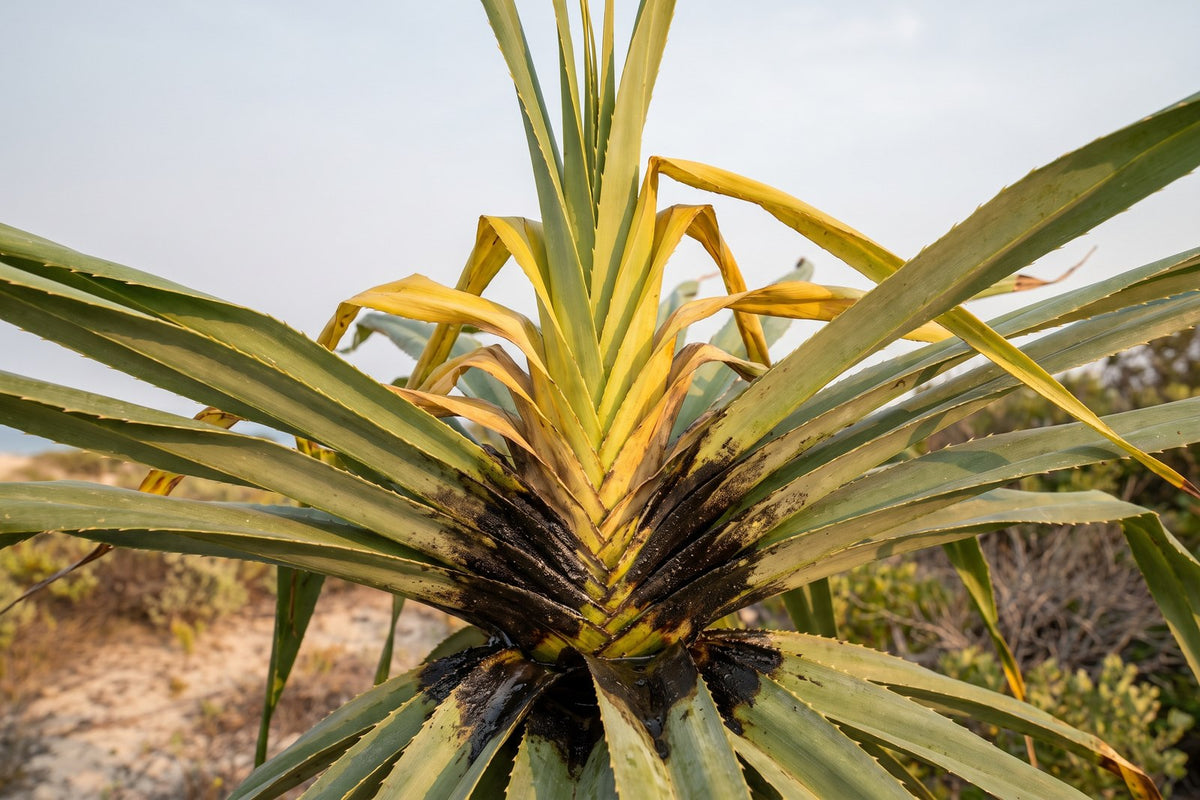
Along the Queensland and northern New South Wales coast, pandanus have been killed in large numbers by the pandanus planthopper, Jamella australiae. It is native to far north Queensland but was moved south on transplanted trees, arriving in areas where its natural predators were absent. Infested crowns yellow, collapse from the centre and eventually die.
Councils along the affected coastline have run biological control programmes using a tiny parasitic wasp that attacks the planthopper's eggs, and these have been broadly successful. For a home gardener the practical points are simple: buy from a reputable nursery rather than moving trees between regions, inspect the crown for sticky honeydew and sooty mould, and act early if a crown starts yellowing from the middle rather than the outside. Local councils in affected shires can usually advise on current treatment.
Choosing the right pandanus
| Species | Size | Spines | Best for |
|---|---|---|---|
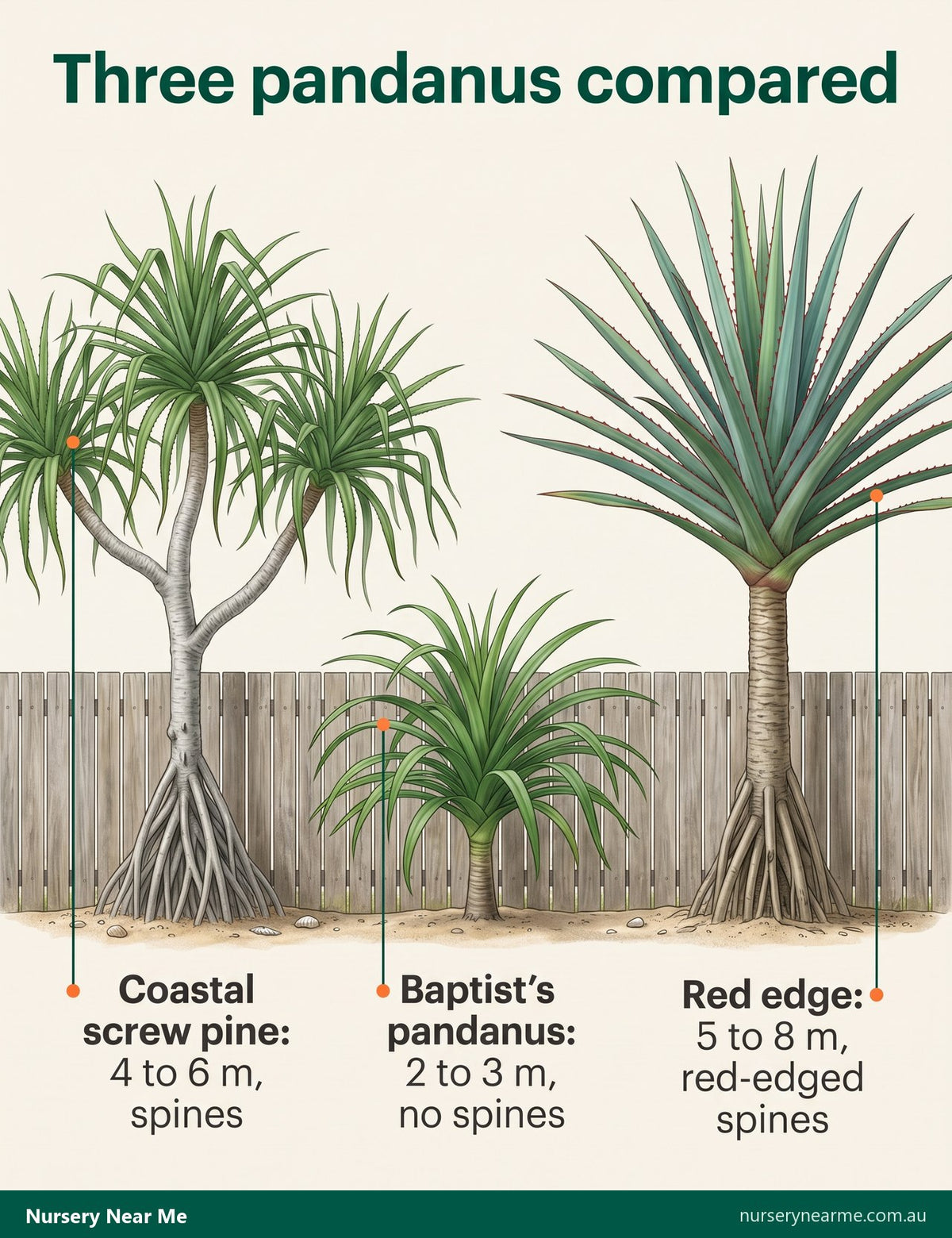
| Coastal screw pine (P. pedunculatus) | 4-6 m | Yes | Front-line coastal, native gardens, the classic beach look |
| Baptist's pandanus (P. baptistii) | 2-3 m | None | Courtyards, pools, paths - safe around people |
| Variegated Baptist's | 2-3 m | None | As above, with gold-striped foliage for contrast |
| Red edge (P. utilis) | 5-8 m | Yes, red-edged | Large feature specimen, striking red leaf margins |
For gardens where people walk past
Choose Baptist's pandanus. It is spineless, stays a manageable two to three metres, and gives the same architectural form without the hazard. Most pandanus carry sharp marginal spines that are genuinely dangerous at eye height for children, so species choice matters more here than aesthetics.
For a true coastal garden
The native coastal screw pine is the one that grows naturally along eastern Australian beaches. It handles salt spray, sand and wind better than almost any other tree, and its stilt roots stabilise dunes. In an exposed beachfront garden it is close to unbeatable.
For a large feature
Red edge pandanus reaches five to eight metres with dramatic red-margined leaves. Give it room and a position where the stilt roots can be seen, since they are the point of the plant.
Where pandanus grows in Australia
- Sunshine Coast, Gold Coast and northern NSW - its natural home. Grows without assistance.
- Brisbane - excellent, including inland suburbs well away from the coast.
- Tropical Queensland and Darwin - fastest growth and largest specimens.
- Sydney - grows well in a warm sheltered position, slower than further north.
- Perth - workable in a warm coastal garden with free-draining sand.
- Melbourne, Adelaide and inland - too cold. Frost damages the crown. Grow in a large pot that shelters over winter if you want one.
How to plant
- Plant in spring or early summer so it establishes through the warm months.
- Choose full sun. Pandanus grown in shade become drawn and lose their dense crown.
- Make sure drainage is sharp. These are sand-country plants and will not tolerate heavy wet clay.
- Allow space for stilt roots. The prop roots spread outward from the trunk over time and should not be crowded by paving.
- Keep spiny species away from paths, play areas and pool edges.
- Water weekly through the first summer, then reduce - established plants rarely need irrigation.
Ongoing care
Watering
Regular water for the first year while the root system develops, then very little. Mature pandanus growing in coastal sand survive on rainfall alone in most seasons. Overwatering in heavy soil is a greater risk than drought.
Feeding
Minimal. A slow-release fertiliser in spring is enough, and plants in decent soil often need nothing. Overfeeding produces soft growth that is more attractive to the planthopper.
Pruning
Remove dead lower leaves to keep the trunk clean and show the stilt roots, which are the ornamental feature. Wear thick gloves and long sleeves for spiny species. Never cut into the growing point at the centre of a crown - like palms, that point cannot regenerate and the stem will die.
Common problems and fixes
- Crown yellowing from the centre outward is the classic sign of pandanus planthopper. Look for sticky honeydew, sooty mould and small white insects at the leaf bases. Seek local advice early, as councils in affected areas run control programmes.
- Sooty mould on leaves follows sap-sucking insects. Treat the insect and the mould clears.
- Brown leaf tips is usually wind or salt burn on a young plant and is cosmetic once established.
- Rot at the base means drainage. Pandanus tolerate sand and drought, not sitting water.
- Slow growth is normal - 200 to 300 mm a year. Buy an advanced plant if you want presence sooner.
- Frost damage to the crown in southern gardens is usually terminal. This is not a cold-climate plant.
Using pandanus in the garden
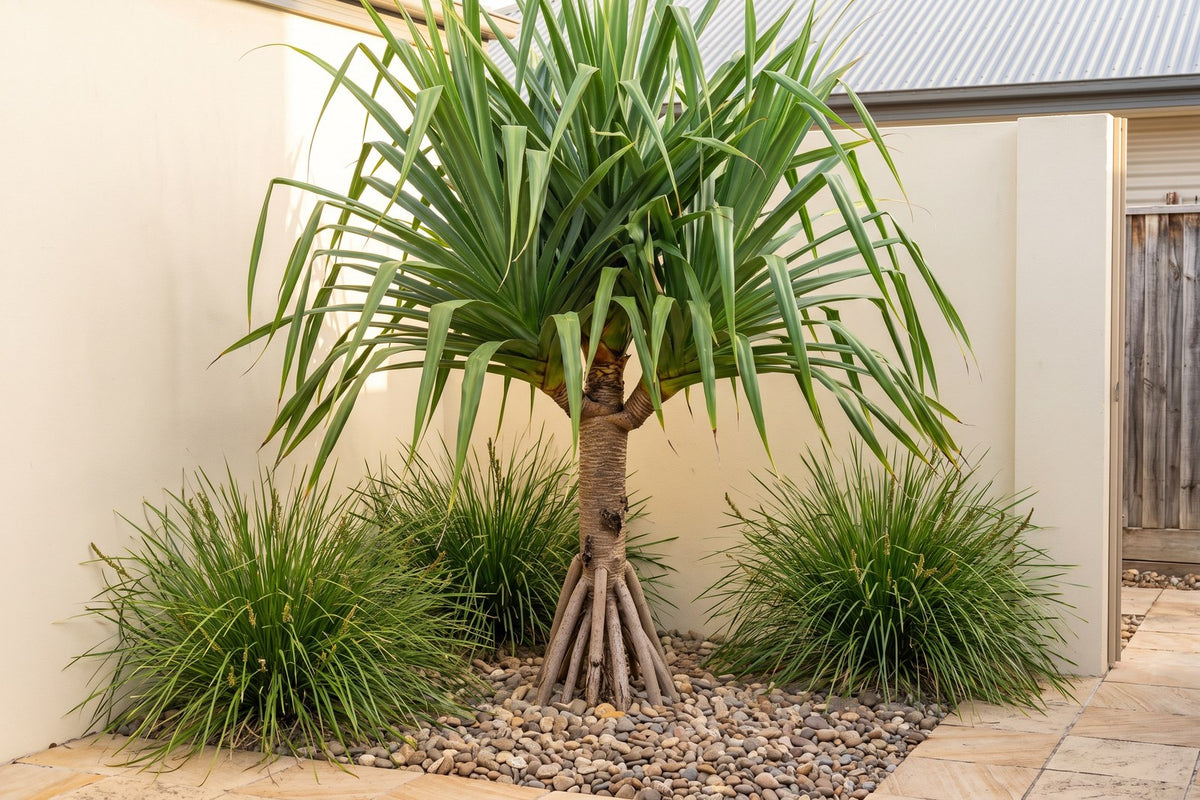
Pandanus is a sculptural plant, so treat it as a specimen rather than mass planting it. It works beautifully as a single feature in a courtyard, uplit at night to throw the stilt roots into relief, or in a group of three in a larger coastal garden. Around pools it is a good choice because it drops large leaves rather than fine litter, though a spineless species is essential there. It sits naturally with other coastal natives, and its strong form contrasts well against soft grasses such as lomandra and dianella.
Frequently asked questions
Is pandanus native to Australia?
Some species are. Pandanus pedunculatus and related species grow naturally along the eastern Australian coastline and are an iconic part of Queensland and northern New South Wales beaches. Others sold in nurseries, such as P. utilis and P. baptistii, come from elsewhere.
What is killing pandanus on the Queensland coast?
The pandanus planthopper, Jamella australiae. Native to far north Queensland, it was carried south on transplanted trees into areas without its natural predators. Infested crowns yellow from the centre and collapse. Biological control using a parasitic wasp has been used successfully by councils along the affected coast.
Do all pandanus have spines?
No. Pandanus baptistii and its variegated form are spineless, which makes them the sensible choice for courtyards, pool surrounds and anywhere near a path. Most other species carry sharp spines along the leaf margins.
How fast do pandanus grow?
Slowly, around 200 to 300 millimetres a year. A substantial specimen represents many years of growth, which is why advanced plants cost what they do and are often worth it.
Will pandanus grow in Melbourne or Adelaide?
Not reliably in the ground. Pandanus is frost tender and southern winters damage the crown. Grow it in a large container that can be moved to a sheltered position over winter, or choose a hardier architectural plant.
Can pandanus grow away from the coast?
Yes. It is famous as a coastal plant because of its salt tolerance, but it grows perfectly well in inland Brisbane gardens and other warm districts, provided drainage is good and frost is not an issue.
Ready to plant?
We grow spined and spineless pandanus, from compact Baptist's for courtyards through to red edge specimens for large gardens. Browse the palms, ferns and tropical collection, or our trees range for other feature options.
Planting near the beach? See the best plants for coastal gardeners, and top pandanus varieties for Australian gardens for a closer look at the individual species.
Before a tree goes in near the house, read our guide to planting near pipes: it sets out what Australian water utilities say about root behaviour, what can go directly over a sewer line, and which trees to keep well away.
Planting a tree to cool the house? Our guide to shade trees that cut cooling bills explains which side of the house to shade, deciduous versus evergreen by climate, and how far back to plant.


