

For sheer flower power in an Australian summer, nothing touches a crepe myrtle. From November to March they carry huge trusses of crepe textured blooms, follow up with fiery autumn foliage, then show off smooth sculptural bark all winter, which is exactly why they appear so often on our list of plants that change colour through the year. They are tough, drought tolerant once established, and available from dwarf shrubs to 8m avenue trees.
Quick facts
| Botanical name | Lagerstroemia indica hybrids |
|---|---|
| Type | Deciduous flowering tree or shrub |
| Height | 1m dwarfs to 8m trees |
| Position | Full sun |
| Soil | Any well drained soil |
| Flowers | White, pink, mauve, red through summer |
| Climate | All of Australia, superb in hot summers |
Choosing a crepe myrtle

The modern Indian Summer range is mildew resistant and reliable. Natchez is the queen of white forms with cinnamon bark, reaching 6 to 8m. Tuscarora carries coral pink flowers on a slightly smaller frame of 5 to 6m. Mid sized gardens suit Miami from $13.95 and Zuni, while Acoma is a graceful semi weeping white to 3m, and our profile of the white crepe myrtle compares the pale forms in detail. For dramatic contrast, the Diamonds in the Dark series pairs near black foliage with jewel bright flowers on compact plants; our notes on growing Diamonds in the Dark cover their pruning quirks.
Planting
When: Winter, while dormant, is perfect, though potted trees establish any time of year.
Position: Full sun brings full flowering. Shade halves the show and invites mildew.
Soil: Not fussy, as long as water drains away. Improve planting holes with compost and mulch well.
Spacing: Allow the mature width, typically 3 to 4m for tree forms. For a flowering screen, plant 1.5 to 2m apart.
Pruning, and the crime of crepe murder
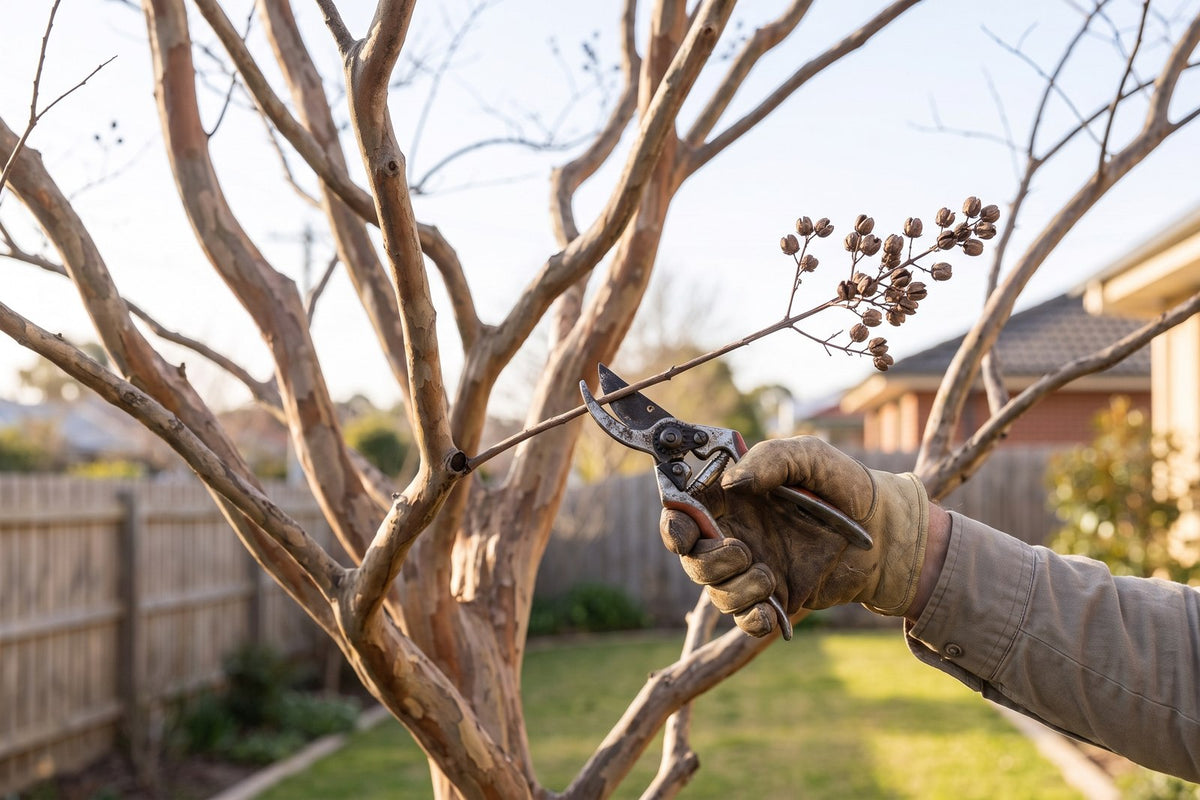
Crepe myrtles flower on new season growth, so prune in late winter. Here is the important part: they do not need hard pruning to flower well. Lopping every branch back to ugly stubs, the infamous crepe murder, ruins the natural vase shape and bark display while producing weak whippy growth. Instead, remove dead or crossing branches, lift the canopy if you want a clear trunk, and tip back last season's growth lightly. That is all.
Ongoing care
Watering: Weekly deep watering in the first two summers. After that they are genuinely drought hardy.
Feeding: A complete fertiliser in early spring. Excess nitrogen means leaves at the expense of flowers.
Mildew: Older varieties can grey over with powdery mildew in humid weather. The varieties above are resistant, but improve airflow and avoid overhead watering if it appears.
Where crepe myrtle grows in Australia

Crepe myrtle is one of very few trees that performs in every Australian capital city. It handles frost once established, tolerates heat and drought, and copes with both humid subtropical and dry Mediterranean summers.
| Location | How it performs |
|---|---|
| Sydney, Melbourne, Adelaide, Canberra | Outstanding - best autumn colour in the cooler cities |
| Perth | Excellent; dry summers suppress mildew |
| Brisbane and southeast Queensland | Very good, though mildew resistance matters more here |
| Tasmania | Performs well in sheltered positions |
| Tropical north | Grows, but flowering and autumn colour are less reliable |
Four seasons of interest
Few trees earn their space year-round and this is one. Bronze-green new growth in spring, months of large flower panicles through summer, orange and red foliage in autumn, then smooth mottled cinnamon bark peeling in sheets over a sculptural frame through winter.
Because it is deciduous it also lets winter sun through, which makes it one of the better trees to plant on the northern or western side of an Australian house - shade when you want it, warmth when you need it.
Do not commit crepe murder
This deserves its own heading because it is so common. Cutting every branch back to the same stubs each year - sometimes called crepe murder - produces a knobbly disfigured framework, weak whippy growth, and heavy flower heads that flop over. It also destroys the beautiful bark and branch structure that is half the reason to plant the tree.
Crepe myrtle flowers on new growth, so a light prune in late winter is all that is needed. Remove dead, crossing and inward-growing branches, thin congested growth to open the canopy, and shorten the previous season's growth. Leave the framework alone.
Choose the size before the colour
- Natchez - 6-8 m, white. For large gardens and avenues.
- Tuscarora - 5-6 m, coral pink.
- Acoma - around 3 m, white, semi-weeping. Good for smaller gardens.
- Zuni - 3-4 m, lavender pink.
- Diamonds in the Dark range - around 3 m with near-black foliage, for courtyards and pots.
Powdery mildew
The grey-white film on leaves and buds is the main disease, and it thrives in humid Australian summers. Older varieties are highly susceptible; the modern named cultivars were bred for resistance and stay noticeably cleaner.
In Brisbane and coastal Queensland, plant in full sun with good airflow, never water overhead, and choose a resistant cultivar rather than a cheap unnamed one.
Plant Drop's crepe myrtle selection guide is a useful cross-check on which of the named cultivars hold their mildew resistance and their size in Australian gardens.
Care
- Full sun - six hours minimum. Shaded plants barely flower and get more mildew.
- Plant in autumn or winter while dormant, or in spring.
- Water deeply through the first two summers, then only in extended dry spells.
- Feed in early spring; avoid high nitrogen, which pushes leaf at the expense of flowers.
- Allow room - most crepe myrtles finish about as wide as they are tall.
- Roots are well behaved, which is why they are used as street trees, but still allow two to three metres from paving and pipes.
Frequently asked questions
When do crepe myrtles lose their leaves?
They are deciduous, colouring orange to red in autumn and bare through winter, which lets winter sun into the garden. We answer this one in full in do crepe myrtles lose their leaves.
How fast do crepe myrtles grow?
40 to 60cm a year is typical, so tree forms reach 4m within five to six years.
Can crepe myrtles grow in pots?
Dwarf and Diamonds in the Dark types make excellent long term pot plants in large containers.
Why did my crepe myrtle not flower?
Almost always too much shade or pruning at the wrong time. Full sun and a late winter prune restore the show.
Ready to plant?
A single mature crepe myrtle is one of the cheapest ways to lift a front garden, as our guide to feature trees that instantly elevate a front yard shows. See the full crepe myrtle range within our flowering trees collection, or explore compact options among our flowering plants. Every order ships under our 30 day guarantee.
Crepe myrtle is an autumn planting favourite, and autumn is the real planting season: April was the busiest month of our year in What Australia Planted in 2025-26, ahead of every spring month.


