

Yuccas occupy a rare niche: genuinely sculptural plants that survive both the neglected office corner and the west facing garden bed that cooks everything else. The strappy rosettes and sturdy trunks bring instant structure, and the care requirements amount to sunlight, drainage and restraint with the watering can. For renters, travellers and self confessed plant killers, the spineless yucca in particular is close to unkillable.
The name covers a spread of plants, from soft leafed indoor types to the spectacular blue desert species, plus one popular impostor. Choosing between them is mostly a question of where the plant will live: inside near a window, on a hot patio, or holding down a corner of a waterwise garden for the next thirty years.
Quick facts
| Botanical name | Yucca elephantipes, Y. desmetiana, Y. rostrata and others |
| Type | Evergreen architectural shrub or small tree |
| Height | 1m to 5m outdoors, 1m to 2.5m indoors |
| Position | Full sun outdoors; bright light indoors |
| Soil | Free draining; cactus mix in pots |
| Growth rate | Slow to moderate |
| Climate | Arid to coastal temperate; most tolerate moderate frost |
Choosing the right yucca

For indoors and pots
The Spineless Yucca (Yucca elephantipes), from $19.95, is the best selling indoor tree yucca for a reason: soft leaf tips that will not spike passers by, tolerance of average indoor light, and a watering schedule measured in weeks. Silver Star Yucca, from $52.95, is its variegated sibling, with cream and silver striped leaves that lift a dim room. Both grow slowly indoors, which for a large architectural plant is a feature: less repotting, and years before one outgrows the space.
For garden beds
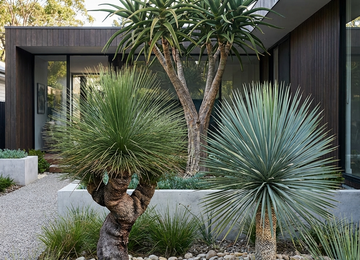
Yucca desmetiana is the soft textured one, a trunkless 1m to 1.5m rosette whose foliage flushes smoky purple burgundy in sun and cold, beautiful mass planted in modern landscapes. The showstopper is Beaked Yucca (Yucca rostrata), a slow growing desert species carrying a perfect silver blue pom pom of fine leaves atop a shaggy trunk, and one of the most cold hardy architectural plants you can buy.
The popular impostor
Red Yucca (Hesperaloe parviflora) is not a true yucca at all, but this grassy leafed cousin earns its place with arching coral pink flower spikes that run from spring to autumn and the same camel like water needs, from $36.95. Our guide to what makes red yuccas so popular covers it on its own terms.
Planting
Outdoors, give yuccas full sun and free draining soil; on clay, plant into raised mounds of gritty soil exactly as you would an agave. Space desmetiana at 80cm for mass planting, and allow trunk forming types like elephantipes a good metre from paths and walls. Yuccas pair beautifully with agaves and ornamental grasses in gravel gardens, and their tolerance of reflected heat makes them ideal against north and west facing walls that cook everything else. Our agave garden ideas show the combination at full scale, and the cowboy cactus adds vertical punctuation to the same bed. Indoors, position spineless and Silver Star yuccas within a metre or two of a bright window, pot them in a cactus mix, and choose a heavy pot, because a top heavy yucca in a light plastic pot is a slow motion accident. Water in once, then let the soil dry before watering again.
Ongoing care
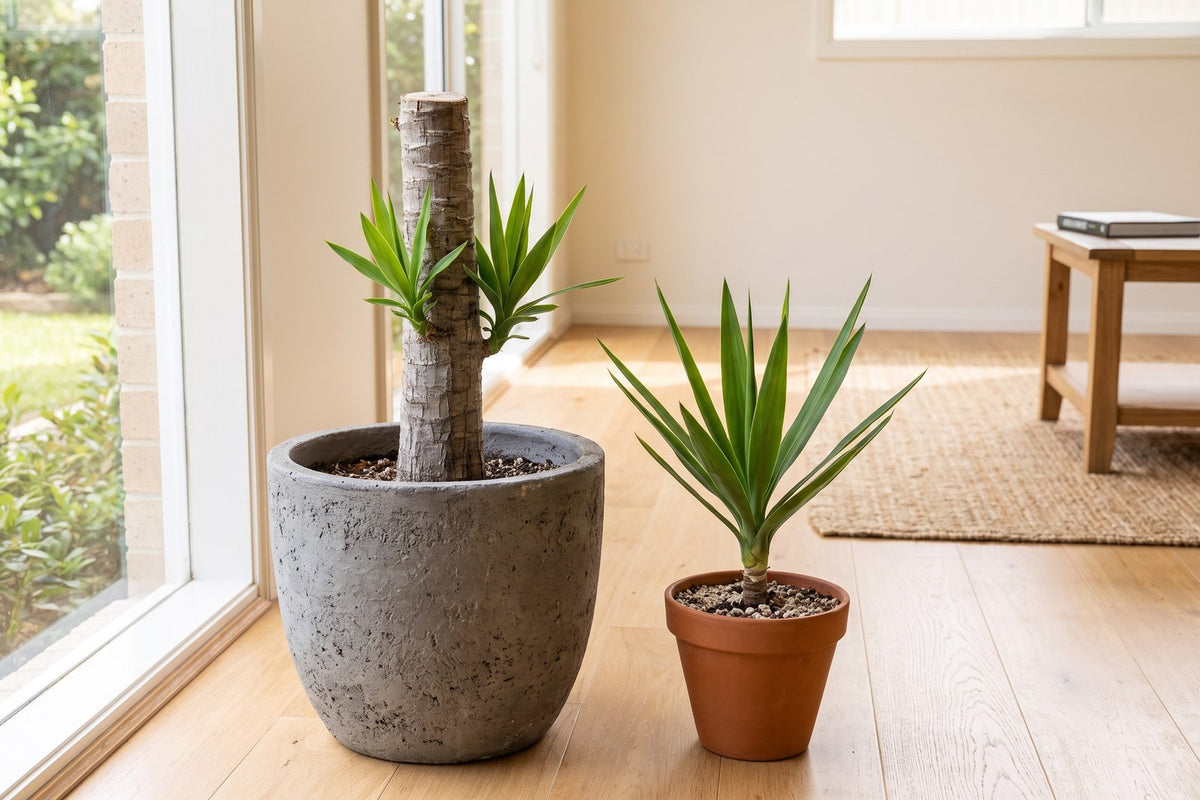
Watering: The golden rule is dry before drink. Indoors that means roughly every two to three weeks in summer and monthly in winter, watering thoroughly until it runs from the drainage holes, then emptying the saucer. Outdoors, established plants live on rainfall in most Australian climates, which puts yuccas firmly among the drought-tolerant plants worth using in a Brisbane garden.
Feeding: A single application of slow release fertiliser in spring is ample. Indoor plants can go years without and barely notice.
Pruning: Pull or cut off browned lower leaves to keep trunks clean. A leggy indoor yucca can be cut through the trunk at any height; it will reshoot below the cut, and the removed top can be potted as a cutting. Spring cuts reshoot fastest, and outdoor flower spikes of cream bells can be removed at the base once finished.
Common problems
Root rot: Yellowing, wilting and a soft trunk base come from overwatering, the only common way to kill a yucca. Let the pot dry out fully and repot into fresh dry cactus mix if the roots smell sour.
Brown leaf tips: Usually fluoride or salts from tap water in pots, or hot dry wind outdoors. Water deeply but less often, and trim tips with scissors for looks.
Pale, stretched growth indoors: Not enough light. Move within sight of a window; a yucca leaning like a sunflower is filing a formal complaint. If the room genuinely has no bright corner, choose from our best low light plants for the home instead.
Scale insects: Brown limpets along leaf bases, indoors especially. Wipe off with a cloth and treat with horticultural oil.
Where yuccas grow in Australia
Yuccas suit Australian conditions extremely well. They come from the dry regions of the Americas, and the combination of heat tolerance, drought hardiness and strong architectural form makes them one of the easiest feature plants in the country.
| Location | How it performs |
|---|---|
| Perth and Adelaide | Ideal. Dry summers and sandy soil are exactly right |
| Sydney and coastal NSW | Excellent in full sun with free drainage. Salt tolerant |
| Melbourne and Canberra | Good - most species handle frost once established |
| Brisbane and southeast Queensland | Good, but drainage is critical through humid wet summers |
| Dry inland and rural blocks | Outstanding. Survives on rainfall alone |
| Tropical north | Rot is the main risk. Plant raised, in gravel |
Drainage matters more than anything else
Yuccas are killed by wet feet far more often than by neglect, heat or cold. In a Brisbane or Sydney wet season, a yucca in heavy clay will rot at the base while an identical plant in sandy Perth soil beside it thrives.
On clay, plant on a raised mound with gravel mixed through the soil, and mulch with gravel or pebble rather than organic mulch, which holds moisture against the trunk. Never plant in a low spot where water collects after rain.
The spine question
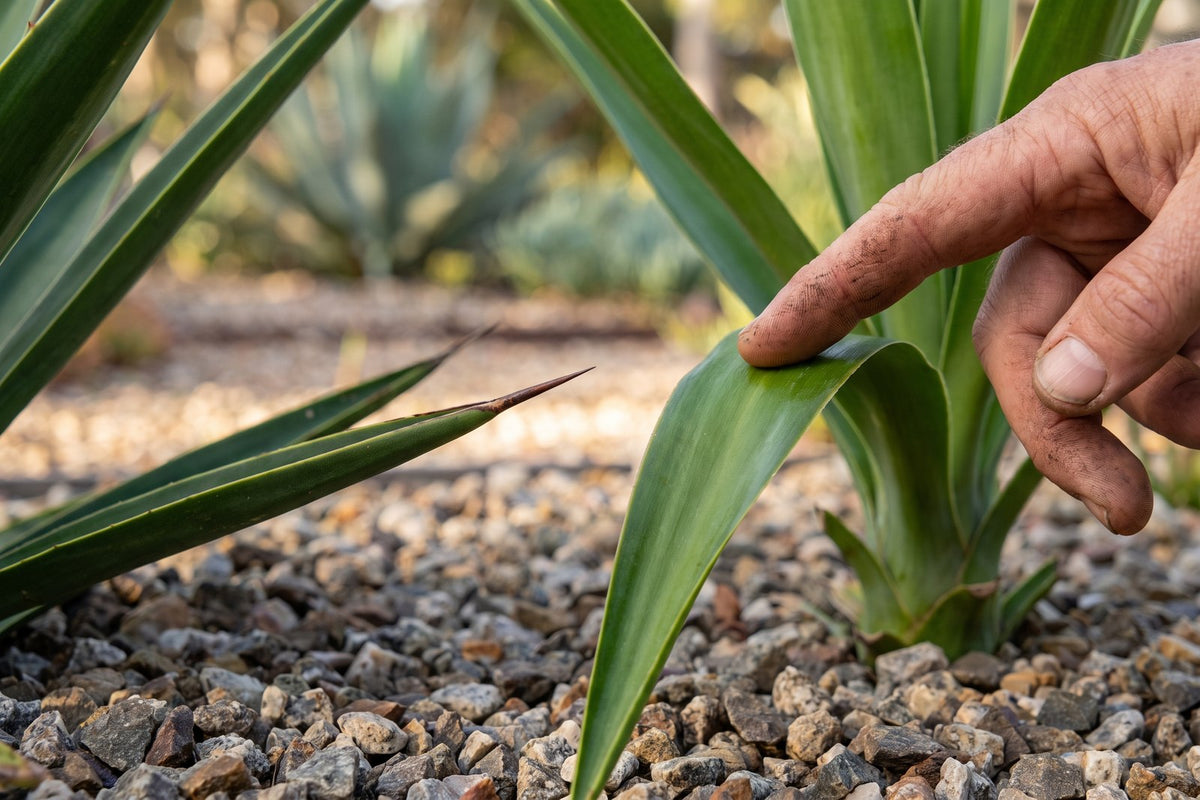
Several yucca species carry genuinely sharp terminal spines on the leaf tips, at exactly the height that causes eye injuries. Yucca aloifolia is the sharpest of the commonly grown species.
Yucca elephantipes, the spineless yucca, has soft leaf tips and is the one to plant near paths, driveways, pool surrounds and anywhere children play. It is also the best choice for a courtyard or a large pot. Check which species you are buying rather than assuming, because they look similar in a nursery.
Using them in an Australian garden
Yuccas sit naturally with the other dry-climate plants that share their conditions - agave, olive, pigface, blue chalksticks and gravel mulch. A single specimen against a rendered wall, or three of the same species repeated along a driveway, reads far better than a mixed collection. They are particularly useful in hot west-facing positions and on dry banks where irrigation is not practical.
Frequently asked questions
Are yuccas good indoor plants?
Spineless yucca is one of the best large indoor plants in Australia, handling bright to moderate light and irregular watering. Give it the brightest spot you have and it will hold its looks for decades.
Are yucca roots invasive?
Trunk forming yuccas have vigorous roots that can crowd nearby pipes and lift paving if planted hard against them. Keep large outdoor specimens at least 1m from paths, pools and plumbing.
Are yuccas frost tolerant?
Most handle light to moderate frost, and Yucca rostrata laughs at -10C. Spineless yucca is the most tender of the group, preferring frost free sites or a covered position.
Are yuccas toxic to pets?
Yes, mildly. The saponins in yucca foliage can cause vomiting in cats and dogs that chew it, so indoor plants are best kept away from persistent chewers.
Ready to plant?
Browse more low fuss greenery in our indoor plants collection, add structure from shrubs, or find a container that matches in pots and planters. Every plant ships under our 30 day satisfaction guarantee.


