

Agaves suit Australian conditions almost embarrassingly well. They handle heat that kills other feature plants, survive on rainfall in most of the country, need no pruning, and hold a strong sculptural shape all year. The design question is not really how to keep them alive - it is where to put them, because a mature Agave americana is two metres across with spines that will genuinely injure someone.
Quick facts
| Detail | What to expect in Australia |
|---|---|
| Size range | 400 mm to 2 m across, by species |
| Position | Full sun. Most tolerate reflected heat |
| Soil | Free draining. Sandy and gravelly is ideal |
| Water | Rainfall only, once established |
| Frost | Most tolerate light frost; few tolerate hard frost |
| Spines | Sharp on most species - a real siting factor |
| Lifespan | Many flower once after years, then die |
| Best climates | Perth, Adelaide, Brisbane, Sydney, dry inland |
Choose by size and spines
| Variety | Size | Spines | Best for |
|---|---|---|---|
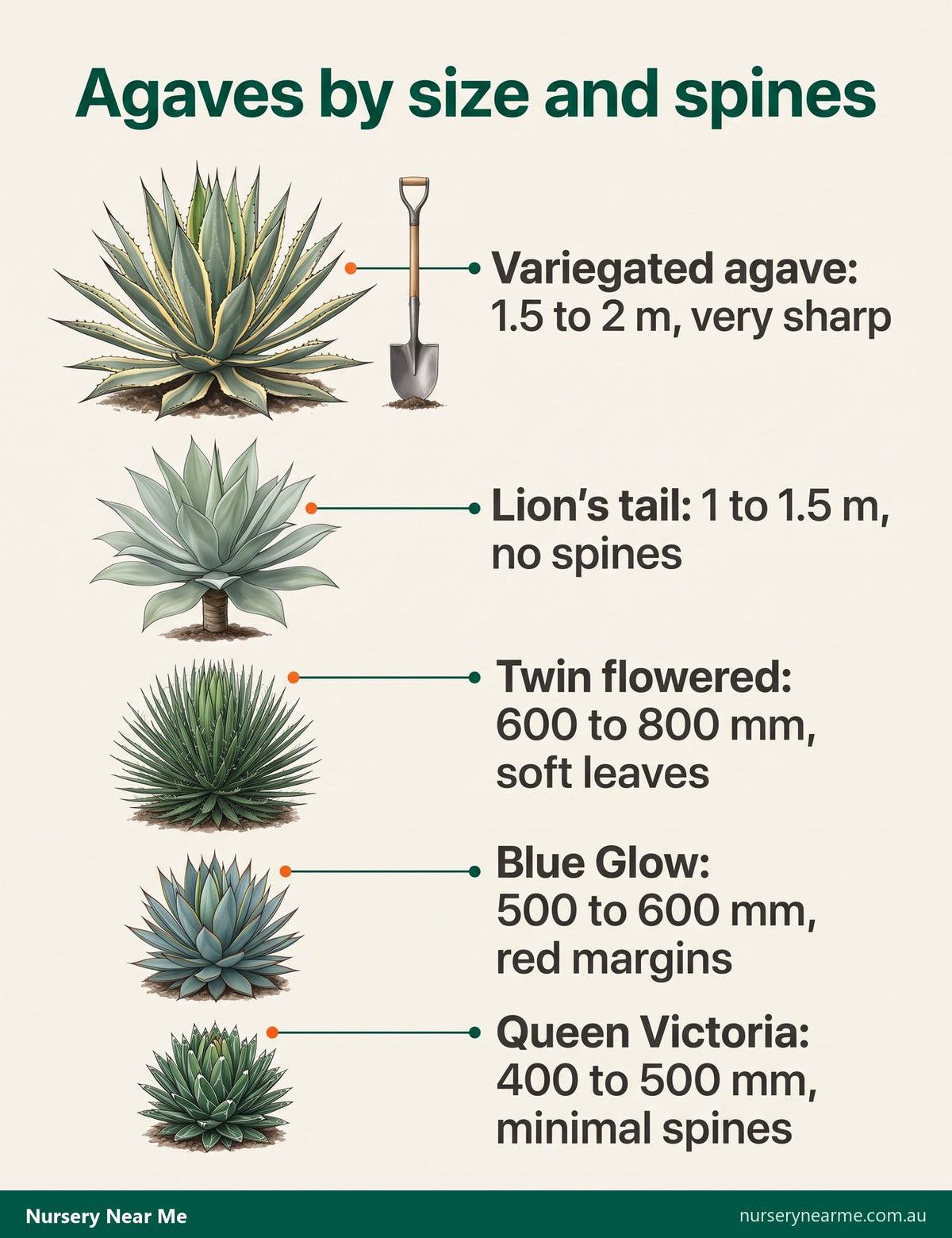
| Variegated agave | 1.5-2 m | Very sharp | Large feature, open beds only |
| Lion's tail (A. attenuata) | 1-1.5 m | None - soft leaves | Paths, pools and pots, frost free gardens |
| Blue Glow | 500-600 mm | Fine red margins | Pots, borders, courtyards |
| Queen Victoria | 400-500 mm | Minimal | Pots, close-up positions |
| Twin flowered (A. geminiflora) | 600-800 mm | Small tip spine only - soft, flexible leaves | Safe near paths and seating |
| El Miradores Gold | 800 mm-1 m | Sharp | Gold-edged feature |
Where people go wrong
Variegated agave is magnificent, but it reaches a metre and a half to two metres across with terminal spines sharp enough to cause serious eye injuries. It belongs in an open bed, a median strip or a large rockery where nobody walks past - not beside a path, a driveway or a play area.
The safe options
Lion's tail agave (Agave attenuata) has no spines at all: soft, pale green rosettes about a metre across that are safe beside a path, a pool or a play area, though it needs a frost free position. Agave geminiflora has no teeth and only a small tip spine - it makes a dense sphere of narrow, flexible leaves edged with fine filaments, and it is the other one to use near seating, paths and children. Queen Victoria agave is compact with striking white leaf markings and minimal spines, and it is arguably the most beautiful of the lot in a pot.
The best all-rounder
Blue Glow is the one most gardens should plant. It stays at 500 to 600 mm, has blue-green leaves with fine red and gold margins that light up at sunset, and is small enough to work in a pot or a border without dominating.
Five ways to use them
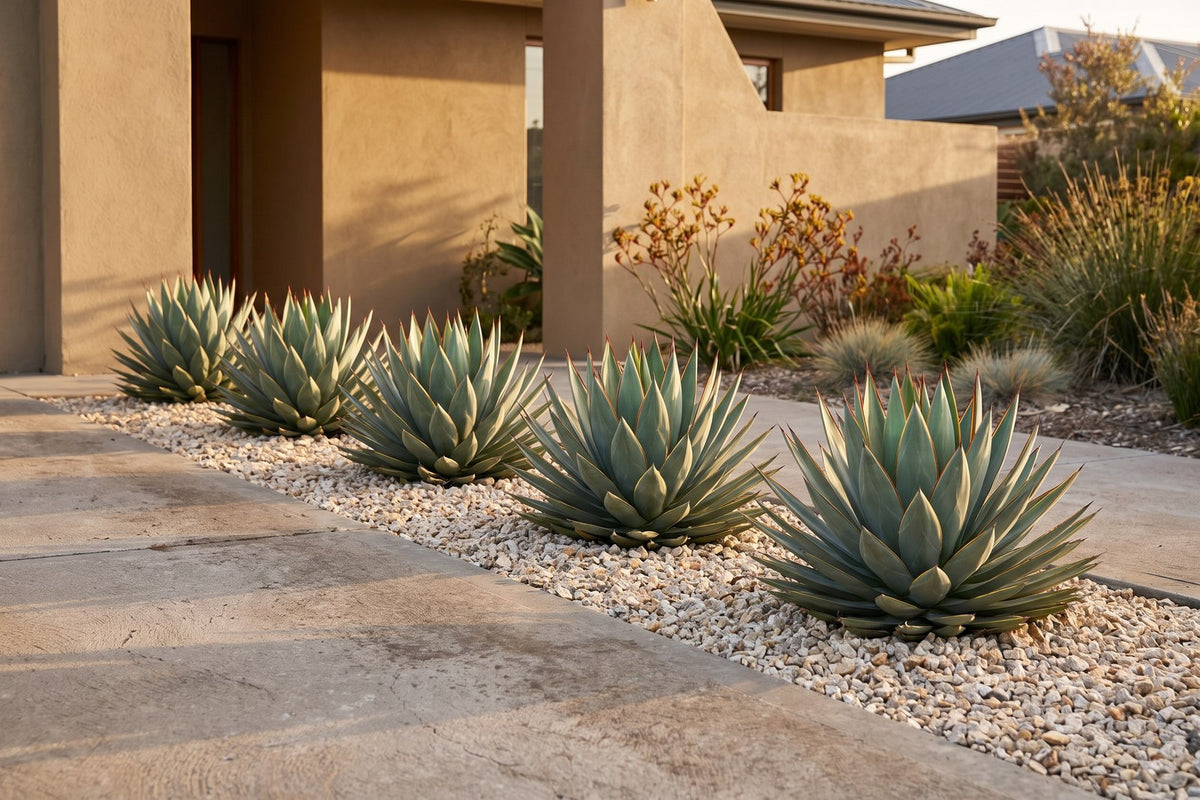
1. Single specimen in gravel
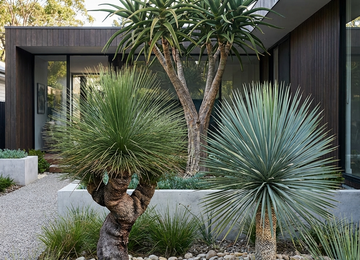
One large agave in a gravel or crushed-rock bed is the simplest and most effective treatment. The plant provides all the interest; the gravel keeps it dry-footed and weed-free. This works particularly well against a rendered or brick wall.
2. Repeated in a row
Three or five of the same variety spaced evenly along a driveway or bed reads as deliberate design in a way a mixed collection does not. Blue Glow and Queen Victoria suit this best because their size is predictable.
3. In pots
Agaves are excellent container plants - the restricted root run suits them, and a pot lifts a compact variety to where its form can be appreciated. Use a free-draining mix, a pot with real drainage, and never leave a saucer full of water.
4. With Mediterranean and dry-climate planting
Agaves sit naturally with olives, rosemary, lavender, pigface, jade plant and blue chalksticks. All want the same conditions, so a bed of them can be genuinely irrigation-free once established.
5. On a hot dry bank
Agaves hold soil on a slope, need no maintenance and thrive in the sharp drainage a bank provides - a good answer to an area that is difficult to plant and awkward to access.
Where they grow in Australia
- Perth and Adelaide - ideal. Dry heat and sandy soil match their Mexican origins closely.
- Sydney and coastal NSW - very good in full sun with free drainage. Also salt tolerant.
- Brisbane and southeast Queensland - good, but drainage is critical. Humid wet summers cause rot in heavy soil, so plant raised or in gravel.
- Melbourne - most handle light frost. Plant in the warmest, driest, best-drained spot available.
- Canberra and cold inland - hard frost damages many species. Grow compact varieties in pots that can shelter.
- Tropical north - humidity and wet-season rain make rot the main risk. Sharp drainage is essential.
Planting and care
- Full sun. Agaves in shade stretch and lose their tight symmetry.
- Drainage above everything. On clay, plant on a raised mound with gravel through the soil.
- Do not enrich the soil. Rich soil produces soft growth that rots and loses form.
- Plant with the crown slightly proud so water drains away from the centre.
- Water occasionally through the first summer, then stop.
- Mulch with gravel, not organic mulch, which holds moisture against the base.
- Wear thick gloves and eye protection when handling spined species. This is not optional advice.
The flowering question
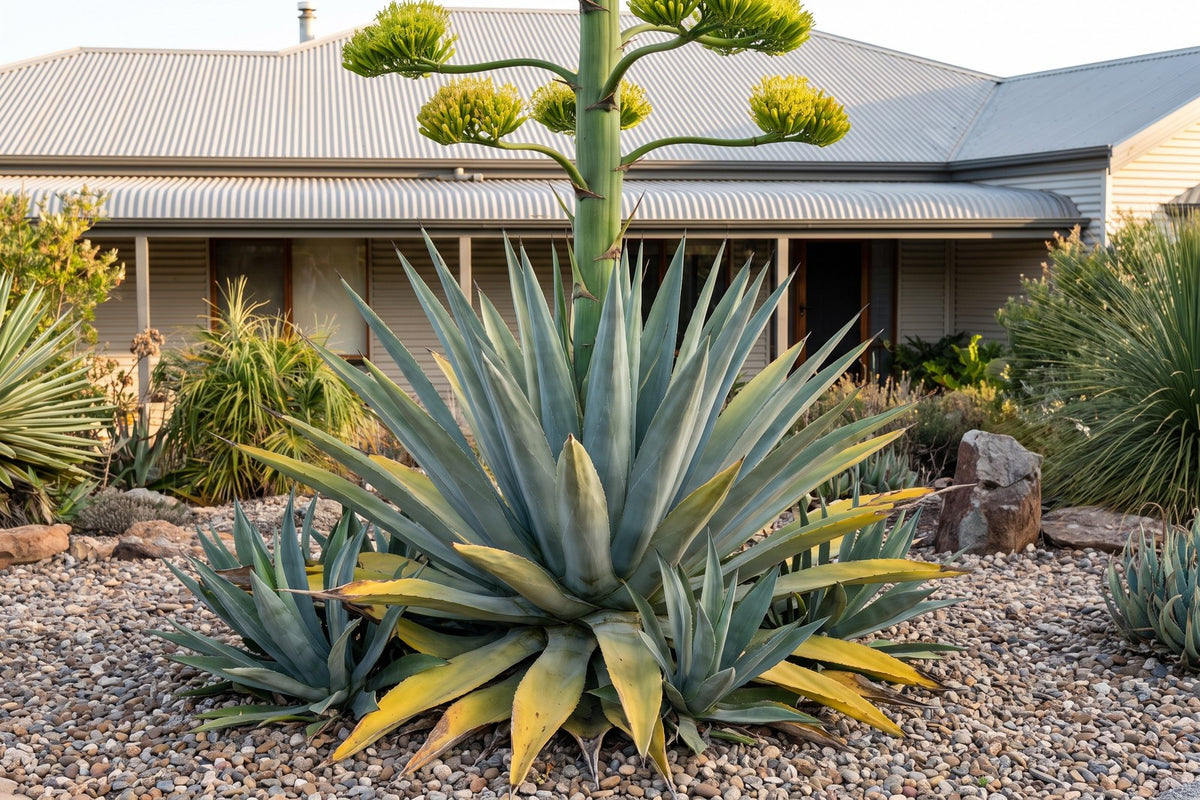
Most agaves are monocarpic - they grow for years, send up a tall dramatic flower spike, then die. Agave americana is sometimes called the century plant for this, though it typically flowers at ten to thirty years rather than a hundred.
The flowering itself is spectacular, and the parent plant usually leaves offsets around its base that carry on. If you want continuity, leave a couple of pups in place rather than removing them all.
Common problems and fixes
- Soft, rotting centre is water sitting in the crown or poor drainage. Plant raised and use gravel mulch.
- Stretched, loose form means too much shade.
- Black spots after cold is frost damage. Usually cosmetic unless severe.
- White cottony patches are mealybug. Treat with horticultural oil.
- Plant dying after flowering is normal, not a fault. Keep the offsets.
- Pups appearing everywhere - remove them while small, wearing gloves.
Frequently asked questions
Which agave has no spines?
Lion's tail agave (Agave attenuata) has none at all: its leaves are soft and pliable, which makes it the right choice near paths, pools and play areas in frost free gardens. Agave geminiflora comes close, with narrow, flexible leaves that have no teeth and only a small tip spine. Queen Victoria agave has minimal spines and is compact enough for pots.
How big does an agave get?
It depends entirely on species - Queen Victoria stays at 400 to 500 millimetres, Blue Glow at 500 to 600, while Agave americana reaches a metre and a half to two metres across.
Do agaves really die after flowering?
Most do. They are monocarpic, growing for years before sending up a tall flower spike and then dying. The parent usually leaves offsets around its base, so leaving a couple of pups keeps the planting going.
Can agaves grow in Brisbane's humidity?
Yes, with sharp drainage. The risk in a humid wet summer is rot rather than heat, so plant raised, use gravel through the soil and gravel mulch on top, and avoid low spots where water collects.
Do agaves need watering?
Occasionally through the first summer while establishing, then essentially not at all in most of Australia. Overwatering is the most common way to kill an agave.
Are agaves dangerous?
The spined species genuinely are. Terminal spines on Agave americana and other large spined species can cause serious injury including to eyes, and the sap irritates skin. Site them away from paths and play areas, and wear gloves and eye protection when handling them.
Ready to plant?
We grow agaves from compact pot varieties to large feature specimens. Browse our sun tolerant plants, or hardy plants for tough spots.
Related reading: 15 low maintenance plants for full sun and growing blue chalksticks.


