

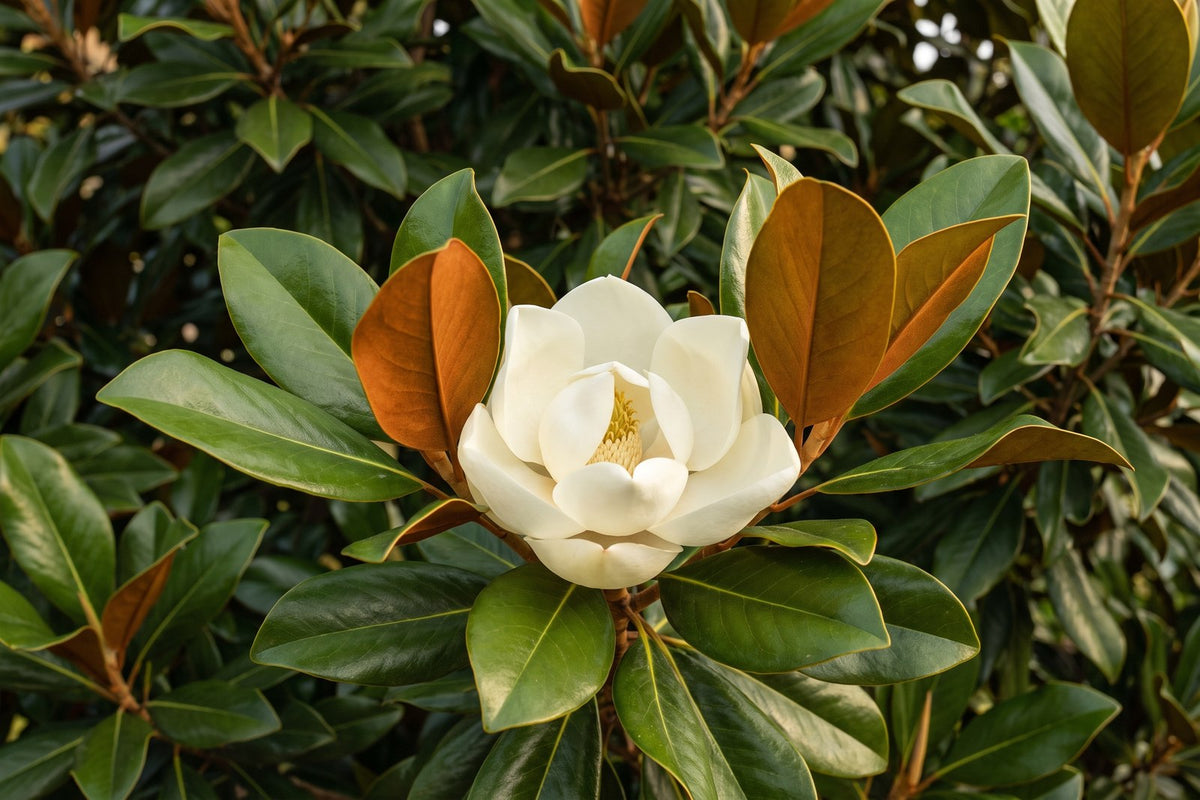
Teddy Bear has become the standard evergreen privacy screen in Australian gardens, and it deserves the position. It holds dense glossy foliage right to the ground, the leaf undersides are covered in rich brown felt that catches the light, it produces large fragrant cream flowers through summer, and it stops at around four metres instead of the twelve a full-size southern magnolia reaches. For a boundary that needs to look deliberate rather than merely functional, there is not much competition.
Quick facts
| Detail | What to expect in Australia |
|---|---|
| Botanical name | Magnolia grandiflora 'Teddy Bear' |
| Mature size | 4 m tall, 2-2.5 m wide |
| Habit | Naturally dense and upright, foliage to the ground |
| Foliage | Glossy dark green, brown felted underside |
| Flowers | Large cream, fragrant, summer |
| Position | Full sun to part shade |
| Frost | Hardy once established |
| Growth rate | Moderate - 300-400 mm a year |
| Best climates | Every Australian capital |
Why it works for screening
- It stays clothed to the ground. Many screening plants go bare and woody at the base; Teddy Bear naturally holds foliage low, which is exactly where privacy is needed.
- It is naturally the right size. At four metres it screens a single-storey house without constant cutting.
- It is narrow at two to 2.5 metres, so it suits boundaries where a wide hedge would encroach.
- It needs very little pruning - it is dense by nature rather than by clipping.
- It flowers, which very few evergreen screens do.
- It grows nationwide, from Brisbane through to Melbourne, Canberra and Perth.
How the magnolias compare for screening
| Variety | Height x width | Best for |
|---|---|---|
| Teddy Bear | 4 x 2.5 m | Standard privacy screen, single-storey |
| Little Gem | 4-5 x 2.5 m | Similar, slightly more open habit |
| Kay Parris | 4-5 x 2.5 m | Narrower leaf, strong bronze underside |
| Coolwyn Gloss | 5-6 x 3 m | Taller screens, glossier foliage |
| Exmouth | 8-10 x 5 m | Large shade tree, not screening |
Teddy Bear is the densest and most compact, which is why it is the default. Little Gem is similar with a slightly more open habit. If you need to screen a two-storey outlook, Coolwyn Gloss reaches five to six metres.
Planting a Teddy Bear screen
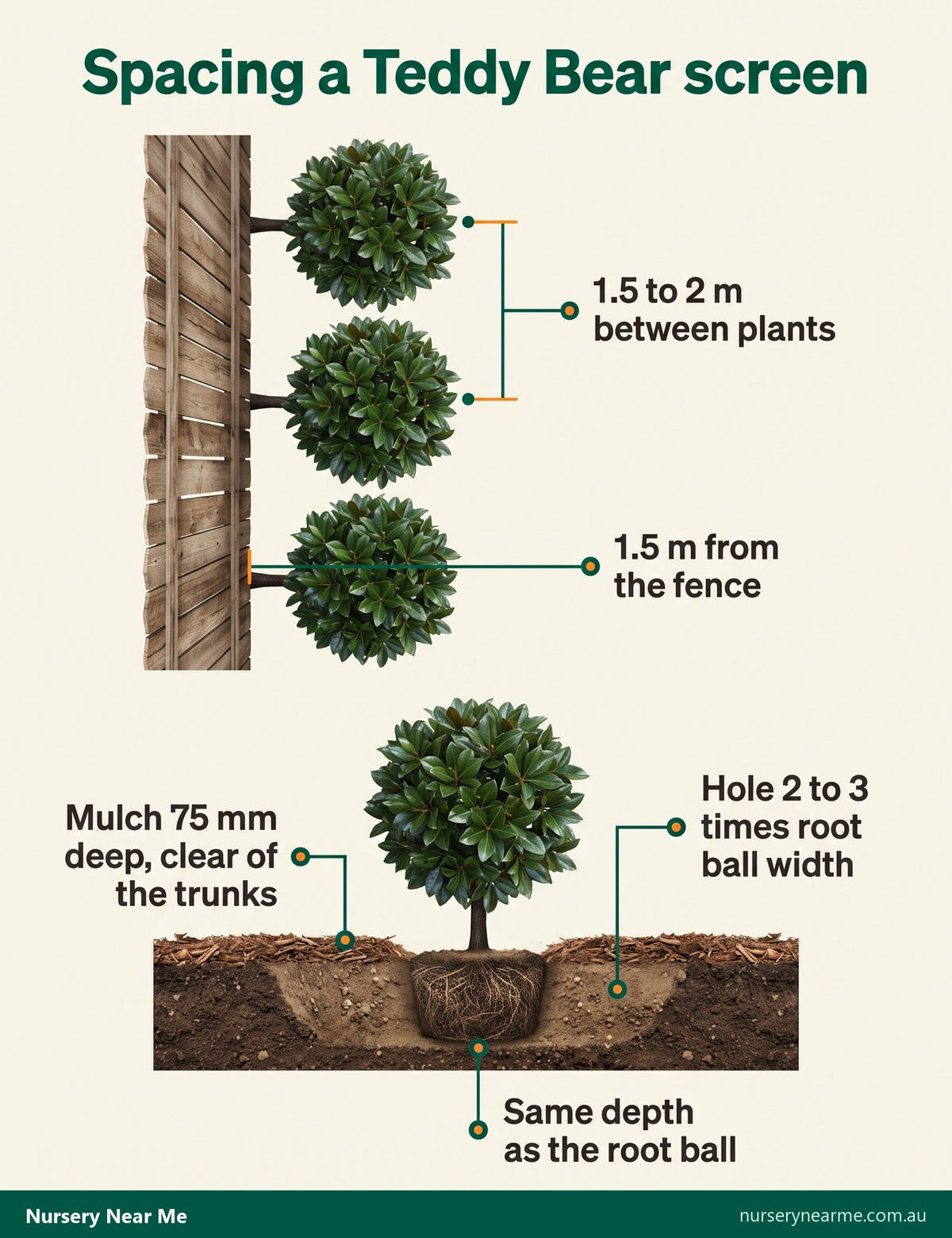
- Space at 1.5 to 2 metres for a continuous screen. Closer crowds the plants and spoils the natural form; wider leaves gaps.
- Plant in autumn or spring, avoiding extreme heat.
- Allow 1.5 m from a fence so you can reach both sides and the plant is not pushing against palings.
- Dig wide, not deep - two to three times the root ball width at the same depth.
- Improve heavy clay with compost and gypsum, and plant slightly raised. Magnolias dislike waterlogging.
- Mulch to 75 mm along the row, kept clear of the trunks.
- Water deeply twice a week through the first two summers.
Magnolias have fleshy surface roots that resent disturbance, so avoid digging around established plants and do not cultivate the soil beneath them. Mulch instead.
Where it grows in Australia
Teddy Bear is one of the more adaptable screening plants available, performing in Brisbane, Sydney, Melbourne, Adelaide, Canberra and Perth. It is frost hardy once established, tolerates heat, and holds its foliage year-round in all of them.
- Brisbane and subtropical Queensland - grows well, though flowering is lighter than in cooler climates.
- Sydney, Melbourne, Adelaide, Canberra - ideal, with the heaviest flowering.
- Perth - performs well with reliable summer water in sandy soil.
- Tropical north - grows but is not at its best; a subtropical native screen suits better.
Pruning: less is more
Teddy Bear is naturally dense, so it does not need the regular clipping a lilly pilly or murraya hedge requires. Light shaping after flowering is enough - remove any wayward branch and shorten growth that spoils the outline.
Avoid hard pruning. Magnolias do not reshoot from old bare wood as readily as lilly pillies, so a heavy cut can leave a permanent gap. If you need a formally clipped hedge, a lilly pilly or murraya is the better plant; Teddy Bear is for a screen that looks good with minimal intervention.
Ongoing care
Watering
Regular deep watering for the first two summers while establishing, then moderate. Established plants tolerate dry spells but the foliage looks better with consistent moisture.
Feeding
Feed in early spring and again after flowering with a controlled-release fertiliser. Magnolias prefer slightly acidic soil, so avoid lime and use an acidic mulch such as composted pine bark.
Common problems and fixes
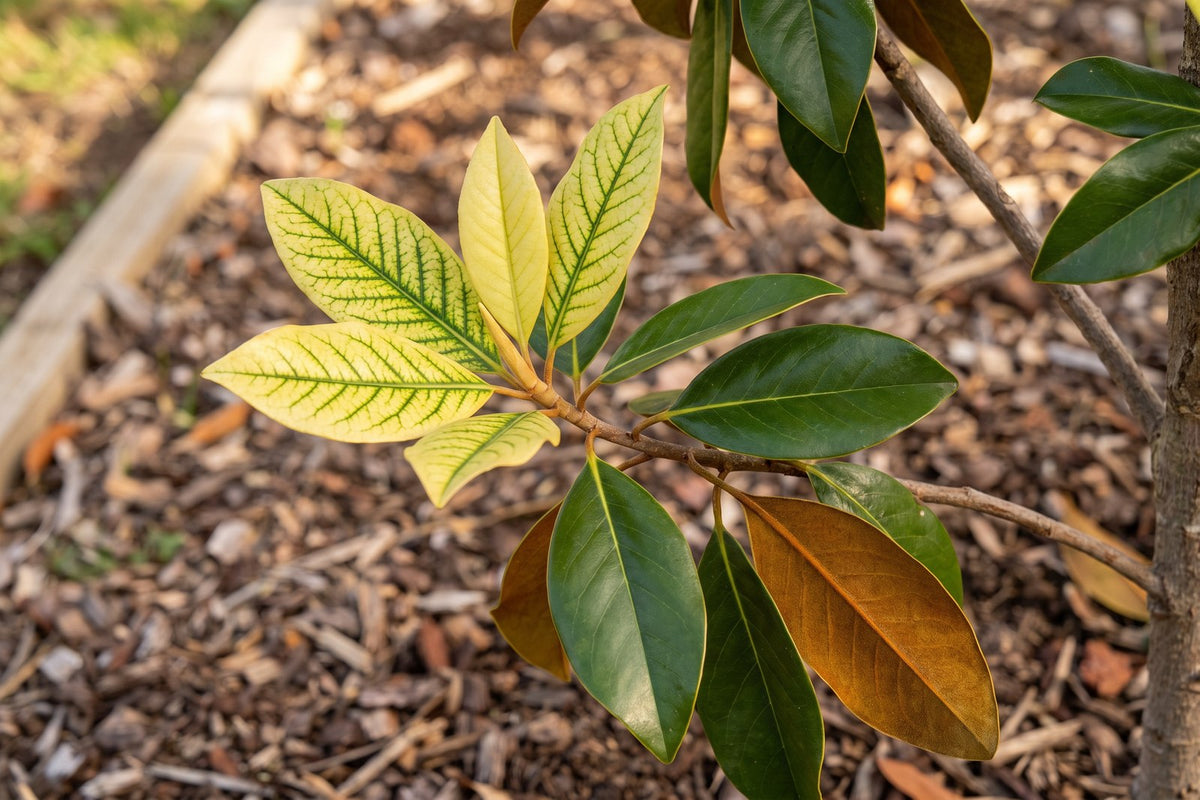
- Yellow leaves with green veins is iron deficiency in alkaline soil. Apply chelated iron and lower the pH with sulphur and acidic mulch.
- Thin, gappy screen usually means plants spaced too far apart, or too much shade.
- Older leaves yellowing and dropping in spring is normal - magnolias shed old foliage as new growth appears.
- Scale and sooty mould occur in still shaded positions. Treat with horticultural oil.
- Slow growth is often surface-root disturbance or dry soil. Mulch heavily and stop digging near the base.
- Permanent gaps after hard pruning - magnolias do not reliably reshoot from bare wood, so prune lightly.
Frequently asked questions
How far apart should I plant Teddy Bear magnolia for screening?
1.5 to 2 metres apart. That gives a continuous screen while letting each plant keep its naturally dense form. Closer crowds them without closing the screen any faster.
How tall does Teddy Bear magnolia grow?
Around four metres tall and two to 2.5 metres wide - considerably smaller than a full-size southern magnolia, which reaches eight to twelve metres. For screening a two-storey outlook, Coolwyn Gloss at five to six metres is the better choice.
Does Teddy Bear magnolia need pruning?
Very little. It is naturally dense and holds foliage to the ground without clipping. Light shaping after flowering is enough, and hard pruning should be avoided because magnolias do not reliably reshoot from bare wood.
How fast does it grow?
Moderately - around 300 to 400 millimetres a year. It is slower than a lilly pilly, so buying advanced stock is worth considering if privacy is needed quickly.
Will Teddy Bear magnolia grow in Melbourne or Perth?
Yes to both. It is one of the more adaptable screening plants, frost hardy once established and heat tolerant, performing across every Australian capital. Flowering is heaviest in the cooler cities.
Why are the leaves yellowing?
If yellow with green veins, it is iron deficiency from alkaline soil - treat with chelated iron. If older leaves yellow and drop in spring as new growth appears, that is normal leaf turnover rather than a problem.
Ready to plant?
We grow the full magnolia range in sizes from small plants to advanced screening stock. Browse our hedging and screening collection, or mature plants for immediate privacy.
Comparing screens? See the best fast growing screening trees and our lilly pilly care guide.
Before a tree goes in near the house, read our guide to planting near pipes: it sets out what Australian water utilities say about root behaviour, what can go directly over a sewer line, and which trees to keep well away.
For shade that lowers the cooling load, the shade trees guide covers placement in the southern hemisphere and the trees that do the job without damaging the house.


