

When a client asks a landscaper for privacy before next Christmas, the answer is very often a row of Pittosporum tenuifolium. These New Zealand natives, known there as kohuhu, are among the fastest respectable hedges available in Australia, putting on up to a metre a year while keeping the small, glossy, wavy edged leaves and dark stems that make them look expensive rather than rushed.
The breeding over the past twenty years has been outstanding, so there is now a pittosporum for almost every job: tall screens, mid height hedges and tight little balls that never need shaping into balls because they grow that way on their own. The care is identical across the range, which makes mixing sizes through a garden easy. Most cultivars also carry tiny chocolate purple flowers in spring, easy to miss by eye but hard to miss by evening perfume.
Quick facts
| Botanical name | Pittosporum tenuifolium cultivars |
| Type | Evergreen shrub |
| Height | 1-4 m depending on cultivar |
| Position | Full sun to part shade |
| Soil | Well drained, enriched with compost |
| Growth rate | Fast, up to 1 m per year |
| Climate | Temperate zones; frost hardy once established |
Choosing a pittosporum
Tall privacy screens
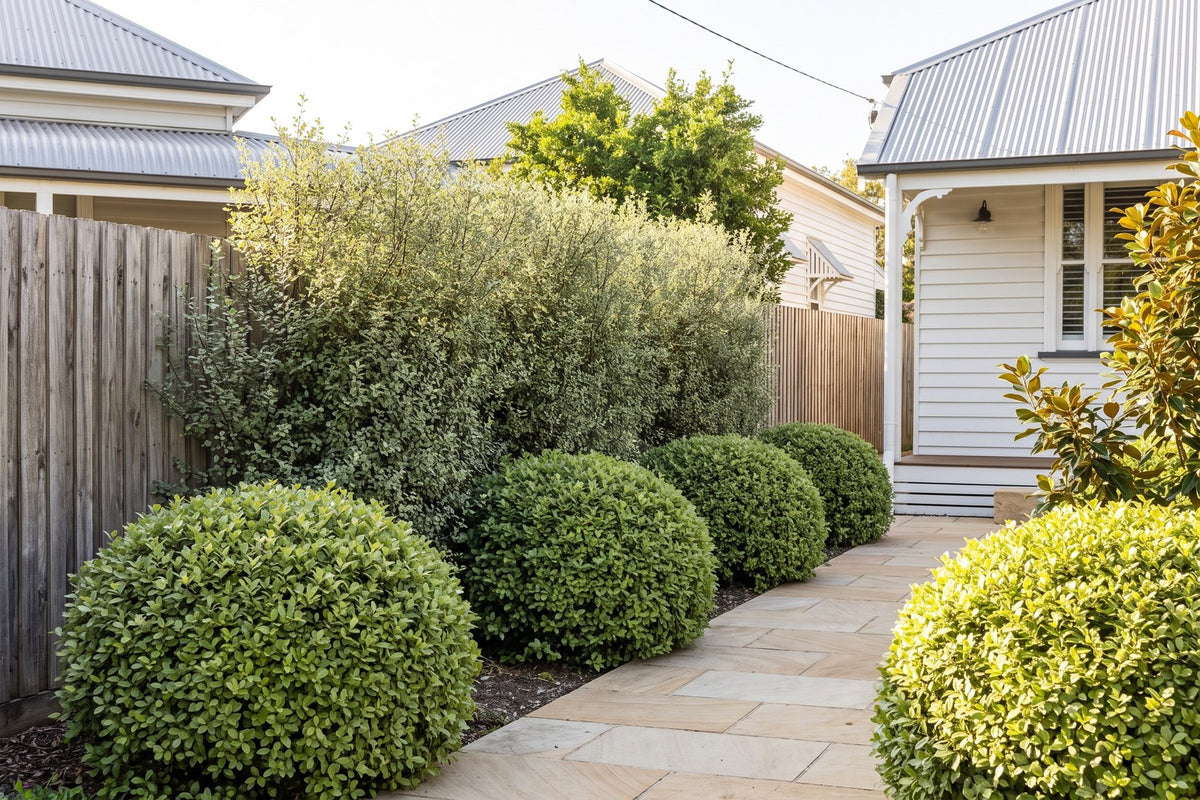
For classic silver screening, Silver Sheen Dream Kohuhu from $16.95 carries small shimmering leaves on black stems to around 3-4 m, catching light and moving in the breeze in a way solid hedges never do. The aptly named Screen Between Kohuhu from $31.95 was selected specifically for narrow boundary runs between houses, growing tall and tight without demanding width you do not have. Tasman Ruffles Kohuhu from $36.95 adds crimped, ruffled foliage and dense habit for a more textured screen.
Mid height hedges
Ivory Sheen Kohuhu from $31.95 offers pale cream green foliage to around 2 m, a lovely contrast planted against darker hedging.
Balls, borders and pots
Some pittosporums did the topiary work themselves. Golf Ball Kohuhu from $36.95 forms a naturally rounded dome to about a metre, while Pittosporum Green Dome from $19.95 does the same in rich green. Plant them in rows along a path or in pots at a doorway, and enjoy telling visitors you clip them daily.
Planting

Pittosporums want sun for at least half the day and, above all, drainage; more hedges are lost to waterlogged clay than to any pest. In heavy soil, mound the planting row 20-30 cm or install ag drainage. Dig through compost, then plant with the rootball just proud of soil level.
Spacing determines how quickly the screen closes: plant tall screening varieties like Silver Sheen Dream and Screen Between at 80 cm to 1 m apart, mid height hedges at 60-80 cm, and ball forms at 50-60 cm along borders. Water in thoroughly with a seaweed solution and mulch to 7 cm, keeping mulch off the stems. Set up dripline irrigation at planting; a hedge watered evenly grows evenly. In windy sites, a temporary shade cloth screen on the windward side for the first summer stops young plants losing more water than their new roots can replace.
Ongoing care
Watering: Deep soakings twice a week for the first summer, then weekly in dry spells. Established hedges are quite drought tolerant, but consistent moisture is what buys you that metre a year.
Feeding: Slow release fertiliser in early spring and again in midsummer, watered in well. Fast growers are hungry growers.
Pruning: Trim lightly and often rather than hard and rarely: twice a year minimum, in spring and late summer, taking no more than a third. Keep the hedge face slightly wider at the base than the top so lower foliage still receives light and stays dense.
Common problems
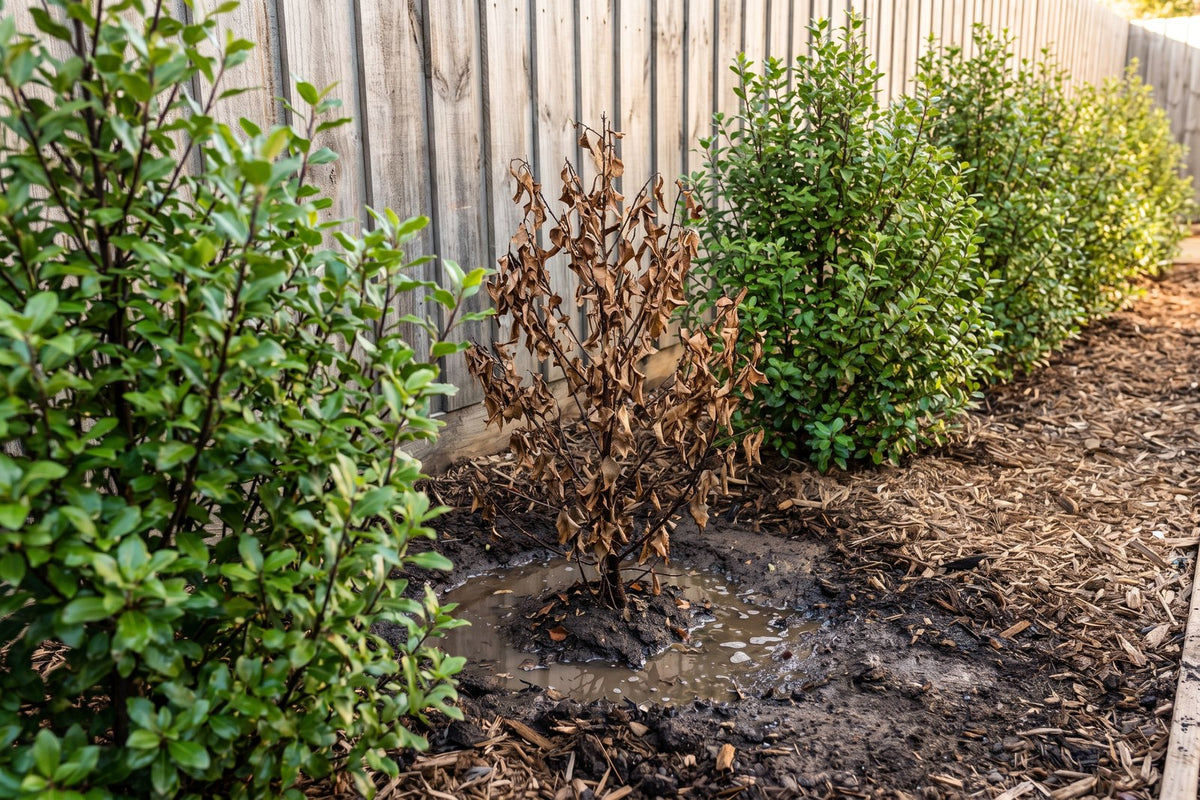
Sudden death of one plant in a row: Almost always root rot from poor drainage, and the reason we bang on about mounding. Remove the victim, improve drainage and replant with fresh stock, ideally a touch higher.
Thinning at the base: The hedge has been clipped narrower at the bottom than the top, shading its own skirt. Re establish a slight A shaped profile and lower growth will recover.
Leaf spot in humid summers: Dark spots and some leaf drop in muggy weather, mostly cosmetic. Thin congested growth for airflow and avoid overhead watering in the evening.
Psyllids and sooty mould: Pimpled, distorted new leaves or a black film indicate sap suckers. Two sprays of horticultural oil a fortnight apart on the new growth sorts both.
Where pittosporum grows in Australia
Pittosporum is planted across the whole country as a hedging and screening shrub, and it is genuinely adaptable - frost hardy, drought tolerant once established, and happy in sun or part shade.
| Location | How it performs |
|---|---|
| Melbourne, Adelaide, Canberra, Tasmania | Ideal. Cool climates suit the New Zealand species best |
| Sydney and coastal NSW | Excellent, one of the most planted screening hedges |
| Perth | Very good with reasonable summer water in sandy soil |
| Brisbane and southeast Queensland | Grows well, though humidity increases fungal leaf spot |
| Tropical north | Struggles. Constant humidity and heat are not its conditions |
Worth knowing: the native species is a weed outside its range
Pittosporum undulatum, sweet pittosporum, is genuinely native to the east coast of Australia, from southeast Queensland through New South Wales into eastern Victoria. Outside that natural range it has become a serious environmental weed - it is a declared or recognised environmental weed in parts of Victoria, South Australia and Western Australia, where birds spread its sticky orange seeds into bushland and it forms dense stands that shade out native understorey.
Being native to Australia does not make a plant safe everywhere in Australia. If you are in Adelaide, Perth or western Victoria, choose one of the New Zealand species such as P. tenuifolium, or check your council's guidance before planting sweet pittosporum near bushland.
Choosing for your climate
The P. tenuifolium cultivars - the silver and variegated hedging forms - are the cool-climate performers and are at their best in Melbourne, Adelaide and Tasmania. P. tobira handles heat and coastal salt better and suits Perth, Sydney and warmer gardens. In Brisbane humidity, keep plants well spaced for airflow, since crowded pittosporum hedges develop fungal leaf spot readily.
Frequently asked questions
How fast does pittosporum grow?
The tall screening varieties grow 60 cm to 1 m per year with water and feeding. A hedge planted from 20 cm pots at 1 m spacings typically gives real privacy inside three years.
How far apart should I plant a pittosporum hedge?
Plant tall screens at 80 cm to 1 m spacings, mid height hedges at 60-80 cm and compact ball varieties at 50-60 cm. Closer spacing closes the gap sooner but costs more plants.
Is pittosporum frost hardy?
Yes, established Pittosporum tenuifolium handles frosts to around minus 5 degrees. Protect new plantings in their first winter in cold inland districts.
Why did one plant in my pittosporum hedge die?
Isolated deaths are nearly always waterlogging and root rot in that section of the row. Check drainage before replanting, and mound the replacement slightly higher than its neighbours.
Ready to plant?
Measure your fence line, do the spacing maths and get the whole row ordered in one go so the hedge matures evenly. Browse our privacy and screening range and fast growing plants, or compare other shrubs. Our delivery page covers hedge quantity orders.
For the view from the street, our front yard kerb appeal planting guide works through hedges, feature trees and groundcovers that make a house look finished from the footpath.


