

Blueberry ash, Elaeocarpus reticulatus, is one of those natives that quietly outperforms almost everything planted around it. It grows as a slender, upright evergreen tree, usually 8 to 10 metres in gardens, with glossy deep green leaves, new growth flushed bronze, and masses of small fringed bell flowers in spring and early summer. The flowers, white or soft pink depending on the form, look hand cut, and they are followed by bright blue berries about the size of a pea that bring currawongs, bowerbirds and figbirds into the garden through autumn and winter.
Its shape is what makes it so useful. Blueberry ash stays narrow, rarely spreading more than 3 to 4 metres, so it fits driveways, boundary lines and courtyards where a spreading tree would be a nuisance. It comes from rainforest margins along the east coast, from Queensland down through New South Wales into Victoria, which tells you most of what it wants: decent moisture, reasonable drainage and protection from hard frost while young.
Quick facts
| Botanical name | Elaeocarpus reticulatus |
| Type | Evergreen native tree |
| Height | 8 to 10 m in gardens, 3 to 4 m wide |
| Position | Full sun to part shade |
| Soil | Moist, well drained, slightly acidic |
| Flowers | White or pink fringed bells, spring to early summer |
| Climate | Coastal Qld, NSW and Vic; tolerates light frost once established |
Choosing a blueberry ash
For most gardens the straight species is the right call. Our Blueberry Ash Tree starts from $22.95 in smaller grades, which is the cheapest way to plant a future 8 metre feature tree. Young plants establish quickly and often flower within two to three years, so you are not waiting a decade for a result.
If you want instant impact, the pink flowering form Prima Donna is the one collectors chase. It flowers heavily, holds a tighter habit than the species and the soft pink bells read beautifully against the dark foliage. We offer Prima Donna Blueberry Ash as an ex-ground advanced tree from $6278.95, dug and prepared for transplant, for projects where a mature tree needs to be there on day one.
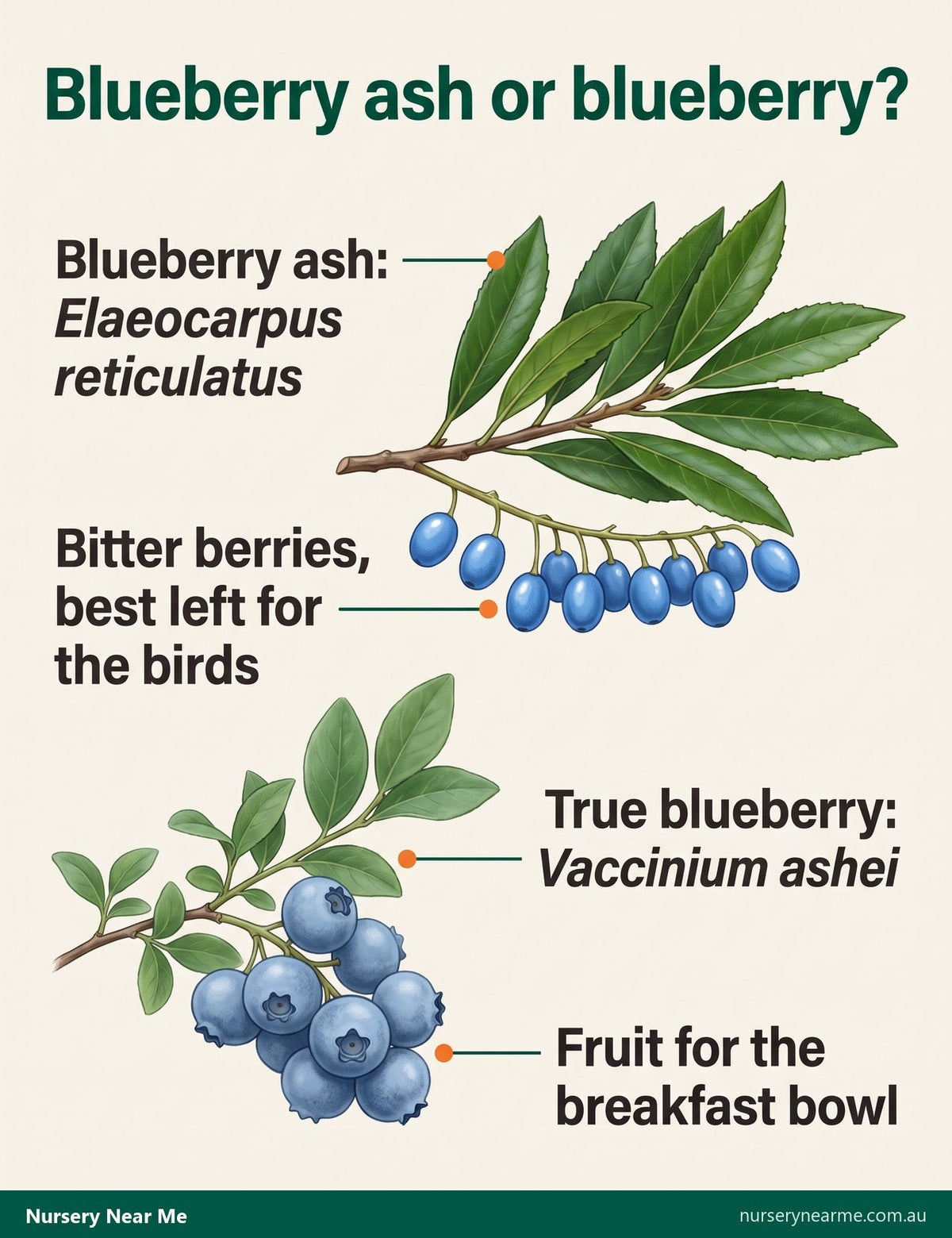
One naming note worth clearing up: the Blueberry Premier from $21.95 is a true fruiting blueberry, Vaccinium ashei, and no relation at all. The blue berries on Elaeocarpus are strictly for the birds, so if you are after fruit for the breakfast bowl, plant both and let the birds argue over the wrong one.
Planting

Pick a spot with full sun to part shade. In cooler districts, more sun means better flowering; in hot inland gardens, afternoon shade for the first few summers helps. Blueberry ash prefers a slightly acidic, well drained soil enriched with compost, but it is remarkably tolerant of heavier soils provided water does not pool around the roots for days.
Dig a hole twice the width of the pot and the same depth, tease out any circling roots, plant so the root ball sits level with the surrounding soil, then backfill and water in with 10 to 20 litres. Mulch 50 to 75 mm deep, keeping mulch clear of the trunk. For a screening row, space trees 2 to 3 metres apart; as a single feature, allow at least 2 metres from paths and structures. Water deeply twice a week for the first summer.
Ongoing care
Watering: Keep soil consistently moist for the first 12 to 18 months. Once established, blueberry ash handles normal coastal rainfall with only occasional deep soaks in extended dry spells. It is a rainforest margin tree, so it will sulk in bone dry soil but never needs pampering.
Feeding: Apply a controlled release native fertiliser in early spring and again in early autumn. It is not as phosphorus sensitive as banksias or grevilleas, so a general slow release also works, but a native blend is the safe default.
Pruning: Very little needed. Remove lower branches progressively if you want a clear trunk, and lightly tip prune after flowering to thicken the canopy. It responds well to shaping and is sometimes even hedged, though that wastes its best feature, the naturally elegant narrow form.
Common problems

Slow early growth: Usually dry soil or heavy competition from lawn. Clear grass to a one metre circle, mulch well and water deeply through the first two summers, and growth typically jumps to 50 to 80 cm a year.
Yellowing leaves: Often a sign of alkaline soil or waterlogging. Check drainage first, then apply iron chelates and a soil acidifier if your pH is above 7.
Frost burn on new growth: Young trees can be marked by frosts below about minus 2 degrees. Protect for the first two winters with a frost cloth; established trees shrug off light frost.
Sooty mould: Occasionally scale insects set up on the foliage and sooty mould follows. Treat the scale with horticultural oil in the cool of the evening and the mould weathers off.
Frequently asked questions
How fast does blueberry ash grow?
Expect 50 to 80 cm a year once established in good conditions. It is moderate rather than rocket fast, which is part of why it makes such a well behaved street and garden tree.
Are blueberry ash roots invasive?
No. It has a relatively compact, non aggressive root system for a tree of its size, which is why councils plant it near paths and services. Keep it 2 metres or more from structures as standard practice.
Can you eat the blue berries?
They are not considered edible eating in the normal sense; the thin flesh is bitter and they are best left for the birds. For edible fruit, plant a true Vaccinium blueberry instead.
Will blueberry ash grow in a pot?
Yes, for some years. Use a 40 cm or larger pot with quality potting mix, water regularly and feed each spring. Long term it wants to be a tree in the ground.
Ready to plant?
Blueberry ash earns its place in almost any east coast garden, whether as a driveway avenue, a narrow screen or a single feature with birds in it half the year. Browse our full range of native plants, compare it with other feature trees, or start small and cheap with tubestock. Not sure what size to order? Our pot and bag size guide explains exactly what arrives, and our delivery page covers your area.


