

Every parterre, knot garden and crisply edged path you have ever admired owes its lines to buxus. Box has been the backbone of formal gardens for centuries because nothing else combines such small, dense evergreen foliage with such tolerance for constant clipping. It grows slowly, which is precisely the virtue: a box hedge trimmed twice a year holds its shape with almost no effort in between.
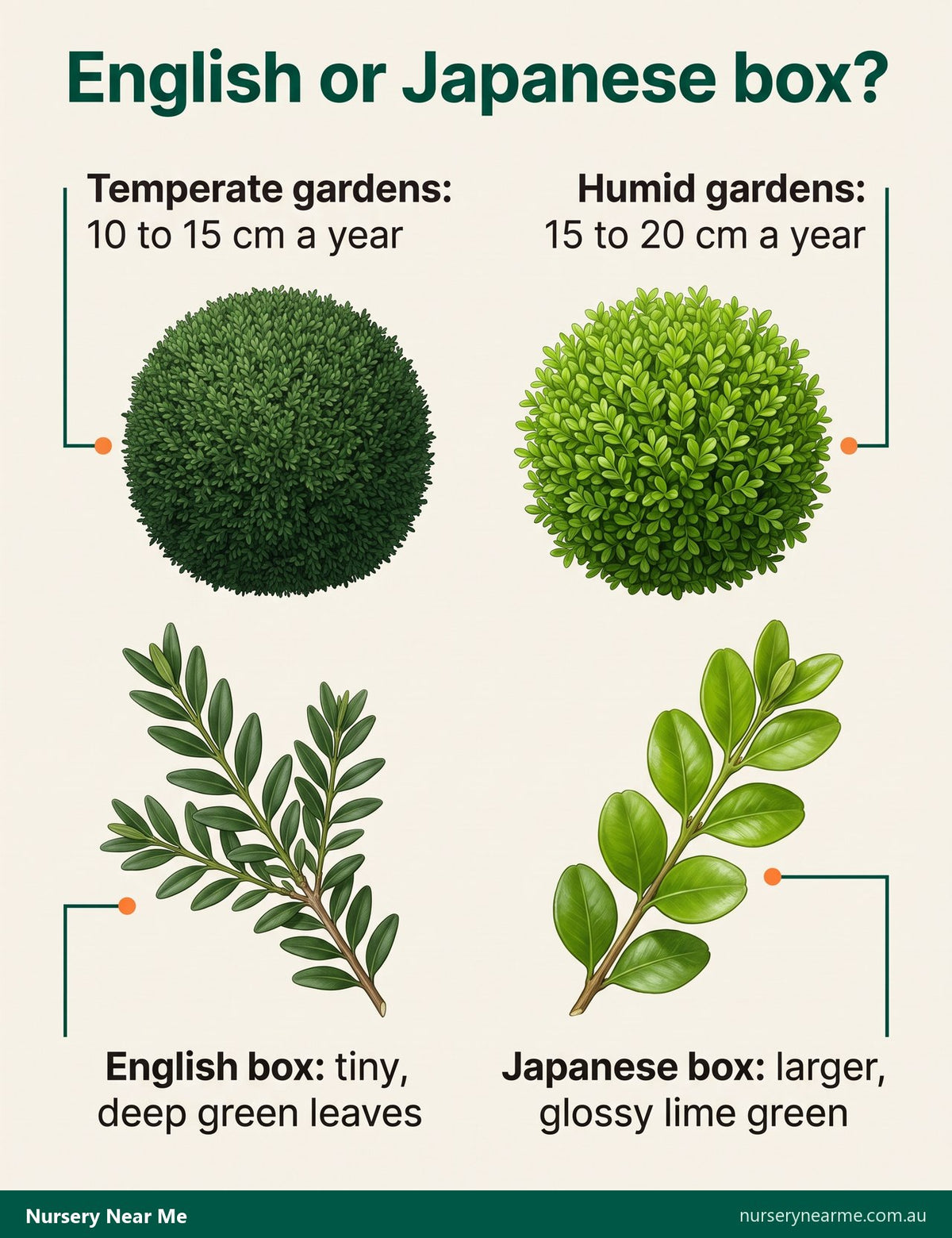
The one decision that matters is species. English box is the tight, slow, deep green classic for temperate gardens, while Japanese box is faster, glossier and far happier in heat and humidity. Choose correctly for your climate and a box hedge will outlive the person who plants it, which is either comforting or sobering depending on the day.
Quick facts
| Botanical name | Buxus sempervirens, B. microphylla |
| Type | Evergreen dwarf shrub |
| Height | 30 cm to 1 m as clipped hedges |
| Position | Full sun to part shade |
| Soil | Any well drained soil; tolerates lime |
| Growth rate | Slow, 10-20 cm per year |
| Climate | English box for temperate zones, Japanese box for warm and humid |
Choosing your buxus
Cool and temperate gardens
The traditional English Box (Buxus sempervirens) from $10.95 is the connoisseur's edge: tiny deep green leaves, the densest surface of any box and that distinctive resinous scent after clipping. It thrives in Melbourne, Adelaide, Tasmania and the highlands, and it is one of the reliable performers in our guide to frost tolerant plants in Australia. For a slightly larger scale hedge from the same species, Evergreen Box from $22.95 provides more advanced starter plants for quicker impact.
Warm and humid gardens
From Sydney north, plant Japanese Box (Buxus microphylla japonica) from $16.95 instead. Its slightly larger, glossier lime green leaves handle heat and humidity that make English box sulk, and it grows noticeably faster. The refined Faulkner Dwarf Japanese Box from $36.95 keeps a tighter, more compact habit suited to low borders and pots.
Specialty choices
Korean Box (Buxus microphylla) from $16.95 is the cold weather champion, shrugging off hard frost that bronzes other species, while Harland Boxwood (Buxus harlandii) from $10.95 offers narrow, elongated leaves and is a favourite with bonsai growers for its fissured bark. Any of the compact forms also make handsome clipped spheres in pots flanking a doorway.
When box is not the answer
Box is unbeatable below a metre, but it is a poor choice when you need height quickly. For a screen rather than an edge, the pittosporum care guide and photinia care guide cover two hedges that will reach two or three metres in the time box takes to reach knee height, and our roundup of fast growing hedges for Aussie gardens compares the field.
Planting
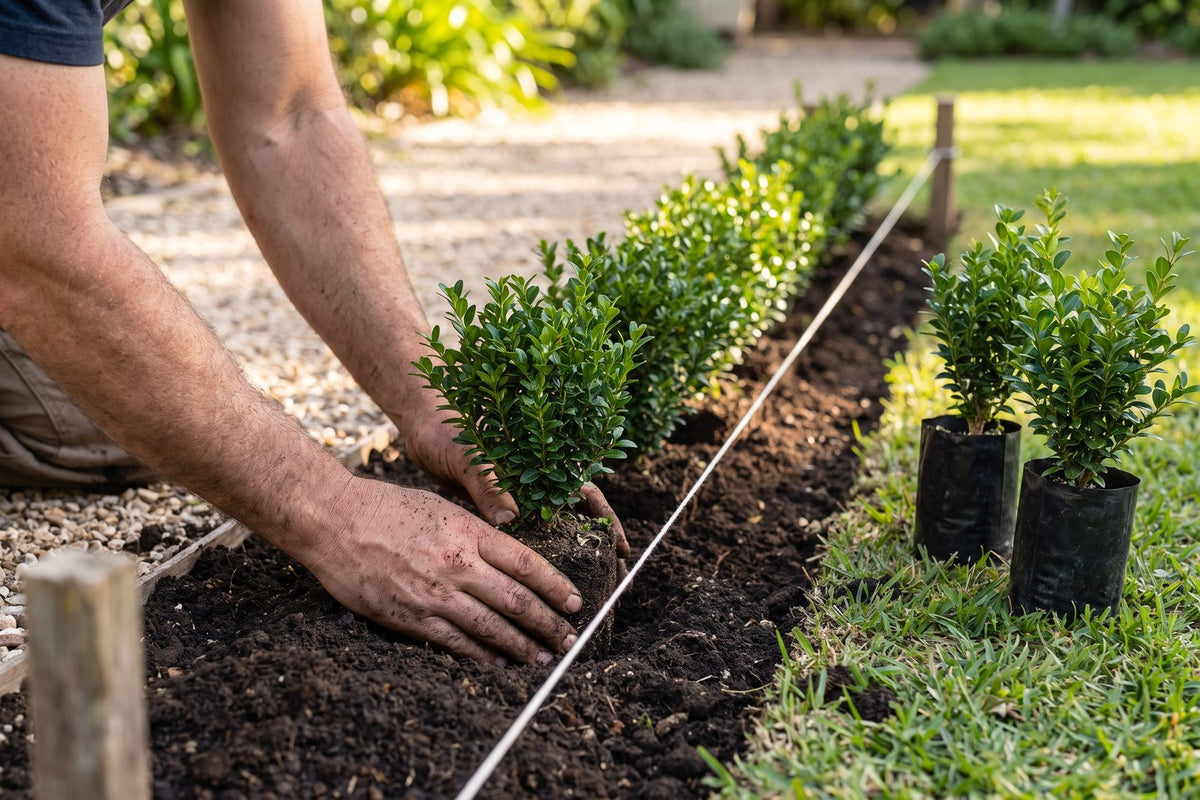
Box grows in full sun or part shade, and Japanese box will even tolerate quite shaded courtyards. Soil simply needs to drain; box is one of the few hedges genuinely happy in alkaline soil near limestone and new concrete. Dig through compost along the whole trench rather than individual holes, which encourages roots to run the length of the hedge. Water the tubes or pots the night before planting so every rootball goes in fully charged, and firm each plant in with your knuckles rather than a boot heel.
Spacing is where formal hedges are won: plant at 20-25 cm apart for a low border under 40 cm, or 30-40 cm apart for hedges to a metre. Set a string line first; a wobbly box hedge advertises itself for decades. Water in with seaweed solution and mulch lightly, keeping mulch clear of stems.
Ongoing care
Watering: Weekly deep watering through the first two summers, then only in hot, dry spells. Shallow rooted box appreciates mulch more than most hedges.
Feeding: Feed in early spring and early autumn with a balanced slow release fertiliser. Nitrogen hungry box that misses meals turns a telltale bronze orange.
Trimming: Clip twice a year, in late spring after the first flush and again in late summer. Never trim in frosty weather or full midday sun, which scorches the fresh cut surface. Keep a photo of the hedge at its best and clip back to that line each time; eyes drift over the years, photos do not. Sharp shears or a battery hedge trimmer both work; blunt tools bruise the leaves brown. The general principles apply to any formal line, and our guide on how to create a great hedge and keep it looking sharp covers batter angles and renovation cuts.
Common problems

Orange or bronze foliage: Winter cold, hunger or water stress rather than disease. Feed in spring, water in dry spells, and colour returns with new growth.
Patchy dieback inside the hedge: Usually root disturbance or dog urine at a favourite corner. Cut out affected sections to healthy wood and feed; box reshoots reliably from old wood.
Box blight: Rare in Australia but serious: black stem streaks and bare patches spreading in humid weather. Improve airflow, water at the base only, disinfect tools, and remove badly affected plants.
Scale insects: White or brown bumps along stems with sticky leaves. Spray twice with horticultural oil, two weeks apart, after trimming.
Using box in the garden
A clipped box line is the cheapest way to make a garden look designed, which is why it appears in almost every front garden that stops people on the footpath. Our guide to front yard planting for kerb appeal shows how to run those lines against a facade, while the perfect edging plants covers the softer alternatives if you would rather not clip anything at all. In a tight space, small courtyard garden ideas shows how a single low box square can organise an entire paved area.
Frequently asked questions
How far apart should I plant English box for a hedge?
Plant 20-25 cm apart for low formal borders and 30-40 cm for taller hedges. Consistent spacing matters more than generous spacing in a formal line.
How fast does buxus grow?
Slowly: English box manages around 10-15 cm a year and Japanese box 15-20 cm. A 30 cm border established from tubestock takes roughly three to four years to knit solid.
Which box hedge is best for Brisbane and humid climates?
Japanese box, without question. It tolerates heat and humidity that stress English box, holds glossier foliage and grows faster in the subtropics.
Can I grow buxus in pots?
Yes, box is a classic container and topiary plant. Use a pot at least 30 cm wide, premium mix, and feed twice yearly; potted box dries out faster than it looks like it should.
Ready to plant?
A formal garden is mostly patience arranged in straight lines, and box supplies the lines. Start with economical tubestock for long runs, browse our full shrub range, and read our pot and bag size guide to choose the right starting size for your budget.
English Box is no period piece. It finished sixth nationally and third in Queensland when we counted a year of orders in What Australia Planted in 2025-26.
The same thinking applies out the front. See front yard planting for kerb appeal for the combinations that photograph well and survive neglect.


