

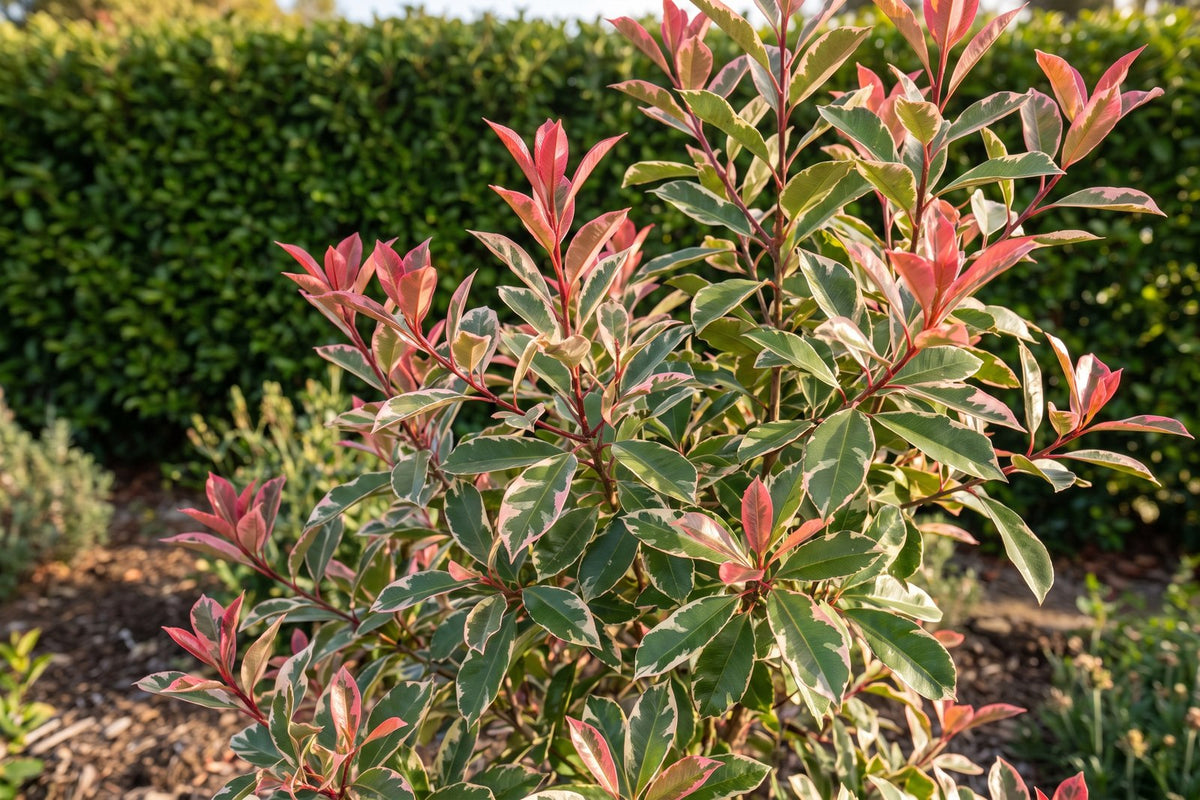
Photinia runs on a simple and rather brilliant piece of biology: every time you cut it, the new growth emerges bright red before maturing to deep glossy green. Trim a photinia hedge and a fortnight later it is wearing a scarlet crown, which makes it one of the few hedges that actively rewards maintenance. Add serious toughness, and its enduring popularity across Australia makes complete sense.
These are hedges for the real world: frost to well below zero, summer heat, wind, average soil and irregular watering once established. If a boundary needs covering and conditions are less than pampered, photinia belongs on the shortlist every time, alongside the other options in our roundup of fast growing hedges for Aussie gardens.
Quick facts
| Botanical name | Photinia x fraseri and related species |
| Type | Evergreen shrub |
| Height | 3-5 m unclipped; usually hedged at 2-3 m |
| Position | Full sun to light shade |
| Soil | Any well drained soil |
| Growth rate | Fast, 60 cm or more per year |
| Climate | Frost hardy and heat tolerant; nearly all of Australia |
Choosing a photinia
The famous one
Red Robin (Photinia x fraseri) from $19.95 is the world's best known photinia for good reason: large glossy leaves, brilliant red flushes and dense growth to 3-4 m that clips into a wall of foliage. It is the default choice for suburban boundary hedges, and deservedly so.
Bigger, faster screens
Where you need serious height, Robusta Photinia from $36.95 is the heavyweight, with coppery red new growth and the vigour to reach 5 m or more, making it the pick for rural boundaries and highway blocks. For a tall screen with a slimmer footprint, Photinia Thin Red from $19.95 was bred narrow, giving height without swallowing the side path.
Finer texture and something different
Photinia glabra Rubens from $15.95 has smaller leaves and a softer texture that suits hedges in the 1.5-2.5 m range, clipping to a finer finish than its big leafed cousins. And Pink Marble Photinia from $19.95 breaks the mould entirely with cream and pink variegated foliage over the usual red flush, a genuine feature shrub as well as a hedge.
Planting
Full sun produces the tightest growth and the most vivid red flushes; light shade is acceptable with slightly looser results. Photinia takes almost any soil that drains, from sand to clay loam. Dig compost through the planting trench and set plants at the depth they grew in their pots, following the ground preparation in our guide on how to prepare the soil for planting.
Space Red Robin and Robusta at 75 cm to 1 m apart for a dense hedge, or up to 1.5 m if you can wait an extra season. Thin Red suits 60-80 cm spacings, Rubens 60 cm for lower hedges. Water in deeply and mulch to 7 cm. Avoid planting into waterlogged winter ground; wait for it to drain or mound the row 20 cm. Where rabbits visit, guard young plants for the first year, because fresh red flush is apparently irresistible.
Ongoing care

Watering: Deeply twice a week for the first summer, weekly through the second, then largely rain fed. A dripline under the mulch beats hand watering for evenness across a long row. Established photinia is one of the more drought tolerant hedges available.
Feeding: Slow release fertiliser in spring and again after midsummer keeps a young hedge moving at full pace. The red flush intensity tracks nutrition; hungry hedges flush pale.
Pruning: Trim two to three times through the warm season, taking the new flush just as it fades to green, which promptly triggers the next one. Keep the face slightly tapered so the base gets light. Neglected hedges can be cut back hard, even to bare wood, in late winter and will reshoot.
Common problems
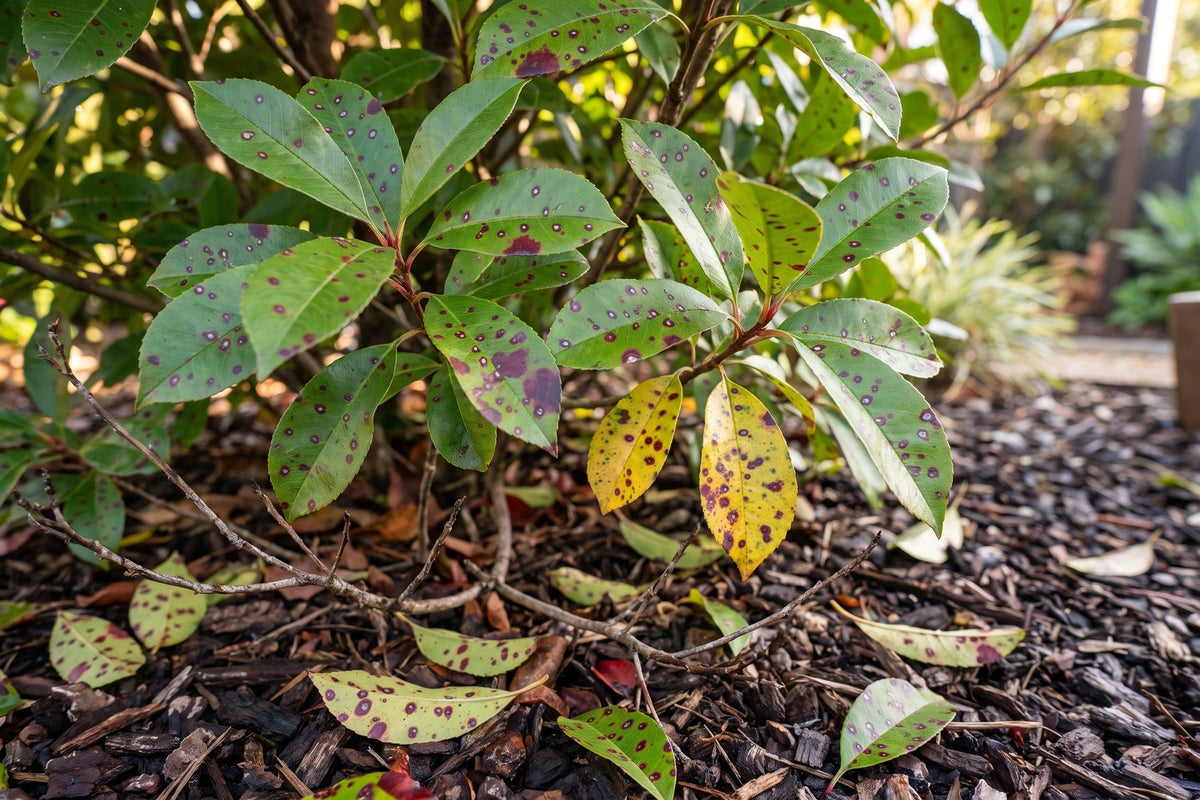
Leaf spot: Dark purple black spots on older leaves, worst in humid, still conditions. Rake fallen leaves away, prune for airflow and avoid evening overhead watering; healthy new flushes quickly replace marked foliage.
Bare legs: Older hedges clipped flat sided go thin at the base. Restore a wider base than top, and rejuvenate bare sections with a hard late winter cut followed by feeding.
Weak colour in the flush: Underfeeding or too much shade. Fertilise in spring, trim to stimulate fresh growth and let the sun do the rest.
Root rot in soggy ground: Wilting despite wet soil means waterlogging. Improve drainage or replant on a mound; no hedge outgrows a swamp. Our guide to understanding root rot covers how to tell it apart from drought stress, which looks similar from a distance.
Where photinia grows in Australia
Photinia 'Red Robin' is planted for one reason - the brilliant red flush of new growth that appears several times a year and turns a hedge into a feature. How well it performs, and how much disease you fight, depends heavily on your climate.
| Location | How it performs |
|---|---|
| Melbourne, Adelaide, Canberra, Tasmania | Ideal. Cool dry conditions mean strong colour and little disease |
| Sydney and coastal NSW | Very good, with occasional leaf spot in wet years |
| Perth | Excellent - dry summers suppress fungal problems |
| Brisbane and southeast Queensland | Grows, but humidity makes leaf spot a persistent battle |
| Tropical north | Not recommended. Choose a subtropical native screen instead |
Leaf spot: the reason photinia fails in humid climates
Entomosporium leaf spot is the single biggest problem with photinia in Australia. It appears as small red-purple spots that spread across the leaves, followed by yellowing and heavy leaf drop, and it can strip a hedge bare from the bottom up.
It thrives in warm humid conditions with poor airflow, which is exactly what a densely clipped hedge in a Brisbane or Sydney summer provides. Wet foliage is what lets it spread, so:
- Never water overhead. Water at the base, and avoid running sprinklers over the hedge.
- Space plants for airflow rather than packing them tight.
- Clear fallen leaves from beneath the hedge, since the spores overwinter in litter.
- Prune to open the canopy rather than shearing it into a solid impenetrable block.
- Avoid pruning in wet weather, which spreads spores between plants.
In a genuinely humid subtropical garden, it is worth being honest that a psyllid-resistant lilly pilly or a viburnum will give you a cleaner hedge with far less intervention. Photinia is at its best in the cooler, drier southern cities.
Getting the red flush
The red colour appears on new growth, so light trimming after each flush encourages another. In Melbourne and Adelaide this typically means a strong spring flush and a second in autumn. Full sun produces the most intense colour; in shade the new growth is duller and the plant grows more openly.
Frequently asked questions
How fast does photinia grow?
Around 60 cm a year for Red Robin and up to a metre for Robusta with water and feeding, which puts it in the same league as the lilly pillies compared in our alternative hedging plants roundup. A screening hedge from 20 cm pots is usually doing its job within three years.
How far apart should I plant Red Robin?
75 cm to 1 m apart for a dense hedge within two to three years. Wider spacing to 1.5 m still closes eventually and saves on plants.
Why is my photinia not turning red?
The red only appears on new growth. Trim the hedge and feed it; each fresh flush emerges red before maturing green, so regular clipping means regular colour.
Is photinia frost hardy?
Yes, photinia handles hard frost and is widely grown in Canberra, the tablelands and inland Victoria. It is one of the most cold tolerant fast hedges available in Australia, and it sits comfortably among the other frost tolerant plants we recommend for cold districts.
Ready to plant?
Count your metres, divide by your spacing and order the row in one batch so it grows in evenly. See our full privacy and screening collection and fast growing plants, with more choices among our shrubs. Every order is backed by our 30 day satisfaction guarantee.


