
Bee and Butterfly Friendly Plants
Live plants delivered Australia wide. 30 day healthy plant guarantee.

A garden that hums with bees sets more fruit, flowers harder and feeds the birds that follow. These are our bee and butterfly friendly plants, over 800 of them, from lavender and rosemary borders to flowering natives like banksia, wattle and melaleuca. The planning trick is flowering season and scale: string together plants that flower in relay through the year, at sizes from ankle high groundcovers to 8m trees, and the pollinators never need to leave.
Which size? How many?
Size ladder: what each pot looks like on arrivalHedge calculator: plants per metre, pricedHeights on arrival sit under every size on the product page. Freight is quoted with multiple freight companies and passed on at cost.
 Sold out
Pacific Blue English Lavender Lavandula angustifolia 'Pacific Blue'
36% off$15.95$24.95On backorderUnit price /Unavailable-
Sold out
Javelin Forte White Spanish Lavender Lavandula stoechas 'Javelin Forte White'
48% off$15.95$30.95On backorderUnit price /Unavailable -
Sold out
Javelin Forte Deep Rose Spanish Lavender Lavandula stoechas 'Javelin Forte Deep Rose'
39% off$15.95$25.95On backorderUnit price /Unavailable -
Sold out
Miss Muffet English Lavender Lavandula angustifolia 'Miss Muffet'
41% off$15.95$26.95On backorderUnit price /Unavailable -
Sold out
Imperial French Lavender Lavandula dentata 'Imperial'
16% off$15.95$18.95On backorderUnit price /Unavailable -
Sold out
Grosso Lavender Lavandula x intermedia 'Grosso'
41% off$15.95$26.95On backorderUnit price /Unavailable -
Sold out
Pink French Lavender Lavandula pedunculata
33% off$13.95$20.95On backorderUnit price /Unavailable -
Sold out
Rosea English Lavender Lavandula angustifolia 'Rosea'
31% off$15.95$22.95On backorderUnit price /Unavailable -
Sold out
Lavender Lace French Lavender Lavandula pedunculata 'Lavender Lace'
43% off$20.95$36.95On backorderUnit price /Unavailable -
Sold out
Blanche White Lavandin Lavender Lavandula x intermedia 'Blanche'
27% off$15.95$21.95On backorderUnit price /Unavailable -
Sold out
Avice Hill English Lavender Lavandula angustifolia 'Avice Hill'
16% off$15.95$18.95On backorderUnit price /Unavailable -
3 sizes, Tube to 200mm
20% offFrom $26.99$33.82per plant, packs of 6Unit price /Unavailable -
Sold out
Allard's Lavender Lavandula x allardii
27% off$15.95$21.95On backorderUnit price /Unavailable -
Prostrate Tick Bush Kunzea ambigua
3 sizes, Tube to 200mm
29% offFrom $26.99$38.15per plant, packs of 6Unit price /Unavailable -
Fall In Love Sweetly Japanese Anemone Anemone hupehensis 'Fall In Love Sweetly'
3 sizes, Tube to 200mm
39% offFrom $24.69$40.59per plant, packs of 10Unit price /Unavailable -
White Malay Ixora Ixora 'White Malay'
2 sizes, Tube to 300mm
42% offFrom $132.95$229.95Unit price /Unavailable -
Sold out
Red Malay Ixora Ixora 'Red Malay'
40% off$11.95$19.95On backorderUnit price /Unavailable -
Sold out
Pirate's Gold Ixora Ixora 'Pirate's Gold'
20% off$11.95$14.95On backorderUnit price /Unavailable -
Pink Malay Ixora Ixora 'Pink Malay'
3 sizes, Tube to 300mm
31% offFrom $85.95$124.95Unit price /Unavailable -
Gold Fire Ixora Ixora coccinea 'Gold Fire'
3 sizes, Tube to 200mm
31% offFrom $19.79$28.69per plant, packs of 10Unit price /Unavailable -
Sold out
Peach Delight Ixora Ixora 'Peach Delight'
46% off$11.95$21.95On backorderUnit price /Unavailable -
Sold out
Flame of the Woods Ixora Ixora coccinea 'Flame of the Woods'
40% off$11.95$19.95On backorderUnit price /Unavailable -
Sold out
Sunkist Dwarf Ixora Ixora 'Sunkist'
25% off$11.95$15.95On backorderUnit price /Unavailable -
Sold out
Sunshine Dwarf Ixora Ixora 'Sunshine'
29% off$11.95$16.95On backorderUnit price /Unavailable -
Sold out
Dwarf Pink Ixora Ixora 'Dwarf Pink'
25% off$11.95$15.95On backorderUnit price /Unavailable -
Sold out
Silver Posie Purple Italian Lavender Lavandula stoechas 'Silver Posie Purple'
43% off$15.95$27.95On backorderUnit price /Unavailable -
Sold out
Dwarf Orange Ixora Ixora 'Dwarf Orange'
48% off$11.95$22.95On backorderUnit price /Unavailable -
Sold out
Mountain Daisy Ixodia achillaeoides
24% off$21.95$28.95On backorderUnit price /Unavailable -
Sold out
Silver Lining Love Italian Lavender Lavandula stoechas 'Silver Lining Love'
50% off$15.95$31.95On backorderUnit price /Unavailable -
Sold out
Silver Lining Passion Italian Lavender Lavandula stoechas 'Silver Lining Passion'
33% off$15.95$23.95On backorderUnit price /Unavailable -
Sold out
Silver Lining Eternity Italian Lavender Lavandula stoechas 'Silver Lining Eternity'
36% off$15.95$24.95On backorderUnit price /Unavailable -
Sold out
HibisQs Apollo Hibiscus Hibiscus 'HibisQs Apollo'
20% off$19.95$24.95On backorderUnit price /Unavailable


More information
How to choose plants that pollinators actually visit
Not every flower feeds a bee. Heavily bred double blooms often hide their nectar behind extra petals, so the workhorses of a pollinator garden are simple, open flowers backed by nectar rich natives. Plan a relay rather than one big spring flush: French Lavender (Lavandula dentata) flowers most of the year in mild climates, crepe myrtles own high summer from December to March, and banksias carry nectar into the cooler months when little else is open.
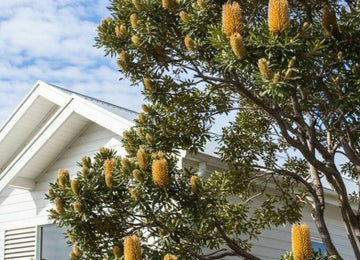
Then think in layers. Groundcovers such as native violet and seaside daisy feed insects at ankle height, shrubs like westringia, murraya and rosemary hold the middle storey, and one flowering tree outweighs a whole bed of perennials: a mature Coast Banksia (Banksia integrifolia) or Ivory Curl Tree carries many thousands of flowers at once. Many of the best performers here double as fragrant plants, murraya and star jasmine among them, so the garden works on the nose as well.
Accept one honest trade off before you buy: a pollinator garden is never perfectly tidy. Seaside daisy self seeds, Brisbane Golden Wattle races up but lives only 15 to 20 years, and any hedge clipped hard every few weeks barely flowers at all. Decide where you can let things loosen up.
Where bee and butterfly friendly plants work hardest
Put them where the pollination pays: beside vegetable beds and under fruit trees, where better fruit set is the immediate reward, and along paths and borders where you will actually see the traffic. In tropical and subtropical gardens, Golden Penda, Ivory Curl Tree, murraya and Lemon Scented Myrtle flower generously in the warmth, though Golden Penda is frost tender and stays north. In cooler southern gardens, lean on the frost hardy core: Coast Banksia, Brisbane Golden Wattle, westringia, Snowstorm Melaleuca, liriope and seaside daisy all cope with frost, and star jasmine climbs through every zone. In dry inland and Mediterranean gardens around Adelaide and Perth, lavender, rosemary and westringia deliver nectar on very little summer water.
Planting and spacing for a pollinator border
Plant in drifts of three to five of one species rather than singles. Bees tend to work one flower type at a time, so a block of a single plant gets visited far more than a scatter of everything.
- Low flowering hedges. French Lavender and Tuscan Blue rosemary at 60cm apart, Westringia 'Zena' at 600mm.
- Borders and edges. Liriope 'Evergreen Giant' at 40cm centres, seaside daisy at 40cm in full sun.
- Groundcover. Native violet at 300mm spacings in moist shade, with edible flowers as a bonus.
- Flowering screens. Murraya and Snowstorm Melaleuca at 1m apart, Brisbane Golden Wattle at 2m for fast cover, and Star Jasmine at 1m spacings along a fence.
- Trees. Ivory Curl Tree at 3m spacings for an avenue; give a Coast Banksia room for a 5m spread.
Most bee and butterfly friendly plants want six hours of sun, deep watering twice a week through the first summer and 75mm of mulch. Leave one sunny patch of bare, undisturbed soil somewhere out of the way, because most Australian native bees nest in the ground, not in hives.
Care that keeps the nectar flowing
The single biggest favour you can do pollinators is putting the sprays away. Systemic insecticides move into nectar and pollen and undo everything the flowers achieve, so spot treat pests with horticultural oil, never spray anything that is in flower, and accept a few chewed leaves as the price of butterflies, since caterpillars have to eat something. Trim flowering shrubs lightly after each flush rather than clipping hard on a schedule, feed natives with a low phosphorus native fertiliser in spring, and set out a shallow dish of water with a few pebbles for bees to land on in summer.
Common questions
Which plants flower for the longest?
French Lavender is the standout, flowering most of the year in mild climates, and crepe myrtles hold their colour from December to March. Add banksias and wattles for the cooler months and the calendar is close to covered.
Do I need Australian natives to help native bees?
A mixed garden serves the widest range. Australia has well over a thousand native bee species and many forage happily on lavender and rosemary, but the Australian native range offers the flower shapes and flowering times local species evolved with.
Will these plants bring bees too close to the pool or back door?
Bees working flowers are foraging, not defending a hive, and stings in the open garden are rare. If you want a buffer, plant the heaviest bee magnets such as lavender and citrus away from doorways and the pool edge.
Do the same plants attract birds?
Often, and the overlap is worth using. Coast Banksia, wattles and melaleucas feed honeyeaters as well as insects, and our bird attracting plants collection picks up where the pollinator list ends.
How does delivery work?
Everything here is delivered Australia wide, with delivery from $29.95 and no minimum order. Advanced and large stock is freighted at cost, and every plant carries our 30 day healthy plant guarantee.
