

"Lilly pilly" covers at least seven different trees that behave very differently in a garden. One makes a 10 m weeping shade tree, one stays at knee height, one flowers on its own trunk, and two of them are the plants the psyllid finds first. Most of the disappointment with lilly pilly hedges comes from buying by the common name. This guide sorts the Syzygium species we sell by what each one does, so you can buy the right plant for the job and not fight it for the next decade.
Quick facts
| Species | Garden size | Best use | Psyllid |
|---|---|---|---|
| Syzygium australe (brush cherry) | 1 to 5 m by cultivar | Hedges and screens at every height | Older forms badly; modern selections resist it |
| Syzygium luehmannii (riberry) | 6 to 8 m | Tall screen, small shade tree, bush food | Rarely troubled |
| Syzygium smithii (creek lilly pilly, formerly Acmena) | 1 to 8 m by form | Hedges in cooler and southern gardens | Rarely troubled |
| Syzygium hemilamprum (broad-leaved lilly pilly) | 8 m | Shade tree or tall screen | Rarely troubled |
| Syzygium francisii | 8 m | Blocking a two-storey outlook | Rarely troubled |
| Syzygium tierneyanum (river cherry) | 8 m | Screening on wet ground | Rarely troubled |
| Syzygium moorei (coolamon) | 8 m | Feature tree, flowers on the trunk | Rarely troubled |
| Waterhousea floribunda (weeping lilly pilly) | 10 m | Tall weeping screen or shade tree | Rarely troubled |
Syzygium australe: the hedging species
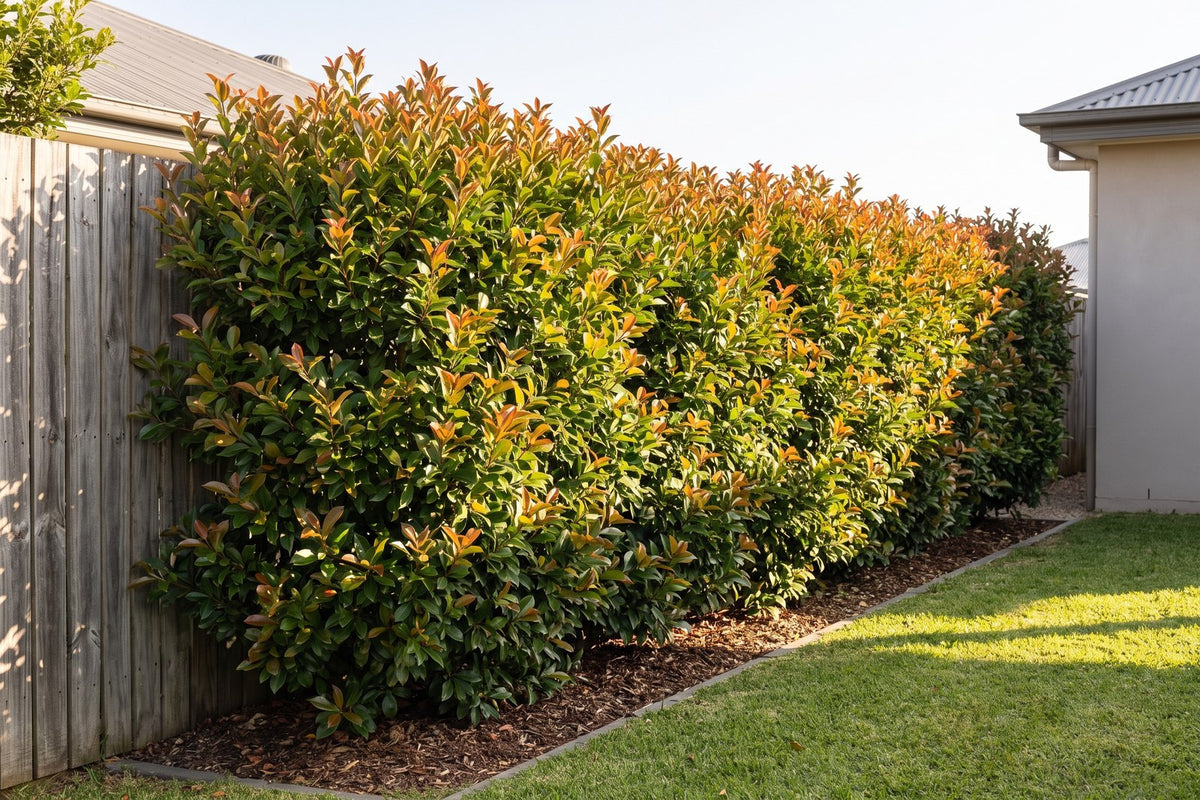
Brush cherry grows wild along the east coast from southern New South Wales to Queensland, and almost every named hedging lilly pilly is a selection of it. The wild tree reaches 15 m in rainforest; in a garden the species settles at about 5 m and the cultivars range from 1 m to 5 m. The foliage is glossy, the new growth flushes bronze, red, gold or purple depending on the selection, and the magenta berries are edible. It is the species that gave lilly pillies their reputation in both directions: fast, dense and clippable, but the older seedling-grown hedges are the ones the pimple psyllid disfigures every spring.
Modern selections were bred to resist the psyllid, and the difference is visible. Resilience is the one to start with for a 3 to 5 m screen, holding foliage to the ground and closing a metre grid in two to three seasons; our psyllid resistance guide explains what resistant means in practice. Northern Select was chosen for humid coastal gardens and clips tighter than most. For colour on every flush, Hinterland Gold breaks gold, Big Red and Winter Lights break red, and Purple Rain breaks deep purple.
The species also gives us the narrow and the small forms. Straight and Narrow holds 5 m of height in a metre of width, bred for the side passage; Cherry Bomb and Cherry Surprise stop at 2.5 to 3 m and 1.5 m wide; Bush Christmas is the small-leaved form that takes a hard clip into balls and cones; and Baby Boomer is a true dwarf at about 1.5 m for low borders and pots. For a full comparison of the screening cultivars, read our Resilience versus the rest guide.
Syzygium luehmannii: the riberry
Small-leaved lilly pilly, riberry, or Luehmann's lilly pilly: all the same rainforest tree from the New South Wales north coast and Queensland. Syzygium luehmannii has the finest foliage in the family, soft and slightly weeping, and every flush of new growth comes through vivid pink to red. Fluffy cream flowers in spring are followed by clusters of small pear-shaped magenta riberries, tart and clove-scented, which are harvested commercially as a bush food and are the reason the tree appears in native food gardens.
In a garden it settles at 6 to 8 m tall and about 4 m wide, so it is a tall screen or a small shade tree rather than a fence-height hedge, though it clips well if you start young. It is rarely bothered by psyllid, grows faster than its reputation suggests once the roots are away, and prefers a sheltered position with reliable moisture; on an exposed, dry, frosty site it sulks. Where you want the look of a lilly pilly screen at 6 m without the psyllid worry, this is the species to choose.
Syzygium smithii: the creek lilly pilly
Older gardeners know this one as Acmena smithii; the botanists moved it into Syzygium, and the trade now uses both names. It grows from Victoria to Cape York, which makes it the most cold-tolerant of the group and the hedging lilly pilly of choice in Melbourne, the Adelaide Hills and the tablelands. The leaves are a duller, darker green than brush cherry, the new growth is bronze to pink, and the fruit ranges from white to pale pink and mauve rather than magenta. It resists the psyllid well, which is why the dwarf and compact smithii forms are so widely planted for low hedges in southern cities: Acmena smithii Minor holds a tight 1 to 2 m hedge, Sublime is a compact selection with lime-green new growth that stays under 3 m, and Goodbye Neighbours is the fast, tall form for a 4 to 5 m screen. The full-sized tree reaches 8 m in a garden and makes a dense screen or a tidy clipped hedge at any height from a metre up.
The tall ones: hemilamprum, francisii, tierneyanum and the weeping lilly pilly
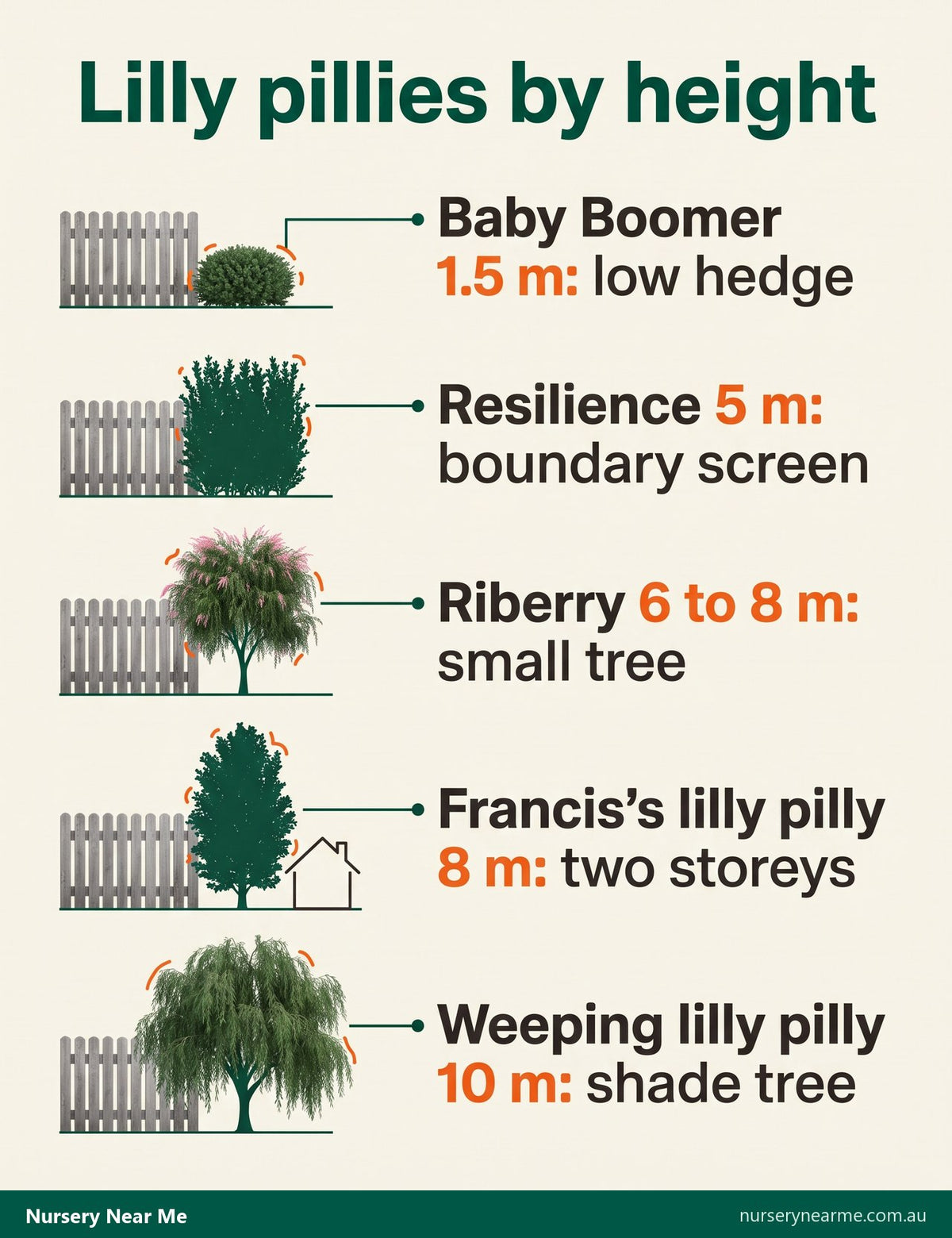
Four species do the work a hedge cannot: blocking a two-storey outlook, shading a yard, or screening wet ground.
Broad-leaved lilly pilly (Syzygium hemilamprum, still sold by many growers as Acmena hemilampra) carries noticeably larger, glossier leaves than the hedging types and builds an 8 m canopy, or a 3 to 4 m screen if trimmed from the first year. It is the one to plant when you want a shade tree with a rainforest look.
Francis's lilly pilly (Syzygium francisii) is the privacy tree: about 8 m tall and 4 m wide, dense from top to bottom, with coppery new growth and small mauve berries. It is what you plant when a 3 m hedge will not hide the neighbour's upstairs window; our guide to blocking a two-storey neighbour puts it beside the alternatives.
River cherry (Syzygium tierneyanum, also sold as forest satinash) grows along creek banks in northern Australia, so it tolerates the soggy back corner that rots most screening plants. It settles at about 8 m, carries cream flowers and white edible fruit, and is fast for a native of its size.
Weeping lilly pilly (Waterhousea floribunda) is a close relative rather than a true Syzygium, and it is the tallest of the group: around 10 m in a garden with long willowy leaves that hang and move. Planted 1.5 m apart and trimmed it makes one of the best tall screens available; left alone it is a shade tree with pink and copper new growth. It is rarely troubled by psyllid and copes with wet ground. Our weeping lilly pilly guide covers spacing and growth rate.
The ones you plant for flowers
Most lilly pillies flower white and briefly. Two are grown for the bloom. The coolamon (Syzygium moorei) is a rare rainforest tree from the New South Wales north coast and southern Queensland that produces deep pink powderpuff flowers straight out of its bark and older branches in summer, a habit called cauliflory that almost nothing else in an Australian garden shares. It settles at about 8 m and makes a dense evergreen feature tree. Cascade is a garden selection of about 4 m tall and 2 m wide with soft weeping new growth and fluffy pink powderpuff flowers through spring and summer, followed by berries; it is the lilly pilly to plant as a feature rather than a block, and our Cascade guide covers it in full.
Common problems and fixes
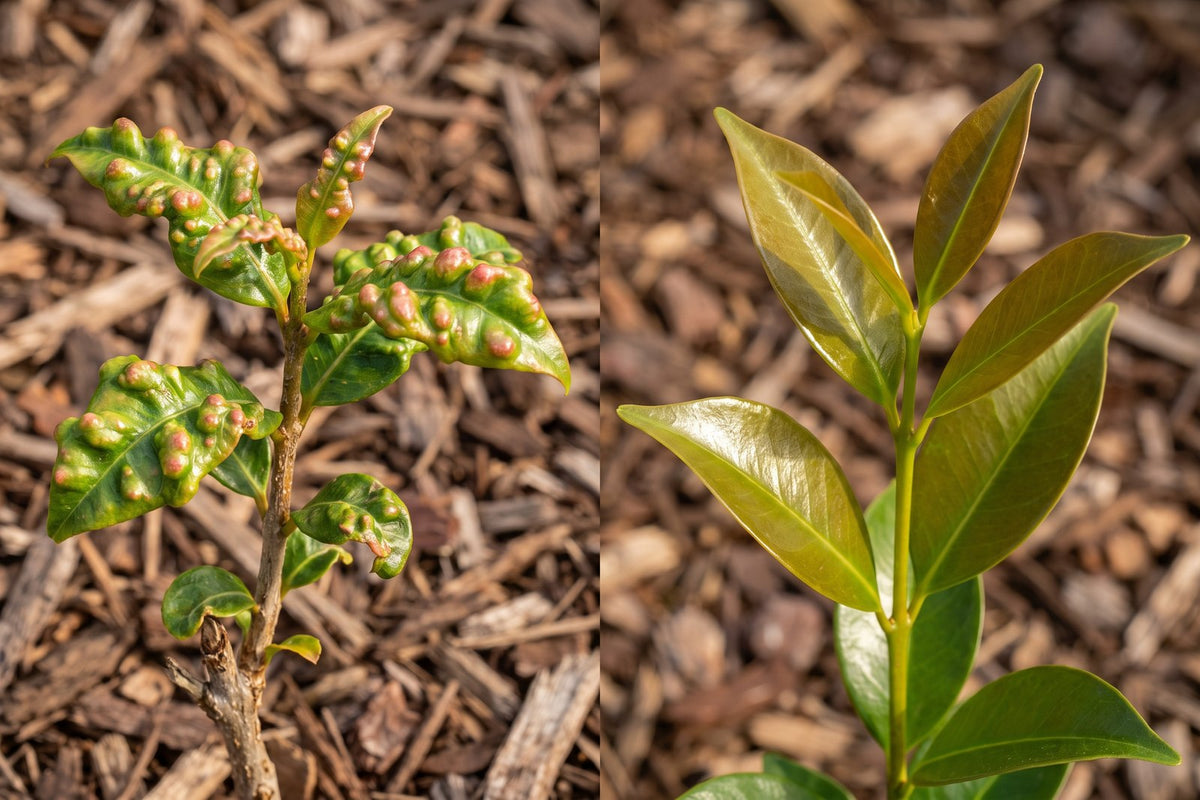
Pimpled, puckered new leaves. Pimple psyllid, a sap-sucking insect that lays eggs in the soft new growth of Syzygium australe and causes the leaf to swell into galls around the nymphs. It disfigures but rarely kills. Spraying is a losing battle on a big hedge; the answer is a resistant selection. If you already have an old hedge, trim it after each flush to remove the galled growth and keep it fed and watered so the next flush outgrows the damage.
Purple-edged spots and yellow powder on new growth. Myrtle rust, a fungal disease of the myrtle family that is now established along the east coast. Lilly pillies vary in how badly they get it. Prune off and bin affected growth, avoid overhead watering in humid weather, and ask your state agriculture department for the currently registered fungicides if it persists.
Yellow leaves and slow growth in a southern garden. Cold, wet winter soil, or the wrong species for the district. Syzygium smithii is the cold-tolerant one; brush cherry selections and the riberry prefer warmth.
A hedge that is bare at the base. Planted too far apart, or never tip-pruned when young. Trim the top lightly three or four times a year from the first season so the plants branch low; a hedge allowed to run to full height first will not fill in underneath. Our guide to planting and pruning a Resilience hedge sets out the routine.
Berries everywhere. All of them fruit, and birds love them. On a clipped hedge the trimming removes most flowers before they set; on a tree, accept the berries as part of the deal and plant it away from paving.
Frequently asked questions
Which lilly pilly is best for a hedge?
For a 2 to 5 m screen in warm and temperate gardens, a psyllid-resistant Syzygium australe selection such as Resilience, Northern Select or Elite. For a low hedge under 2 m, a compact form such as Cherry Bomb, Bush Christmas or Baby Boomer. In Melbourne, Adelaide and frosty districts, a Syzygium smithii form. For height above 6 m, Francis's lilly pilly or the weeping lilly pilly.
Which lilly pillies get psyllid?
Mostly Syzygium australe, especially older seedling-grown hedges and the unselected species, and Syzygium paniculatum. Syzygium smithii, Syzygium luehmannii and Waterhousea floribunda are rarely troubled, and the modern australe selections such as Resilience were bred to resist it. Resistant is not immune: a resistant hedge may show the odd pimple in a bad spring without ever needing a spray.
Is Acmena the same as Syzygium?
Yes. The genus Acmena was merged into Syzygium, so Acmena smithii is now Syzygium smithii and Acmena hemilampra is Syzygium hemilamprum. Growers and labels still use both names for the same plants.
Are lilly pilly berries edible?
Yes, on every species in this guide. The riberry (Syzygium luehmannii) is the one harvested commercially; the magenta fruit of brush cherry makes jam and the pale fruit of the creek lilly pilly is edible but bland. Wash them, and expect the birds to get most of them.
How far apart do I plant a lilly pilly hedge?
One metre apart for the standard 3 to 5 m screening selections, 60 to 80 cm for the narrow and dwarf forms, and 1.5 m for the weeping lilly pilly and the tall tree species grown as a screen. Closer spacing closes the gap a season sooner; wider spacing saves plants but leaves the base open for longer.
Ready to plant?
The Syzygium collection holds every species and selection in this guide, and the lilly pilly collection groups the hedging forms by height. If a hedge is the job, start with our lilly pilly care guide for planting and pruning, and compare the field in hedging and screening plants before you commit to one species for a long boundary.


