

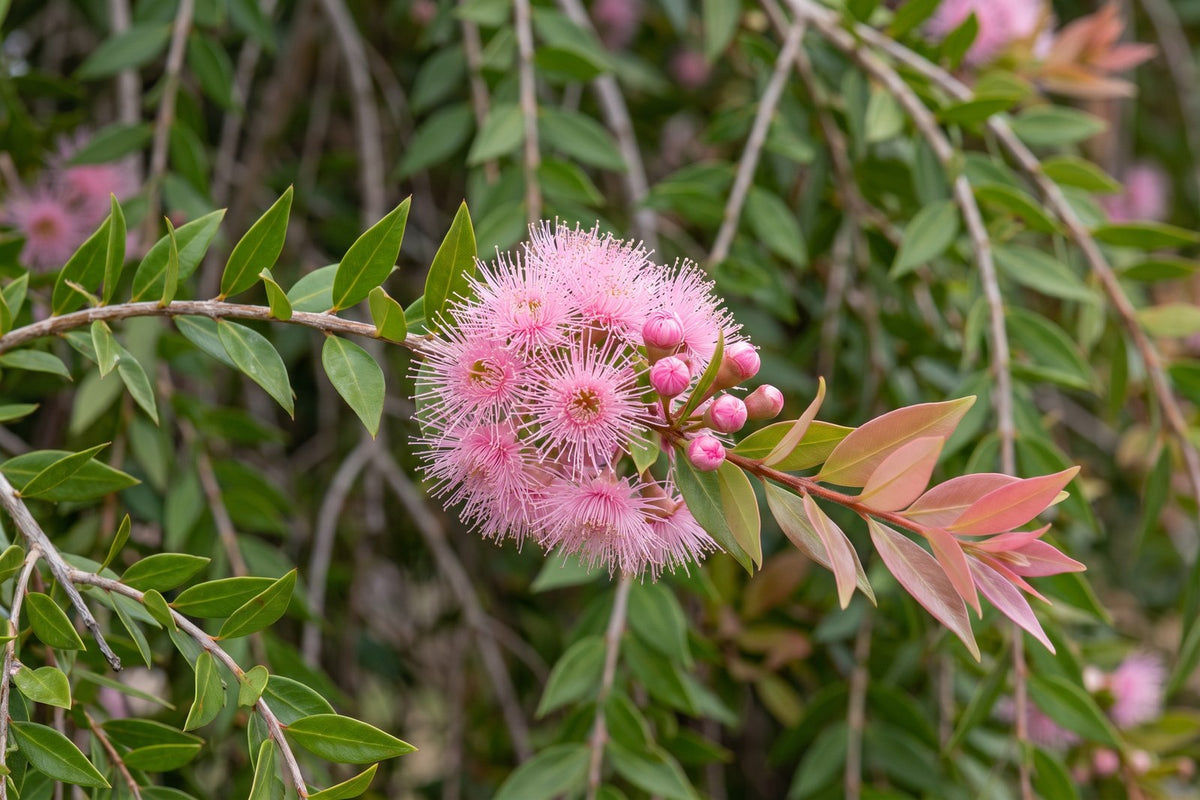
Cascade is the lilly pilly people plant when they want one that flowers. Most lilly pillies are grown as green screening and the blossom is incidental; Syzygium australe 'Cascade' produces genuine fluffy pink powder-puff flowers through spring and summer, on a softly weeping plant with pink-bronze new growth. It stays around three metres, which puts it within reach of gardens that cannot accommodate a full-size hedging variety.
Quick facts
| Detail | What to expect in Australia |
|---|---|
| Botanical name | Syzygium australe 'Cascade' |
| Origin | Australian native cultivar |
| Mature size | 3 m tall, 2 m wide |
| As a hedge | Easily held at 1.5-2.5 m |
| Flowers | Pink powder-puffs, spring into summer |
| New growth | Pink to bronze, flushing several times a year |
| Position | Full sun to part shade |
| Psyllid | Resistant |
| Best climates | Brisbane, coastal NSW, Sydney, Melbourne, Perth, Adelaide |
What makes Cascade different
Three things, and each is worth understanding before you choose it over a standard hedging lilly pilly.
- It flowers properly. Soft pink powder-puff blooms cover the plant in spring and often flush again through summer. Bees and honeyeaters work them heavily.
- It weeps. The branches arch outward and down rather than standing upright, giving a much softer outline than the columnar hedging varieties.
- It stays small. Three metres is the natural ceiling, so it does not need constant cutting to stay in proportion in a suburban garden.
Like the other modern Syzygium australe cultivars it is psyllid resistant, so the new growth stays clean rather than developing the pimpled distortion that ruins older lilly pilly varieties.
How it compares
| Variety | Height | Habit | Best for |
|---|---|---|---|
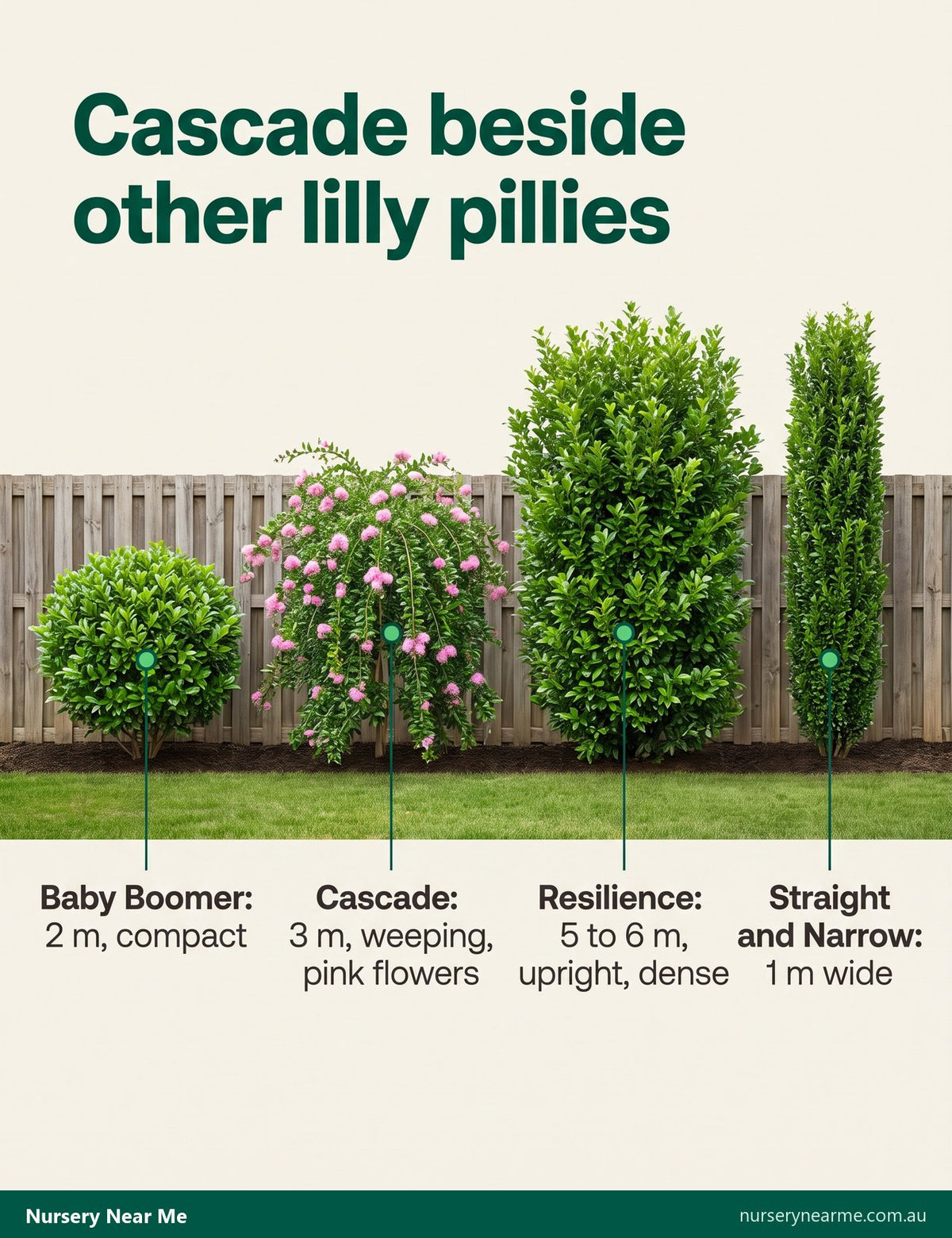
| Cascade | 3 m | Weeping, pink flowers | Feature shrub, soft informal hedge |
| Resilience | 5-6 m | Upright, dense | Standard boundary hedge |
| Straight and Narrow | 5-6 m | Very narrow, columnar | Tight spaces, 1 m wide |
| Baby Boomer | 2 m | Compact, rounded | Low hedges, pots |
| Weeping lilly pilly | 10-15 m | Large weeping tree | Tall screens above 5 m |
Choose Cascade when you want flowers and a softer shape. Choose Resilience when the job is a straightforward dense boundary hedge and blossom is not the point.
Where it grows in Australia
- Brisbane, Gold and Sunshine Coasts, northern NSW - ideal, with the longest flowering season.
- Sydney and coastal NSW - excellent, flowering reliably each spring.
- Melbourne and Adelaide - grows well in a sheltered spot. Young plants can be marked by hard frost, so plant in spring.
- Perth - performs well with reliable summer water in sandy soil.
- Frost-prone inland districts - marginal. Repeated heavy frost damages young growth.
How to plant
- Plant in autumn or spring, avoiding the extremes of summer and winter.
- Full sun gives the most flowers. It grows in part shade but blooms noticeably less.
- Space at 1 to 1.5 m for an informal flowering hedge, or allow 2 m for a specimen shrub.
- Improve heavy clay with compost and plant slightly raised so water drains away from the crown.
- Mulch to 75 mm, kept clear of the stems.
- Water deeply two or three times a week through the first two summers.
Pruning for flowers
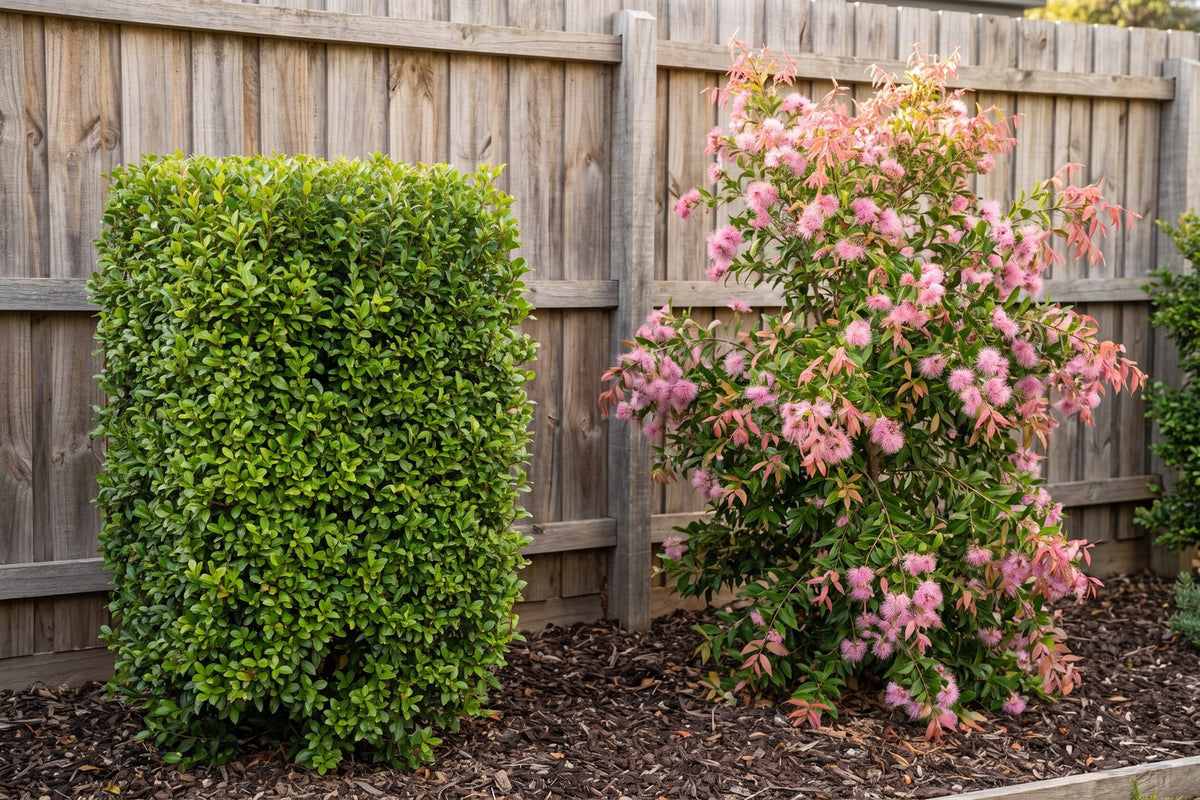
This is where Cascade differs from a normal hedging lilly pilly, and where most people go wrong. Flower buds form on growth made after the previous flowering, so constant tight clipping removes the buds and you end up with a green shrub that never blooms.
Prune once, straight after the main flowering finishes. That gives the plant the rest of the season to make the growth that carries next year's flowers. Light tip pruning through the year is fine; repeated hard shearing is not.
If you want a crisply formal clipped hedge, plant Resilience and accept the trade-off. Cascade rewards a lighter hand.
Ongoing care
Watering
Regular deep watering through the first two summers, then moderate. Established plants tolerate dry spells but flower better with consistent moisture. Sandy Perth soils need more than Brisbane clay loam.
Feeding
Feed in early spring and again after flowering with a controlled-release fertiliser. Avoid high-nitrogen lawn fertiliser drifting into the bed, which pushes leafy growth at the expense of blooms - a very common reason a healthy lilly pilly refuses to flower.
Common problems and fixes
- No flowers on a healthy plant is nearly always over-pruning or too much nitrogen. Prune once after flowering and check what fertiliser is reaching the bed.
- Thin, bare base in a hedge means the sides were clipped vertical. Taper it wider at the bottom.
- Yellow leaves usually means hunger or poor drainage.
- Purple staining on paving comes from the fruit. Keep it back from light-coloured paths.
- Scale and sooty mould appear in still shaded positions. Treat with horticultural oil.
- Frost damage on young plants in southern gardens - protect through the first winter and prune damage in spring.
Using it in the garden
Cascade works best where its weeping shape and flowers can be seen rather than hidden in a boundary row. It suits a feature position beside an entry, a soft informal screen along a fence, a large pot on a patio, or a row spaced widely enough that the individual plants keep their arching form. It is a genuinely good bird and bee plant, which is worth something in a suburban garden.
Frequently asked questions
How big does Cascade lilly pilly grow?
About three metres tall and two metres wide, which is small for a lilly pilly. It can be held at 1.5 to 2.5 metres as an informal hedge with light annual pruning.
Why is my Cascade lilly pilly not flowering?
Usually too much pruning. Flower buds form on growth made after the last flowering, so repeated shearing removes them. Prune once immediately after flowering. Too much nitrogen fertiliser and too much shade also reduce blooms.
Is Cascade psyllid resistant?
Yes. Like the other modern Syzygium australe cultivars it resists lilly pilly psyllid, so new growth stays clean rather than becoming pimpled and distorted.
Can Cascade be grown in a pot?
Yes, and it does well. Use a pot at least 500 mm across with quality potting mix, keep it in full sun for flowering, and feed twice a year. Potted plants stay smaller than those in the ground.
Cascade or Resilience?
Cascade for flowers, a weeping shape and a smaller plant. Resilience for a taller, denser, more formal clipped boundary hedge where blossom is not the priority.
Does Cascade attract birds?
Yes. The pink powder-puff flowers are rich in nectar and draw honeyeaters and bees, and the fruit that follows is eaten by birds as well.
Ready to plant?
We grow Cascade in pot sizes through to advanced ex-ground specimens. Browse our hedging and screening collection, or the Australian natives range.
Comparing varieties? See how the lilly pilly varieties compare and our weeping lilly pilly guide.
Cascade sits inside a genus that dominates Australian planting. Our year of order data, What Australia Planted in 2025-26, found lilly pillies taking the top three places nationally.
Native plants that also feed the household are covered in our bush tucker guide, from lemon myrtle and midyim to the trees that need an acreage block.
Before a tree goes in near the house, read our guide to planting near pipes: it sets out what Australian water utilities say about root behaviour, what can go directly over a sewer line, and which trees to keep well away.


