

A boundary fence solves a single-storey problem. When the windows looking into your yard sit five or six metres up, you need a plant that still holds dense foliage at first-floor height, and most shrubs sold as fast screening either top out at three metres or go bare at the base first.
This guide is height-led rather than speed-led: the species that genuinely reach four to eight metres in an average Australian backyard, and the spacing that closes the screen at the height you need it.
Quick facts
| Plant | Mature size | Position | Soil and water | Climate zones |
|---|---|---|---|---|
| Lilly Pilly Goodbye Neighbours | 6 m x 2.5 m | Sun to part shade | Free-draining, moderate | Subtropical to temperate |
| Green Avenue Weeping Lilly Pilly | 7-8 m x 4 m | Full sun | Deep soil, moderate to high | Subtropical, warm temperate |
| Slender Weavers Bamboo | 6-8 m x 2 m clump | Sun to part shade | Rich, well drained, regular | Subtropical to temperate |
| Eumundi Quandong | 8-10 m x 4 m | Sun to part shade | Moist, well drained | Subtropical, frost-free |
| Straight and Narrow Lilly Pilly | 6 m x 1 m | Full sun | Free-draining, moderate | Subtropical to temperate |
| Leighton Green | 8-12 m x 3 m | Full sun | Well drained, low water | Cool temperate, frost hardy |
Choosing the right screening plant for the height you need

Start by measuring, not guessing. Stand where you feel overlooked and work out how high the foliage has to sit to break that sightline. A standard Australian two-storey home puts the first-floor sill at about 4.5 metres and the head of the window at about 6.5 metres. Screening the whole window is rarely necessary; breaking the line of sight from the patio or bedroom below usually means five to six metres of plant rather than eight.
Then check your width. Narrow columnar selections such as Straight and Narrow hold roughly a metre of spread, which is why they suit a 1.5 metre side setback where a weeping lilly pilly at four metres wide would end up half over the fence. In Queensland and New South Wales, overhanging branches and roots from a neighbour's planting are dealt with under dedicated tree dispute legislation, so it pays to be the person who planted with room to spare.
Finally, be honest about climate. Leighton Green is superb in Melbourne, Adelaide and the tablelands but resents humid subtropical summers, where it becomes prone to canker and thins from the inside. In Brisbane and northern New South Wales the lilly pillies, Eumundi Quandong and clumping bamboo do the same job far more reliably. Our roundup of fast-growing screening trees is the companion piece if speed matters more.
How to plant
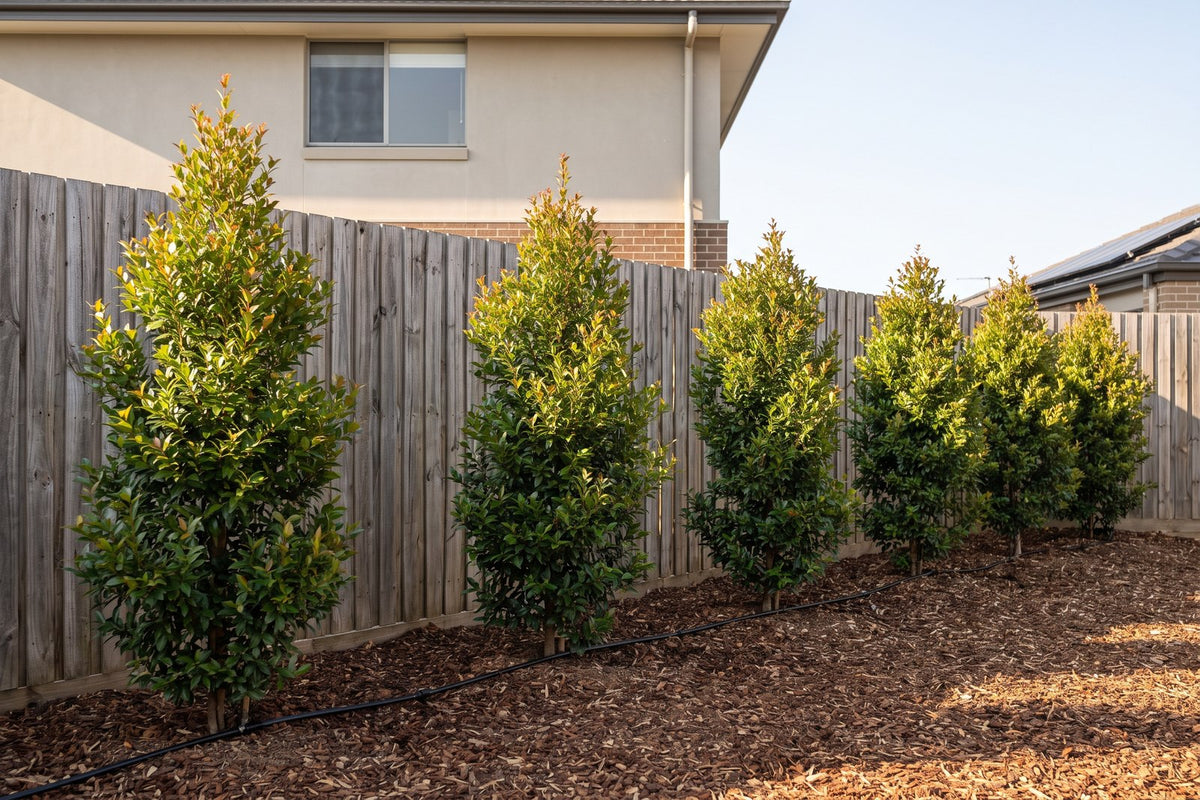
Set the row at least a metre off the fence line, and further for anything wider than three metres at maturity. Planting hard against a fence starves the back of the plant of light, which is the most common reason a screen ends up thin on one side.
Spacing decides how quickly the screen closes and how tall it finishes. Space at roughly half the mature width: 1.2 to 1.5 metres apart for Goodbye Neighbours or Straight and Narrow, 1.5 to 2 metres for clumping bamboo, and 2.5 to 3 metres for Green Avenue or Eumundi Quandong. Tighter spacing joins faster but forces competition, and a crowded row tends to stall around four metres.
Dig each hole twice the width of the pot and no deeper, so the root flare finishes level with the surrounding soil. Backfill with the soil you removed rather than compost, water in with a seaweed tonic, and mulch 75 mm deep over the row, clear of the trunks. In heavy clay, mound the row 200 to 300 mm above grade rather than digging a sump.
Ongoing care
Watering
Deep, infrequent watering builds the root system a tall plant needs to stay upright. Water two to three times a week for the first summer, then taper to weekly. A row of six-metre plants draws serious volume in a Brisbane January, so run inline dripper line down the row rather than relying on a hand-held hose, which almost never wets the full root zone.
Feeding
Feed in early spring and again in late summer with a controlled-release fertiliser at label rate. Bamboo is the hungriest of the group and appreciates a nitrogen-rich feed in spring, which is what drives the new culms that carry the height. Avoid feeding after mid-autumn, since soft growth going into winter burns in the first cold snap.
Pruning
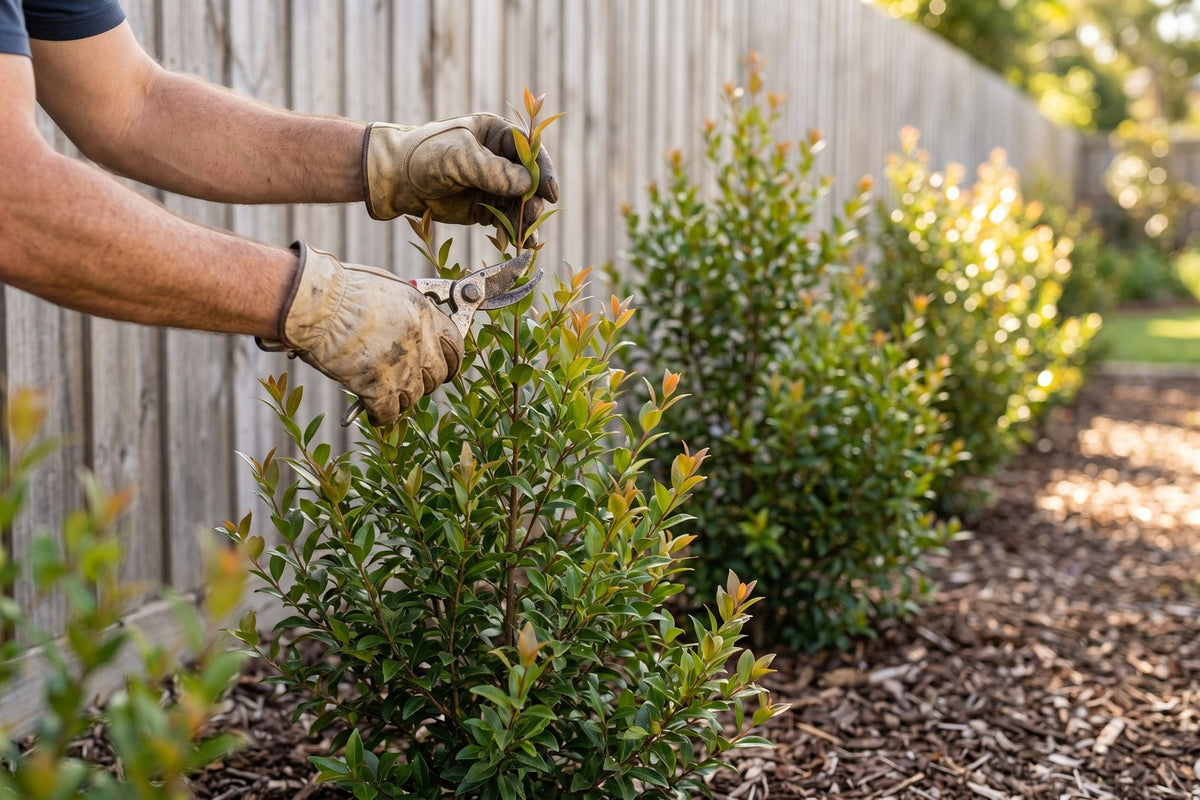
Tip prune lightly and often rather than hard and rarely. Trimming the leader by 50 to 100 mm two or three times through the growing season triggers branching low down, which is what fills the bottom two metres of the screen. Once the row has reached the height you want, hold it there with a light trim in spring and another in late summer. For clumping bamboo, thin the oldest culms at ground level every second year and strip the lower branches to expose the canes.
Common problems and fixes
Bare at the base. Almost always a light problem caused by planting too close to a fence or spacing too tightly. Thin every second plant if the row is crowded, and prune the tops to let light reach lower foliage.
Psyllid pimpling on lilly pilly. The lumpy, dimpled new growth is cosmetic but ugly on a feature screen. Choose resistant selections such as Goodbye Neighbours or the Waterhousea group, which psyllid does not attack. Our guide to Lilly Pilly Resilience growth rates compares resistant varieties.
Bamboo anxiety. Only running bamboos spread. Clumping Bambusa such as Slender Weavers expand at the edge of the clump by a few centimetres a year, as our guide to bamboo for screening explains.
Sudden yellowing and collapse. Usually waterlogging in clay, not drought. Check the soil 200 mm down before adding more water.
Frequently asked questions
How tall does a screen need to be to block a two-storey window?
Between five and six metres suits most suburban blocks. First-floor sills sit at roughly 4.5 metres, so foliage reaching five metres already breaks the line of sight into a ground-level patio. Screening the full window head at 6.5 metres is only worth doing where the two houses sit very close together.
How long will it take to get there?
From a 45 litre plant, expect two to three years to reach four metres and four to five years to sit comfortably at six, given decent soil, full sun and consistent water. Clumping bamboo is the fastest to height, often screening at four metres inside 18 months. Starting from advanced stock, as in our mature plants for immediate privacy range, removes the first two years.
What if I only have a metre of width?
Use a genuinely columnar selection. Straight and Narrow Lilly Pilly holds about a metre of spread at six metres tall, and Pittosporum tenuifolium selections bred for screening sit around 1.5 metres wide. Both need annual side trimming, and both need light on at least one face, so a metre-wide slot between two fences will not work.
Can I plant right on the boundary?
You can plant on your side of it, but leave room for the mature canopy to sit inside your property. Roots and branches crossing a boundary can be lawfully cut back by your neighbour at the fence line, which quickly ruins the shape of a screen. A metre of setback for a narrow plant and two metres for anything wider is a sensible minimum.
Will a tall screen block my own light?
It can, particularly on the northern side of a southern-state garden where winter sun is already low. Put tall screening on the eastern, western or southern boundary where you can, and use a lower hedge or a deciduous tree to the north. Often a couple of well-placed trees beat a continuous row.
Ready to plant?
The right screen is the one that reaches the height you need, in the width you have, in your climate. If you want the outlook fixed this season, start with advanced stock from our mature plants for immediate privacy collection, or compare heights across the full screening plant range. For a narrow boundary, Lilly Pilly Goodbye Neighbours and Slender Weavers Bamboo are the two most reliable performers we ship nationally, and Eumundi Quandong remains the pick where you want a tree rather than a hedge.
You are solving the most common problem in Australian gardens. Hedging and screening topped the purpose rankings in our year of order data, What Australia Planted in 2025-26.
For the view from the street, our front yard kerb appeal planting guide works through hedges, feature trees and groundcovers that make a house look finished from the footpath.


