







A front garden facing north or west takes full sun plus heat radiating off the driveway, the path and the house wall. It is the hardest position on most Australian properties, and it is exactly where cacti and succulents excel while conventional planting fails repeatedly. This guide covers which ones to choose, how to plant them so they do not rot, how to keep the spines away from people, and how to arrange them so the bed reads as designed rather than collected.
Why cacti suit a front facade
They store water in thick, fleshy tissue, so they shrug off the weeks without rain that kill a lawn or a bed of annuals, and they need no mowing, feeding or regular pruning. Their forms are architectural, which suits a rendered wall or a modern frontage, and they hold that form all year. Cacti sit naturally alongside the other drought-tolerant plants for a Brisbane garden and belong in any waterwise garden plan. The full succulents and cacti range is where the plants below come from.
Where they perform in Australia
| Location | How they perform |
|---|---|
| Perth and Adelaide | Ideal. Dry summers and sandy soil |
| Dry inland and rural blocks | Outstanding, genuinely irrigation-free |
| Sydney and coastal NSW | Very good in full sun with sharp drainage |
| Melbourne | Good; choose frost-tolerant species and plant raised |
| Brisbane and southeast Queensland | Workable, but humid wet summers make rot the main risk |
| Tropical north | Difficult. Wet season rot is a serious problem |
Drainage, not drought, is what kills them here
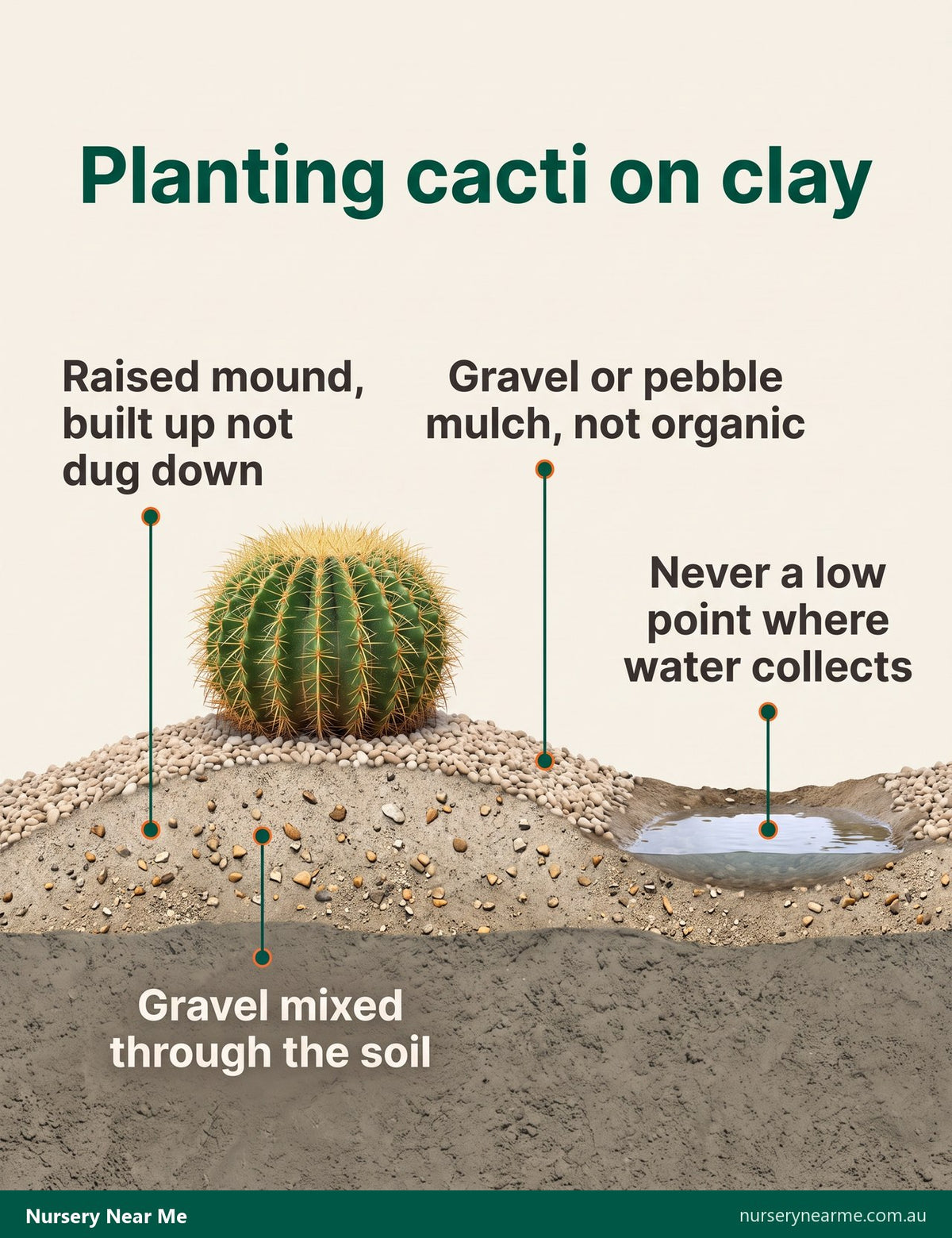
This is the single most important point for an Australian garden. Cacti and succulents are killed by wet feet far more reliably than by heat, cold or neglect. In a Brisbane or Sydney wet summer, a plant in heavy clay will rot at the base while an identical one in Perth sand thrives beside a driveway. On clay, build the bed up rather than digging down. Plant on a raised mound with gravel mixed through the soil, mulch with gravel or pebble instead of organic mulch, which holds moisture against the base, and never plant in a low point where water collects after rain. It is the same principle we apply across soil preparation for planting generally, just taken further in the direction of drainage.
Reliable performers
Golden barrel cactus
The golden barrel cactus is the classic front-garden cactus: a ribbed globe to about 60 cm across, covered in golden spines that light up in afternoon sun. Plant it in threes on a gravel bed and leave it alone.
Cowboy cactus and candelabrum cactus
For height at the back of a bed, the cowboy cactus (Euphorbia acrurensis) builds a candelabra of ribbed green columns to about 3 metres that reads as pure architecture against a rendered wall, and the candelabrum cactus gives a similar effect on a taller frame. Both are euphorbias rather than true cacti, and their milky sap is the reason for the safety note below; the wider euphorbia range has smaller forms for pots.
Agave and yucca
Agaves are the sculptural centrepiece of most Australian cactus gardens: Blue Glow and Queen Victoria for smaller spaces, variegated agave as a feature. Agaves in particular repay the pairing, and our roundup of the best agave garden ideas covers the varieties that hold their form in the same conditions. Yucca elephantipes is spineless and safe near paths; red yucca is spineless, frost hardy, and flowers for months.
Dragon tree, jade and the ground layer
The dragon tree gives a dramatic silhouette and is extremely drought hardy. Jade plant thrives on neglect and is excellent in pots by the door. Blue chalksticks and pigface make a low spreading cover between the larger specimens, and both are spineless.
Safety matters more on a front facade
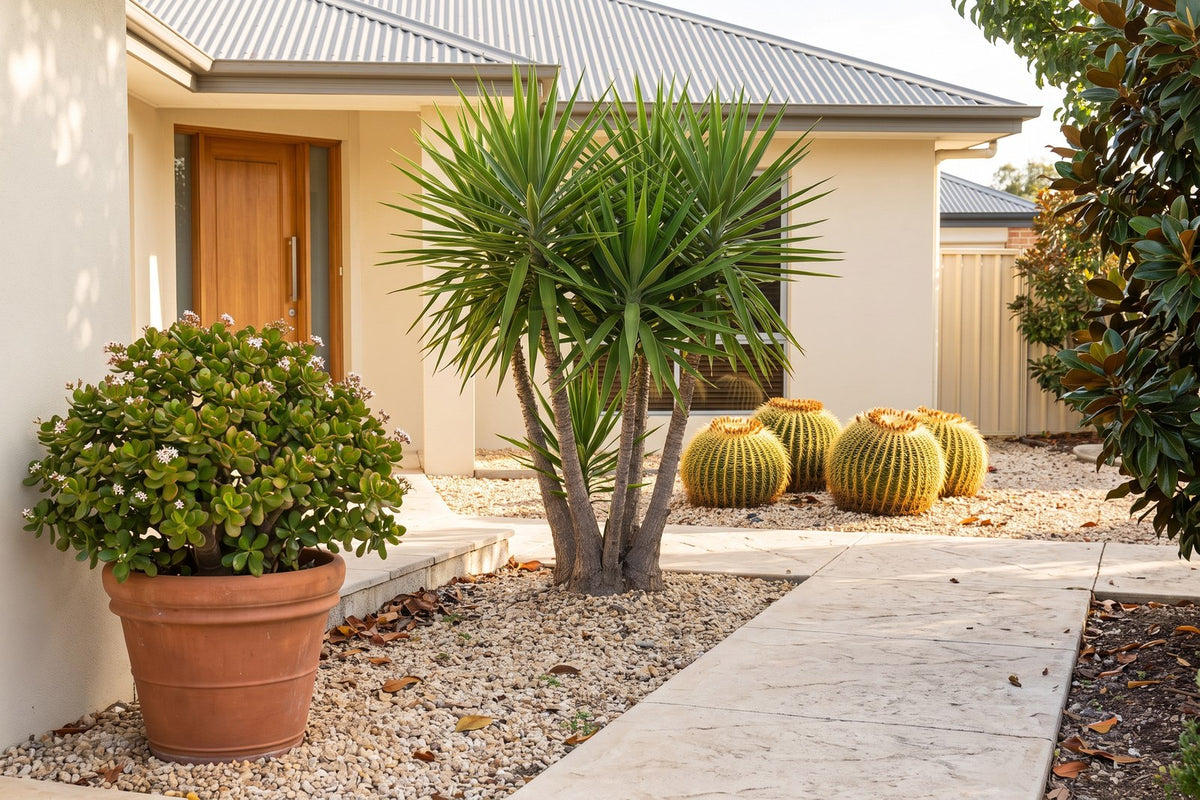
This is the area where visitors, delivery drivers and children walk, so spines are a genuine consideration rather than a detail.
- Keep spined species well back from paths, the letterbox, the driveway edge and anywhere people brush past.
- Use spineless options near paths: Agave geminiflora, Yucca elephantipes, jade plant, blue chalksticks, pigface.
- Euphorbias including firesticks have sap that causes severe eye injury. Site them away from where anyone would prune casually or where children play, and wear gloves and glasses when you cut them.
- Terminal spines on large agaves sit at eye height for a child. Open beds only.
Getting the look right
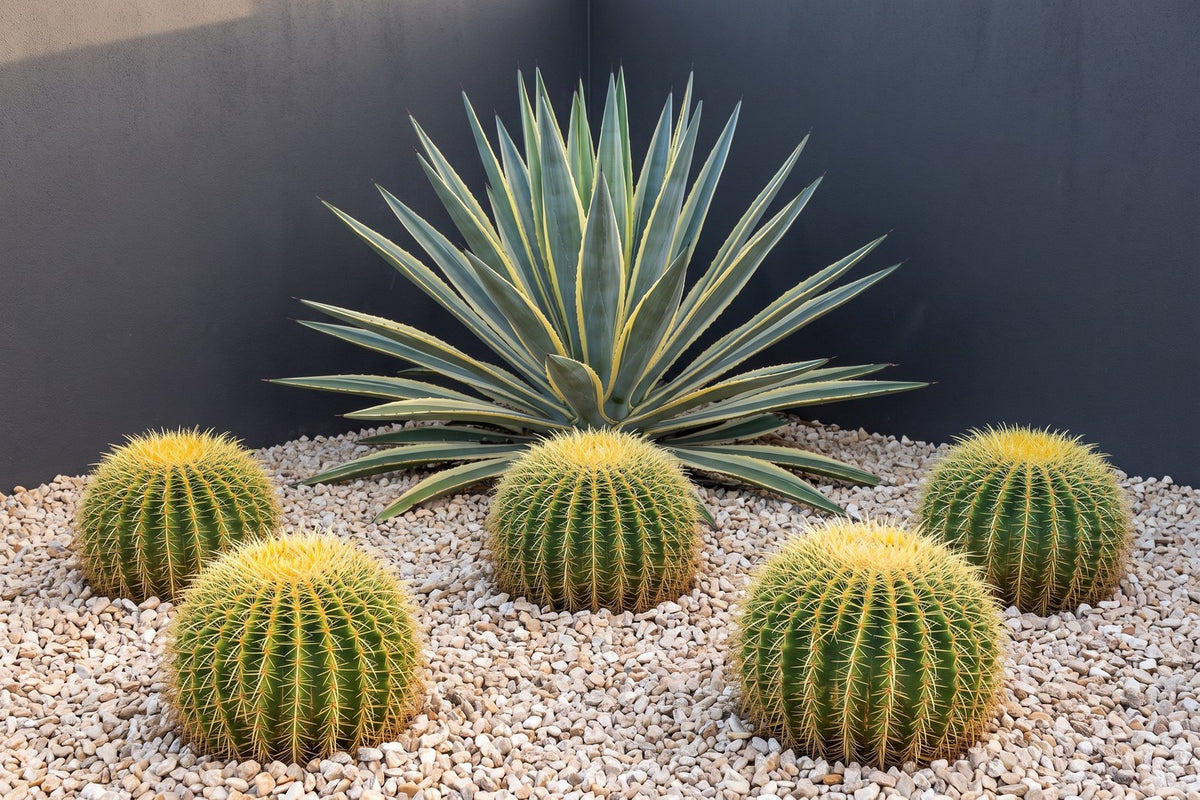
Repetition rather than collection. Three or five of the same species placed deliberately, with gravel between and a single larger specimen as the focal point, reads as designed. Fifteen different plants reads as a nursery display. Pale gravel also reflects heat and keeps the root zone cooler, which matters on a hot front facade, and it suppresses weeds without holding moisture. Mixing cacti with ornamental grasses and softer succulents produces a contrast of hard and soft textures, an approach that sits comfortably among the broader ideas in our guide to plants for low-maintenance architectural gardens. See front yard planting for kerb appeal for the combinations that photograph well and survive neglect.
Care, which is almost none
Full sun, water occasionally through the first summer and then essentially not at all, and do not enrich the soil; rich ground produces soft growth that rots and loses form. A light feed in spring at most. Check for mealybugs in the crevices and scale on the ribs once or twice a year and dab them with methylated spirits. Protect frost-tender species in Melbourne and inland districts with a cover on the coldest nights of their first winter. That is the entire maintenance schedule, which is why this style suits a front garden nobody wants to spend weekends on. Low-maintenance garden ideas for Australian gardens covers the rest of it, and for the same sculptural look with softer foliage the ripple jade care guide is the place to start.
Bringing cacti indoors
The same qualities that suit a front facade make cacti good indoor plants, and many gardeners run both. Light is the single factor that decides whether an indoor cactus thrives or stretches: give them a north-facing window and five to six hours of sun a day, because cacti kept in dark corners grow spindly and pale, and a grow light is a genuine fix in a poorly lit room. Use a pot with drainage holes and a cactus and succulent mix rather than a general potting mix, water thoroughly but infrequently, letting the mix dry out completely in between, and barely at all through the cooler dormant months. If you want more houseplants in the same easy-care category, see our guide to the best low light plants for the home.
Ready to plant?
Browse our full cactus collection, widen the search across succulents and cacti, or find something for a hot, dry aspect in low water plants for hot climates. Every plant is backed by our 30 day satisfaction guarantee.


