

Bromeliads are among the easiest tropical plants to grow in a warm Australian garden: they tolerate shade, need little root space and hold their colour all year. This guide covers where they grow, which types suit which position, and the few rules that keep them alive.
Where bromeliads grow in Australia
Bromeliads are one of the best-suited plant families for warm Australian gardens. They tolerate shade, need very little root space, survive on neglect, and hold colour year-round without flowering.
| Location | How they perform |
|---|---|
| Brisbane, Gold and Sunshine Coasts | Ideal. Grown outdoors year-round, often as garden bedding |
| Darwin and tropical Queensland | Excellent, with the fastest growth and best colour |
| Northern NSW | Very good in frost-free positions |
| Sydney | Good in a warm sheltered spot; some species mark in cold snaps |
| Perth | Workable in shade with regular water - low humidity is the constraint |
| Melbourne, Adelaide, Canberra | Under cover or indoors. Frost is fatal to most |
The mosquito question
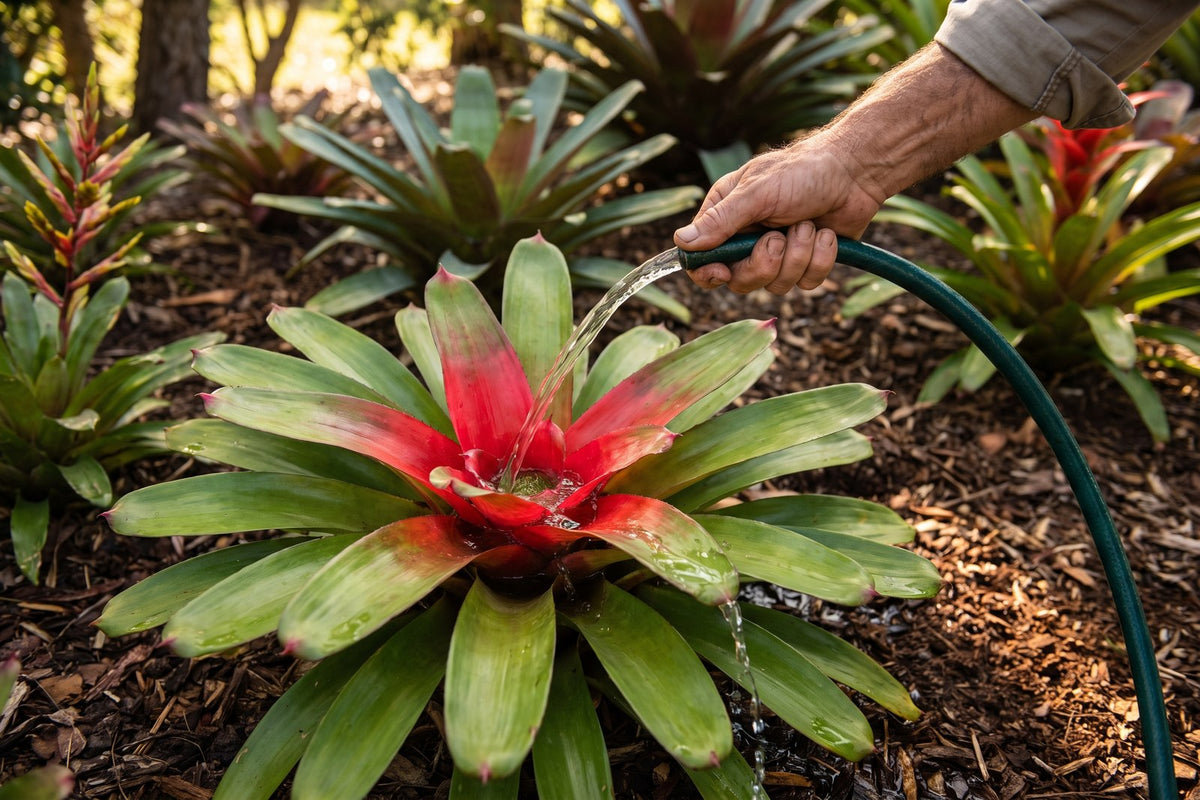
This matters in Australia and is worth addressing directly. Many bromeliads hold water in the central cup formed by their leaves, and that water can breed mosquitoes - including, in northern Queensland, the species that transmit dengue.
Queensland Health and several north Queensland councils have run public campaigns about bromeliads for exactly this reason, and some have specific guidance or restrictions in dengue-risk areas. If you garden in far north Queensland, check your council's current advice.
Elsewhere, the management is simple: flush the cups with fresh water weekly so any larvae are washed out before they mature, or tip the plants to empty them. In Brisbane and southern gardens this is a nuisance issue rather than a health one, but it is still worth doing.
Choosing by position
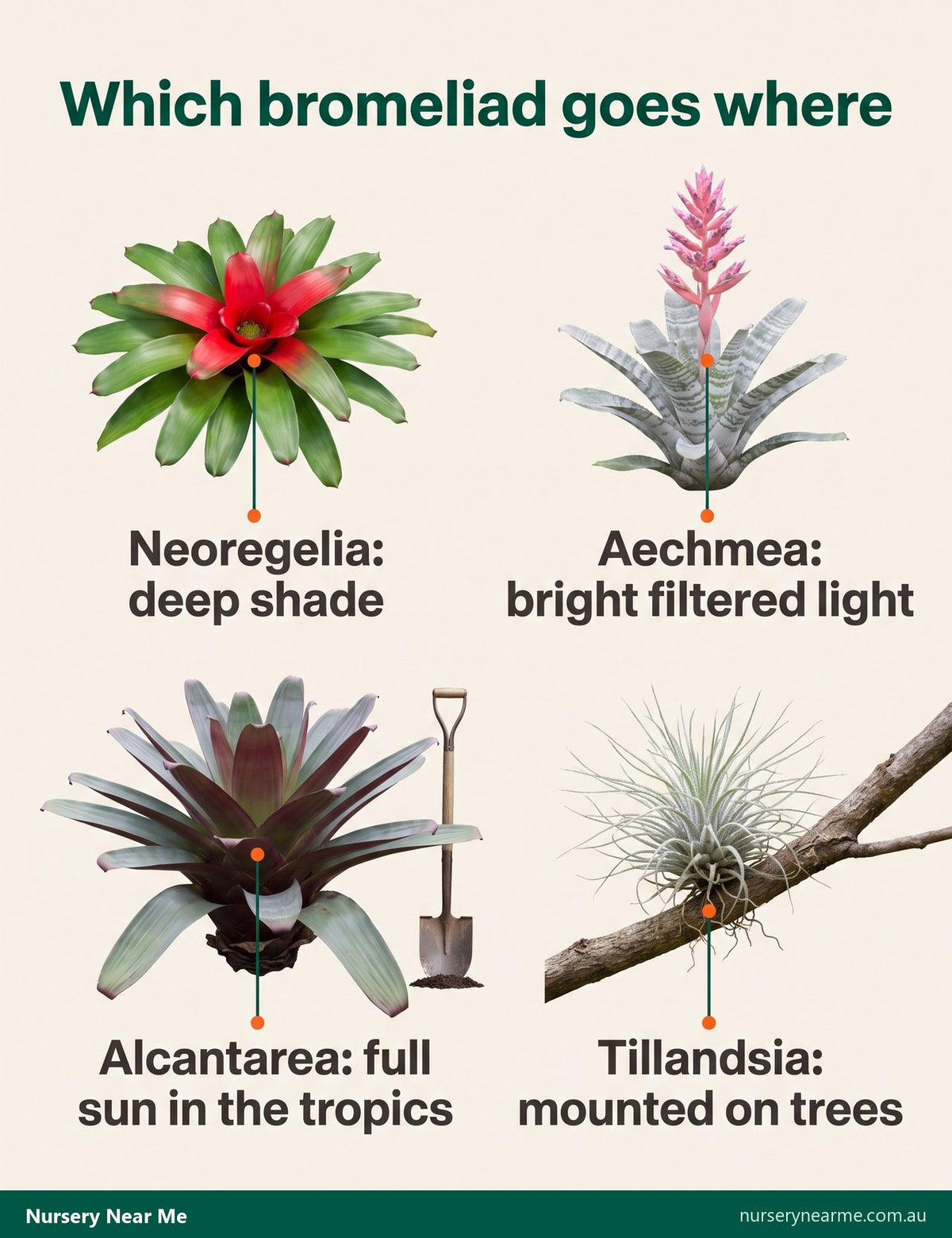
- Deep shade - most Neoregelia and Vriesea, which colour well in low light.
- Bright filtered light - Aechmea, which develops stronger colour with more light.
- Full sun in the tropics - Alcantarea and Portea, the large landscape species.
- Mounted on trees - Tillandsia, the air plants, which need no soil at all.
- Large feature specimens - Alcantarea imperialis, which reaches over a metre across.
Growing them properly
Bromeliads absorb most of their water and nutrients through the central cup and their leaves rather than their roots, which is why they grow on trees in the wild. Practically:
- Water into the cup, not just the soil, and keep it topped up.
- Use a very open mix - orchid bark, perlite and coarse material. Ordinary potting mix holds too much water and rots the base.
- Feed very lightly, at quarter strength. Bromeliads burn easily on fertiliser and too much nitrogen washes out the colour.
- Do not bury the base. Planting too deep is the most common cause of rot.
- Never use copper - copper-based fungicides and copper pots are toxic to bromeliads.
Each rosette flowers once
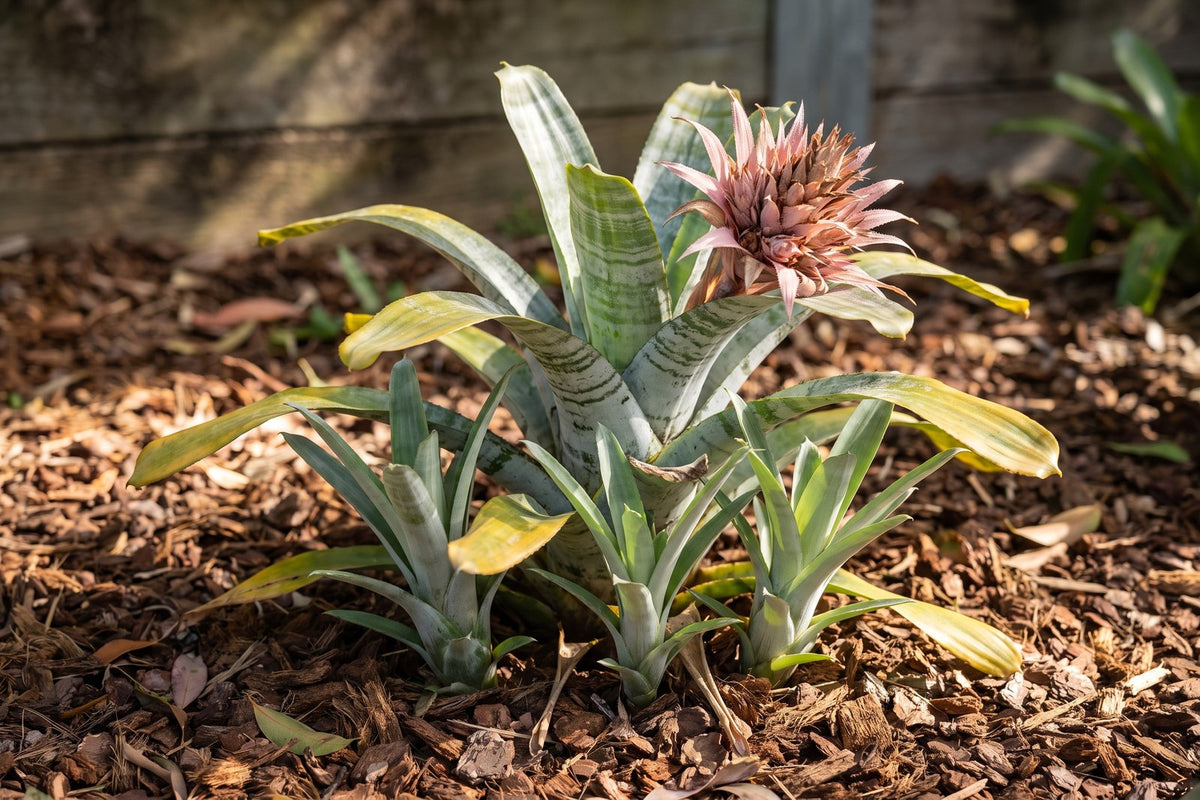
A bromeliad rosette flowers a single time and then slowly declines, producing pups around its base as it does. This is normal rather than a problem. Leave the pups attached until they are around a third the size of the parent, then separate them or simply let the clump build up naturally - which is how the large drifts in Brisbane gardens are formed.
Related guides
Aechmeas are among the toughest of the group and the easiest to find in a large size. The Giant Silver Plum bromeliad carries silvery banded foliage that holds interest long after the flower has faded.
Outdoors in a warm climate the alcantareas are the ones that stop people in their tracks. Alcantarea imperialis forms a rosette over a metre across and works as a feature plant, while the compact Fireball bromeliad colours up to deep burgundy in bright light and spreads into a groundcover.
They sit naturally beside the plants in our guides to elephant ear plant care and Philodendron Xanadu.
In shaded beds bromeliads combine well with ferns, which want the same humidity and the same protection from hot afternoon sun. Our guide to ideal fern environments covers how to build that microclimate.
Our guide to designing a tropical garden shows how to use them in a wider planting.
Ready to plant?
Bromeliads are slow, forgiving and almost impossible to kill through neglect, which makes them a safe first tropical plant. Browse our tropical garden plants to build the rest of the bed around them.


