

Magnolia grandiflora, the evergreen southern magnolia, is the most planted screening tree in Australian suburbs for a simple reason: it holds glossy leaves all year, it flowers for months, the roots behave near paving, and the breeders have given us a form for every width of bed. That last point is where buyers go wrong. Little Gem, Teddy Bear, Kay Parris, Exmouth and the rest are all the same species, but they finish anywhere from 3.5 m to 10 m tall and from 2 m to 5 m wide. Pick by the space you have, not by the name you recognise, and the tree will do the job without a fight for the next thirty years.
Quick facts
| Detail | Magnolia grandiflora |
|---|---|
| Type | Evergreen tree from the south-eastern United States; the named forms are garden selections |
| Size range | 3.5 m to 10 m tall, 2 m to 5 m wide, depending on the cultivar |
| Flowers | Large cream-white goblets, 15 to 25 cm across, late spring through summer, lemon-vanilla scent |
| Foliage | Thick, glossy dark green, backed in rust-brown felt on most forms |
| Growth rate | Slow to moderate: 30 to 60 cm a year once established |
| Position | Full sun; tolerates light shade with fewer flowers |
| Soil | Deep, well-drained and slightly acidic is ideal; tolerates clay if not waterlogged |
| Climate | Cool temperate to subtropical; frost hardy, heat tolerant, copes with coastal air |
| Roots | Non-invasive; routinely planted beside driveways and paths |
Choosing the right cultivar
| Cultivar | Height x width | Character | Choose it for |
|---|---|---|---|
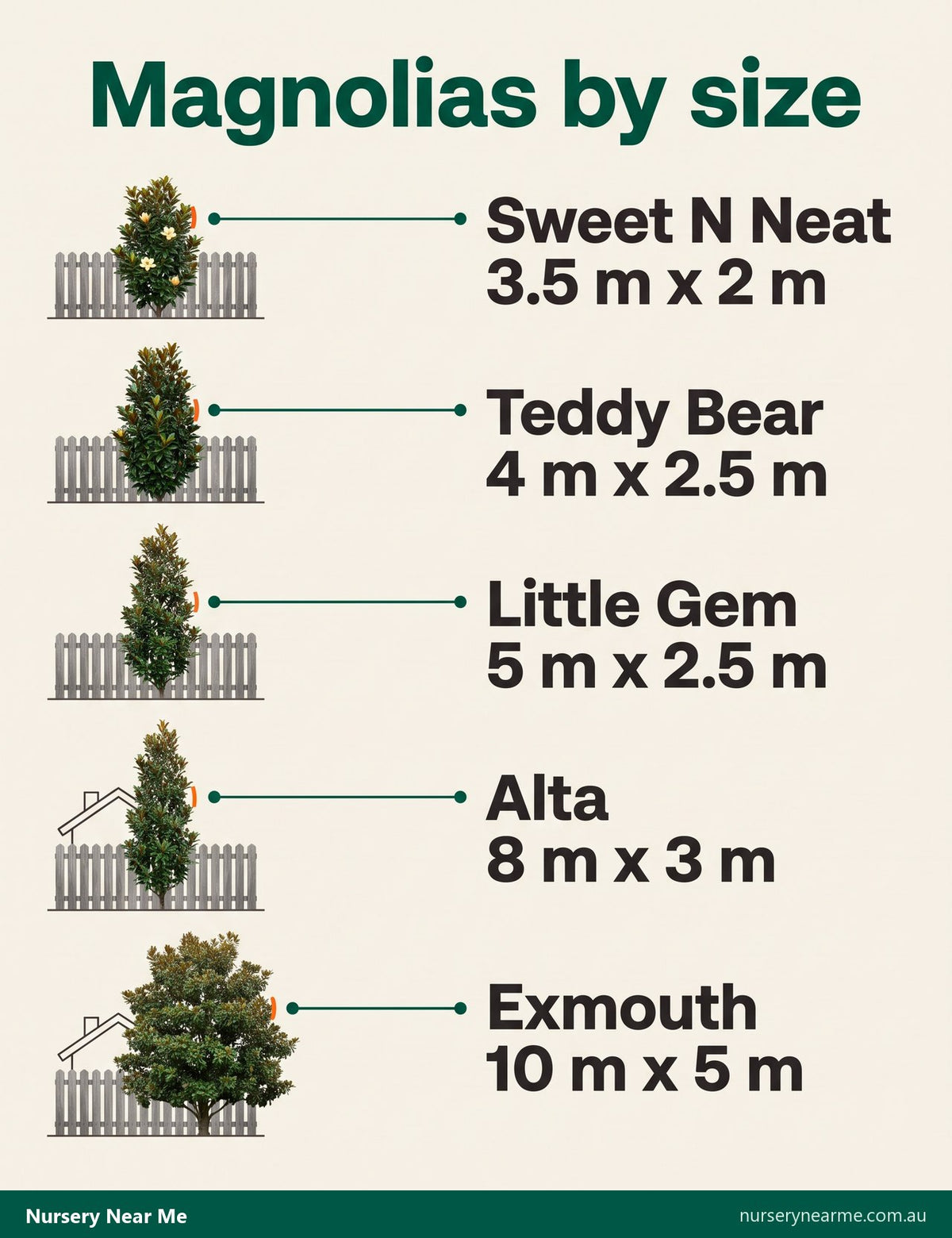
| Sweet N Neat | 3.5 m x 2 m | The compact one; dense, slow, bronze-backed leaves | A screen that must stay under the eaves, courtyards, large pots |
| Teddy Bear | 4 m x 2.5 m | Tightest branching, thick rounded leaves with heavy rust felt beneath, foliage to the ground | A dense boundary screen at fence height plus a metre or two |
| Super Gem | 4 m x 2 m | Narrow, furnished to the ground, flowers young | A first-floor window screened from a bed barely 2 m deep |
| Little Gem | 5 m x 2.5 m | The classic; faster than Teddy Bear, slightly more open, flowers from a young age | The all-round screen or small feature tree, and the widest range of sizes |
| Kay Parris | 5 m x 2.5 m | Smaller, wavy-edged leaves with bright rust backs; flowers very young and for longer | A formal screen at 2 m spacing with the longest flowering season |
| Sweet Spire | 6 m x 2 m | Naturally columnar | Height along a narrow boundary with no clipping |
| Coolwyn Gloss | 6 m x 3.5 m | Very glossy, deep green, steady grower | A tall screen that reads as planting rather than a hedge |
| Alta | 8 m x 3 m | Upright and columnar at full size | Screening a two-storey outlook from a path-width bed |
| Exmouth | 10 m x 5 m | The full-sized tree; dinner-plate flowers, a landmark | Avenues, estates, a shade tree with room to become one |
The three names most people arrive with are Little Gem, Teddy Bear and Kay Parris, and the difference between them is width and density. Teddy Bear is the tightest and slowest, with the heaviest felt under the leaf, and it holds foliage to the ground best, which is why it makes the densest screen; our guide to Teddy Bear for privacy covers its spacing. Little Gem grows faster and a little taller and is sold in the widest range of sizes from tubes to 2000 L trees. Kay Parris sits between them, with distinctive wavy leaves and the longest flowering season of the group, often opening its first flowers while still in the pot. Any of the three will screen a standard fence line; choose Teddy Bear for density, Little Gem for speed and range, Kay Parris for flowers.
For the full species, and for anything over 6 m, Exmouth is the tree. It is the form that becomes the classic southern magnolia of parks and old gardens, and it needs the room to do it. The magnolia collection holds every cultivar in this table, and our guide to the best small magnolia varieties compares the compact forms with the deciduous magnolias.
How to plant a magnolia screen
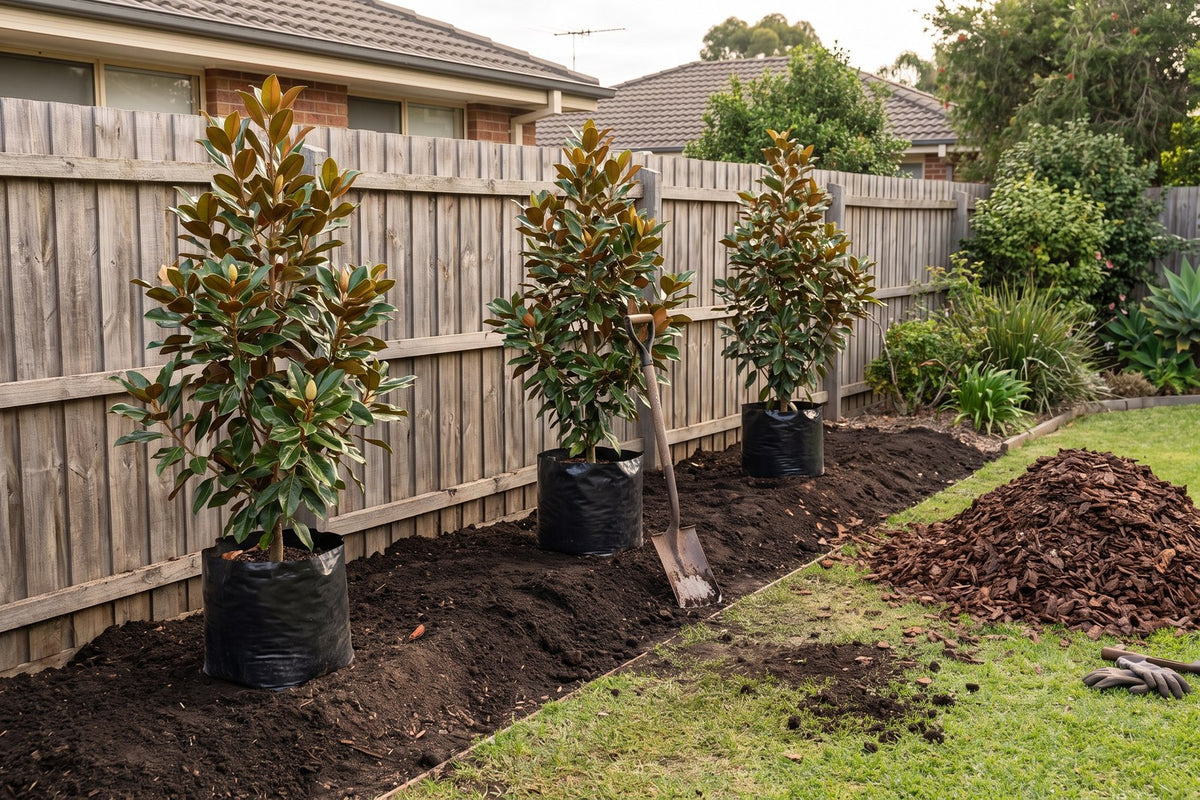
Spacing. For a dense screen, plant the compact forms (Sweet N Neat, Teddy Bear, Super Gem) 1.5 m apart, Little Gem and Kay Parris 2 m apart, and the tall forms 2.5 to 3 m apart. Closer spacing gives a faster screen but the trees compete and lose their lower foliage sooner. For a single feature tree, allow the full mature width in every direction.
Choosing the size. A 300 mm or 400 mm plant is about 1 to 1.5 m tall and establishes quickly; a 100 L bag is 2 m or more and screens a fence from the first season. Because magnolias grow slowly, the advanced sizes are worth more here than with a fast hedge: the two or three years you buy are years you would otherwise spend looking at the fence.
Soil and position. Full sun, and a deep soil that drains. On heavy clay, mound the row 200 mm above grade and plant into the mound; a magnolia will tolerate clay but not standing water in winter. Dig in compost over the whole planting strip rather than the hole, and keep the top of the root ball level with or slightly above the surrounding soil. Mulch 75 mm thick to the drip line, clear of the trunk.
Timing. Autumn and spring in the south; autumn to early spring in the subtropics so the roots are away before the first summer. The general routine for a new tree is in our guide to the best time to plant a tree.
Ongoing care
Watering
Deeply twice a week for the first summer, weekly through the second, then only in dry spells. Magnolias have shallow, fleshy roots that resent drying out while young and resent sitting in water at any age. A thick mulch does more for them than any amount of sprinkling.
Feeding
A complete slow-release fertiliser in early spring and again in late summer for the first three years, then once a year. Magnolias prefer slightly acidic soil; if the leaves yellow between the veins on an alkaline soil, apply iron chelate and read our guide to lowering soil pH.
Pruning
Very little. The compact forms hold their shape without help. To keep a screen at a set height, trim the tips lightly straight after the main flowering in late summer, never into bare wood, because magnolias reshoot poorly from old branches. Remove any shoot that competes with the leader on a young tree. Our magnolia pruning guide covers the timing in detail.
Common problems and fixes
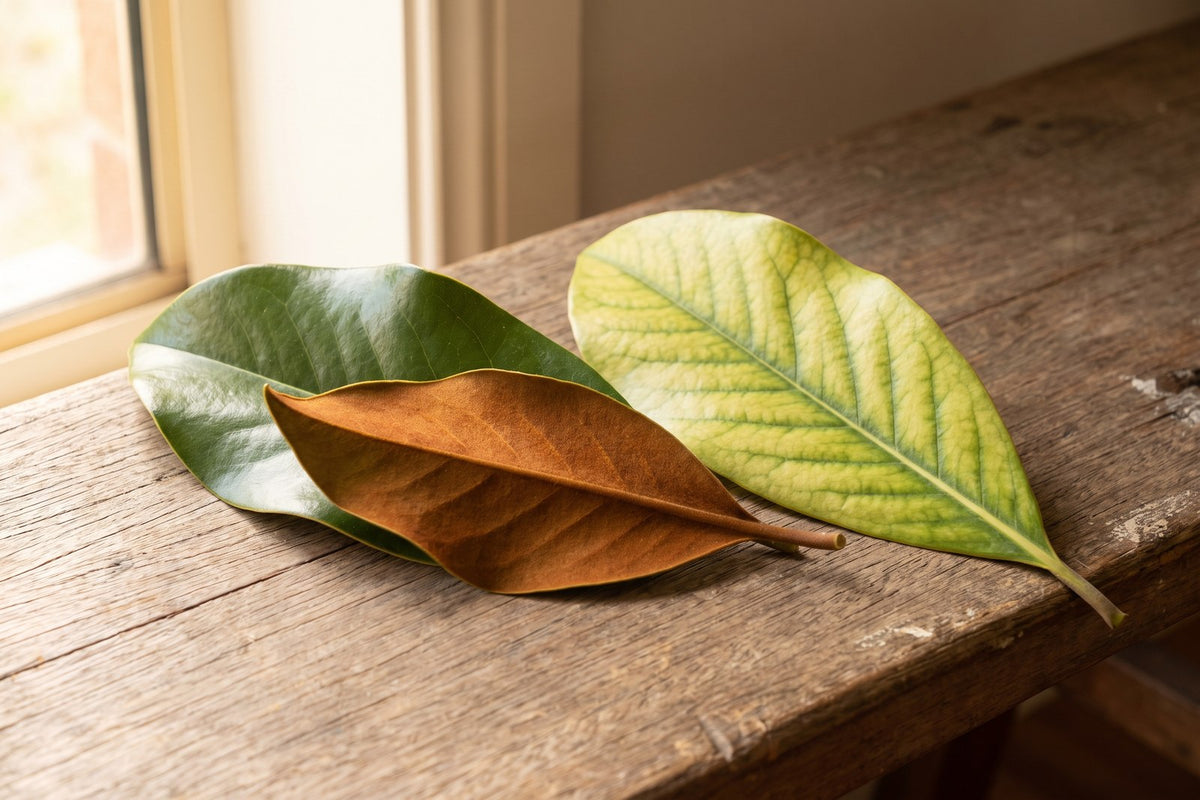
Leaf drop in spring. Normal. Evergreen magnolias shed a flush of old leaves as the new growth comes through, and the thick leaves take a while to break down. Rake them into the mulch or the compost.
Yellow leaves with green veins. Iron deficiency from an alkaline or waterlogged soil. Improve drainage, apply iron chelate and sulphur, and mulch with pine bark.
Few or no flowers. Too much shade, or a seedling tree. Every cultivar in the table is grafted or grown from cuttings and flowers young; a plant sold as plain Magnolia grandiflora may be a seedling and can take ten years. Give the tree full sun and a late-summer feed.
Bare lower trunk on a screen. The row was planted too close, or it was shaded from one side. Plant at the spacing above and keep the sunny side open; once a magnolia loses its lower foliage it does not reliably replace it.
Scale and sooty mould. Occasional on stressed trees. Treat with a horticultural oil on a cool morning and improve watering and mulch.
Scorched leaf edges in the first summer. Transplant stress on a tree planted in hot weather. Water deeply, shade it for a fortnight, and it will push clean growth in autumn.
Frequently asked questions
Little Gem or Teddy Bear: which is better for a screen?
Teddy Bear for density and a slightly smaller finished size, Little Gem for faster growth and the widest choice of sizes. Both screen a fence line well. If the bed is narrow and you want the screen furnished to the ground, Teddy Bear; if you want 5 m of height sooner, Little Gem.
How fast does Little Gem grow?
About 30 to 60 cm a year once established, faster in warm, well-watered gardens and slower in cool districts or dry soil. A 1.5 m plant reaches 3 m in roughly three to four years. Teddy Bear and Sweet N Neat are slower; Exmouth and Alta are faster.
Are magnolia roots invasive?
No. Magnolia grandiflora has a shallow, fleshy, non-invasive root system and is one of the standard choices beside driveways, paths and pool surrounds. Keep the compact forms 1 m from paving and the tall forms 2 m, for the canopy's sake.
Will Magnolia grandiflora grow in Brisbane?
Yes. It handles the heat and humidity well and flowers through summer. Give it full sun, mulch heavily and water it through dry spells. It also grows in Melbourne, Adelaide, Sydney and Perth, and tolerates frost once established.
Can I grow a magnolia in a pot?
The compact forms, yes. Sweet N Neat, Teddy Bear and Super Gem live for years in a 500 mm or larger pot with a quality potting mix, a slow-release feed each spring and water whenever the top of the mix dries. Our guide to choosing the right pot size sets out the sizes.
Ready to plant?
Every cultivar in this guide is in the magnolia collection, from tubes to advanced trees. If the job is a boundary, compare the field in tall and narrow screening plants, and read our guide to the types of magnolia if you are also weighing up the deciduous kinds.


