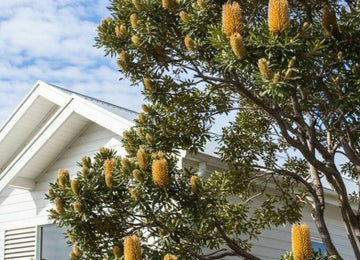


The ivory curl tree (Buckinghamia celsissima) is the flowering native for a block that is too small for a poinciana or a jacaranda but still wants a tree people stop to look at. From late summer into autumn it hangs long, curling, creamy white flower spikes through a dense evergreen canopy, and the scent carries across a yard on a still evening. In a garden it settles at 6 to 8 m, the roots are well behaved, and it is one of the few rainforest trees that copes with a dry, hot suburban position once it is established. This guide covers where it grows, how to plant it, and why a young tree sometimes takes a few years to flower.
Quick facts
| Detail | Ivory curl tree |
|---|---|
| Botanical name | Buckinghamia celsissima, a Queensland rainforest native in the protea family (Proteaceae) |
| Garden size | 6 to 8 m tall, 4 m wide; 20 m or more in its home rainforest |
| Growth rate | Moderate: about 50 cm a year once established |
| Flowers | Creamy white curling spikes 15 to 20 cm long, late summer to autumn, fragrant, full of bees and nectar birds |
| Position | Full sun to light shade; flowers best in sun |
| Soil | Any well-drained soil; copes with clay on a slope |
| Climate | Tropical, subtropical and warm temperate; light frost only once established |
| Roots | Non-invasive; safe near driveways and paths |
| Best planting window | Spring and autumn; any time in the frost-free north with water |
Where it belongs in a garden
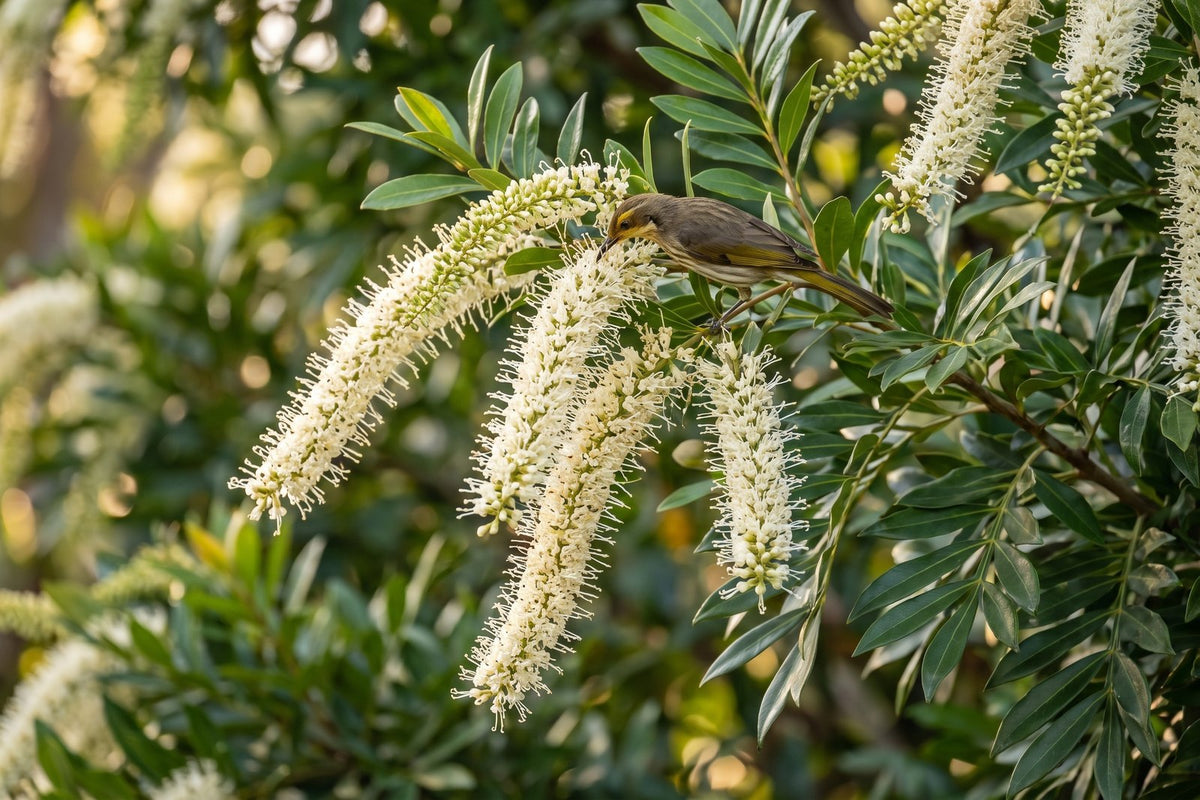
The ivory curl tree comes from the wet tropics of north Queensland, where it grows as a tall rainforest tree, but it has turned out to be one of the most adaptable natives in cultivation. Councils plant it as a street tree from Cairns to Sydney because it stays a sensible size, tolerates reflected heat, keeps its roots to itself and flowers reliably without any care. That same list makes it a near-perfect suburban tree.
As a feature tree. One tree in a front lawn or beside an entry path is the classic use. The canopy is dense and rounded, glossy enough to look good out of flower, and the bronze-pink new growth in spring is a second display. Our guide to feature trees for a front yard puts it beside the other candidates.
Along a driveway. The non-invasive roots and the upright trunk make it a good avenue tree at 5 to 6 m spacing, and it tolerates the heat off the concrete; see our guide to trees for lining driveways.
As a tall screen. Planted 3 m apart it builds an evergreen screen to 6 m that flowers. It is slower to close than a lilly pilly but it never needs clipping.
Beside the other small flowering natives. It is often chosen against three trees of similar size: golden penda, which flowers gold in summer and prefers the warmer coast; tulipwood, grown for its orange and black seed capsules and glossy canopy; and blueberry ash, the fringed white bells and blue berries of the south-east coast. The ivory curl tree flowers later than all three and is the most fragrant, so in a garden with room for two, pair it with one that flowers in spring.
Where it does not suit. Cold districts with regular hard frost, where a young tree is cut back every winter; a boggy site that stays wet; and a position where you want shade in year two, because it takes a few seasons to build a canopy.
How to plant
Choosing the size. A 200 mm or 300 mm plant establishes fastest and is the best value for a feature tree; an advanced tree in a 100 L bag gives you a 2 m tree with presence on day one and is worth it beside an entry. The ivory curl tree is available from tubes through to advanced sizes.
Position. Full sun for the best flowering, with shelter from strong wind while it is young. Allow 4 m of clear width at maturity and keep it 3 m from a building so the canopy does not need lopping on one side.
Soil. It is not fussy, but it is a member of the protea family, so a well-drained, slightly acidic soil suits it best and heavy phosphorus does not. On flat clay, mound the planting position 150 mm and plant into the mound; on sand, dig in compost over a wide area rather than filling a hole with it.
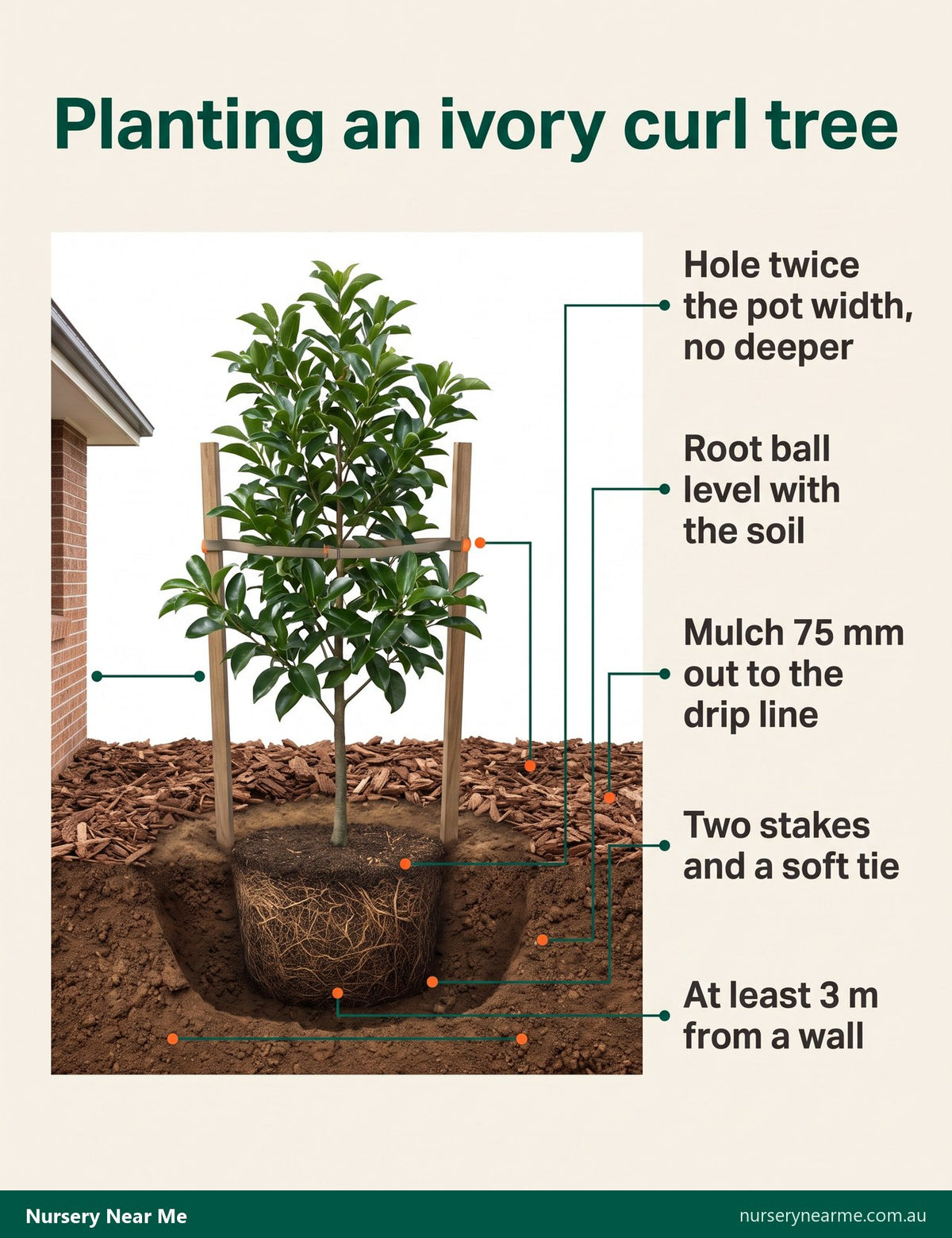
Planting. Dig a hole twice the width of the pot and no deeper, tease out any circling roots, set the top of the root ball level with the soil, backfill, water deeply and mulch 75 mm thick to the drip line, clear of the trunk. Stake with two stakes and a soft tie for the first year in a windy position. The full routine for a new tree is in our guide to the best time to plant a tree.
Timing. Spring and autumn are ideal everywhere it grows. In Brisbane and north it can go in at any time of year if you water it through the first summer.
Ongoing care
Watering
Water deeply twice a week for the first summer and weekly through the second, then only in extended dry spells. Established trees are drought tolerant, but a tree that is kept watered through a dry autumn flowers far better than one left to struggle.
Feeding
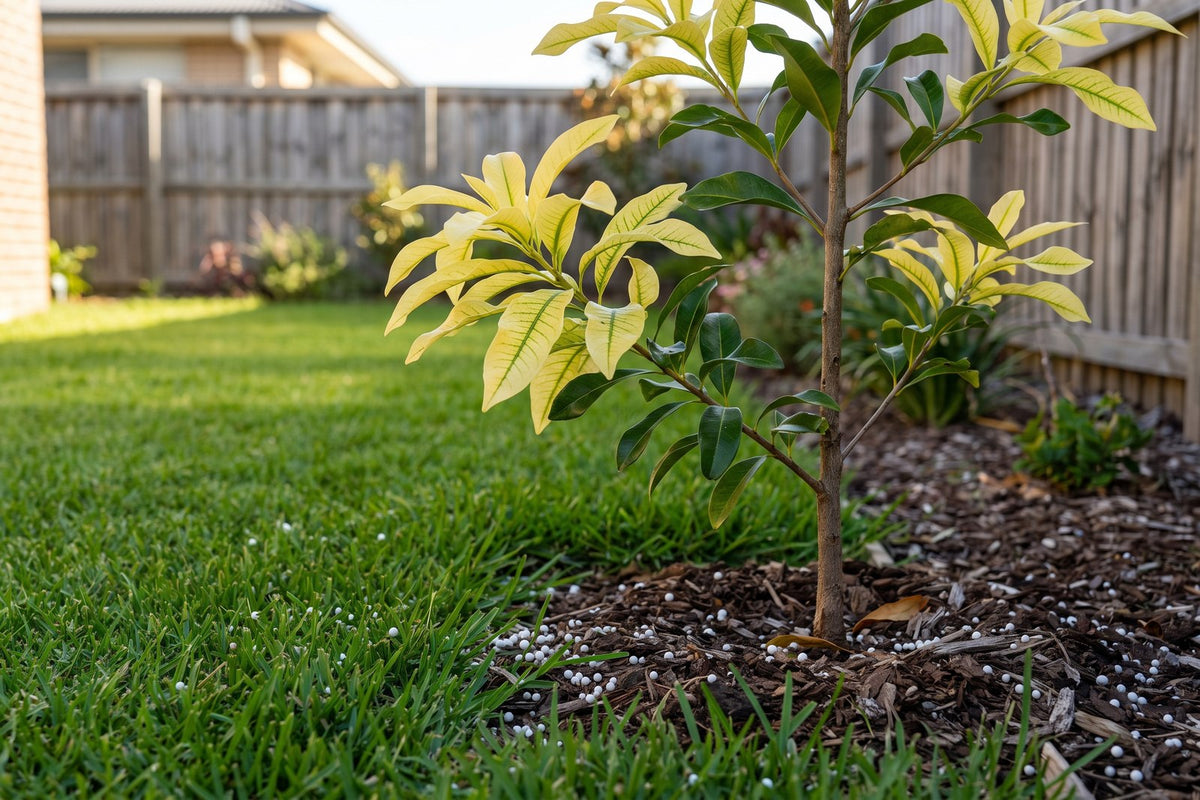
Feed lightly in spring with a low-phosphorus native fertiliser, the same rule as for grevilleas and banksias, which are its relatives. Standard complete fertilisers and lawn food running into the root zone cause yellowing and poor growth. Once established it needs little more than mulch.
Pruning
Almost none. Lift the lower branches gradually over the first few years if you want a clear trunk to walk under, cutting back to the collar in late winter. Do not top it; a topped tree throws weak multiple leaders and loses its shape. Spent flower spikes drop on their own.
Common problems and fixes
No flowers after three or four years. The commonest complaint, and usually patience. Seedling-grown trees can take five to seven years to flower; trees grown from cuttings of flowering stock flower much younger. Too much shade, too much nitrogen and heavy pruning all delay it. Keep it in sun, stop feeding it anything but a native fertiliser, and water it through autumn.
Yellow leaves with green veins. Phosphorus toxicity or iron lockout from fertiliser, or alkaline soil. Stop feeding, water deeply to flush, and if the soil is alkaline apply iron chelate and sulphur as set out in our guide to lowering soil pH.
Frost damage on a young tree. Burnt tips and blackened new growth after a cold night. Cover young trees in frosty districts for the first two winters, plant on the north side of the house, and leave the damaged growth on until spring so it protects the wood beneath.
Slow growth in the first two years. Normal. It puts its energy into roots first, then grows at about half a metre a year. Mulch, water and a spring feed are all it needs.
Leaf spot in a wet summer. Brown spots on older leaves in humid weather are cosmetic. Improve airflow, keep the mulch clear of the trunk and rake up fallen leaves; the tree outgrows it.
Frequently asked questions
How big does an ivory curl tree get?
In a garden, about 6 to 8 m tall and 4 m wide, with a rounded dense canopy. In its north Queensland rainforest home it can reach 20 m or more, but it never approaches that in an open suburban site.
How long until it flowers?
A tree grown from a cutting of flowering stock can flower within two or three years of planting. A seedling can take five to seven. Sun, a native fertiliser and water through autumn bring flowering forward; shade and nitrogen delay it.
Will it grow in Sydney or Melbourne?
Sydney, yes: it is widely planted as a street tree there and flowers well in warm temperate gardens with light frost at most. Melbourne is marginal; it survives in a sheltered, frost-free inner suburb but grows slowly and flowers less. Cold tablelands and inland districts with hard frost are not suitable.
Are the roots invasive?
No. The ivory curl tree has a well-behaved root system and is routinely planted beside driveways, paths and in narrow street verges. Keep it 3 m from a house for the canopy's sake rather than the roots.
Is it good for bees and birds?
Very. The nectar-rich flower spikes are worked by honeyeaters, lorikeets, native bees and honey bees from late summer into autumn, a time when fewer natives are flowering. It is one of the best small trees for a wildlife garden.
Ready to plant?
The ivory curl tree is listed from tubes to advanced bags. Compare it with the other flowering natives in the Australian native trees collection and the flowering trees collection, and if the block is small, read our guide to small trees for small backyards before you decide.


