

Olives are one of the toughest, longest-lived trees you can plant in an Australian garden. They handle heat, drought, salt-laden coastal wind and poor soil, they hold their silver-grey foliage all year, and a well-sited tree will outlive the person who planted it. This guide covers which varieties suit which part of Australia, how to plant and prune them, and what to expect if you want fruit rather than just the look.
Quick facts
| Detail | What to expect in Australia |
|---|---|
| Botanical name | Olea europaea |
| Mature size | 4-8 m tall in the ground; 1.5-2 m kept pruned or in a large pot |
| Position | Full sun, minimum six hours. Olives will not fruit in shade |
| Soil | Free-draining above all else. Tolerates poor, rocky and alkaline soil |
| Water | Weekly while establishing, then only in extended dry spells |
| Frost | Hardy to about -7°C once established; young trees need protection |
| Best climates | Adelaide, Perth, Melbourne, inland NSW and Victoria, the Riverland |
| First fruit | 3-5 years from a nursery tree, longer in humid regions |
Where olives actually thrive in Australia
Olives evolved around the Mediterranean, so they want hot dry summers, mild wet winters and sharp drainage. Australia has large areas that match that description almost exactly, and some that do not.
- Adelaide, Perth and inland South Australia are close to ideal. Olives here fruit reliably and need very little once established.
- Melbourne, Geelong and central Victoria grow excellent olives. Cooler winters actually help, since olives need a cold period to set flower buds.
- Inland NSW, the Riverina and the Riverland produce most of Australia's commercial crop for good reason.
- Sydney and coastal NSW grow healthy trees, though humidity can reduce fruit set in wetter years.
- Brisbane and subtropical Queensland is the honest exception. Olive trees grow perfectly well here as ornamental and screening plants, but summer humidity interferes with flowering and encourages anthracnose, so a heavy crop is unlikely. Plant them for the silver foliage and drought tolerance rather than for the olives.
- Tropical north Queensland and the Top End is too wet and warm year-round. Olives are not a sensible choice.
One requirement catches people out: olives need roughly 200-300 hours below about 10°C over winter to flower properly. That is why a tree in Adelaide fruits heavily and the same variety in Cairns never does.
Choosing the right olive variety
Variety matters more than most people expect. Some are bred for table olives, some for oil, and one of the most useful in Australian gardens produces no fruit at all.
| Variety | Best for | Notes |
|---|---|---|
| Swan Hill | Streets, driveways, paved areas | Fruitless and effectively pollen-free. No mess, no seedlings, no hay fever |
| Manzanillo | Table olives | The classic green table olive. Reliable, widely grown, moderate size |
| Kalamata | Table olives | Purple-black Greek olive. Needs a warm dry autumn to ripen well |
| Frantoio | Oil | Italian oil variety, heavy cropper, good in cooler districts |
| Picual | Oil | Spanish, very hardy and productive, tolerates tougher sites |
| Arbequina | Oil, small gardens, pots | Naturally compact and early to bear, the best choice for containers |
| Tolleys Upright | Narrow spaces, screening | Columnar habit, useful where width is limited |
| Helena | Dual purpose | Australian selection, good for both table and oil |
| Mission | Dual purpose | Cold-hardier than most, upright and vigorous |
Fruitless olives for paths and driveways
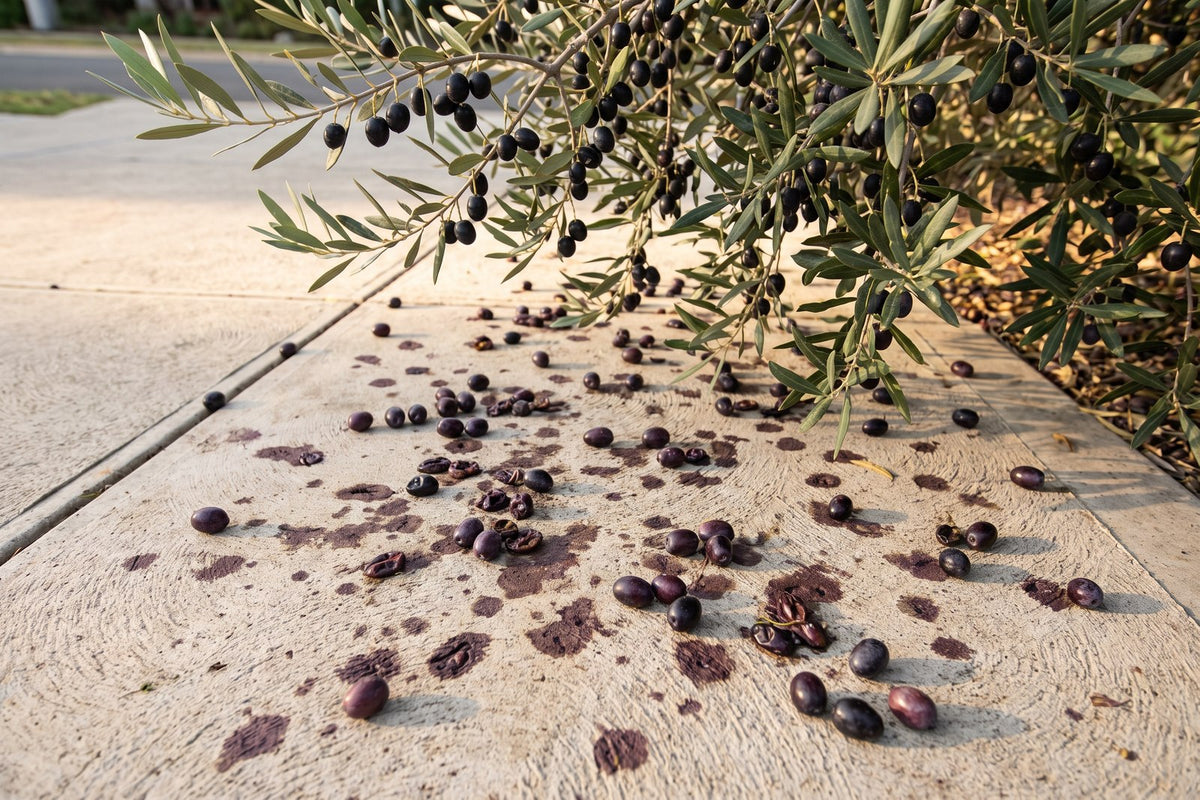
If the tree is going near a driveway, footpath, pool or entertaining area, plant Swan Hill. Ripe olives stain concrete and paving badly, they are slippery underfoot, and birds spread the seed into bushland where olives have become a weed in parts of South Australia and Victoria. Swan Hill gives you the same silver canopy with none of that.
Do you need two trees for fruit?
Most olive varieties are partly self-fertile, so a single tree will set some fruit. Planting a second variety nearby lifts the crop noticeably. Manzanillo and Kalamata are a common pairing for table olives; Frantoio and Picual work well together for oil. You can browse the full range in our olive trees collection.
How to plant an olive tree

Autumn (March to May) is the best planting window across most of Australia, giving roots the cool months to establish before summer. In frost-prone districts wait until early spring instead.
- Check the drainage first. Dig a hole, fill it with water and let it drain, then fill again. If water is still sitting after four hours, plant on a raised mound instead. Wet feet kill more olives in Australia than cold ever will.
- Dig wide, not deep. Two to three times the width of the pot, the same depth. The graft union and the top of the root ball should finish slightly proud of the surrounding soil.
- Do not over-improve the soil. Olives fruit better in lean ground. A little compost through the backfill is plenty; rich soil produces lush growth and few olives.
- Stake only if needed. Trees allowed to flex build stronger trunks. If the site is windy, use a low stake and remove it after the first year.
- Mulch, but keep it clear of the trunk. A 50-75 mm layer held 100 mm back from the trunk conserves moisture without causing collar rot.
- Water deeply once a week for the first summer, then taper off.
Growing olives in pots
Olives take well to containers, which is the practical answer for courtyards, balconies and Brisbane gardens where in-ground fruiting is unreliable. Use a pot at least 500 mm wide, a free-draining premium potting mix, and never a saucer that holds water. Arbequina is the most naturally compact choice. Potted trees need more regular watering than trees in the ground and a controlled-release fertiliser each spring.
Ongoing care
Watering
Established olives are genuinely drought tolerant and the most common mistake is kindness. Water deeply and infrequently rather than little and often, which encourages shallow roots. In a hot inland summer a mature tree may want a deep soak every two to three weeks; through a wet Sydney or Brisbane summer it may want nothing at all. If you are after fruit, keep water up from flowering through to fruit set in late spring, as that is when drought stress causes the crop to drop.
Feeding
Olives are light feeders. A balanced fertiliser in early spring, and again in early summer if the tree is carrying fruit, is enough. Nitrogen-heavy lawn fertiliser produces soft leafy growth at the expense of flowers. Trees in pots need feeding more often than trees in the ground because nutrients leach out with every watering.
Pruning
Prune after harvest, or in late winter before new growth starts. Olives fruit on wood grown the previous season, so cutting everything back hard each year removes next year's crop.
- Open the centre to light and air. The traditional shape is a vase, which reduces fungal problems in humid areas.
- Remove suckers from the base and any water shoots growing straight up.
- Take out dead, crossing or inward-facing branches.
- Keep the tree at a height you can actually pick from. Olives regrow readily from old wood, so a neglected tree can be brought back over two or three seasons.
Common problems and fixes
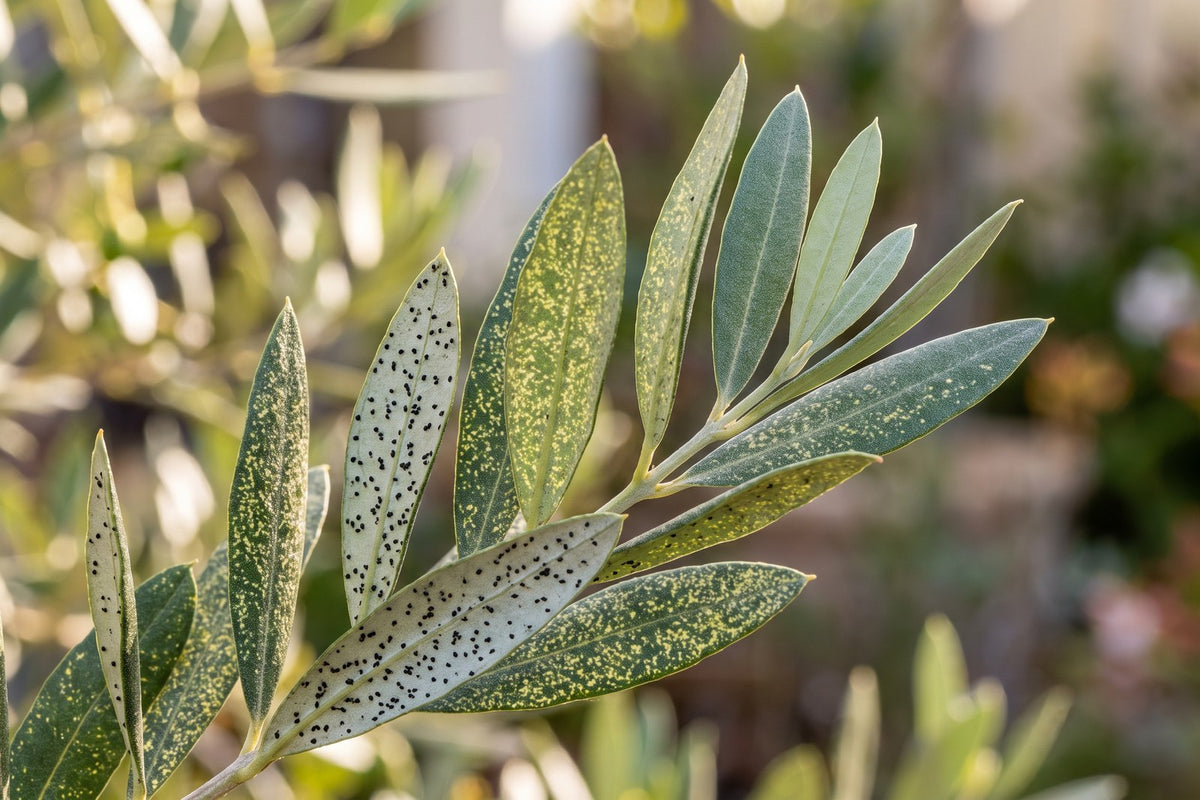
- Olive lace bug is the main pest in Australian gardens. Look for yellow stippling on leaves and black specks underneath. Treat with horticultural oil, covering the leaf undersides, and repeat after two weeks.
- Black scale shows as dark bumps on stems, often with sooty mould and ants. Horticultural oil works; improving airflow through pruning prevents it returning.
- Anthracnose causes fruit to rot and drop in humid weather. It is the main reason olives disappoint in subtropical gardens. Improve air movement, remove fallen fruit, and choose a more suitable species if the site is genuinely humid.
- Yellow leaves and dieback almost always mean drainage, not disease. Check whether water is sitting around the roots before reaching for anything else.
- Healthy tree, no fruit is usually one of three things: not enough winter chill, too much shade, or too much nitrogen.
Harvesting
Olives ripen from late autumn into winter, roughly April to July depending on variety and district. Green olives are picked early and are firmer; black olives are left to ripen fully and bruise more easily. Fruit straight off the tree is inedibly bitter and must be cured in brine or water over several weeks before eating.
Frequently asked questions
How long before an olive tree fruits in Australia?
A nursery-grown tree usually produces its first useful crop three to five years after planting, and reaches full production around eight to ten years. Trees in warm humid districts take longer and may never crop heavily. Container-grown trees generally fruit less than trees in the ground.
Will an olive tree fruit in Brisbane?
It will grow well but is unlikely to fruit reliably. Subtropical Brisbane rarely delivers the winter chill olives need to set flower buds, and summer humidity encourages anthracnose in whatever fruit does form. Plant olives in Brisbane for the silver foliage, drought tolerance and screening value rather than for a harvest.
Are olive trees frost tolerant?
Established trees handle frost to about -7°C, which covers most Australian growing districts including the Adelaide Hills and central Victoria. Young trees are more vulnerable in their first two winters and benefit from a frost cloth on the coldest nights. A period of winter cold is beneficial, not harmful, as it triggers flowering.
Which olive tree does not drop fruit?
Swan Hill is fruitless and produces almost no pollen, which makes it the standard choice for driveways, footpaths, pool surrounds and anywhere staining or slipping would be a problem. It was selected in Australia and is widely used for street planting.
How far from a house or pipes should I plant one?
Allow four to five metres from a building for a full-sized tree. Olive roots are not aggressively invasive compared with figs or willows, but a mature canopy spreads four to six metres and needs the room. For narrow spaces choose a columnar variety such as Tolleys Upright.
Can I grow an olive tree in a pot long term?
Yes. Olives are among the best trees for large containers and can stay in the same pot for many years with an annual prune and fresh mix through the top. Choose a compact variety such as Arbequina, use a pot at least 500 mm wide, and make sure it drains freely.
Ready to plant?
We grow a full range of Australian-suited olive varieties, from fruitless Swan Hill for driveways through to Manzanillo and Kalamata for the table. Browse the olive trees collection, or see the rest of our fruit trees and drought tolerant plants if you are planting a low-water garden.
Not sure an olive suits your climate? Our guide to olive trees in the Brisbane climate covers the subtropical case in more detail, and the best trees for lining driveways compares olives against other avenue options.
Before a tree goes in near the house, read our guide to planting near pipes: it sets out what Australian water utilities say about root behaviour, what can go directly over a sewer line, and which trees to keep well away.
Planting a tree to cool the house? Our guide to shade trees that cut cooling bills explains which side of the house to shade, deciduous versus evergreen by climate, and how far back to plant.


