

An evergreen tree holds its leaves all year, which makes it the tree for screening a neighbour, blocking a wind, giving a garden its structure through winter and sheltering birds. Australia has an advantage most temperate countries do not: the great majority of our native trees are evergreen. This guide covers the best evergreens for each climate and job, the leaf drop that is normal, the position where a deciduous tree is the better choice, and the planting and care that establish them. The full trees range is sorted by both.
Why choose an evergreen
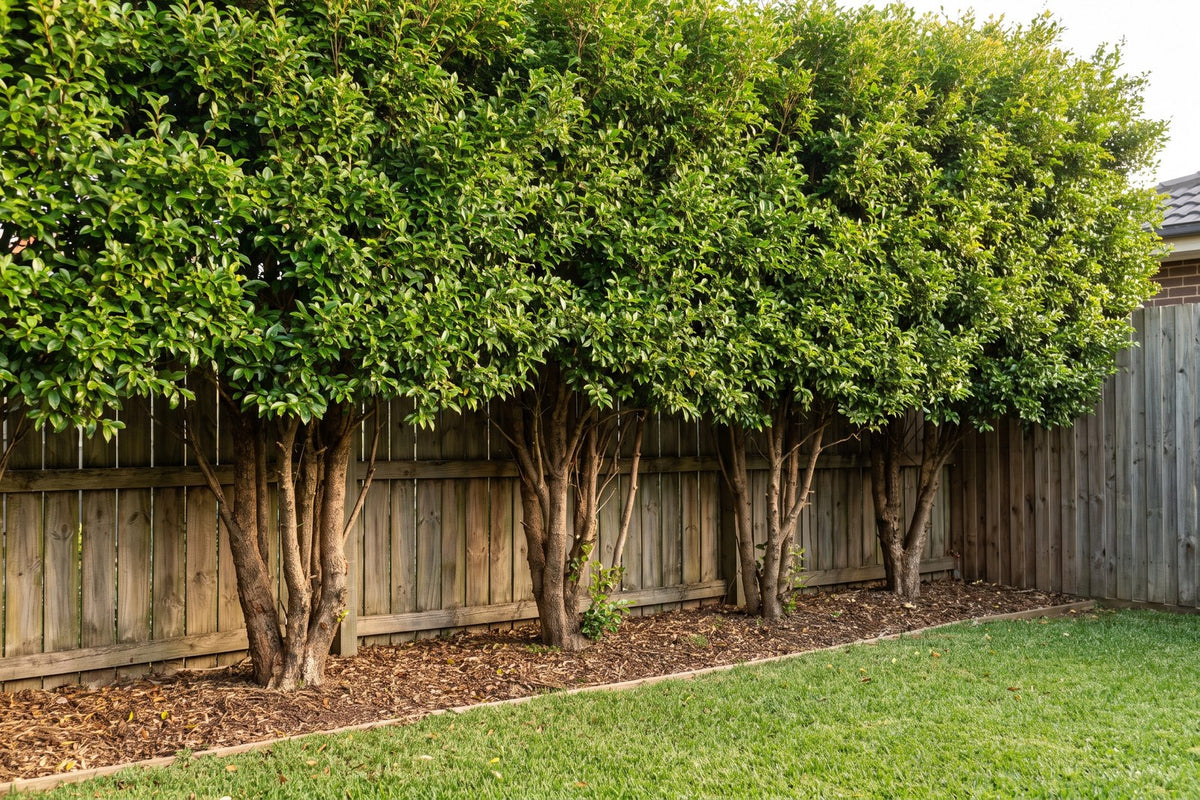
- Screening and privacy: a hedge or screen that is bare for three months is not doing its job. Evergreens are the only choice for a boundary.
- Wind and noise: a dense evergreen canopy breaks wind and softens road noise all year.
- Structure: evergreens hold a garden together through winter, so flowering plants can be accents rather than the whole design.
- Habitat: dense evergreen foliage shelters small birds in every season.
- Less raking: evergreens drop leaves steadily rather than all at once.
Evergreen trees for Australian gardens
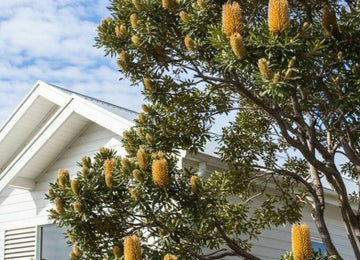
Eucalypts, melaleucas, lilly pillies, banksias, tuckeroos and figs all hold foliage year-round, so a garden built around natives never goes bare.
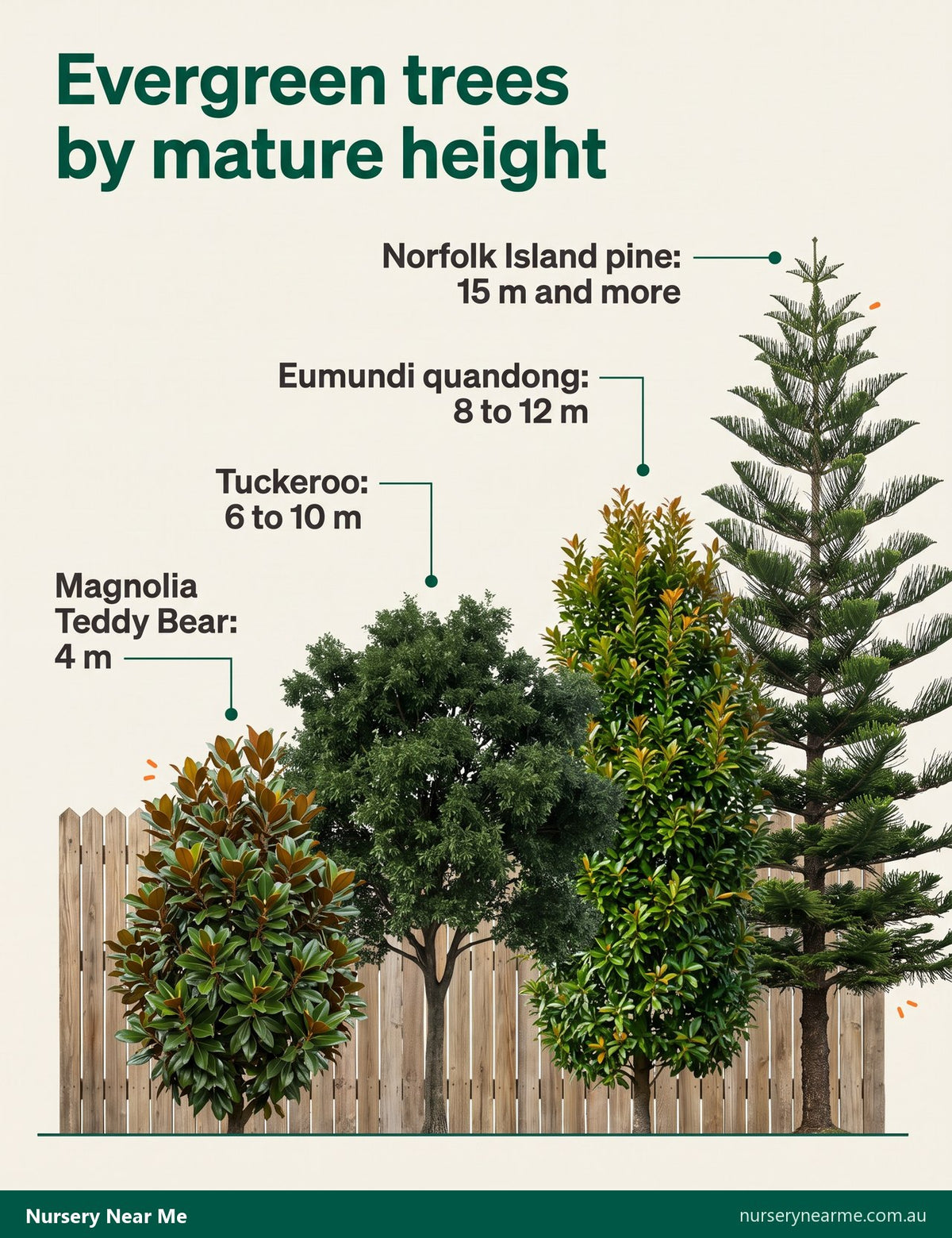
| Tree | Height | Best for |
|---|---|---|
| Lilly pilly (various) | 2 to 15 m by cultivar | Hedging and screening at any scale |
| Tuckeroo | 6 to 10 m | Coastal gardens, tidy habit, bird attracting |
| Blueberry ash | 6 to 10 m | Narrow upright screening, flowers and berries |
| Eumundi quandong | 8 to 12 m | Tall narrow screens, bronze new growth |
| Magnolia 'Teddy Bear' | 4 m | Dense privacy screen, foliage to the ground |
| Golden penda | 6 to 10 m | Evergreen with gold flowers, subtropical |
| Brown pine (Podocarpus) | 10 to 20 m | Large native conifer, clips well |
| Norfolk Island pine | 15 m and more | Coastal landmark tree for a large block |
The Norfolk Island pine is the one to think twice about: it is a superb coastal tree that laughs at salt wind, but at 15 metres and more it belongs on a large block or a foreshore, not a suburban backyard.
Choosing by climate
- Brisbane and subtropical Queensland: golden penda, tuckeroo, Eumundi quandong and blueberry ash, lilly pilly, and the tropical natives are all at their best.
- Sydney and coastal NSW: blueberry ash, lilly pilly, tuckeroo and brown pine perform strongly, and handle coastal exposure.
- Melbourne, Adelaide, Canberra: Teddy Bear magnolia, sweet viburnum, photinia and conifers are the reliable evergreens; many subtropical natives are marginal.
- Perth: olive, tuckeroo, lilly pilly and Mediterranean evergreens suit the dry summers.
- Tasmania and cool highlands: conifers and cold-hardy broadleaf evergreens.
Evergreen does not mean no leaf drop
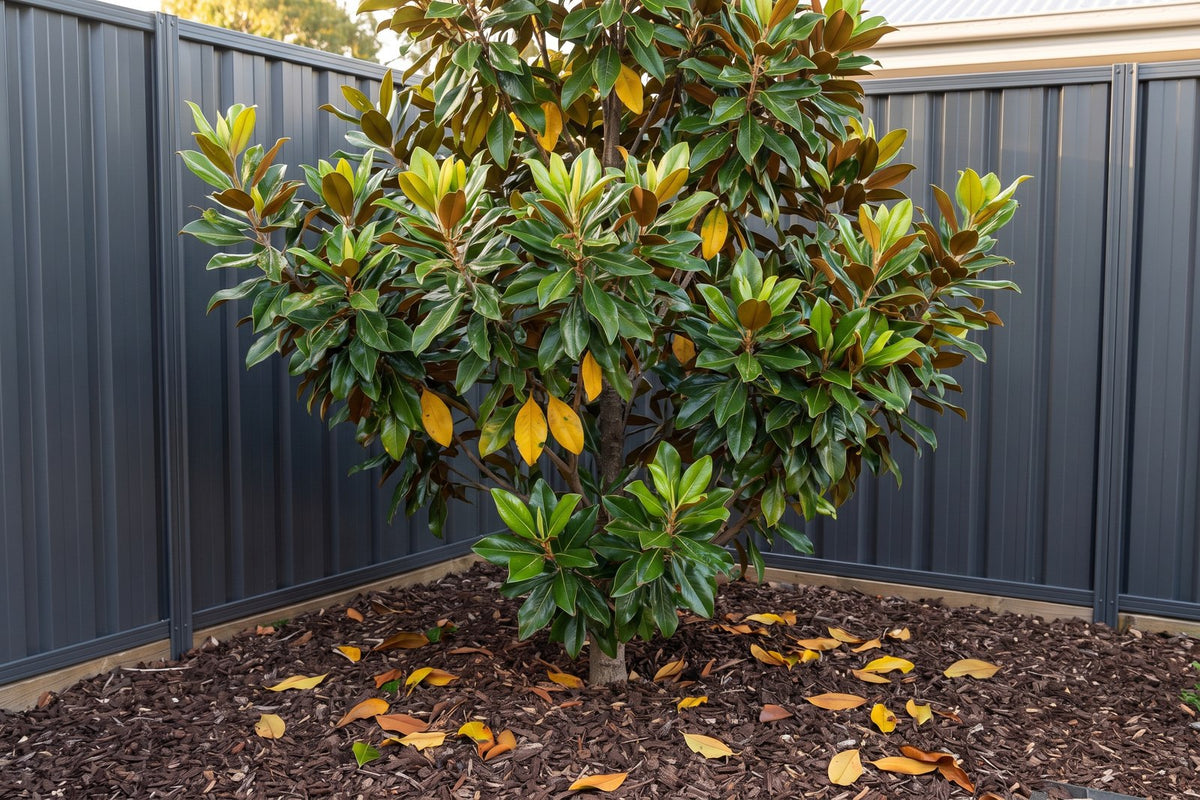
Worth clearing up, because it causes a lot of complaints. Evergreen trees shed leaves continuously in small quantities rather than all at once, and many Australian natives drop a noticeable flush in spring as new growth pushes the old leaves off. A magnolia or lilly pilly yellowing and dropping older leaves in September is behaving normally, not failing. Eucalypts also shed bark, sometimes in large sheets. That is normal and is not a sign of disease.
When deciduous is actually the better choice
Being honest about this matters. On the northern and western side of a house in most of Australia, a deciduous tree outperforms an evergreen for household comfort: it shades the walls and windows through summer when you want it, then drops its leaves and lets winter sun in when you need the warmth. An evergreen in that position shades the house all year and makes winter rooms colder and darker. Use evergreens where you want year-round screening, privacy or structure, and deciduous where the job is summer shade on the house. Many good Australian gardens use both deliberately. For shade that lowers the cooling load, the shade trees guide covers placement in the southern hemisphere and the trees that do the job without damaging the house.
Planting and care
Plant in autumn across most of Australia so roots establish through the cool months before their first summer; spring suits subtropical species in the north. Dig wide rather than deep, keep the root flare at ground level, mulch to 75 mm kept clear of the trunk, and water deeply through the first two summers. Use a low-phosphorus native fertiliser on Australian natives, and keep lawn fertiliser out of native beds entirely. Prune screening evergreens lightly after each flush of growth so they stay dense to the ground, and never cut a native back into bare wood. If there is a sewer or stormwater line anywhere near the planting spot, our planting near pipes guide gathers the water utilities' distances and their lists of trees to avoid.
Common problems
- Browning tips after a hot wind: wind burn, not disease. Water deeply and the next flush covers it.
- Yellowing on new growth: iron lock-out in alkaline soil or near concrete; chelated iron and a pH test.
- Pimpled, distorted new leaves on lilly pilly: psyllid; choose a resistant cultivar rather than spray.
- Sudden collapse in wet weather: root rot in a low or poorly drained spot; fix the drainage or replant on a mound.
- Thin at the base: the screen was never tip-pruned young; start pruning the next flush and accept it will take a few seasons to thicken.


