

Variegated plants carry patches of white, cream, gold or pink where the leaf has little or no chlorophyll. They lift a shaded corner, break up a wall of green and give a garden structure that flowers cannot, since the pattern is there every day of the year. They also behave differently under an Australian sun than the same plants do in Europe or the United States, and that difference is what decides whether yours thrives or scorches.
Quick facts
| Detail | What to expect in Australia |
|---|---|
| What it is | Leaf tissue with reduced or absent chlorophyll |
| Position | Morning sun with afternoon shade suits most. Few tolerate full western sun |
| Growth rate | Slower than the plain green form, sometimes by half |
| Common problem | Leaf scorch on the pale tissue in summer |
| Second problem | Reversion - all-green shoots appearing and taking over |
| Propagation | Cuttings and division. Seed rarely comes true |
| Best use | Shaded beds, courtyards, pots, under established trees |
Why Australian sun changes the rules
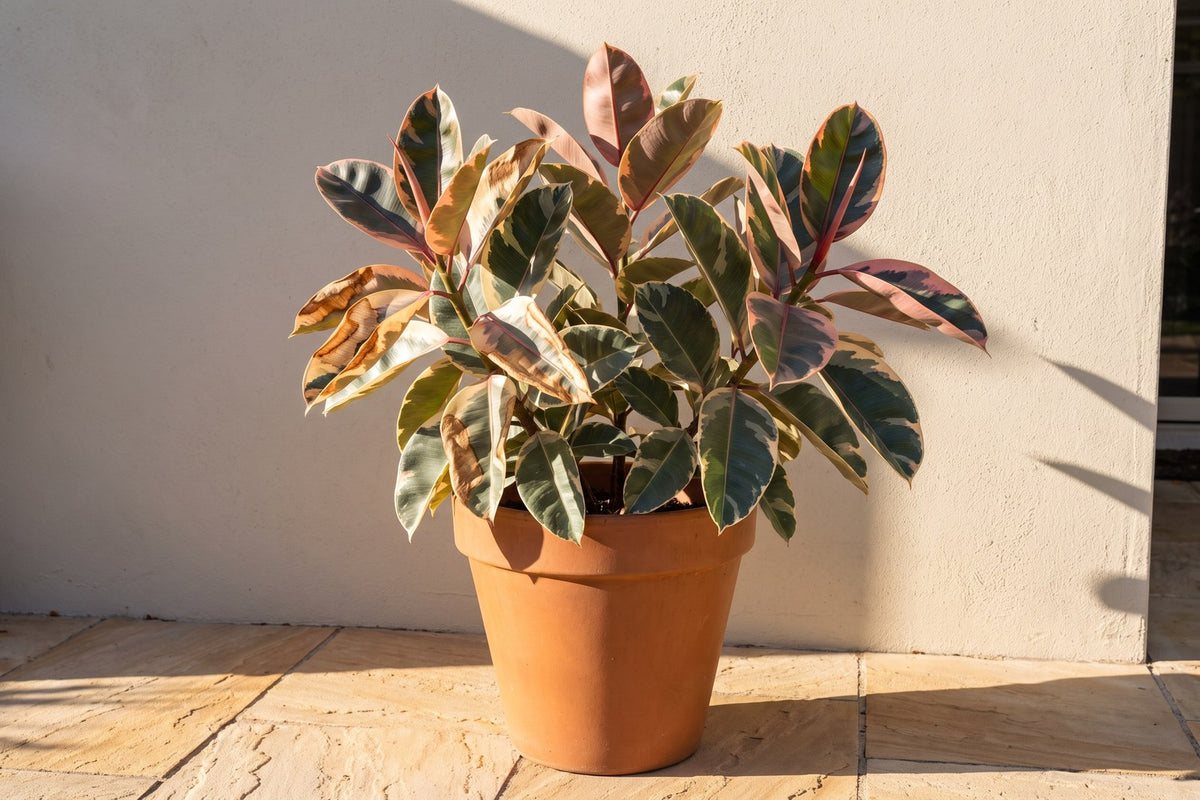
This is the part most guides written for the northern hemisphere leave out. The white and cream sections of a variegated leaf contain little chlorophyll and, just as importantly, little of the pigment that shields leaf tissue from ultraviolet light. Australia has some of the highest UV levels of any populated country, so a plant that sits happily in full sun in an English garden will burn here.
The practical rule: give variegated plants morning sun and afternoon shade, or bright dappled light all day. A hot western wall is the worst position you can choose. The scorch shows first as papery brown patches on the palest parts of the leaf, and it does not recover - those leaves stay damaged until they are replaced.
There are exceptions. Variegated agave, oleander and pittosporum have tougher leaves and handle full sun in most districts. As a general rule, the thicker and more leathery the leaf, the more sun it will take.
How much sun is safe where you live
- Brisbane and subtropical Queensland - morning sun only for most variegated foliage. Summer sun from mid-morning onwards will mark pale leaves, though humidity means they dry out less quickly.
- Perth and Adelaide - the harshest combination of heat and dry air. Restrict to dappled light or an eastern aspect, and water consistently through summer.
- Sydney and coastal New South Wales - morning sun with afternoon shade works well, and coastal humidity reduces scorch.
- Melbourne, Hobart and cooler districts - the most forgiving. Many variegated plants take several hours of direct sun here without marking.
- Tropical north Queensland and Darwin - filtered light under a canopy. Direct sun is too strong, but humidity suits shell ginger and cordylines beautifully.
Variegated plants that work in Australian gardens
| Plant | Position | Best for |
|---|---|---|
| Variegated agave | Full sun | Hot dry gardens, coastal, low water. Very sun hardy |
| Variegated oleander | Full sun | Tough screening in hot inland and coastal gardens |
| Ivory Sheen pittosporum | Full sun to part shade | Light hedging and screening with a silvery edge |
| Pink Marble photinia | Full sun to part shade | Feature shrub with pink new growth |
| Variegated shell ginger | Part shade | Subtropical gardens, gold-striped foliage, lush look |
| Silver Streak dianella | Sun to part shade | Mass planting, native strappy foliage, low care |
| Stripey White liriope | Part to full shade | Border and under-tree planting where little else grows |
| Variegated society garlic | Full sun | Edging, drought hardy, mauve flowers |
| Cordyline (Pink Diamond, Chocolate Queen) | Part shade | Tropical colour in beds or pots |
| Song of India | Bright indirect light | Indoors or a sheltered patio |
| Triostar stromanthe | Bright indirect light | Indoors. Pink undersides, needs humidity |
| Ruby rubber plant | Bright indirect light | Indoors. Bold pink and cream |
For a shaded garden bed
Liriope, dianella and shell ginger are the workhorses. They tolerate the dry shade under established trees where most colour plants fail, and the pale striping does the job flowers would otherwise have to.
For full sun
Stick to the thick-leaved and Mediterranean types. Variegated agave and variegated society garlic both handle heat, drought and coastal exposure without burning.
For indoors
Song of India, Triostar and the variegated rubber plants want bright indirect light - near a window but out of direct sun. In lower light they lose their pattern and revert towards plain green, because the plant compensates by producing more chlorophyll.
Reversion, and what to do about it
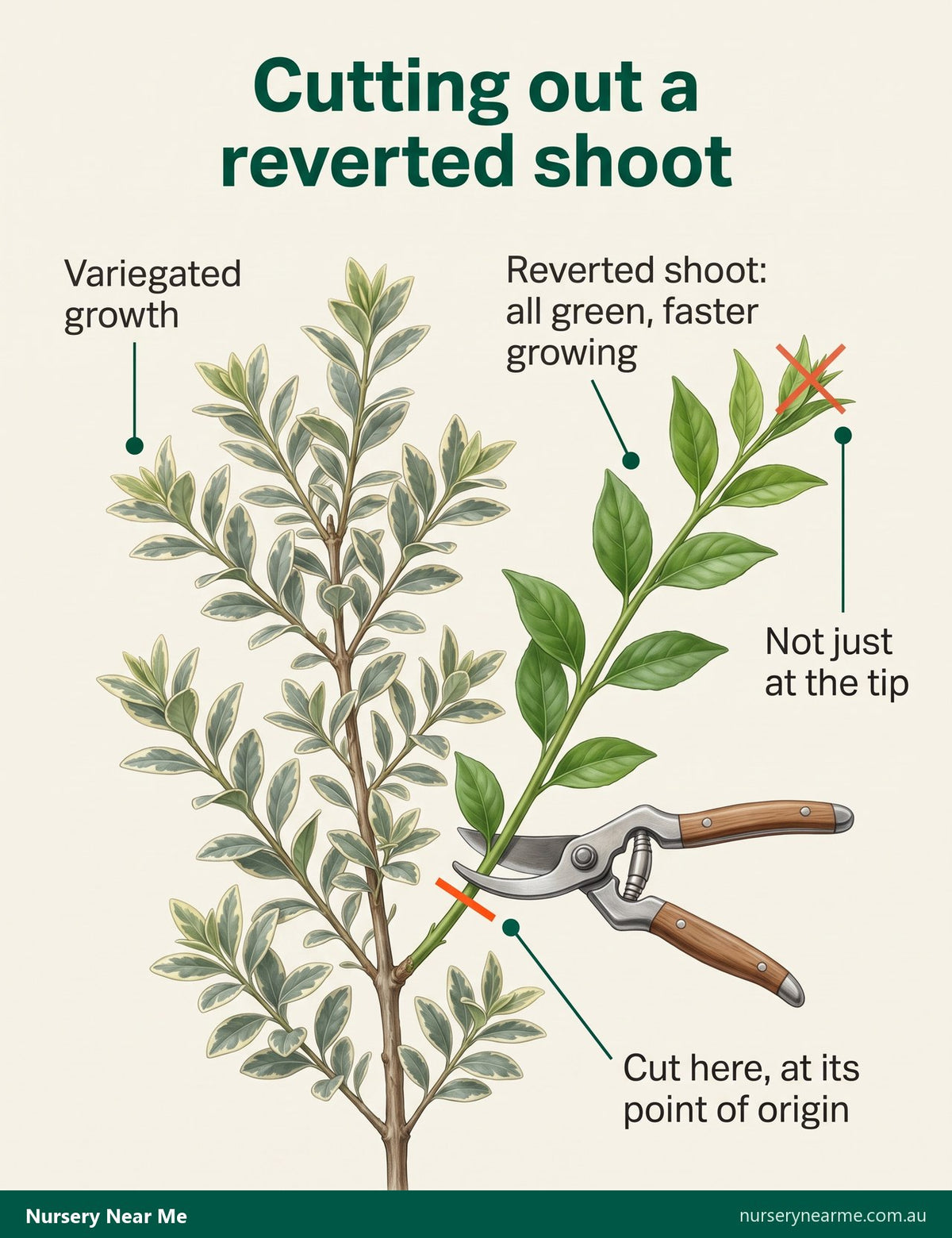
Sooner or later a variegated plant sends out a shoot that is entirely green. That shoot has full chlorophyll, so it grows faster and stronger than the variegated growth around it, and if left alone it will gradually dominate the whole plant.
Cut reverted shoots out at their point of origin as soon as you notice them, not just at the tip. This is normal plant behaviour rather than a fault, and it happens more often in low light, which is another reason to give these plants enough of it.
Planting and ongoing care
- Choose position first. Morning sun, afternoon shade for most. Check the individual plant before committing it to a western aspect.
- Improve the soil with compost and mulch well, keeping mulch clear of the stems.
- Water consistently through the first summer. Variegated plants are less resilient to drought stress than their green forms because they have less leaf area doing the work.
- Feed lightly. Heavy nitrogen encourages green growth and can accelerate reversion. A balanced slow-release fertiliser in spring is enough.
- Prune reverted shoots whenever they appear.
- Expect slower growth than the plain form, and buy a size up if you want quicker impact.
Common problems and fixes
- Brown papery patches on the pale sections is sun scorch. Move the plant, or provide afternoon shade. The damaged leaves will not recover.
- Pattern fading towards plain green usually means not enough light, common with indoor plants placed too far from a window.
- An all-green shoot outgrowing the rest is reversion. Cut it out at the base.
- Slow growth is normal. Less chlorophyll means less photosynthesis, so variegated forms grow more slowly than the species.
- Leaf drop after transplanting reflects lower reserves. Keep water up and avoid moving them in midsummer.
Designing with variegated foliage
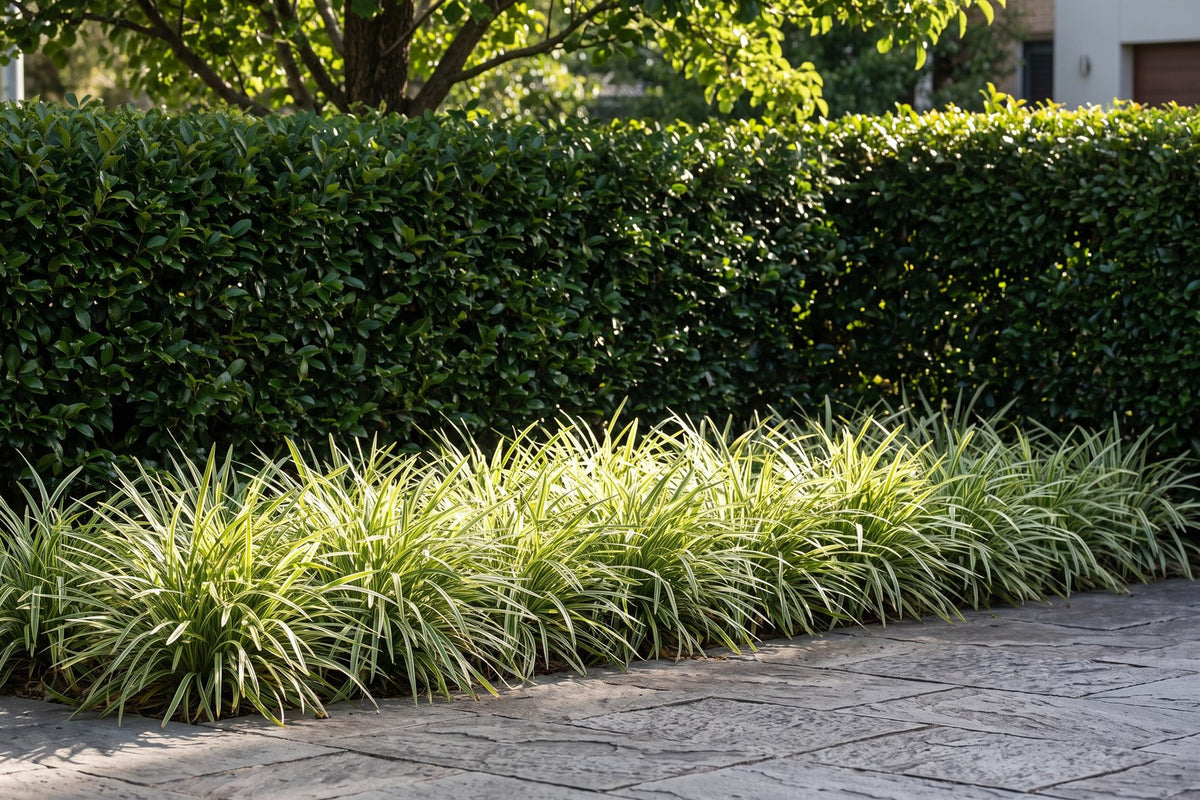
Variegation reads as light from a distance, so it works where you want to draw the eye or brighten a dark corner. Use it in blocks rather than scattered singles, which look busy. It pairs well with solid dark green - a stand of variegated liriope in front of a green hedge is far more effective than a mix of several patterned plants competing with one another. In a courtyard or small garden, one variegated feature plant usually does more than three.
Frequently asked questions
Why is my variegated plant turning green?
It is reverting, which most often happens in low light. The plant produces all-green shoots that photosynthesise better, and because they grow faster they take over. Cut them out at their origin as soon as they appear, and move the plant somewhere brighter.
Can variegated plants handle full sun in Australia?
Most cannot. The pale tissue lacks the pigment that protects against ultraviolet light, and Australian UV levels are high enough to scorch it. Morning sun with afternoon shade suits the majority. Thick-leaved plants such as variegated agave, oleander and pittosporum are the exceptions and take full sun.
Why do variegated plants grow more slowly?
Less of the leaf contains chlorophyll, so the plant produces less energy than the all-green form of the same species. Expect slower growth and a smaller mature size, and buy a larger plant if you want immediate presence.
What are the brown patches on my variegated leaves?
Almost always sun scorch on the white or cream sections, which burn before the green parts do. Check the position, particularly if the plant faces west. Damaged leaves do not repair, so relocate the plant and wait for fresh growth.
Do variegated plants need different fertiliser?
No, but go lightly. High-nitrogen fertiliser pushes vigorous green growth and can encourage reversion. A balanced slow-release fertiliser in spring is all most need.
Can I grow variegated plants from seed?
Usually not. Most garden variegation is chimeral, meaning it exists in the layers of the growing tip rather than the genes passed to seed, so seedlings come up plain green. Propagate from cuttings or division taken from variegated growth instead.
Ready to plant?
We grow variegated plants for every position, from sun-hardy agaves and oleanders to shade-loving liriope and indoor stromanthe. Browse our shrubs collection for garden plants, or the indoor plants range for the patterned foliage types.
Planting a shaded area? Our guide to the best ground cover plants for shade covers what grows under trees, and plants that change colour through the year looks at foliage colour beyond variegation.


