

Walk any foreshore park from Coffs Harbour to Cairns and the tree throwing the best shade is usually a tuckeroo. Cupaniopsis anacardioides is a compact Australian native rainforest tree that decided, somewhere in its evolution, to also master the beach: it handles salt spray, sandy soil and full coastal sun while keeping a dense, glossy, dark green canopy year round. Councils plant it by the thousand as a street tree, which tells you everything about its manners around paths and services.
In a home garden it makes a tidy 6-8 m shade or feature tree with a neatly rounded crown, and in winter it produces yellow orange fruit capsules that split open and bring rainbow lorikeets, figbirds and honeyeaters to the yard. If you garden anywhere warm and want a native tree you can plant and largely forget, this is the one.
Quick facts
| Botanical name | Cupaniopsis anacardioides |
| Type | Evergreen native tree |
| Height | 6-8 m tall, 4-6 m wide in gardens |
| Position | Full sun to part shade |
| Soil | Sandy to clay, well drained; handles poor coastal soil |
| Growth rate | Moderate, faster with summer water |
| Climate | Coastal QLD and NSW; warm temperate to tropical |
Choosing a tuckeroo
Starting small and cheap
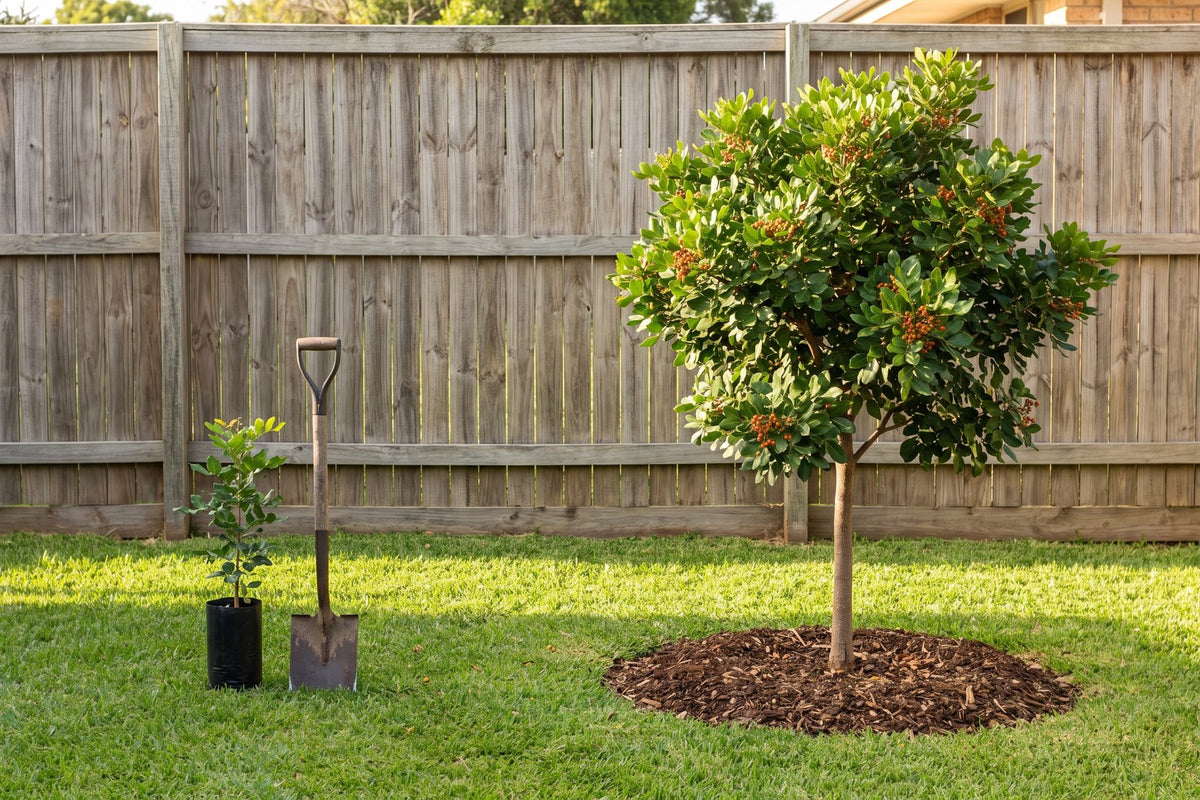
The Tuckeroo Tree (Cupaniopsis anacardioides) from $10.95 in a tube is the smart buy for most gardens. Tuckeroos are famous for how quickly tubestock establishes; a healthy tube planted in spring routinely overtakes a potted advanced tree within four or five years, at a fraction of the price. Planting a driveway or boundary row, this is the way to do it.
Instant shade
When the brief is shade this summer rather than shade in 2032, the Small Leaf Tuckeroo (Cupaniopsis parvifolia) from $229.95 gives you an advanced native with finer, more refined foliage than the standard species. For landscape projects and serious statements, we also supply ex ground Tuckeroo from $6197.95, full grown trees delivered and craned into place.
A refined relative
The Fine Leaved Tuckeroo (Lepiderema pulchella) from $369.95 is not a true Cupaniopsis but a closely related rainforest native from the same family, smaller at 5-7 m with delicate, glossy leaflets and orange flower clusters along the branches. It suits courtyards and smaller blocks where the standard tuckeroo would eventually feel broad.
Planting

Full sun grows the densest canopy, though tuckeroo tolerates part shade politely. It genuinely does not care whether your soil is beach sand or heavy loam so long as water drains away; only permanently boggy ground defeats it. Dig a hole twice the width of the rootball, plant at the same depth it grew in the pot, water in with 10 litres and a seaweed tonic, and mulch to 7 cm.
Space specimen trees 5-6 m apart, or 3-4 m for an informal screen or avenue. Keep the trunk at least 2.5 m from paths and driveways; the roots are considered non aggressive, which is why councils love it, but every tree deserves elbow room. Young trees are frost tender for their first two winters, so in marginal areas plant in spring and give them a season of growth before their first cold snap.
Ongoing care
Watering: Water deeply once or twice a week for the first summer, then taper off. An established tuckeroo survives on rainfall in its preferred coastal climates, though a deep soak in drought keeps the canopy full.
Feeding: An annual application of a native friendly slow release fertiliser in spring is all it asks. Avoid high phosphorus products around natives generally; tuckeroo is more forgiving than banksias, but there is no need to test it.
Pruning: Shape lightly in its early years to a single clean trunk and lift the crown to head height if planting near paths. Mature trees need nothing beyond removing the odd dead branch.
Common problems

Slow growth inland: Away from the coast, cold winters and dry air slow tuckeroo noticeably. Plant in a warm, sheltered north facing position and be patient through the first few years.
Frost burn on young trees: Blackened new growth after a cold snap. Leave damaged foliage in place until spring, then trim it off; established trees shrug off light frost.
Leaf spot in humid weather: Brown blotches on older leaves during wet summers. Cosmetic and self resolving; rake up fallen leaves and let airflow do the rest.
Fruit drop on paving: The winter fruit that feeds the lorikeets will also land on your pavers. Site the tree over lawn or garden beds, or accept a fortnight of sweeping as rent paid to the birds.
Frequently asked questions
How fast does a tuckeroo grow?
Moderately, around 40-60 cm a year in good coastal conditions. Tubestock typically reaches 3 m in four to five years, and growth accelerates once the root system establishes.
Are tuckeroo roots invasive?
No, the root system is regarded as well behaved, which is why tuckeroo is one of the most widely used council street trees in coastal Queensland and New South Wales.
Will tuckeroo grow in Melbourne or cooler climates?
It is marginal south of about Sydney. Frost is the limiting factor; in cool climates it needs a warm, frost protected microclimate and will grow slowly at best.
Is tuckeroo good for privacy screening?
Yes, planted at 3-4 m spacings it forms a dense evergreen screen to 6 m or more. It is a tree rather than a hedge though, so expect width as well as height.
Ready to plant?
For a native tree that thrives on neglect and feeds the local birds, tuckeroo is hard to beat. Explore more of our Australian natives, compare shade options in our tree range, or start cheap with tubestock. Our 30 day satisfaction guarantee covers every plant we send.
If you garden in a bushfire prone area, our guide to bushfire-wise garden plants gathers what the CFA, CSIRO and the native plant societies say about placement, plant traits and the species on their published lists.


