

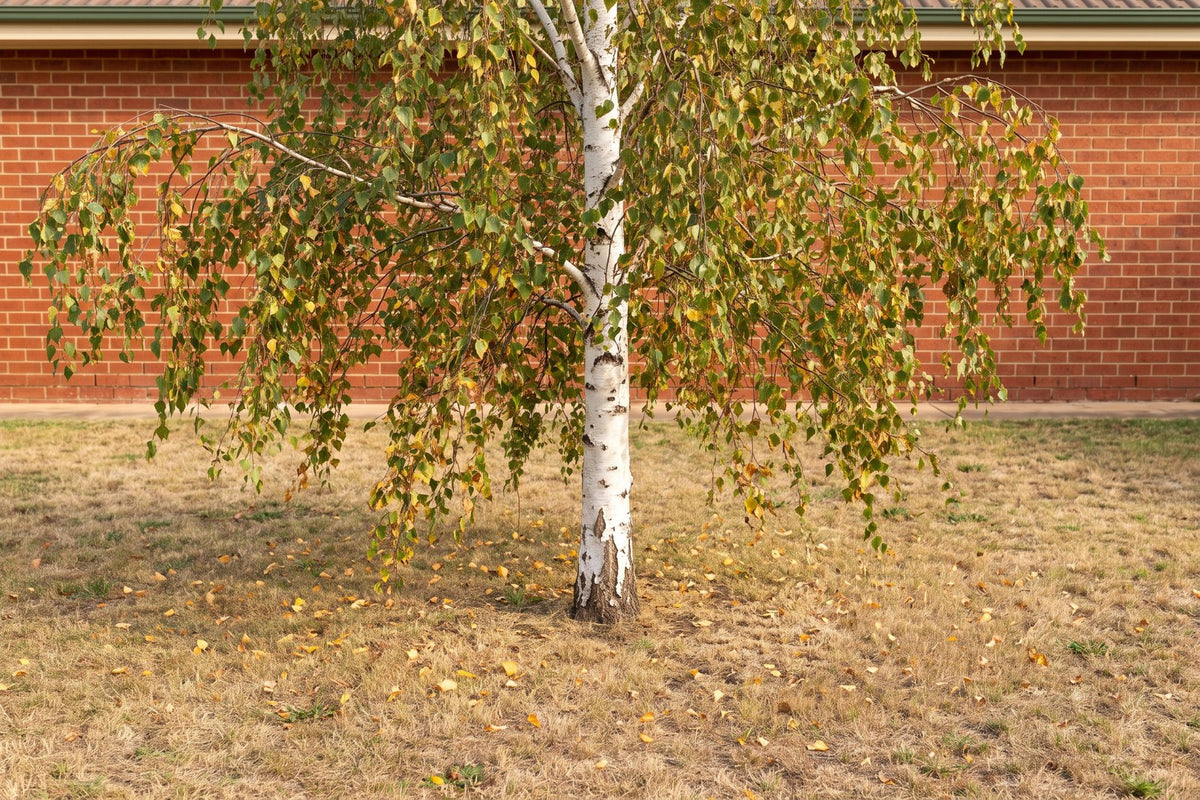
Few trees have a stronger signature than a silver birch: a slender white trunk, fine weeping branchlets, small leaves that flicker in the slightest breeze, and clear butter-yellow autumn colour. It is also a cool-climate tree with a shallow root system and no drought tolerance to speak of, which means the difference between a beautiful specimen and a struggling one comes down almost entirely to where you plant it.
Quick facts
| Detail | Specification |
|---|---|
| Botanical name | Betula pendula |
| Mature size | 10 to 15m tall, 4 to 6m wide in Australian conditions |
| Position | Full sun to light shade, with a cool root run |
| Soil | Moist, well-drained, slightly acidic, pH 5.0 to 6.5 |
| Water | Moderate to high; not drought tolerant at any age |
| Climate zones | Cool and cold temperate; frost hardy well below -10°C, poor in the subtropics |
| Habit | Deciduous, upright to weeping, golden autumn colour |
Choosing the right birch
The name silver birch covers several species sold in Australia, and they suit different climates.
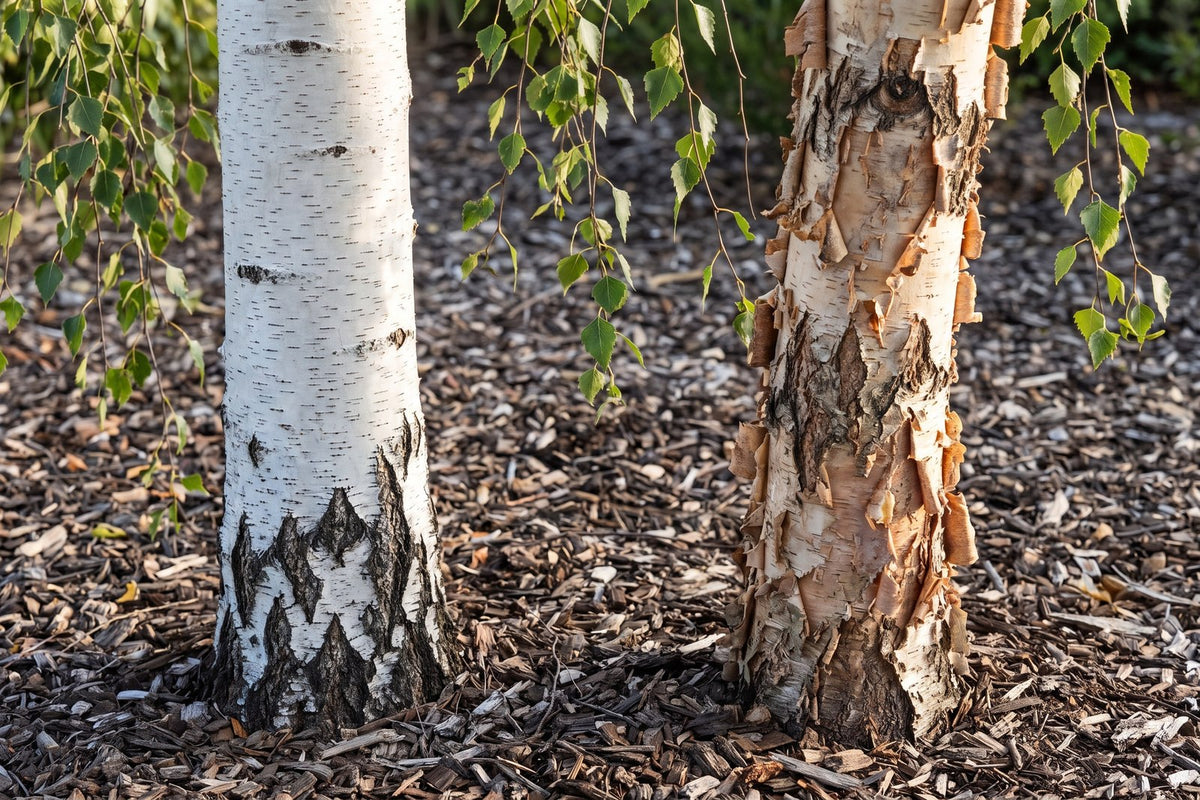
Betula pendula is the true silver birch: 10 to 15m here, white bark that develops black diamond fissures at the base, and pendulous branchlets. It performs beautifully in Melbourne, the Adelaide Hills, Canberra, Ballarat, Bathurst, the Southern Highlands and Tasmania. Betula pendula is the standard form, with Moss White selected for particularly clean bark.
Betula utilis var. jacquemontii, the Himalayan birch, carries the whitest and smoothest bark of any birch and holds it lower down the trunk, reaching about 10 to 12m with a slightly broader crown. Himalayan birch is the one to plant where the trunk itself is the feature.
Betula platyphylla var. japonica, sold as Whitespire, is more tolerant of heat and humidity than Betula pendula and grows to a tidy 10 to 12m, which makes it a sensible compromise in Sydney's cooler suburbs and inland New South Wales.
Betula nigra, the river birch, is the outlier and the answer for warm climates. It tolerates heat, humidity and periodically wet soil far better than any white-barked species, growing 10 to 15m with cinnamon-and-cream peeling bark instead of white. If you garden anywhere north of Sydney and want the birch effect, plant river birch rather than fighting the climate.
How to plant
When. Late autumn through winter, while the tree is dormant, gives the best establishment. Potted stock can go in at other times, but avoid the heat of summer.
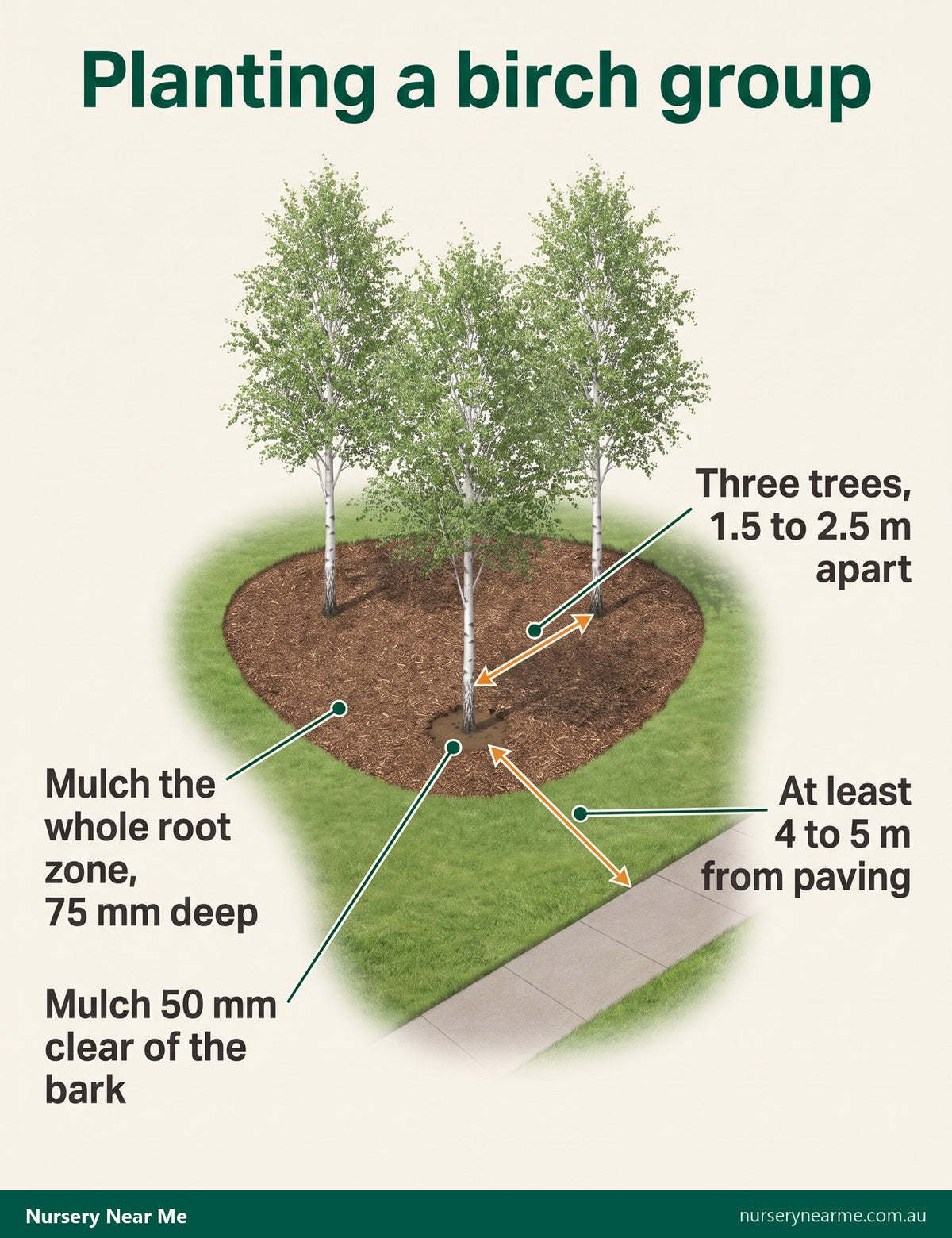
Position. Full sun on the canopy and shade on the roots is ideal, which is how birches grow in the wild. Keep them at least 4 to 5m from paving, paths and service trenches, because the shallow fibrous root system will lift slabs over time.
Soil. Birches want moisture-retentive, free-draining, slightly acidic ground, and develop iron chlorosis on alkaline soils. Dig compost through a wide area rather than deep into a narrow hole, since the roots spread laterally.
Spacing and grouping. A single birch is fine, but the classic effect comes from planting three or five at 1.5 to 2.5m apart so the white trunks group and the canopies merge. Multi-stemmed specimens do the same job in one hole and suit smaller gardens, in the manner described in our guide to feature trees that elevate a front yard.
Mulch. Mulch the entire root zone, not just a ring around the trunk, to 75mm depth, keeping it 50mm clear of the bark. Lawn running up to the trunk competes directly with the surface roots.
Ongoing care
Watering
Birches are not drought tolerant, and treating them as though they are is the most common mistake. Water deeply once a week through summer, wetting the full spread of the canopy rather than just the base, and more often during heatwaves. Early leaf drop in January and February is the tree telling you it has run out of water.
Feeding
A complete fertiliser in early spring as the buds move is sufficient, supported by an annual top-dressing of compost over the root zone. If leaves go yellow between the veins while the veins stay green, the issue is iron availability in alkaline soil: apply chelated iron and work towards lowering the pH over time rather than adding more general fertiliser.
Pruning
Prune in late summer to early autumn. Birches, like maples, bleed sap heavily from cuts made in late winter and spring when sap pressure is high. Beyond removing dead, damaged or crossing branches and lifting the lower canopy, a well-sited birch needs very little. Never top a birch; the natural shape is the whole point. The same timing logic applies to Japanese maples, as set out in our Japanese maple care guide.
Common problems and fixes
Early leaf drop and browning in summer. Heat and drought stress. Deep watering plus a wide mulched root zone is the answer. A birch in an exposed western-facing lawn will always struggle.
Sticky honeydew and sooty mould below the canopy. Aphids on new growth. Unsightly on cars and furniture rather than dangerous; a strong hose, or patience while predators build up, is usually enough.
Fine stippling and bronzing in hot dry weather. Two-spotted mite. Keep the tree well watered and avoid broad-spectrum sprays that remove the mite's predators.
Sawdust at the base and dying upper branches. Stem-boring beetles attack birches already stressed by drought or heat, and there is no reliable spray. Keep the tree watered and mulched, remove affected limbs, and accept that a badly stressed birch in a warm climate is better replaced with river birch.
Yellow leaves with green veins. Iron chlorosis on alkaline soil. Chelated iron gives a quick response; compost and acidic mulches address the cause.
Frequently asked questions
Will silver birch grow in Brisbane or Sydney?
Silver birch is not suited to the subtropics. Hot humid summers and warm nights stress the tree, shorten its life to a decade or so and leave it open to borers. Sydney gardeners in cooler western and upper suburbs sometimes succeed, but on the coast and anywhere in Queensland, river birch is the far better choice.
How far from a house should you plant a silver birch?
Allow at least 4 to 5m from paving, paths and service lines. Silver birch has a shallow, fibrous root system rather than a deep taproot, so it lifts paving and competes hard with lawn and shallow-rooted plants, though it is not the aggressive pipe-seeking type that willows and figs are.
When should you prune a birch?
Late summer to early autumn, once the leaves are fully mature. Birches bleed sap heavily if cut in late winter or spring, and while the bleeding rarely kills the tree it weakens it and looks alarming. In practice a well-grown birch needs almost no pruning beyond removing damaged or crossing branches.
Why are my birch leaves turning yellow and dropping in summer?
Usually heat and drought stress rather than disease. Silver birch has a shallow root system and no reserve against dry soil, so it sheds leaves early to save itself. Deep weekly watering through summer and a thick mulch layer over the whole root zone prevent it. Yellowing between green veins instead points to iron deficiency in alkaline soil.
How long do silver birches live in Australia?
Forty to sixty years in a genuinely cool climate such as the Southern Highlands, Ballarat or Tasmania. In warmer districts expect twenty to thirty. They are not long-lived trees anywhere by comparison with oaks or elms, which is part of why they are usually planted in groups of three or five.
Can you plant birches in a group?
Yes, and it is how they look best. Landscape practice is to plant three or five trees 1.5 to 2.5m apart so the trunks read as a copse and the canopies knit together. Multi-stemmed specimens achieve the same effect from a single planting hole.
Ready to plant?
A birch earns its keep twice a year: gold in autumn and bare white trunks all winter that let low sun into the house, which is the argument made in our comparison of evergreen versus deciduous trees. It sits naturally alongside the other seasonal performers in our guide to plants that change colour through the year, and it is properly at home among the frost tolerant plants for Australian gardens. Browse the birch range and its companions in our deciduous trees collection, or go straight to Betula pendula if your climate suits it.


