

Nothing else in the catalogue delivers as much tropical drama per square metre as a heliconia. The waxy bracts last for weeks on the plant and a fortnight in a vase, the paddle-shaped foliage reads as pure rainforest, and a mature clump fills a difficult corner faster than almost any shrub. They are also honest plants: give them heat, food and water and they perform, withhold any one of those and they sulk visibly.
Quick facts
| Detail | Specification |
|---|---|
| Botanical name | Heliconia species and hybrids |
| Mature size | 1 to 1.5m for psittacorum types, up to 4m for rostrata and caribaea types |
| Position | Full sun to about 50 per cent shade, sheltered from wind |
| Soil | Rich, moisture-retentive but free-draining, pH 5.5 to 6.5 |
| Water | High: at least 25mm a week through the warm months |
| Climate zones | Tropical and subtropical; frost-free only, protected or potted south of Sydney |
| Flowering | Warm months, and close to year-round in the tropics |
Choosing the right heliconia
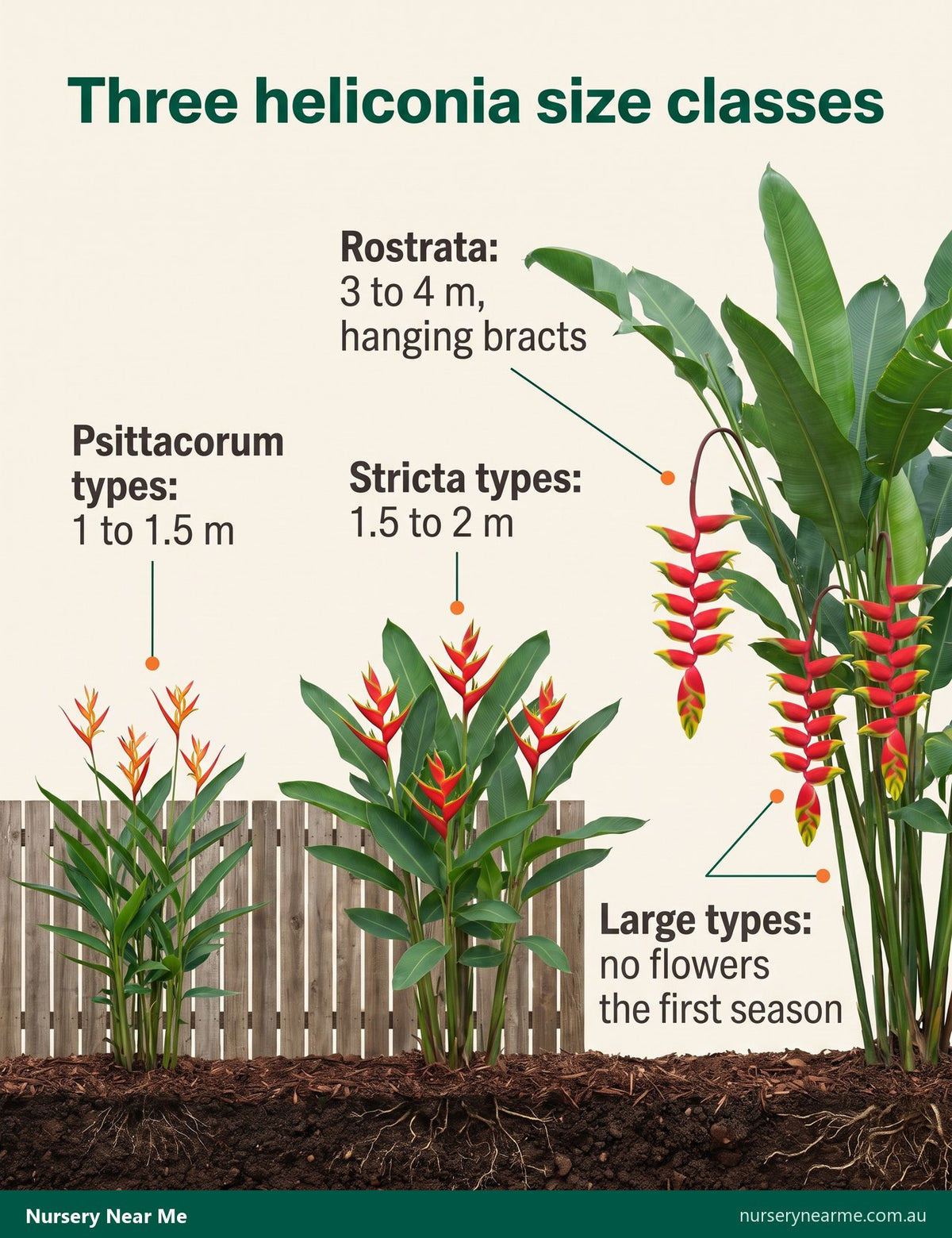
Heliconias divide neatly into three size classes, and choosing the wrong class is the usual cause of regret.
Small and free-flowering. The Heliconia psittacorum group grows 1 to 1.5m, flowers from a young age, tolerates full sun and repeats almost continuously in warm weather. These are the ones for a suburban bed, a pool surround or a first attempt. Lady Di is the classic orange-red form, and the Golden Torch hybrid carries upright yellow bracts on a slightly larger clump.
Mid-sized and upright. Heliconia stricta types sit around 1.5 to 2m with stiff, upright red and yellow bracts held clear of the foliage. Tagami is a reliable performer in Brisbane gardens and a good middle layer behind the psittacorum types.
Large and architectural. The hanging types are the ones people photograph. Heliconia rostrata reaches 3 to 4m and drips scarlet and yellow bracts from arching stems, while Temptress combines pink pendulous bracts with striking veined foliage at around 2.5 to 3.5m. Both need space, shelter and patience, because they will not flower in their first season.
Whichever you choose, plan the planting as layers rather than a row. Our guide to designing a tropical garden that looks lush year round covers how to stage heights so the bed reads as jungle rather than as a collection.
How to plant
When. Early summer, as the wet season begins, is ideal. Warm soil and reliable moisture get the rhizome moving quickly, and the clump has a full growing season before its first cool snap.
Position. Morning sun with afternoon shade suits almost every species. The psittacorum types take full sun in the subtropics, while rostrata and chartacea colour better and hold their foliage in filtered light. Wind is the real enemy: exposed leaves shred within weeks, so plant behind a fence, a hedge or taller foliage. The tougher options in our list of hardy tropical plants that handle wind and heat make good shelter companions.
Soil. Dig plenty of compost and aged manure through the bed before planting, to a depth of at least 300mm. Heliconias want a soil that stays moist but never stagnant, which usually means adding organic matter to sand and improving drainage on clay.
Depth and spacing. Plant so the rhizome sits 50 to 100mm below the surface. Allow 1m between plants for psittacorum types and 1.5 to 2m for the large species, remembering that the clump widens every year.
Mulch. A thick 75 to 100mm layer of organic mulch is not optional. It keeps the rhizome cool, holds moisture and adds the nutrients these plants constantly draw down.
Ongoing care
Watering
Heliconias are among the thirstiest plants we sell. Through the warm months they want the equivalent of at least 25mm of water a week, delivered as one or two deep soakings rather than daily sprinkles. Drooping, curled leaves in the afternoon that do not recover by morning mean the clump is genuinely dry. In winter, cut back sharply: cool wet soil is the fastest route to rhizome rot.
Feeding
Feed heavily and often through the growing season. A controlled-release fertiliser in early spring plus monthly liquid feeding from October to March suits most gardens, and a potassium-rich formulation encourages bracts rather than leaves. Top-dress with compost twice a year. Pale, narrow leaves and a clump that produces only foliage almost always mean underfeeding rather than disease.
Pruning
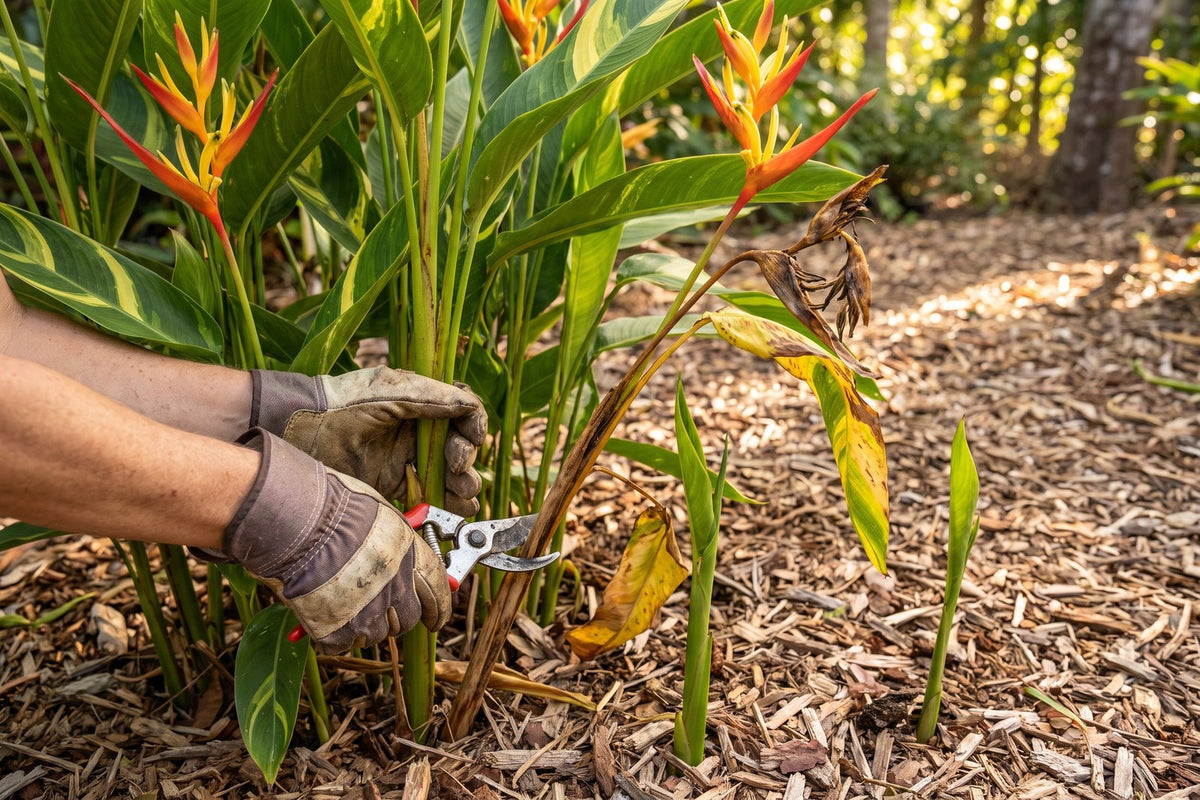
Each stem flowers once and then declines, so pruning is really maintenance. Cut spent stems off at ground level as soon as the bracts brown, remove any leaves damaged by wind or cold, and thin crowded clumps so light reaches the centre. Every three to four years, lift and divide the clump in early summer to restore vigour. This is exactly the sort of routine covered in our broader notes on tropical gardening best practice.
Common problems and fixes
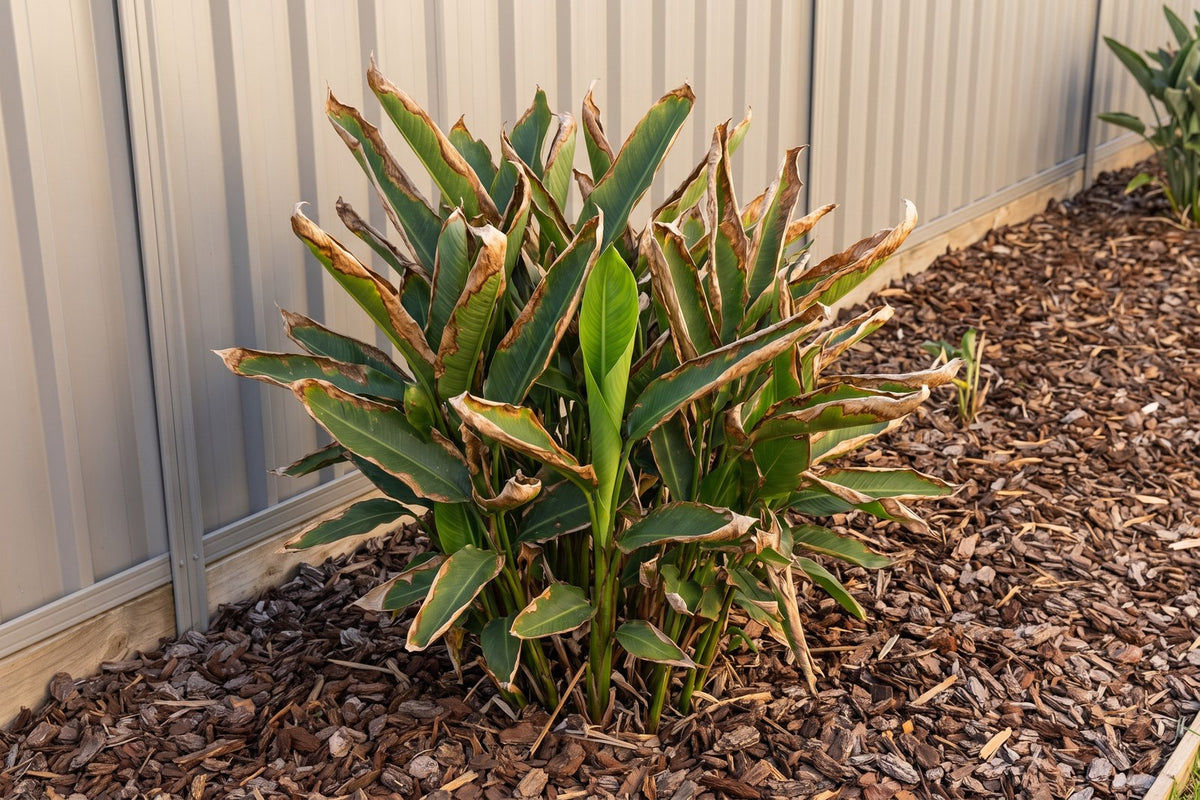
Brown, papery leaf edges after winter. Cold burn, not disease. Anything below about 5°C marks the foliage. Leave the damaged leaves in place until spring, because they protect the rhizome, then cut them out as new growth begins.
Shredded, tattered leaves. Wind. There is no fix other than shelter, so reposition the planting or establish a windbreak on the exposed side.
Mealybug and scale in the leaf sheaths. The tight sheaths where stem meets leaf are a favourite hiding place. Treat with horticultural oil, directing the spray into the sheath, and repeat after three weeks.
Yellowing lower leaves with soft, collapsing stems. Rhizome rot from waterlogged soil, usually in winter. Improve drainage, raise the bed and stop irrigating over the cool months. Our guide to understanding root rot covers the diagnosis.
Orange pustules on the undersides of leaves. Heliconia rust appears in prolonged humid weather. Remove affected leaves, improve airflow by thinning the clump and avoid overhead watering.
Where heliconias grow in Australia
Heliconias are genuinely tropical, and climate decides almost everything about growing them here. In Darwin or Cairns they are close to weeds; in Melbourne they are a greenhouse plant.
| Location | How they perform |
|---|---|
| Darwin and tropical Queensland | Ideal. Grow vigorously and flower for much of the year |
| Brisbane, Gold and Sunshine Coasts | Very good in warm sheltered positions with summer water |
| Northern NSW | Workable in frost-free coastal gardens |
| Sydney | Marginal. Slower, and cold snaps mark the foliage |
| Perth | Difficult - dry heat and low humidity are not their conditions |
| Melbourne, Adelaide, Canberra | Not outdoors. A heated glasshouse or large sheltered pot |
Below about 10°C growth stops, and frost kills the foliage outright. In practice this is a Brisbane-and-north plant across Australia, and the further north you are the better it performs.
Heliconias are not native to Australia - they come from tropical Central and South America and the Pacific islands - but the wet-season climate of northern Australia reproduces their natural conditions closely enough that they thrive without much intervention.
Humidity and wind
Heliconias need humidity as much as heat, which is why they excel through a Queensland wet season and struggle in a Perth summer. Group plantings, mulch heavily and consider a water feature nearby to lift local humidity.
Wind is the other constraint. The large paddle leaves shred along the ribs exactly as banana leaves do, and a windy week leaves a planting looking tattered for the rest of the season. Site them where buildings, fences or other planting break the prevailing wind.
Feeding a hungry plant
Heliconias are among the heaviest feeders in a subtropical garden. They produce enormous amounts of growth each season and need it fuelled - a controlled-release fertiliser in early spring and again in midsummer, plus generous compost and mulch. Underfed clumps produce fewer and smaller bracts, which is the usual reason a healthy-looking plant does not flower well.
Cutting back and dividing
Each stem flowers once and then dies, so cut spent stems to the ground rather than leaving them. Clumps expand steadily and become congested after a few years, flowering less as they do. Divide in spring at the start of the warm season, replanting healthy rhizomes with several shoots attached. In tropical Queensland this is worth doing every two or three years.
Frequently asked questions
How cold can heliconias tolerate?
Foliage begins to burn once night temperatures drop below about 5°C, and any frost destroys the top growth outright. In Brisbane and northern New South Wales a well-mulched established clump usually reshoots from the rhizome in spring even after a cold snap. South of Sydney, grow them in pots that can be moved under cover for winter.
Why has my heliconia never flowered?
Three usual causes. The clump is too young, since many larger species including Heliconia rostrata need eighteen months to two years of stem growth before the first bracts appear. Or it is too shaded, or it is underfed. Heliconias are heavy feeders and a hungry clump puts everything into leaves.
Do heliconia stems flower more than once?
No. Each stem produces one inflorescence and then slowly dies back, which is why a clump always contains stems at different ages. Cut spent stems off at ground level once the bracts have faded and new shoots will take their place from the rhizome.
How do you divide a heliconia?
Lift or cut a section from the edge of an established clump in early summer as the wet season begins. Each division needs a healthy length of rhizome plus two or three stems. Trim the leaves back by half to reduce water loss, replant at the same depth and keep it wet until new growth appears.
Are heliconias invasive?
They spread steadily by rhizome rather than by seed, so a clump widens outwards by roughly 30 to 50cm a year in good conditions. That is easy to manage with an annual spade cut around the edge, but keep the vigorous larger species out of small beds and away from pool coping.
Ready to plant?
Heliconias combine best with other bold foliage rather than with fine-textured shrubs, so pair them with gingers, palms and the big-leafed forms covered in our guide to growing Strelitzia nicolai. Start with a psittacorum type if you want flowers in the first summer, or commit to Heliconia rostrata if you have the space and can wait a season. The full range, from compact hybrids to the large hanging species, sits in our heliconias collection.


