

The native figs are the trees behind the great shade canopies of the east coast: the Moreton Bay fig in every old park, the Port Jackson fig along Sydney's harbour, the small-leaved fig over country showgrounds. They are magnificent, fast, long-lived and wonderful for wildlife, and they are also the most expensive planting mistake a suburban gardener can make, because the roots go wherever the water is and the canopy becomes the size of a house. This guide sorts the four native figs we sell by what they do and where they belong, including the one that works as a clipped hedge in a normal backyard.
Quick facts
| Fig | Garden size | Where it belongs | Roots |
|---|---|---|---|
| Moreton Bay fig (Ficus macrophylla) | 15 m tall, 15 m wide and still growing after decades | Acreage, paddocks, parkland | Buttressed and invasive; keep 20 m from any structure |
| Port Jackson or rusty fig (Ficus rubiginosa) | 12 m tall, 12 m wide | Large open lawns, coastal acreage | Vigorous; keep 10 m or more from pipes and footings |
| Small-leaved fig (Ficus obliqua) | 12 to 15 m tall, 12 m wide | Acreage, school grounds, rural blocks | Vigorous; keep 10 m or more from pipes and footings |
| Hill's weeping fig (Ficus microcarpa var. hillii) | 12 m as a tree; any height as a clipped hedge | Hedges, pleached screens and topiary in warm climates | Invasive even when clipped; keep 5 m from pipes, paving and footings |
Moreton Bay fig: the park tree
Ficus macrophylla grows from the Illawarra to central Queensland, and in cultivation it becomes the largest tree most Australians ever stand under. Expect 15 m tall and as wide within a few decades on a good site, on a trunk that develops the famous buttresses, with large glossy leaves backed in rust and heavy crops of figs that feed fruit doves, figbirds, currawongs and flying foxes. It grows fast with water and space. The Moreton Bay fig is a tree for a paddock, an acreage entrance or a large open lawn, and for nothing smaller: its roots lift paving and kerbs, find drains, and run far beyond the canopy. On the right site it is the best shade tree in the country and it will outlive your grandchildren.
Port Jackson and small-leaved figs: the tough ones
Port Jackson fig
Ficus rubiginosa, the rusty fig, grows naturally on headlands and rock outcrops from the south coast of New South Wales to Cape York, which tells you how tough it is: salt, wind, heat, drought and poor shallow soil are all on its list. In a garden it settles at around 12 m tall and wide with a dense dark canopy, rust-felted leaf undersides and small figs that keep birds busy for months. The Port Jackson fig is the native fig for an exposed coastal acreage or a big lawn near the sea, where a Moreton Bay fig would be too much and most other shade trees would burn. It is also the species most often grown as a bonsai, because it tolerates the root restriction that kills others.
Small-leaved fig
Ficus obliqua is the fig over the old showgrounds, cemeteries and school ovals of inland New South Wales and Queensland, and the dense shade it casts explains why. It reaches 12 to 15 m tall and 12 m wide on a buttressed trunk, with small glossy leaves that make the litter easier to live with than the big-leaved figs, and small yellow to orange figs over a long season. The small-leaved fig is a rural tree: for a house paddock, a dam bank or the corner of a large block where the shade is wanted and the roots can run. Our guide to shade trees for farm paddocks puts it beside the other options.
Hill's weeping fig: the one you can hedge
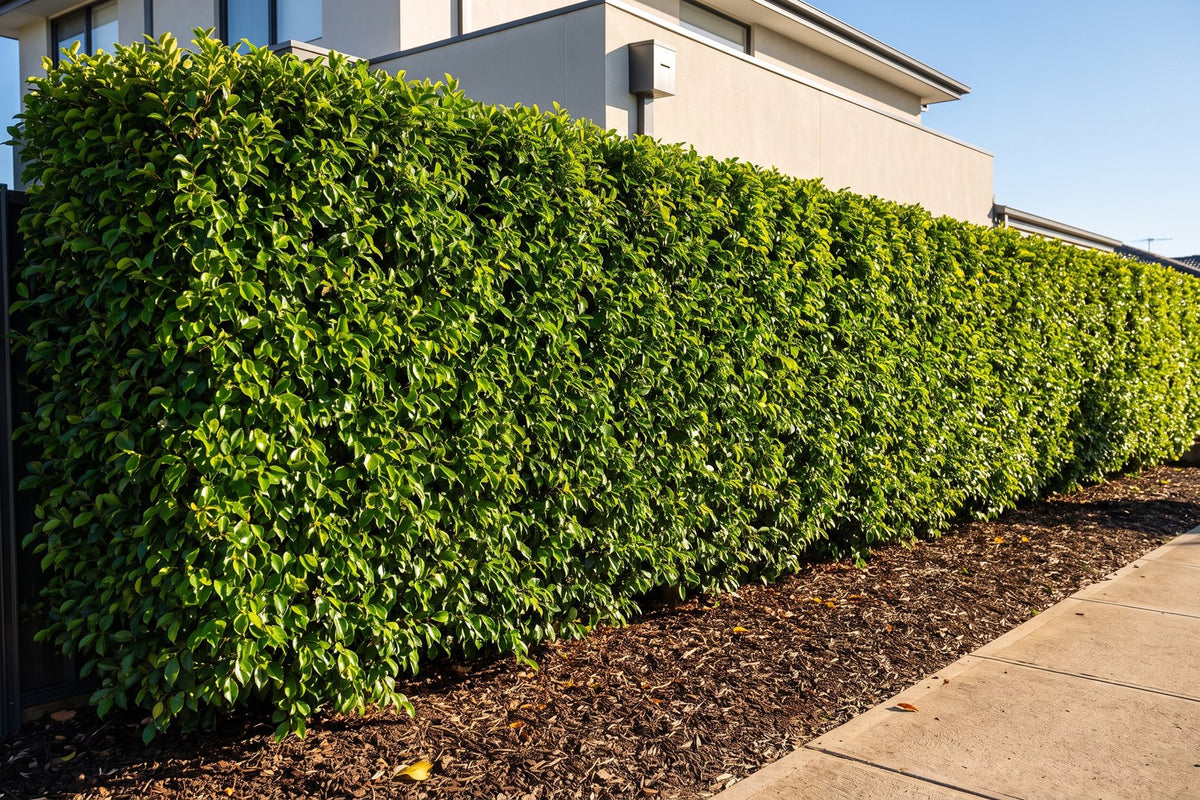
Ficus microcarpa var. hillii is a native form of the Indian laurel fig from the Queensland and New South Wales rainforests, and it is the only fig in this guide that belongs in a suburban garden, with one condition. Left alone it is a 12 m tree with an 8 m crown; clipped from the first year it makes the densest, glossiest tall hedge available in a warm climate, the standard choice for pleached screens, cubes and formal columns, and it reshoots from old wood after the hardest cut. Hill's weeping fig is sold from 140 mm pots to 2000 L trees, and the named forms Emerald and Flash are selected for faster, tighter screening growth.
The condition is the roots. Even as a clipped 3 m hedge, a Hill's fig sends roots out well beyond the planting line, and they find sewer joints, lift paths and crack pool surrounds. Plant it 5 m from any pipe, footing or paving, install a root barrier along any boundary closer than that, and never plant it on a narrow side passage. Where the bed is too small for that rule, the compact forms Green Island and Green Mound stay at 1.5 to 2 m with far less below ground, and our Ficus hillii topiary guide covers clipping and shaping.
How to plant a native fig
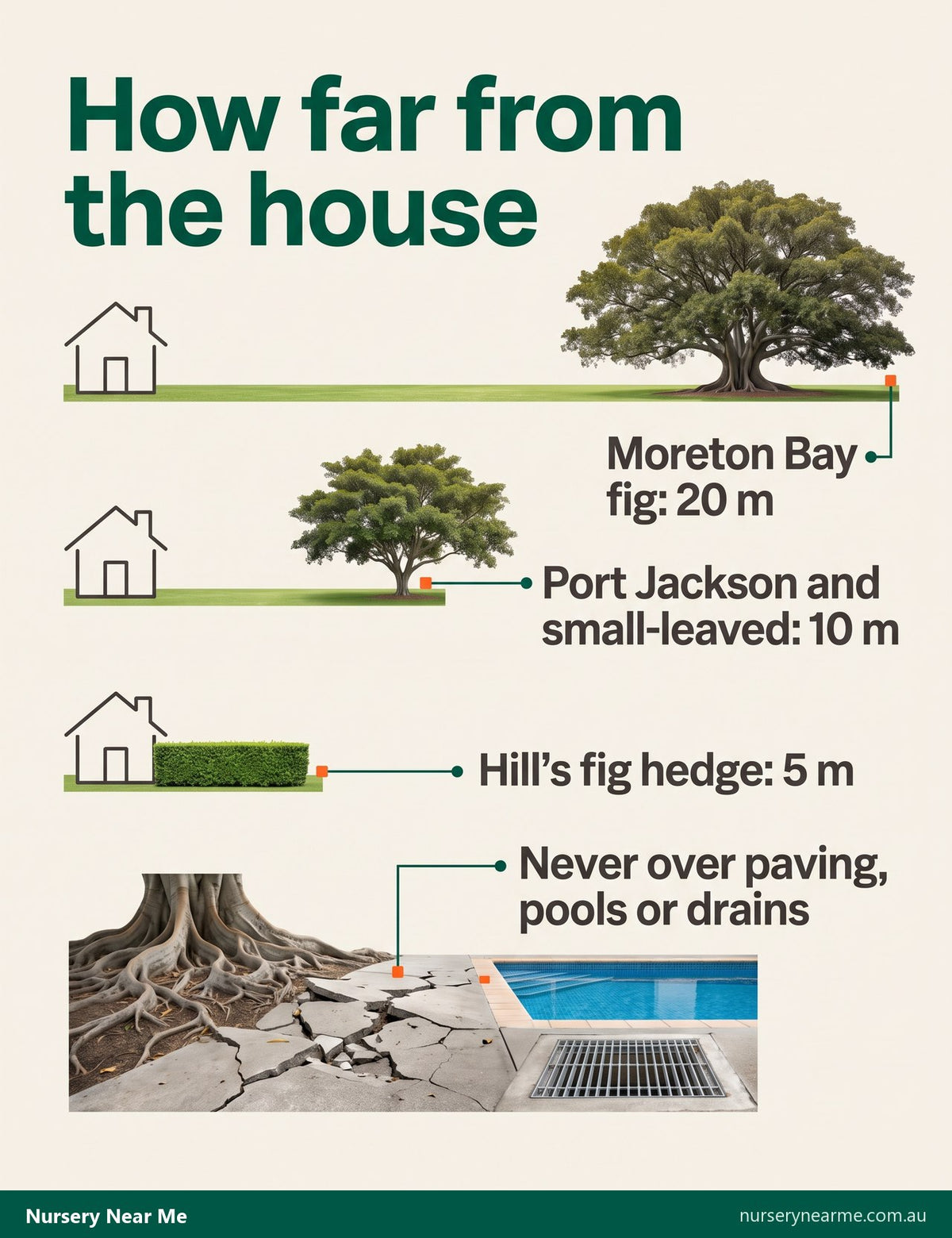
Site it for the tree it will be, not the tree in the pot. Measure 15 m from the house, the shed, the septic trenches, the pool and the neighbour's fence for a Moreton Bay fig, 10 m for a Port Jackson or small-leaved fig, and 5 m for a Hill's hedge. If you cannot get those distances, choose a different tree; our guide to planting near pipes lists the ones with better manners.
Size to buy. Figs grow fast, so a 300 mm or 400 mm plant catches up to an advanced tree within a few years at a fraction of the cost. Buy advanced only for a hedge that must screen now.
Soil and water. Any soil that is not permanently waterlogged. Dig a wide hole, no deeper than the root ball, backfill, mulch to 75 mm and water deeply twice a week for the first summer. After that a native fig looks after itself.
Timing. Spring to early autumn in the subtropics; spring in the south, once frost has finished. Young figs are frost tender; established trees handle light frost.
Ongoing care
Watering and feeding
Water through the first two summers and then only in severe drought. Feed young trees with a complete fertiliser in spring; mature trees need nothing. Mulch widely and let the fallen leaves lie under the canopy, where nothing much grows anyway.
Pruning
For a tree: lift the canopy gradually over the first ten years by removing the lowest branches at the collar in late winter, and leave the rest to the tree. For a Hill's hedge: clip three or four times a year through the warm months, hardest in late winter, and never let it run to full height before you start, because a tall unclipped fig does not reduce gracefully. The sap is a skin irritant; wear gloves and long sleeves when cutting.
Living with the fruit
Every fig in this guide fruits heavily, the birds and flying foxes come for it, and the stain on paving and cars is real. Plant figs over lawn, mulch or open ground, never over a driveway, a pool or a clothesline.
Common problems and fixes
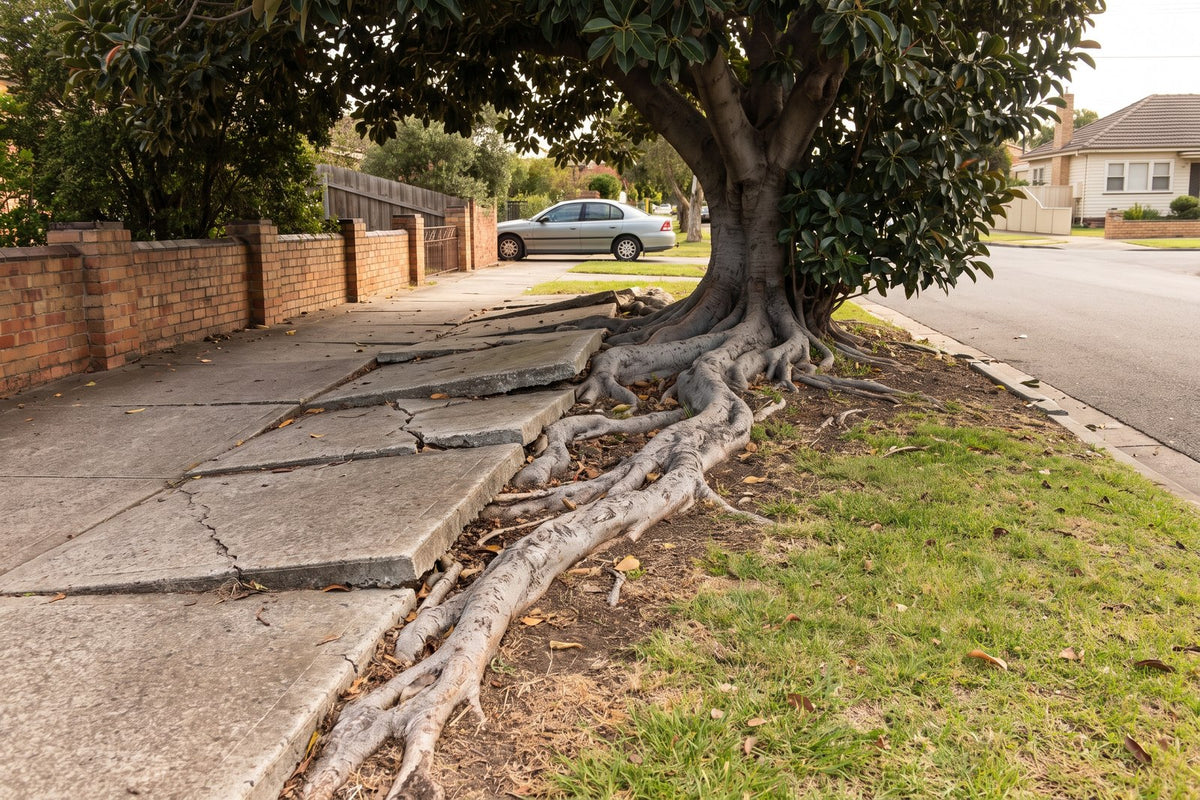
Roots in the pipes or lifting the paving. The tree was planted too close. A root barrier 600 mm deep along the boundary helps a young tree; for an established fig the honest answers are to reroute the service or remove the tree, and a large fig may need council approval to remove.
Leaf drop after planting or after a dry spell. Normal: figs shed leaves when stressed and refoliate within weeks once watered. A Hill's hedge that drops leaves in a cold winter in the south is at the edge of its range.
Thrips and curled leaves on Hill's fig. Fig thrips roll the new leaves into pockets. Clip off the affected growth, which removes most of the population, and keep the hedge fed and watered so the next flush outgrows them.
Scale and sooty mould. Treat with a horticultural oil on a cool morning; on a big tree, let the ladybirds and parasitic wasps do it.
A fig growing out of a gutter, a wall or another tree. That is how these figs start in the wild: as stranglers from a bird-dropped seed. Pull seedlings out while they are small, because a fig that has rooted into a wall cannot be cut out cleanly.
Frequently asked questions
How far from the house should I plant a Moreton Bay fig?
At least 20 m, and the same from any pipe, pool or paved area. The canopy reaches 15 m across and the roots run further than that. It is a tree for acreage, not a suburban block.
Can I grow a native fig in a pot?
Yes, for years. Port Jackson and Hill's figs tolerate root restriction well, which is why they are classic bonsai subjects and courtyard pot trees. Repot every two or three years, keep them watered, and expect a pot-grown fig to stay a fraction of its garden size.
Which fig makes the best hedge?
Hill's weeping fig, or its selected forms Emerald and Flash, in a warm climate and at 5 m from any pipe or footing. For a low clipped hedge under 2 m, Green Island or Green Mound. In cold districts, none of them: choose a lilly pilly or a viburnum instead.
Are native figs good for wildlife?
Exceptionally. The fruit feeds fruit doves, figbirds, koels, currawongs, bowerbirds and flying foxes, the canopy shelters nests, and the tree is pollinated by its own species of tiny wasp. A mature fig on acreage is one of the most valuable wildlife trees you can plant.
Which fig is the fastest for shade?
The Moreton Bay fig with water and space, closely followed by the small-leaved fig and Hill's fig. All three put on a metre or more a year once established. Our guide to the best shade trees compares them with the trees that suit a smaller block.
Ready to plant?
The Ficus collection holds all four native figs plus the compact clipping forms, and the fast-growing shade trees collection has the alternatives for a block that cannot carry a fig. For the family as a whole, from fiddle leaf to edible figs, start with our fig and ficus care guide, and browse Australian native trees for the natives with better manners near a house.


