






Mulch laid in the second week of November is worth roughly twice the mulch laid in January, because by January the soil has already dried out and you are simply sealing that dryness in. The pre-summer window across the southern states runs from mid-October to the end of November, and earlier further north and in Perth: soil is warm, autumn and winter rain is still in the profile, and there are usually six weeks before the first serious heat. Get mulch and irrigation right in that window and the garden looks after itself through the worst of the season.
Quick facts
| Job | What to do |
|---|---|
| Best window | Mid-October to late November in the southern states, earlier in Brisbane, Sydney and Perth; always after a decent soaking rain or watering |
| Mulch depth | 50mm to 75mm settled; 100mm for loose sugar cane, which compacts to about half |
| Clearance | Keep mulch 50mm to 100mm clear of every trunk, stem and wall |
| Coverage | Out to the drip line of the canopy, not just a ring around the stem |
| Watering before mulching | Soak to 200mm depth; check with a screwdriver or a soil probe |
| Dripline spacing | Emitters at 300mm centres for beds, 2 to 4 emitters per established tree |
| Run time | Long and infrequent: 40 to 60 minutes twice a week beats 10 minutes daily |
Choosing the right mulch
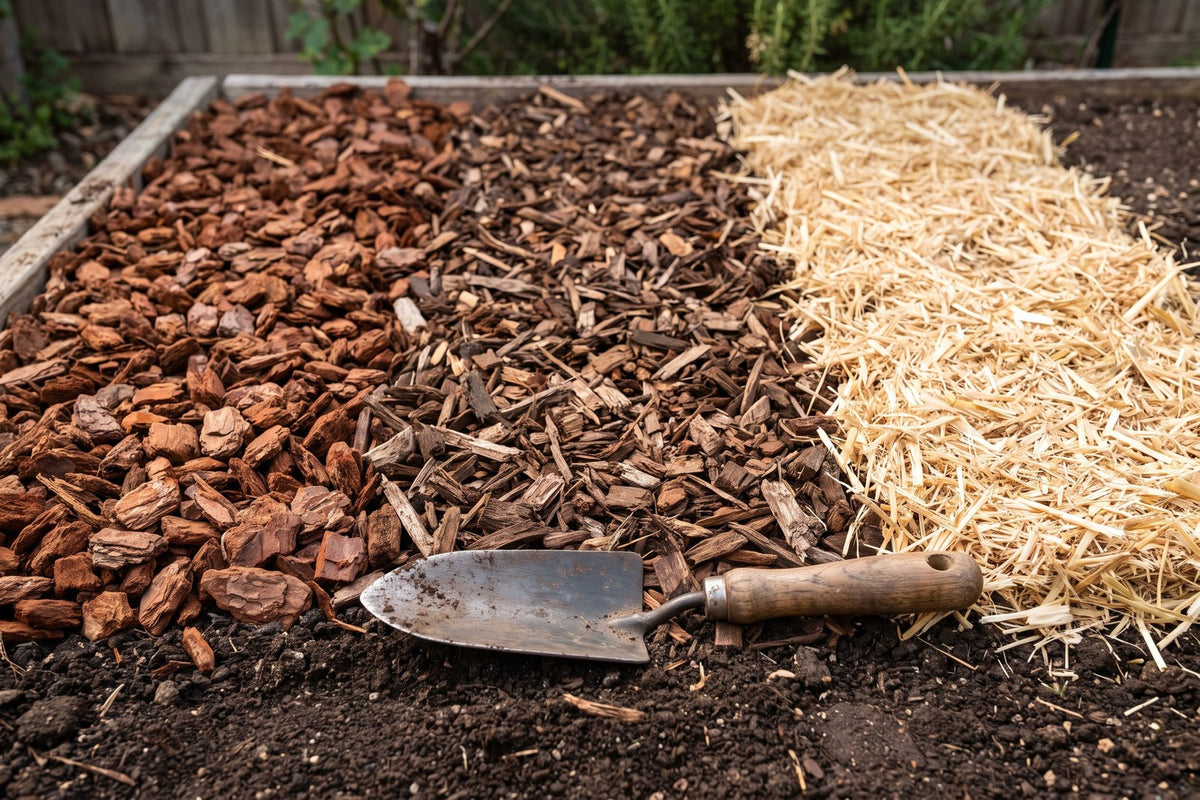
The best mulch for a garden bed is coarse, open and slow to break down. Fine, dense materials such as fresh grass clippings, sawdust or finely shredded bark mat together and become water repellent, which is exactly the failure you are trying to prevent.
Bark and woodchip
Pine bark mulch and hardwood mulch are the long-life options, lasting eighteen months to three years before they need topping up. They suit shrub borders, native beds and around trees, where you want to lay it once and forget it. Coarse grades let rain through far better than fine grades, so buy the chunkiest product you can find.
Sugar cane and lucerne
Sugar cane mulch breaks down within a season, feeding the soil as it goes. It is the right choice for vegetable beds, annuals and any bed you are actively improving. Lay it thicker than you think, around 100mm, because it settles to roughly half that within a fortnight. Composted straw-based mulches sit between the two, adding nutrients while still lasting most of a year.
What not to use near the house
Avoid plastic weed mat under organic mulch in garden beds: it stops worms and organic matter reaching the soil, and mulch on top of it dries out completely. Pebble and gravel look tidy but store heat, which is a liability against a hot west-facing wall. Save them for succulent beds and paths.
How to lay it

Weed the bed thoroughly first, because mulch suppresses seedlings but does nothing to a running grass such as couch or kikuyu. Water deeply the day before, or wait for rain, then check the depth of penetration with a screwdriver: it should slide in easily to 200mm. If the soil is already water repellent, and most sandy and long-mulched soils in Australia are, apply a soil wetter and water it in before you spread anything.
Spread mulch evenly to a settled depth of 50mm to 75mm across the whole bed, extending out to the drip line of trees and shrubs rather than making a doughnut around each stem. Then pull it back from every trunk. Mulch piled against bark holds moisture on the collar and invites collar rot, which is the single most common way a well-intentioned gardener kills a young tree. Finish by watering the mulch itself so it knits down instead of blowing away.
If you are installing irrigation, lay it under the mulch, not over it. Inline dripline at 300mm emitter spacing, run in loops through the bed, delivers water to the root zone with almost no evaporation loss. For established trees, run a ring of dripline at two thirds of the canopy radius, where the feeder roots actually are. Put the whole system on a tap timer and set it to run before 8am. Our guide to watering explains why depth matters more than frequency.
Ongoing care
Watering
Two long soaks a week through summer builds deep roots; daily sprinkles build shallow ones that fail in a heatwave. In Perth and Adelaide sandy soils, three shorter cycles on the same day beat one long one because the water otherwise drains past the roots. Check under the mulch with your fingers before adding more water, since well-mulched soil often stays damp for a week.
Feeding
Apply slow-release fertiliser to the soil surface before mulching, not on top of the mulch, where it feeds the decomposing bark rather than your plants. Fresh woodchip can temporarily draw nitrogen from the surface layer, which shows up as pale foliage on shallow-rooted plants; a light nitrogen feed corrects it.
Topping up
Check depth in late summer and again in autumn. Anything under 25mm has stopped working. Rake the existing layer to break any crust before adding more, and resist the urge to keep piling on until the bed sits above the surrounding paths, which starves the soil of oxygen.
Common problems and fixes
Water running off instead of soaking in. Water repellent soil. Apply a wetting agent, then water in short repeated cycles rather than one long blast.
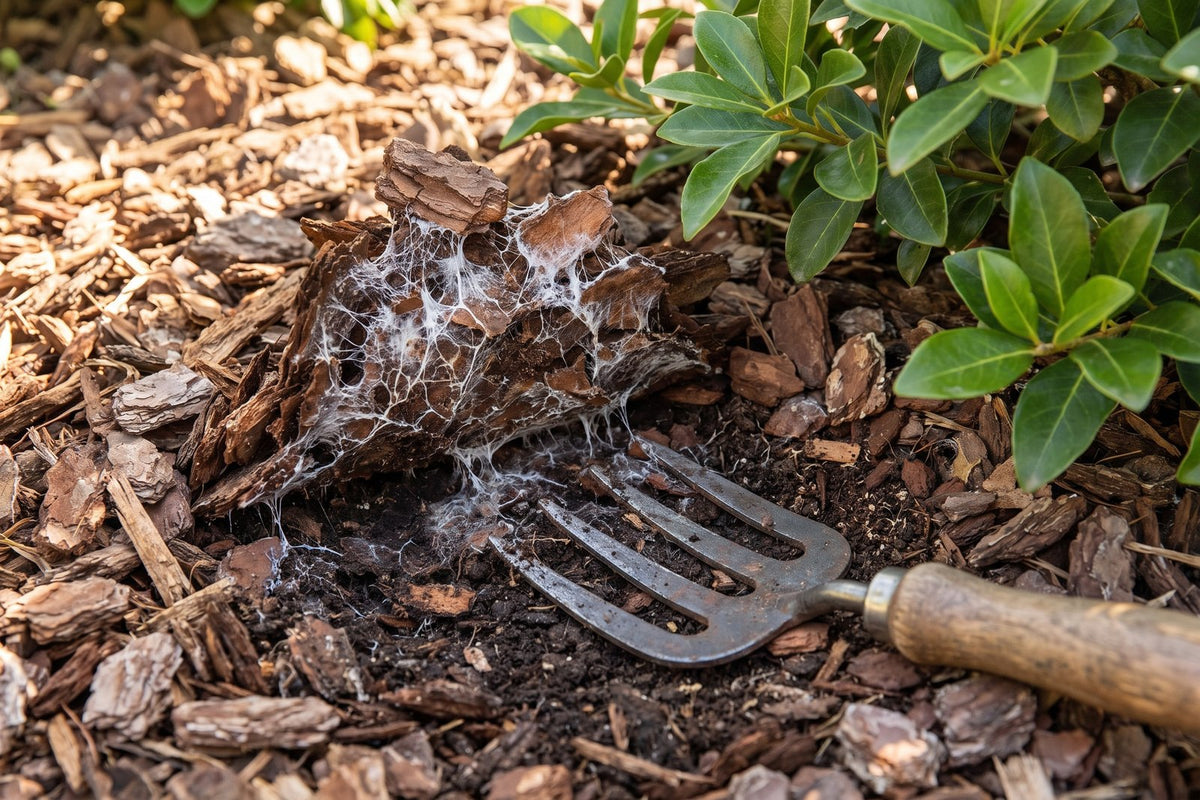
White fungal threads through the mulch. Harmless saprophytic fungi doing their job. Turn the mulch to break it up if the appearance bothers you.
Plants collapsing at the base. Collar rot from mulch pushed against the stem. Pull it back immediately and improve airflow; badly affected plants rarely recover.
Mulch washing into paths after storms. Common on slopes and in summer downpours. Switch to a heavier hardwood grade, or install a timber or steel edge. Preparing beds for storms is covered in our guide to storm season readiness.
When to mulch, by region
Timing matters more than most people realise. Mulch applied too late traps heat that is already in the soil; applied at the right moment it holds the cool and moisture from the previous season.
| Region | Best time to mulch |
|---|---|
| Brisbane and southeast Queensland | Early spring, before the summer wet and heat |
| Sydney and coastal NSW | Spring, September to October |
| Melbourne, Adelaide, Canberra | Mid to late spring, once the soil has warmed |
| Perth | Late winter to early spring, before the sandy soil dries out |
| Darwin and tropical north | End of the wet season, to hold moisture through the dry |
| Cold inland | After the last frost, once soil has warmed |
Mulching in cool climates too early in spring keeps the soil cold and slows growth. In Perth and Adelaide the opposite applies - get it down before summer dries the profile out, because mulch holds existing moisture far better than it lets new water in.
Water repellent soils
This is a specifically Australian problem and it affects mulching directly. Sandy soils across Western Australia, South Australia and parts of Victoria become hydrophobic - waxy coatings on the sand grains make water bead and run off rather than soak in.
Mulching over hydrophobic soil without fixing it first simply hides the problem. Test by pouring water on a dry patch; if it beads and sits for more than a few seconds, apply a soil wetting agent and water it in thoroughly before mulching.
Choosing mulch for the conditions
- Coarse bark and woodchip - the best all-round garden mulch. Lasts, lets water through, suppresses weeds.
- Sugarcane and pea straw - break down fast and feed the soil, good for vegetable beds. Need topping up each season.
- Gravel and pebble - for succulents, agaves and dry native beds where organic mulch holds too much moisture against stems.
- Avoid fine mulches such as sawdust or finely shredded material, which mat together and repel water rather than letting it through.
Depth and the trunk gap
Aim for 75 mm. Thinner does not suppress weeds or hold moisture; much thicker can stop light rain reaching the soil at all. The one non-negotiable rule is keeping mulch 50 to 100 mm clear of trunks and stems - mulch piled against a trunk holds moisture there and causes collar rot, which kills established trees slowly and is entirely avoidable.
Frequently asked questions
How thick should mulch be?
Aim for 50mm to 75mm once it has settled. Thinner than 25mm does almost nothing for weed suppression or evaporation, and thicker than 100mm can stop light rain reaching the soil at all. Loose materials such as sugar cane should go on at about 100mm because they compress to roughly half their laid depth within two weeks.
When is the best time to mulch in Australia?
Mid-October to late November in the southern states, and earlier in Brisbane, Sydney and Perth, once the soil has warmed but before it dries out. A second lighter top-up in autumn, around March and April, protects soil through winter rain. Never mulch dry soil: you will lock the dryness in for the whole season.
Does mulch stop water reaching the soil?
Only if it is too fine or too deep. A coarse bark or cane mulch at 75mm lets rainfall and irrigation through easily while cutting evaporation from the surface by more than half. Fine, compacted mulch over 100mm deep can shed light showers entirely, which is why grade matters more than brand.
Should mulch touch the trunk?
No. Leave a clear collar of 50mm to 100mm around every trunk and stem, and rake it back if it has crept in over the season. Mulch held against bark keeps it permanently damp and creates ideal conditions for collar rot and borer attack, particularly on citrus, magnolias and young natives. The plant that dies eighteen months after planting for no obvious reason has usually been buried at the base, not underwatered.
Is it better to water in the morning or the evening?
Early morning. Evaporation losses are lowest, plants enter the heat of the day fully hydrated, and foliage dries before nightfall, which reduces fungal disease. Evening watering is the second-best option in extreme heat, but avoid wetting foliage in humid subtropical conditions.
Ready to plant?
Everything you need is in our potting mixes, mulches and fertilisers range, from bulk sugar cane to soil wetters. If you are improving the bed before you mulch it, our guides to preparing soil for planting and surviving a heatwave cover the rest of the pre-summer routine, and avoiding overwatering explains how to read a moist bed correctly.


