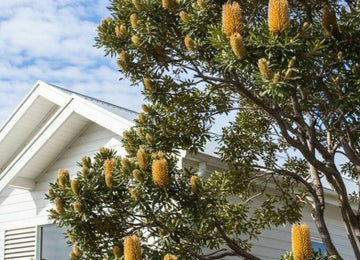
Macarthur Bottlebrush (Callistemon viminalis 'Macarthur') is a compact weeping bottlebrush that keeps the graceful arching habit of the species at roughly half the size, settling at about 3.5m tall and 2.5m wide. Deep red brushes cover the drooping branches in spring and again in autumn, and honeyeaters find them within days. It is the version of the weeping bottlebrush that actually fits a suburban front garden.
Why you'll love it
-
Weeping form at a manageable size. The straight species reaches 6m to 8m; this selection holds around 3.5m, so it suits a small block without constant cutting back.
-
Two flowering flushes. Heavy red brushes in spring, then a lighter repeat in autumn, with scattered flowers between.
-
A bird magnet. Honeyeaters, lorikeets and native bees work the flowers from the first season.
-
Copes with wet, dry and salt air. It tolerates drought once established, handles ground that stays damp, and shrugs off coastal wind, so a low or exposed spot is no obstacle.
Where it works best
Feature planting. A single plant in a lawn or courtyard bed carries the weeping silhouette on its own, and formative pruning lifts it into a small multi trunked tree.
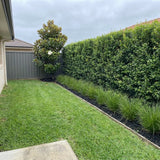
Screening. Plant 2m apart for a soft weeping screen. It gives movement and flower rather than the flat green wall of a clipped hedge, so allow for the arching width.
Driveways and small gardens. Spaced 3m apart along a drive it reads as an informal avenue, and the modest mature size keeps it clear of gutters and eaves.
Growing Macarthur Bottlebrush in Australia
Position and climate. Full sun for the heaviest flowering. It is a plant for tropical, subtropical and warm temperate gardens and takes light frost only, so cold inland districts, the tablelands and hard frosting southern gardens will do better with a hardier native.
Soil. Not fussy. It grows in clay, sand and everything between, and unlike most shrubs it accepts periodically wet ground. Mulch 75mm deep, kept clear of the trunk.
Water and feed. Deep soak twice weekly through the first summer, then only in extended dry spells. A low phosphorus native fertiliser after the spring flush and again in late summer keeps the foliage dark and the flowering heavy.
Pruning. Trim immediately after each flowering flush, cutting back the spent brushes to the wood below them. This is what keeps the plant dense and encourages the next flush; left unpruned it opens up and flowers less.
What to expect when it arrives
It is grown in a 140mm pack of ten, a 200mm pack of six, a single 300mm pot and 45L advanced stock. The 140mm and 200mm packs are the value choice for a run of screening plants, arriving as young plants that establish quickly. The 300mm is the usual middle ground for a feature position, and the 45L arrives with real height and structure already formed.
Plants are packed to travel upright and delivered Australia wide, with delivery from $29.95. Advanced and large stock is freighted at cost. Expect a quiet three or four weeks after planting, then new growth through the first warm season. Every plant is covered by our 30 day healthy plant guarantee.
Plant care guides and related reading
Common questions
How far apart should I plant it for a screen?
Two metres apart in a single row. Any closer and the arching branches crowd each other, which thins the lower growth and defeats the point of the weeping habit.
Will it survive frost?
Light frost only, and best once it is established. In cold inland or southern gardens it needs a sheltered warm position, and even then a hard frost can damage the soft new growth.
Can I keep it smaller than 3.5m?
Yes. Pruning after each flowering flush holds it at 2m to 2.5m indefinitely, and it reshoots readily from older wood if a neglected plant needs cutting back hard.
Western Australia: this species has escaped from gardens and naturalised in WA, where it competes with local bushland plants. We do not recommend it for gardens in the south west of WA. Please choose a local alternative.