Callistemon 'Red Rover' (Callistemon viminalis cultivar) is the bottlebrush for gardens without room for a full sized one. It settles at roughly 1.5m tall and 1.5m wide, stays furnished with foliage down low rather than lifting into bare stems, and carries deep red brushes that bring honeyeaters in. Frost hardy, drought tolerant and untroubled by ground that stays wet, it is one of the easiest natives to keep alive.
Why you'll love it
-
Compact by nature, not by pruning. At about 1.5m each way it holds its size without constant trimming, which separates it from the older weeping bottlebrushes.
-
Red brushes that feed wildlife. Honeyeaters, lorikeets, native bees and butterflies all work the flowers, so one shrub earns its place.
-
It handles both extremes. Drought tolerant once the roots are down, yet tolerant of wet feet, so a dry verge and a low wet spot both suit it.
-
Safe around pets. Not toxic to cats or dogs, which matters for a shrub planted at nose height along a fence.
-
It grows almost anywhere. Tropical through to cool temperate and arid gardens, and salt tolerant enough for a coastal block.
Where it works best
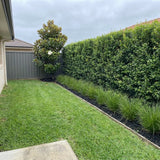
Low hedging and screening. Plant 1m apart in a single row for a dense informal hedge around 1.5m high. That suits a boundary you want softened rather than blocked, or a bin bay and pool pump to hide.
Mass planting and borders. At 1m centres across a slope or nature strip it reads as one band of foliage that turns red twice a year, and the same spacing suits a bed edge.
Growing Callistemon 'Red Rover' in Australia
Position and climate. Full sun gives the heaviest flowering and tightest growth; part shade works but the plant opens up and flowers less. Being frost hardy, it can go in the open in cool temperate and inland gardens, and it is equally at home in humid subtropical conditions or an arid garden given occasional deep watering.
Soil. Not fussy. Clay, sand and everything between, and unlike most natives it copes with ground that stays damp. Mulch 75mm deep, kept clear of the stem.
Water and feed. Deep soak twice a week through the first summer, then water only in dry spells. Use a low phosphorus native fertiliser in early spring, since standard garden fertiliser can damage the roots.
Pruning. Trim straight after each flush, taking the spent brushes and about a third of the new growth. That one habit keeps a bottlebrush dense instead of leggy.
What to expect when it arrives
It is sold as tube stock and as an established 300mm plant. Tubes are young and single stemmed, and they are the sensible choice for a long hedge run: cheaper per plant, quick to root out, a season behind on height. The 300mm plants arrive branched and already look like a shrub.
Stiff foliage means bottlebrush travels well. Plants are packed upright and delivered Australia wide, with delivery from $29.95. Expect little visible change for the first month, then steady growth through the warm season and a first real display in the second spring. Every plant carries our 30 day healthy plant guarantee.
Plant care guides and related reading
Common questions
How far apart should I plant it for a hedge?
One metre apart in a single row. The plants knit together within two seasons at that spacing and stay dense at the base. Planting tighter costs more and makes the row harder to water evenly.
Can I keep it lower than 1.5m?
Yes. Trimming after each flowering flush holds it near 1m without thinning it, because callistemon reshoots readily from older wood. Wait until the brushes finish or you cut off the next display.
Will it survive frost?
It is frost hardy and suits cool temperate gardens once established. Young plants still do better in a sheltered spot through their first winter.
Western Australia: this species has escaped from gardens and naturalised in WA, where it competes with local bushland plants. We do not recommend it for gardens in the south west of WA. Please choose a local alternative.