
Plants for Pots
Live plants delivered Australia wide. 30 day healthy plant guarantee.

The right plants for pots solve problems a garden bed cannot: no digging into clay, nothing invasive near pipes, and the whole display moves house with you. This collection gathers over 1,300 plants proven in containers, from dwarf citrus and lavender to screening magnolias and palms. The trade off is commitment. A potted plant depends on you for every drink and feed, so match the plant's thirst to the attention you will actually give it.
Which size? How many?
Size ladder: what each pot looks like on arrivalHedge calculator: plants per metre, pricedHeights on arrival sit under every size on the product page. Freight is quoted with multiple freight companies and passed on at cost.

Little Gem Magnolia Magnolia grandiflora 'Little Gem'
14 sizes, Tube to 2000L
44% offFrom $247.95$443.95Unit price /Unavailable
Straight and Narrow™ Lilly Pilly Syzygium australe 'SAN01' PBR Intended
7 sizes, Tube to 100L
28% offFrom $22.95$31.95Unit price /Unavailable-
French Lavender Lavandula dentata
3 sizes, Tube to 300mm
45% offFrom $16.69$30.19per plant, packs of 10Unit price /Unavailable -
Xanadu Philodendron Philodendron xanadu
3 sizes, 140mm to 300mm
49% offFrom $130.95$258.95Unit price /Unavailable -
Elephants Ear Plant Alocasia brisbanensis
4 sizes, 140mm to 400mm
55% offFrom $115.95$255.95Unit price /Unavailable -
Evergreen Frangipani Plumeria pudica
6 sizes, 140mm to 100L
31% offFrom $148.95$215.95Unit price /Unavailable -
Giant White Bird of Paradise Strelitzia Nicolai
7 sizes, 140mm to 200L
44% offFrom $148.95$266.95Unit price /Unavailable -
Eureka Lemon Tree Citrus limon 'Eureka'
6 sizes, 200mm to 150L
29% offFrom $261.95$368.95Unit price /Unavailable -
Acoma Crepe Myrtle Lagerstroemia 'Acoma'
8 sizes, Tube to 150L
12% offFrom $132.95$150.95Unit price /Unavailable -
Silver Falls Dichondra Dichondra argentea
4 sizes, Tube to 200mm
15% offFrom $16.95$19.95Unit price /Unavailable -
Helena Olive Tree Olea europaea 'Helena'
5 sizes, Tube to 100L
28% offFrom $22.95$31.95Unit price /Unavailable -
Pink Crepe Myrtle Lagerstroemia 'Zuni'
9 sizes, 200mm to 400L
41% offFrom $195.95$332.95Unit price /Unavailable -
Lemonicious Lemon Tree Citrus limon 'Lemonicious'
3 sizes, 140mm to 250mm
49% offFrom $54.49$107.65per plant, packs of 6Unit price /Unavailable -
Desert Star Carissa macrocarpa
4 sizes, Tube to 300mm
29% offFrom $14.95$20.95Unit price /Unavailable -
Giant Taro Alocasia macrorrhizos
5 sizes, 140mm to 110L
41% offFrom $173.95$294.95Unit price /Unavailable -
Teddy Bear Magnolia Magnolia grandiflora 'Teddy Bear'
12 sizes, 300mm to 1000L
32% offFrom $478.95$704.95Unit price /Unavailable -
Fountain Grass Pennisetum alopecuroides
3 sizes, Tube to 200mm
35% offFrom $14.89$22.89per plant, packs of 10Unit price /Unavailable -
Tuscan Blue Rosemary Rosmarinus officinalis 'Tuscan Blue'
4 sizes, Tube to 200mm
21% offFrom $15.99$20.29per plant, packs of 10Unit price /Unavailable -
5 sizes, Tube to 330mm Tiles
25% offFrom $14.95$19.95Unit price /Unavailable -
White Knight Hydrangea Hydrangea macrophylla 'White Knight'
2 sizes, 200mm to 250mm
12% offFrom $50.82$57.82per plant, packs of 6Unit price /Unavailable -
Japanese Box Buxus microphylla japonica
14 sizes, Tube to 200L
38% offFrom $12.09$19.59per plant, packs of 10Unit price /Unavailable -
Aimee Yoshiba Fragrant Gardenia Gardenia augusta 'Aimee Yoshiba'
5 sizes, Tube to 45L
42% offFrom $10.95$18.95Unit price /Unavailable -
Silver Spoons Kalanchoe Kalanchoe ‘Silver Spoons’
5 sizes, 100mm to 400mm
29% offFrom $151.95$214.95Unit price /Unavailable -
Grass Tree Xanthorrhoea glauca
13 sizes, Tube to 1500L
29% offFrom $19.95$27.95Unit price /Unavailable -
Persian Lime Tree Citrus latifolia
12 sizes, 140mm to 500L
60% offFrom $255.95$642.95Unit price /Unavailable -
Cascade Lilly Pilly Syzygium australe 'Cascade'
7 sizes, Tube to 150L
19% offFrom $21.95$26.95Unit price /Unavailable -
Emerald Green Arborvitae Thuja occidentalis 'Smaragd'
5 sizes, 140mm to 500mm
27% offFrom $148.95$202.95Unit price /Unavailable -
Bird of Paradise Strelitzia reginae
7 sizes, Tube to 90L
26% offFrom $165.95$223.95Unit price /Unavailable -
Evergreen Giant Liriope Liriope muscari 'Evergreen Giant'
5 sizes, Tube to 400mm
29% offFrom $14.95$20.95Unit price /Unavailable -
8 sizes, Tube to 400L
41% offFrom $22.95$38.95Unit price /Unavailable -
Washington Navel Orange Tree Citrus sinensis
9 sizes, 200mm to 400L
45% offFrom $214.95$391.95Unit price /Unavailable -
Fruit Salad Plant Monstera deliciosa
5 sizes, Tube to 400mm
46% offFrom $17.95$32.95Unit price /Unavailable


More information
How to choose plants for pots
Pick for the light the spot receives first, then check the plant's mature size against the container you can offer. The best plants for pots are naturally compact or slow: gardenias, dwarf citrus, Japanese box and rosemary at the small end, Little Gem magnolia and Teddy Bear magnolia at the large end. Teddy Bear is the denser and slower of the two, reaching about 4m, which makes it the better long term tub specimen. A dwarf grafted lemon stays near 2m and fruits close to year round.
Be wary of anything labelled fast growing. Speed in the ground means a rootbound pot within two seasons, more watering and an early repot. In a container, slow is an asset.
Where potted plants work
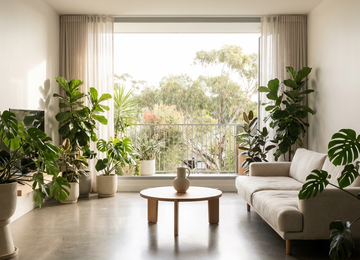
Pots earn their keep on balconies and courtyards, on decks and poolside, in rentals where planting in the ground is not an option, and either side of a front door, where a matched pair of clipped Japanese box reads as formal without effort. In cold districts, pots also let you grow frost tender plants and move them under cover for winter.
Pot sizes, mix and drainage
Give roots room, but not an ocean. Step up one or two pot sizes at each move, finishing around 300mm to 400mm wide for shrubs and herbs and 500mm to 700mm for small trees and screening plants. Always use a premium potting mix rather than garden soil, which slumps and sets hard in a container. Drainage holes are not negotiable, and pot feet help on sealed surfaces. Our pots and planters range runs from table top sizes to large tree planters.
Watering and feeding container plants
Pots dry from the sides inward and can need water daily in a hot summer. Water until it runs from the base, let the top few centimetres dry, then water again. Feed with a controlled release fertiliser each spring and refresh the top 5cm of mix once a year. Every two to three years, or when roots circle the base, move up a pot size, or root prune and return the plant to the same container with fresh mix.
Common questions
What size pot does a small tree need?
A tub 500mm to 700mm wide, holding 50 litres of mix or more, suits a magnolia, olive or citrus for years. Anything smaller dries out too fast in summer and blows over in wind.
Can I grow a lemon tree in a pot?
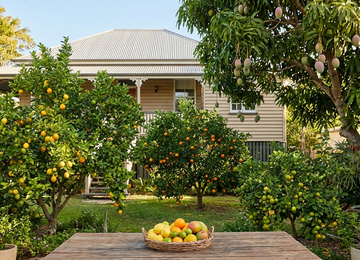
Yes. Choose a dwarf grafted variety, which stays near 2m, give it full sun and feed it in spring and late summer. A dwarf Eureka lemon crops close to year round.
Do plants stay smaller in pots?
A container does restrict size, usually to well under the plant's garden height, but it is not a bonsai dish. Choose something whose natural size sits close to what you want rather than fighting a forest tree in a tub.
Which fruit trees handle pots best?
Citrus are the standouts: lemons, limes, mandarins and oranges all crop well in large containers. Our citrus trees range covers the varieties worth growing this way.
